
GADGETS
NASA Drops 12,217 Artemis II Photos In Largest Moon Mission Archive Ever

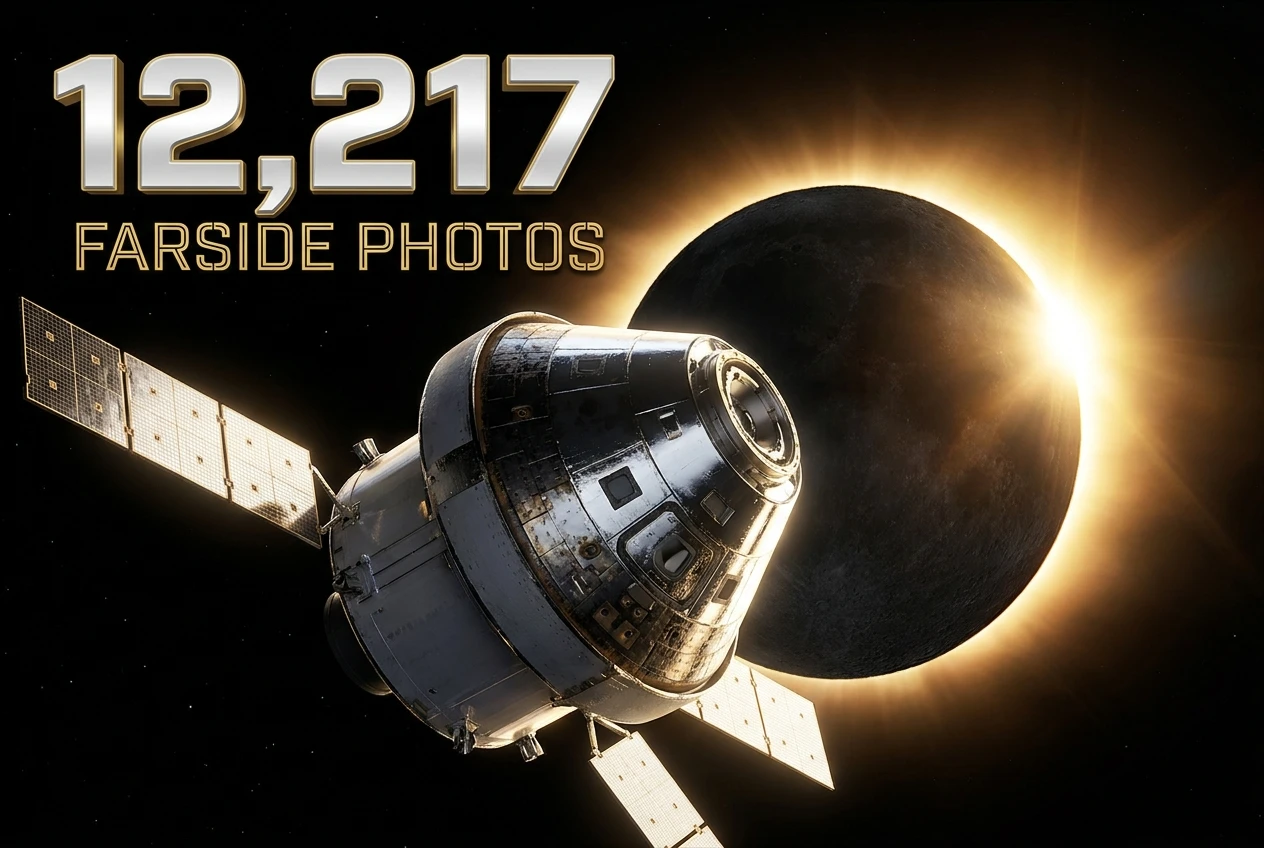
NASA quietly uploaded 12,217 unedited photos from Artemis II to its public astronaut archive over the weekend, vaulting the April moon flyby past every prior crewed mission for sheer image volume. The drop, posted on May 3, 2026, lets anyone scrub through the lunar farside, an in-space solar eclipse, and quiet hours inside Orion at full resolution. No paywall. No watermark.
The Artemis II crew of Reid Wiseman, Victor Glover, Christina Koch, and Jeremy Hansen flew from April 1 to 11 and shot most frames on Nikon D5 DSLRs, a Nikon Z9 mirrorless, and the iPhone 17 Pro Max. Every frame now sits on NASA’s Gateway to Astronaut Photography of Earth at eol.jsc.nasa.gov, tagged ART002-E. The free release outpaces anything Apollo, Skylab, or Shuttle ever published in raw form.
Inside the 12,217-Image Drop
The release covers the full arc of the mission, not just the highlight reel NASA shared during the flight. File codes run from ART002-E-168 through ART002-E-30001, suggesting roughly 18,000 more frames are still in processing somewhere downstream. Several thousand flight images stayed off the public feed entirely until this weekend.
Most of the trove is engineering documentation. Switch panels. Docking targets. Thruster plumes. Reflections of cabin displays in helmet visors. Every frame carries timestamp and lens metadata that lets researchers reconstruct each phase of the flight second by second.
The visual showstoppers sit beside the technical frames. Earth as a thin blue crescent through Orion’s window. Crater fields on the lunar farside in higher resolution than Apollo crews ever recorded. The Sun’s corona burning around the Moon’s silhouette. Long-exposure star trails revealing the spacecraft’s slow rotation against the Milky Way.
Volunteer archivists tagged the dataset within hours, organising 12,217 files under ART002 into searchable buckets by camera, date, and subject. An Internet Archive mirror of the Artemis II raw image dump already serves community downloads. NASA’s curated subset lives on the agency’s Artemis II multimedia hub for crew photos and mission video, while the full pool sits on the Johnson Space Center photo server.
The Cameras That Survived Deep-Space Radiation
Three camera systems carried the load. Nikon D5 DSLRs handled most general shooting because their optical viewfinders work without electricity and their mechanical shutters survive radiation that would kill modern sensors. The body design is over a decade old. NASA hardened the firmware against cosmic rays years ago.
The Z9 was a last-minute addition fitted inside a thermal blanket housing called the Handheld Universal Lunar Camera. It came home with no detectable sensor degradation, clearing a critical engineering gate for the Artemis III lunar surface flight planned for 2027. The mirrorless body now carries flight heritage few consumer products in any category can claim.
The iPhone 17 Pro Max was the surprise. Apple’s flagship recorded the now-famous 8x telephoto frame of Chebyshev Crater on the lunar farside. NASA’s certification for crewed flight made it the first consumer smartphone to operate beyond low Earth orbit. Lockheed Martin’s Orion Artemis II media kit lists roughly 28 cameras supporting the flight overall, including older GoPros that have been mounted to Orion since 2014.
| Camera | Role | Mission Use |
|---|---|---|
| Nikon D5 | Primary DSLR | Most cabin and window photography |
| Nikon Z9 (HULC) | Mirrorless test bed | Long-lens lunar farside detail |
| iPhone 17 Pro Max | Quick captures and video | Front-camera selfies, 8x telephoto crater shot, Earthset video |
| GoPro (legacy units) | Cabin and exterior POV | Wide-angle launch, flyby, splashdown coverage |
What The Pictures Actually Show
The dataset breaks into a few distinct visual categories that each carry weight beyond aesthetics. Earth shows up as a thin blue crescent suspended in pure black, often framed against the inner edge of an Orion window or a thruster strut. The crescent thins with each successive day’s frames, a quiet log of how far the spacecraft pushed from home.
The lunar farside arrives in resolution Apollo crews never had time to capture. Vavilov Crater fills several frames at high zoom. Chebyshev Crater appears in the iPhone 17 Pro Max’s 8x telephoto shot. Impact craters, ancient lava flows, and surface fractures sit in the data, ready for geologists studying the Moon’s evolution to comb through them.
Star-trail composites show Orion rolling slowly against the Milky Way during long-exposure captures, a side effect of the spacecraft’s barbecue-roll thermal management. The arcs of starlight reveal the rotation rate visually, a kind of accidental engineering log shot for the public.
A solar eclipse sequence forms the most dramatic single chapter. The Sun’s corona emerges from behind the lunar disk, with Orion hardware visible in foreground silhouette in several frames. The shots span tens of minutes of totality, far longer than any ground-based eclipse photographer could ever record.
The crew themselves appear in candid sequences easy to miss inside an archive of 12,217 files. Wiseman and Koch share a window. Glover floats to inspect a panel. Hansen pauses during a procedure. Each crew member also took a turn at the same window with Earth above the Moon in frame, a deliberate echo of Apollo 8’s Earthrise.
An Eclipse Nobody On Earth Could See
The eclipse is the headline image and the rarest fact in the dataset. The Moon, viewed from Orion at lunar-flyby distance, appeared exactly large enough to fully cover the Sun. Totality stretched close to 54 minutes. No ground observer on any continent could see what the four astronauts watched in real time.
By the numbers:
- 54 minutes of solar totality witnessed from Orion’s vantage on April 6, 2026
- 252,756 miles the crew’s farthest distance from Earth, breaking Apollo 13’s 1970 record by 4,111 miles, per NASA’s farthest human spaceflight record release
- 4,067 miles Orion’s closest approach above the lunar surface during the flyby
- 6 meteoroid impact flashes the crew observed on the darkened lunar surface, logged for planetary scientists
Crew Voices From Beyond Apollo
“This continues to be unreal,” Victor Glover said over mission comms as the Sun’s corona haloed the Moon. The pilot described the lunar disk during totality as “the gray that blends and drifts into the blackness,” and reported the crew could still pick out surface features with the Sun completely behind it. The audio was logged in NASA’s flight day 6 lunar flyby photo dispatch and timestamped April 6, 2026.
The mission’s distance milestone landed before the eclipse. Orion crossed the 248,655-mile mark Apollo 13 set in April 1970 and kept going, ultimately reaching 252,756 miles from home. Wiseman, Glover, Koch, and Hansen now hold the all-time human distance record together.
Apple chief executive Tim Cook addressed the crew publicly after splashdown:
You captured the wonders of space and our planet beautifully, taking iPhone photography to new heights, and we’re grateful you shared it with the world.
Apple marketing chief Greg Joswiak posted that the iPhone in space was “one small step for iPhone.” The phone’s front-camera capture of Wiseman and Koch through Orion’s window on April 2, flight day 2, went viral within hours of Apple flagging it.
The Archive Isn’t Finished Yet
The numbering gap suggests roughly 18,000 frames remain in processing. NASA’s photo pipeline at Johnson Space Center prioritises raw upload speed first, then metadata enrichment. Captions, locations, and tagging will keep rolling in across coming weeks.
Researchers studying the Z9’s radiation performance are likely to publish preliminary sensor-degradation analysis later this year, before the Artemis III crew flies. The mission’s geologic photo record will feed peer-reviewed work on lunar farside crater morphology and lava-flow age dating.
Apollo image data is still being mined more than half a century later. The Artemis II raw set, two orders of magnitude larger than any single Apollo flight produced, will keep yielding new science and new visuals long after the May social-media excitement fades.
Frequently Asked Questions
How Do I Access The Full Artemis II Photo Archive?
The 12,217 raw images sit on NASA’s Gateway to Astronaut Photography of Earth at eol.jsc.nasa.gov. Search the mission code field for “ART002-E” to pull the full set. NASA’s curated highlights also live at nasa.gov/artemis-ii-multimedia. An Internet Archive mirror posted on May 3, 2026, offers community-tagged subsets organised by camera and date for faster browsing.
Are The Photos Free To Download And Reuse?
Yes. NASA imagery is generally in the public domain and free to download, share, and republish, including commercially, with credit to NASA. Crew portraits and identifying images carry separate guidelines for endorsement contexts. Always check the agency’s media usage page for any specific frame, especially before using one in marketing or paid promotion.
What Cameras Did The Artemis II Crew Use?
The crew used Nikon D5 DSLRs as the workhorse, a Nikon Z9 inside a thermal-blanket housing called the Handheld Universal Lunar Camera, and the iPhone 17 Pro Max for quick captures and front-camera selfies. Older GoPros mounted to Orion since 2014 covered exterior wide-angle and POV footage. Roughly 28 camera systems supported the flight in total.
When Will The Rest Of The Photos Come Out?
NASA has not given a public timeline. The file numbering runs from ART002-E-168 to ART002-E-30001, leaving roughly 18,000 frames still in processing. Past mission archives have rolled out across months as captions and metadata are added. Watch the Gateway to Astronaut Photography page and NASA’s Artemis II Flickr album for incremental updates.
Why Is The Artemis II Eclipse Different From One On Earth?
Totality from Orion’s lunar-flyby vantage stretched close to 54 minutes, far longer than the few minutes possible from any spot on Earth. The Moon, seen from Orion’s distance, perfectly covered the Sun. The corona was visible without an atmosphere distorting it, giving a cleaner view of the Sun’s outer layers than ground-based instruments capture.
The release lands a month after splashdown and roughly a year before Artemis III’s planned attempt at the first crewed lunar landing in 53 years. Wiseman, Glover, Koch, and Hansen pulled cameras to the cabin window and quietly produced the most photographed deep-space mission in history.
A public archive of 12,217 frames now sits on a federal server, free to anyone with a browser, with potentially 18,000 more queued behind it. The science and the awe will keep unspooling for decades.


South Korea Retail Investors Face Reckoning After KOSPI AI Rally Collapses

Surrey AI Maps Three Heart Attack Paths and Their Molecular Roots

Germany Locks Neutral Apple ATT Prompts Across Most of Europe

Apple’s 5% EU Fee Quietly Rewrites Alternative App Store Math

Apple’s EU Fee Truce Cuts Complexity but Leaves Rivals Fuming

Pixel 11 Pro Fold Trades Thinness for Durability and Seven-Year Stay

Mayo AI Flags HCM Obstruction From Everyday Ultrasound Videos

Indian Brands Quietly Scale Landmark Screens and Home Tech

Navin Vatsa Turns Grief Into a Lifetime of Quiet Seeing

Google Bets Pixel 11 Agentic AI Will Redefine Phones

Oracle Cuts 21,000 Jobs in a Year, Cites AI in 10-K Filing

Fable 5 and Mythos 5 Return as US Lifts Anthropic Export Controls

SpaceX’s Google Deal Turns a Rocket Company Into a Cloud Landlord

CD Projekt Red Co-CEO: Redemption Arc Isn’t Done, Witcher 4 in 2027

XPL Rallies 30% Ahead of Plasma One Card Tier Launch

Google Search Profiles Build a Follow Graph Inside Discover

DGO App Brings Rs 549 Mobile Pass for FIFA World Cup 2026 in Nepal

Moonshot AI Targets $30 Billion in China’s Fastest AI Funding Sprint

Oppo’s ColorOS 17 Eligibility List Leaves A-Series Buyers Behind

Microsoft Xbox Layoffs Start in July as Sharma Slams 3% Margin
-
 AI2 months ago
Oracle Cuts 21,000 Jobs in a Year, Cites AI in 10-K Filing
-
 AI2 months ago
Fable 5 and Mythos 5 Return as US Lifts Anthropic Export Controls
-
 AI2 months ago
SpaceX’s Google Deal Turns a Rocket Company Into a Cloud Landlord
-
 GAMING2 months ago
CD Projekt Red Co-CEO: Redemption Arc Isn’t Done, Witcher 4 in 2027
-
 CRYPTO2 months ago
XPL Rallies 30% Ahead of Plasma One Card Tier Launch
-
 NEWS2 months ago
Google Search Profiles Build a Follow Graph Inside Discover
-
 APPS2 months ago
DGO App Brings Rs 549 Mobile Pass for FIFA World Cup 2026 in Nepal
-
 AI2 months ago
Moonshot AI Targets $30 Billion in China’s Fastest AI Funding Sprint