
NEWS
PCB Prices Keep Climbing After the Laminate Squeeze
FR-4 sheets in China more than tripled after a Jubail PPE hit, and AI servers now take the glass cloth, so prototype boards pay first.

Kingboard Laminates booked HK$2.89 billion in first-half profit, up 209%, after copper-clad laminate prices and a Gulf resin shock rewrote PCB costs. Standard FR-4 sheets in China climbed from about 70 yuan in July 2025 to about 260 yuan by June 2026, a rise of more than 270%, and a Goldman Sachs note put finished-board prices up as much as 40% from March to April alone.
The May warning that a PCB shortage was coming was not a false alarm. It was the first print on a squeeze that has since moved upstream into resin, glass cloth and foil, then back down onto the cheap boards that small shops still order by the panel.
The 40 Percent Print Was Only April
The 40% March-to-April jump was a finished-board number. The longer move sits in the sheet stock those boards are pressed from. Copper foil is about 42% of copper-clad laminate cost, resin about 26%, and glass fabric about 19%, and all three legs moved together while copper traded above $13,300 a ton.
HOW THE SQUEEZE STACKED FROM FEBRUARY TO AUGUST
- Late February 2026: Smaller Chinese laminate plants start lifting standard grades, citing cloth, foil and chemical costs.
- March 2026: Resonac posts a 30%+ increase across copper-clad laminate and prepreg, and other majors begin a run of 10-20% notices.
- April 7, 2026: A strike hits the Jubail petrochemical complex in Saudi Arabia; SABIC’s high-purity PPE output stops.
- April 2026: Finished PCB prices jump as much as 40% from March on the Goldman Sachs note; Mitsubishi Gas Chemical lifts high-end materials by up to 30% from April 1; Mitsui Kinzoku adds 12% on MicroThin foil.
- May 27, 2026: Kingboard raises the full laminate series 10% and prepreg by as much as 20%.
- May 2026: South Korea’s copper-clad laminate import price hits $20,728 a ton, up 74.5% year over year and the highest since Korea Customs Service records began in 2000.
- June 2026: Standard FR-4 spot prices in China reach about 260 yuan a sheet; several producers switch from open orders to quotas; Xinyu Mulinsen lifts all PCB series 20% from June 12.
- July-August 2026: Advanced laminate waits stretch to as long as 140 days; standard FR-4 that once shipped in days takes about two to four weeks from major suppliers.
Prismark puts the global PCB market on track for $95.8 billion in 2026, up 12.5%, with AI infrastructure doing most of the pulling. A Citi note in June said the bottleneck had already moved upstream from board shops toward laminate and electronic cloth, with M4 grades up 30-40%, M7 and below at least 20%, and M8, where makers protect long-term accounts, up 10-20%.
A Strike in Jubail Pushed Cheap Boards Into Line
The event that turned a tight market into a scramble was not a missing press in Shenzhen. It was a single complex on the Gulf. Fabricators and materials guides put SABIC at about 70% of global high-purity polyphenylene ether, the resin backbone for mid-loss and low-loss systems such as Panasonic Megtron 6 and 7 and Isola I-Speed, the grades that sit in 5G gear, automotive radar and AI servers.
SABIC sells that chemistry as NORYL powders and as PPE oligomers for epoxy systems, low-molecular-weight additives meant to cut dielectric loss, raise heat resistance and keep moisture out of thermoset stacks. When Jubail stopped, Asahi Kasei, Mitsubishi Gas Chemical and Romira could not fill a 70% hole inside a year. Recovery notes still talk in a 6-9 month window.
WHAT A COPPER-CLAD LAMINATE ACTUALLY IS
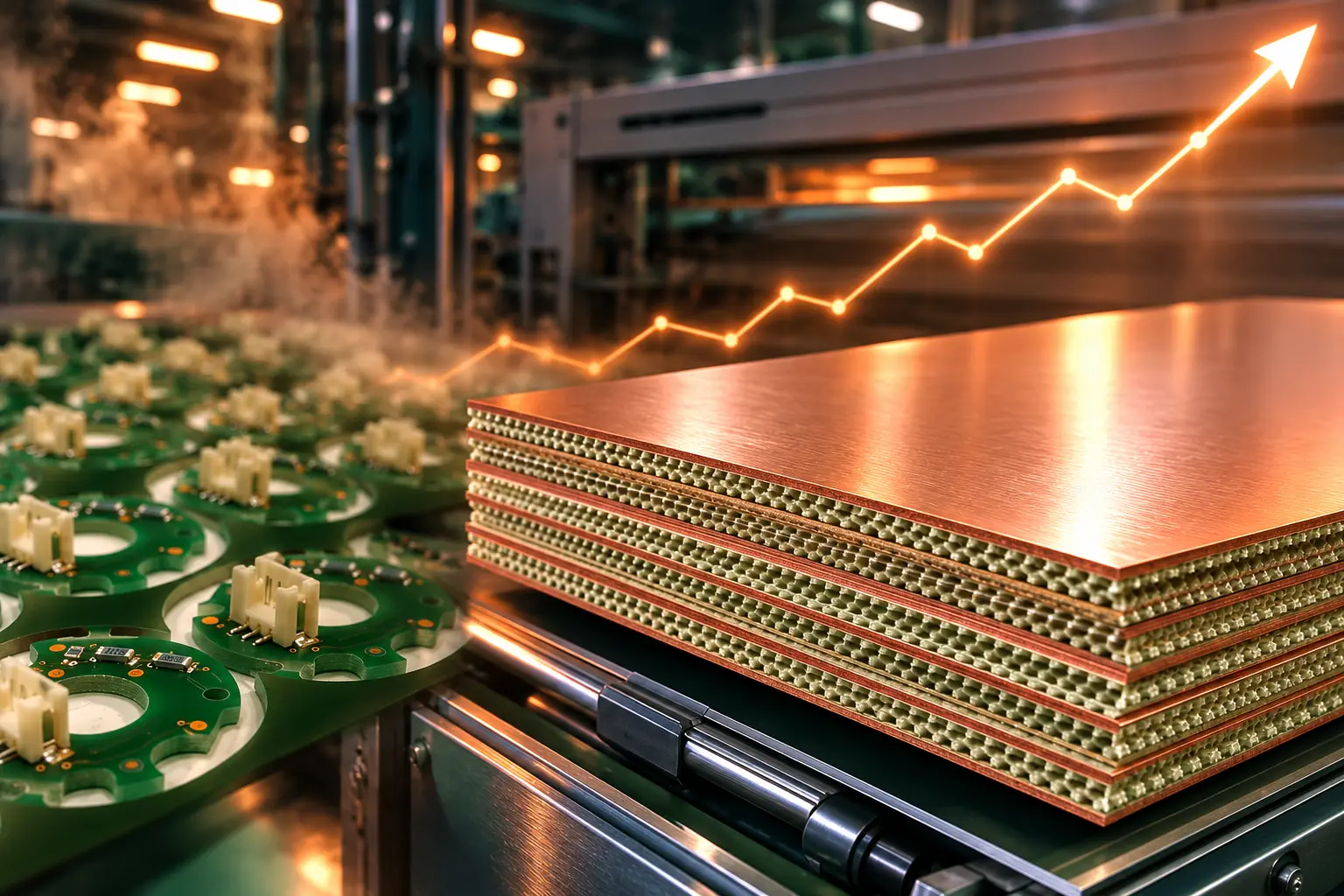
- The sandwich: Copper foil, resin-soaked glass cloth, and another foil, pressed into the sheet a fabricator later etches and drills.
- The cheap grade: Standard FR-4, fiberglass plus epoxy, still the default for consumer and industrial boards.
- The scarce grade: Low-loss PPE-based systems, which need the Gulf resin and the fine glass that AI racks now book first.
The second hit is the one most May coverage missed. Teams that could not get Megtron 6 shifted onto high-Tg epoxy. That ate the epoxy that industrial and auto buyers use, and those buyers dropped onto standard FR-4. Epoxy resin waits went from about 3 weeks to 15 weeks, and commodity FR-4 tightened even though it never used PPE. South Korean maker Daeduck Electronics opened price talks with customers after the strike. Panasonic has since dropped standard glass-fiber laminate to keep press time on higher-margin grades.
AI Servers Take the Glass Cloth First
A single AI server can use 10-15x the PCB material of a conventional box, and the presses follow the margin. High-end M8 and M9 sheets pay several times what FR-4 pays, so cloth, foil and press time move up the stack. The same conversion is already familiar in memory, where HBM lines have drained commodity DRAM and left a memory shortage already hitting base iPhones.
Electronic-grade glass is the slowest leg. TrendForce puts Nitto Boseki, trading as Nittobo, at about 90% of global T-glass, the low-expansion cloth used in M6-M7 boards and in ABF substrates for GPU packages. Hyperscalers have been booking that output ahead of volume shipments, which leaves IC-substrate and PCB plants fighting over leftover rolls. Lead time in 2026 is often the wait for an allocation, not the wait for a drill.
MID-2026 LEAD TIMES BY LAMINATE GRADE
| Material | Typical use | Lead time |
|---|---|---|
| Standard FR-4 | Consumer and general industrial boards | About 2-4 weeks |
| High-speed M6-M8 | Networking and high-layer boards | 8-16 weeks |
| M9 ultra-low-loss | AI servers and 1.6T switching | Up to 140 days, quota only |
| HDI build-up | Phones and compact dense boards | 6-12 weeks |
Kingboard’s own 2025 accounts already described traditional electronic yarn and fabric lines being steered toward AI products, which left the older grades short and let the company raise those prices several times. HVLP copper foil, the low-roughness sheet AI channels need, is equally tight: Mitsui Kinzoku holds more than 90% of the premium circuit-foil market, and qualifying a new foil source can take three to five years.
Kingboard’s First-Half Profit Jumped 209%
Someone is being paid for this. Kingboard Laminates Holdings, the largest copper-clad laminate maker, told the Hong Kong exchange on July 30 that a tight market for laminate products and for electronic fibreglass yarn, fabric and copper foil had driven unit prices and sales volumes higher. The later first-half accounts put net profit at HK$2.89 billion, up 209%, on revenue of HK$14.9 billion, up 55%.
The market is facing an increasingly severe supply shortage of electronic fibreglass yarn, electronic fibreglass fabric, copper foil and laminates.
Kingboard Laminates Holdings, HKEX filing, July 30, 2026
The fiberglass arm made about HK$1 billion, up 280%. Laminate volume rose 14%, with average monthly sales above 10 million sheets. Management said July alone delivered a record profit of about HK$1.1 billion as yarn, fabric, foil and laminate prices kept climbing, and it told investors the imbalance should last in the near term. The interim dividend went to 28 HK cents, up 87%. Vertical integration, yarn and cloth and foil and resin under one roof, is what let Kingboard take the upcycle instead of eating it.
What a Prototype Board Costs After the Squeeze
Small-run and prototype orders now pay list price, sit in a longer queue, and lose quote validity in weeks, because fabricators pass laminate hikes in full when there is no annual contract to blunt them. JLCPCB and other volume houses posted substrate adjustments across FR-4, flex, aluminum, copper, Rogers and Teflon in mid-2026, and quotes that held for 30-60 days last year now arrive with surcharge clauses. Contracted tier-one accounts still see smaller steps; everyone else sees the full round.
WHO EATS THE LAMINATE HIKE
- Prototype houses: Short quotes, material surcharges, and FR-4 that used to ship in days now taking about two to four weeks.
- Non-AI electronics: Auto, consumer and industrial boards that cannot reprice like a GPU rack, even when their own demand is flat.
- Independent fabricators: Shops that buy yarn, cloth and foil on the open market, unlike Kingboard’s integrated chain.
- Phone brands already under a memory squeeze: Board cost is a second pass-through on top of DRAM, the same pattern as handset brands passing memory costs through in India.
One production-floor view from NextPCB, a Shenzhen fabricator, is that M8 and M9 feeding AI servers are the crisis band, and that standard FR-4 is tighter and dearer rather than gone. That is cold comfort if your build is a four-layer FR-4 panel whose quote just moved and whose validity now expires before the purchase order clears. Gold for ENIG finishes is a separate sting on the same invoice.
Sumitomo’s 1993 Blast Taught the Same Lesson
On July 4, 1993, an explosion at Sumitomo Chemical’s plant in Niihama, Japan, killed one worker and took 50-60% of the world’s epoxy cresol resin, the stuff that goes into plastic chip packages. Spot memory prices jumped. The Semiconductor Industry Association later said panic orders, not a lasting hole, had inflated its book-to-bill ratio to 1.12 in July and 1.08 in August, before it fell to 1.01 in September and 1.00 in October. The line was running again by November 30, and SIA executive Andrew A. Procassini said the potential for shortages had dissipated.
The 2026 version rhymes only halfway. Panic buying is real: some Korean PCB makers were reported to have placed advance orders at five times normal monthly volume. The difference is that T-glass looms, HVLP foil lines and CCL presses are not a single Japanese factory that can restart in five months. They are multi-year tools, already booked by AI programs, and the Gulf feedstock risk has not closed. On September 13 the UK Maritime Trade Operations centre logged a report of a projectile hitting a vessel in the Strait of Hormuz, a day after Saudi Arabia shut its East-West pipeline following a drone strike.
Glass Furnaces and a 2027 Queue
Nittobo’s answer is a new cloth plant at its Fukushima Enterprise Center, a 15 billion yen glass-cloth expansion that Japan’s trade ministry has backed with a subsidy of up to 2.4 billion yen. Construction was set to start in October 2025 and finish in December 2026, with production in the fourth quarter of fiscal 2026. If every new loom went to T-glass for leading-edge logic packages, output could reach about three times the prior level. President Hisanobu Hayashi has already said even that will not be enough.
THE BOTTLENECKS THAT OUTLAST A QUOTE CYCLE
- T-glass: Nittobo still holds about 90% of the grade; full Fukushima impact is a 2027-2028 story.
- HVLP foil: Mitsui’s premium share is above 90%, and new foil qualification runs to years.
- PPE resin: Alternate producers cannot replace SABIC’s high-purity volume inside a year.
- Press tools: New copper-clad laminate equipment is on waits measured in about two years, which caps how fast anyone can add sheets.
Kingboard’s July profit of about HK$1.1 billion is what the squeeze looks like when the seller owns yarn, cloth, foil and the press. The board that used to be a three-day commodity is now a materials wait, and the looms that would loosen it are still going up in Fukushima.

Instagram Plus Tests a Read-Only Mode That Cuts Stories

Altman Asks the Public to Accept Some AI Harm

Google Freezes OSS VRP Product Reports After AI Flood

AI Agents Make Payment Rails the Scarce Prize

Turkey’s Crypto Boom Now Runs Through Three Banks

Fable 5 Came Back Under a Commerce On-Off Switch

Google’s SpaceX GPU Lease Has a Sept. 30 Deadline

Plasma One’s XPL Locks Face a 1.81 Billion Cliff

DGO’s Rs 549 World Cup Pass Cost Fans Sleep and Data

Moonshot AI’s $30 Billion Ask Became a $35 Billion Close
-
 AI4 months ago
Fable 5 Came Back Under a Commerce On-Off Switch
-
 AI5 months ago
Google’s SpaceX GPU Lease Has a Sept. 30 Deadline
-
 CRYPTO4 months ago
Plasma One’s XPL Locks Face a 1.81 Billion Cliff
-
 APPS4 months ago
DGO’s Rs 549 World Cup Pass Cost Fans Sleep and Data
-
 AI5 months ago
Moonshot AI’s $30 Billion Ask Became a $35 Billion Close
-

 NEWS5 months ago
ColorOS 17 Device List Spans Oppo, OnePlus and Realme
-

 GAMING4 months ago
The RTX 4050 Under Rs 70,000 Hides a Wattage Gap
-

 AI4 months ago
Boris Cherny’s Loops Still Demand a Higher Production Bar