
COMPUTERS
BlackBerry Stock Tops $8 as QNX Backlog and FedRAMP Renewal Reset the Story

BlackBerry’s U.S. listing closed Tuesday at $8.39, up roughly 6.1% on the first session after Memorial Day, with about 39.7 million shares changing hands and an intraday high of $8.77. The price sits well above the $5.16 average target that eight analysts on S&P Global Market Intelligence were still publishing before CIBC raised its number this week.
The gap is the story. A Canadian software name once shorthand for failed phones is now trading on a QNX automotive backlog of roughly $950 million, a fresh FedRAMP renewal at the U.S. government’s highest civilian-cloud bar, and a share repurchase authorization that started two weeks ago.
The Setup Behind the $8.39 Close
Tuesday was the first U.S. trading session after the Memorial Day holiday closure, and BlackBerry walked into it with a strong Friday tape and a wave of fresh attention on its government-security business. The broader market did not hurt: S&P 500 and Nasdaq names rallied on AI optimism, and the Invesco QQQ ETF added 1.4%.
The trading session put the stock back into the same volume class as other mid-cap software names, a place its float had not reliably occupied for years.
| BlackBerry (NYSE: BB), Tuesday session | Value |
|---|---|
| Closing price | $8.39 |
| Day’s high | $8.77 |
| Session move | +$0.48 (+6.1%) |
| Volume | ~39.7 million shares |
| Analyst consensus rating | Hold (eight covering) |
| Consensus average target | $5.16 |
What the table does not show is the catalyst stack feeding the bid. Three distinct items hit the wire in the two weeks before Tuesday’s open, and the market spent the session pricing them as one story rather than three.
CIBC’s Number, FedRAMP’s Renewal, the Buyback’s Window
CIBC Capital Markets lifted its BlackBerry price target from $6 to $8.50 and kept an Outperform rating, citing clearer visibility into profitable growth across QNX and Secure Communications. The bank flagged QNX demonstrations on Intel and NVIDIA hardware and pointed to a new robotics architecture benchmark report as evidence that the operating system is no longer confined to dashboards.
That note landed on a market already digesting two earlier items.
- On May 8, the company filed an SEC disclosure renewing its normal course issuer bid, the Canadian-market term for a buyback. The authorization lets BlackBerry repurchase up to 26,785,714 shares, about 4.58% of the public float as of April 30, and runs from May 12, 2026 through May 11, 2027. Any shares bought back are cancelled.
- On May 20, BlackBerry AtHoc, the emergency-communications platform, secured its 2026 FedRAMP Class D (High) re-certification, the U.S. federal cloud-approval bar for sensitive unclassified data where a loss of confidentiality or availability would cause severe or catastrophic consequences. The company says 80% of U.S. federal agencies use the platform.
- QNX, the embedded operating-system unit, posted a record quarter in early April, with $78.7 million in revenue and a royalty backlog the company now puts at roughly $950 million.
Stacked, those items read less like three press releases and more like a balance-sheet thesis. A buyback program signals management confidence in cash generation. The FedRAMP renewal locks in the federal customer base for another certification cycle. The royalty backlog effectively pre-sells revenue that has not yet been recognized.
That is what CIBC’s upgrade was paying for. The peer reaction was muted: CrowdStrike rose 1.7%, Palo Alto Networks slipped 0.9%, and SentinelOne fell 0.6%, so this was not a cyber-sector rally riding along.
QNX Is the Engine, Not the Logo
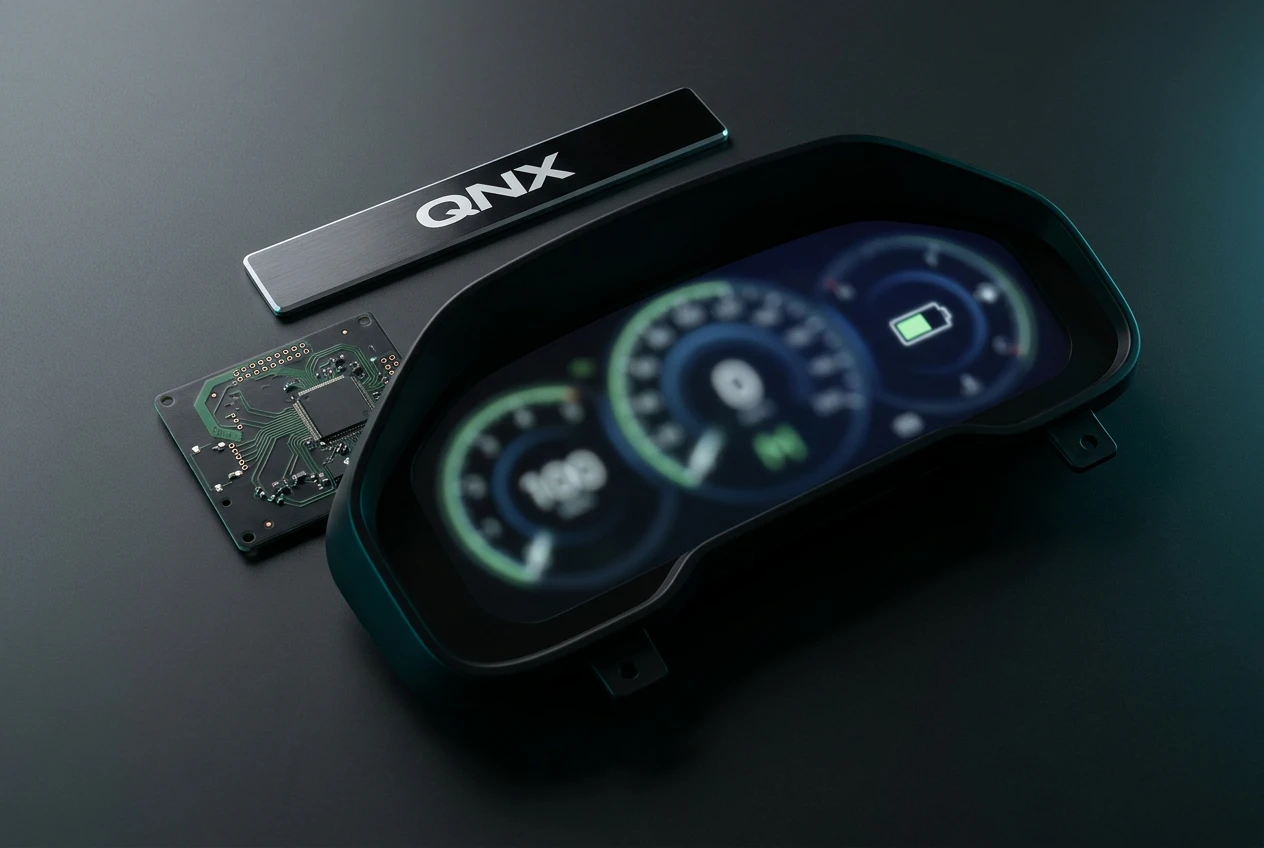
The brand is what makes the chart screenshot interesting. The business is what makes Tuesday’s close defensible.
The Revenue Mix Has Tilted
QNX (the safety-certified real-time operating system embedded in cars, medical devices, and industrial controllers) brought in $268.0 million in fiscal 2026 (the year ended February 28), or close to half the company’s full-year revenue of $549.1 million. Fourth-quarter QNX revenue of $78.7 million was up 20% year over year, and the segment grew 14% for the full year, per BlackBerry’s Q4 fiscal 2026 results filed with the SEC.
Secure Communications, the older institutional-software unit that houses AtHoc and the SecuSUITE encryption stack, generated $258.9 million for the year, with $72.5 million in the fourth quarter, up 8% from a year earlier.
The Backlog Tells the Forward Story
The figure that anchors the bull case is the $950 million QNX royalty backlog, meaning per-unit license revenue that will be recognized as vehicles roll off production lines. The backlog represents more than twice the segment’s current annualized royalty recognition rate, which is what gives the multi-year revenue visibility that CIBC and other constructive analysts have started leaning on.
For fiscal 2027, BlackBerry guided to total revenue of $584 to $611 million, with QNX at $290 to $307 million and adjusted EBITDA (earnings before interest, taxes, depreciation, and amortization) of $110 to $130 million. The Q1 fiscal 2027 quarter wraps May 31, with results scheduled for June 25.
The Design Wins Behind the Number
QNX software is now embedded in more than 275 million vehicles globally, up roughly 100 million since 2020. Named original equipment manufacturer (OEM) customers include BMW, Bosch, Continental, Geely, Honda, Hyundai, Mercedes-Benz, Toyota, Volkswagen, and Volvo. Fresh design wins disclosed alongside the fiscal year results include BMW Group and Volvo Cars, plus a Johnson & Johnson contract for an artificial-intelligence-enabled medical device.
That is the second-order shift the share price is starting to reflect: a software company whose largest single segment now sells embedded operating systems into the auto and medical hardware stack, with revenue visibility extending years out.
Why Secure Communications Still Matters
The federal half of the business is the part most often left out of the QNX story. FedRAMP (the Federal Risk and Authorization Management Program, the U.S. government’s cloud-service approval framework) does not hand out Class D (High) authorizations often, and an expired certification can effectively lock a vendor out of federal procurement until a renewal lands.
BlackBerry’s AtHoc re-certification announcement on May 20 kept the platform inside that procurement perimeter.
We are the only CEM platform to reach this bar in 2025, and this re-certification reflects our sustained investment in helping organizations coordinate faster, operate more securely, and respond effectively when conditions are most demanding.
That is Ramon Pinero, general manager of BlackBerry AtHoc, speaking in the company’s May 20 release. Dubhe Beinhorn, senior vice president for the public sector inside BlackBerry Secure Communications, framed the renewal as a signal to existing federal customers that the platform will continue to meet rising compliance and resilience requirements.
Read against the QNX numbers, AtHoc is the customer-stickiness floor: 80% of U.S. federal agencies, an installed base that does not flip vendors casually, and a renewed certification that buys time before the next compliance review.
The Analyst Gap That Hasn’t Closed
The argument against Tuesday’s price is published every morning. S&P Global Market Intelligence aggregates eight covering analysts at a Hold rating with an average price target of $5.16, well below where the stock is trading and well below CIBC’s new mark. Those numbers were compiled before this week’s upgrade, but only one of the eight has moved publicly so far.
| Reference point | Price | Implied stance vs Tuesday close |
|---|---|---|
| S&P Global Market Intelligence consensus (8 analysts) | $5.16 average target, Hold | ~38% below the close |
| CIBC Capital Markets, updated | $8.50, Outperform | ~1% above the close |
| Tuesday’s close | $8.39 | n/a |
The dispersion is the trade. CIBC’s number prices in the QNX backlog and FedRAMP renewal as durable. The consensus number prices in the prior three years, when stagnant top-line growth and Secure Communications softness offset the QNX story and kept the share count moving the wrong way.
The June 25 print is the first quarterly result that will let the rest of the desk decide which number is right.
What Could Undo This
The mixed read is not about whether the operating numbers improved. They did. The risk is whether the price has run ahead of what the next quarter can confirm.
- Project deferrals at QNX customers. RBC has flagged the risk that platform launch delays inside automotive customers push royalty recognition out of fiscal 2027 and into later years. The $950 million backlog does not vanish, but the timing line can shift.
- Secure Communications drag. The unit grew 8% in the fourth quarter but has spent years as a flat-to-down business. If the FedRAMP renewal does not translate into net new federal contract value, the segment becomes a maintenance line item rather than a growth driver.
- Sentiment unwind. The stock is rallying in part on AI-rotation flows. If big tech sells off through June or Middle East risk reasserts itself in the macro tape, BlackBerry’s beta to that mood is high enough to give back the move quickly.
- Valuation reset. Even with the fiscal 2027 guidance, a price near $8.40 implies the market is paying for a level of QNX execution that has not yet been printed. A single miss against the high end of the guide can compress the multiple fast.
Chief Executive John Giamatteo’s framing on the April earnings call was direct: “We are no longer a company in transition.” That sentence is now load-bearing. The June print is what tests whether the market lets him keep saying it.
Heading Into June 25
The first quarterly results of fiscal 2027 land Wednesday, June 25, before the U.S. open, with the quarter closing this Sunday, May 31. BlackBerry’s guidance points to Q1 QNX revenue of $60 to $64 million and Secure Communications revenue of $66 to $70 million, with consolidated non-GAAP earnings per share of 15 to 19 cents for the full year.
If QNX prints inside or above its quarterly range and management edges the full-year backlog number up, the CIBC framework wins and the $5.16 consensus number gets revised on contact. If QNX prints below the range or the company walks back any portion of the fiscal 2027 EBITDA guide, the gap between consensus and tape closes from the other direction, and the buyback program becomes the only structural bid left under the share price.
Disclaimer: This article is for informational purposes only and does not constitute investment advice. Equity securities such as BlackBerry Limited carry market, execution, and macroeconomic risk, and past performance does not indicate future results. Readers should consult a qualified financial professional before making investment decisions. Prices, analyst targets, and operating figures are accurate as of publication.


South Korea Retail Investors Face Reckoning After KOSPI AI Rally Collapses

Surrey AI Maps Three Heart Attack Paths and Their Molecular Roots

Germany Locks Neutral Apple ATT Prompts Across Most of Europe

Apple’s 5% EU Fee Quietly Rewrites Alternative App Store Math

Apple’s EU Fee Truce Cuts Complexity but Leaves Rivals Fuming

Pixel 11 Pro Fold Trades Thinness for Durability and Seven-Year Stay

Mayo AI Flags HCM Obstruction From Everyday Ultrasound Videos

Indian Brands Quietly Scale Landmark Screens and Home Tech

Navin Vatsa Turns Grief Into a Lifetime of Quiet Seeing

Google Bets Pixel 11 Agentic AI Will Redefine Phones

Oracle Cuts 21,000 Jobs in a Year, Cites AI in 10-K Filing

Fable 5 and Mythos 5 Return as US Lifts Anthropic Export Controls

SpaceX’s Google Deal Turns a Rocket Company Into a Cloud Landlord

CD Projekt Red Co-CEO: Redemption Arc Isn’t Done, Witcher 4 in 2027

XPL Rallies 30% Ahead of Plasma One Card Tier Launch

Google Search Profiles Build a Follow Graph Inside Discover

DGO App Brings Rs 549 Mobile Pass for FIFA World Cup 2026 in Nepal

Moonshot AI Targets $30 Billion in China’s Fastest AI Funding Sprint

Oppo’s ColorOS 17 Eligibility List Leaves A-Series Buyers Behind

Microsoft Xbox Layoffs Start in July as Sharma Slams 3% Margin
-
 AI2 months ago
Oracle Cuts 21,000 Jobs in a Year, Cites AI in 10-K Filing
-
 AI2 months ago
Fable 5 and Mythos 5 Return as US Lifts Anthropic Export Controls
-
 AI3 months ago
SpaceX’s Google Deal Turns a Rocket Company Into a Cloud Landlord
-
 GAMING2 months ago
CD Projekt Red Co-CEO: Redemption Arc Isn’t Done, Witcher 4 in 2027
-
 CRYPTO3 months ago
XPL Rallies 30% Ahead of Plasma One Card Tier Launch
-
 NEWS3 months ago
Google Search Profiles Build a Follow Graph Inside Discover
-
 APPS3 months ago
DGO App Brings Rs 549 Mobile Pass for FIFA World Cup 2026 in Nepal
-
 AI3 months ago
Moonshot AI Targets $30 Billion in China’s Fastest AI Funding Sprint