
AI
Factory AI Pods Turn Data Centers Into Production Lines
Multi-year deals and 3.5x factory growth let Schneider ship prefabricated AI pods in days, industrializing high-density capacity the traditional way cannot match.

Schneider Electric’s prefabricated AI pods now cut high-density data center installation from months to days and overall deployment by up to 60 percent. The company is scaling factories 3.5 times and locking multi-year deals that treat modules like aircraft parts.
That factory model is the second-order change. It turns AI infrastructure supply into a predictable production line instead of one-off construction projects.
What Prefabricated AI Pods Deliver on Site
AI pods arrive as complete white-space modules. They already contain the power distribution and cooling loops needed for high-density GPU racks. Operators drop them in, connect utilities, and bring compute online far faster than stick-built halls.
Thomas Humphrey of Schneider Electric described the shift plainly in the company’s July 29 blog. Modular data centers reduce total deployment time by up to 60 percent. Prefabricated IT pods shrink the final installation step from months to days.
- 60 percent faster overall modular builds versus traditional methods
- Months to days for IT pod white-space installation
- Integrated power and cooling distribution ready for high-density AI
- Factory-tested quality that limits on-site surprises
The same approach shows up across the industry. Other builders report similar compression to 8-12 months total for modular AI capacity versus 24-36 months for conventional concrete shells. Speed matters because AI model roadmaps now wait on physical capacity.
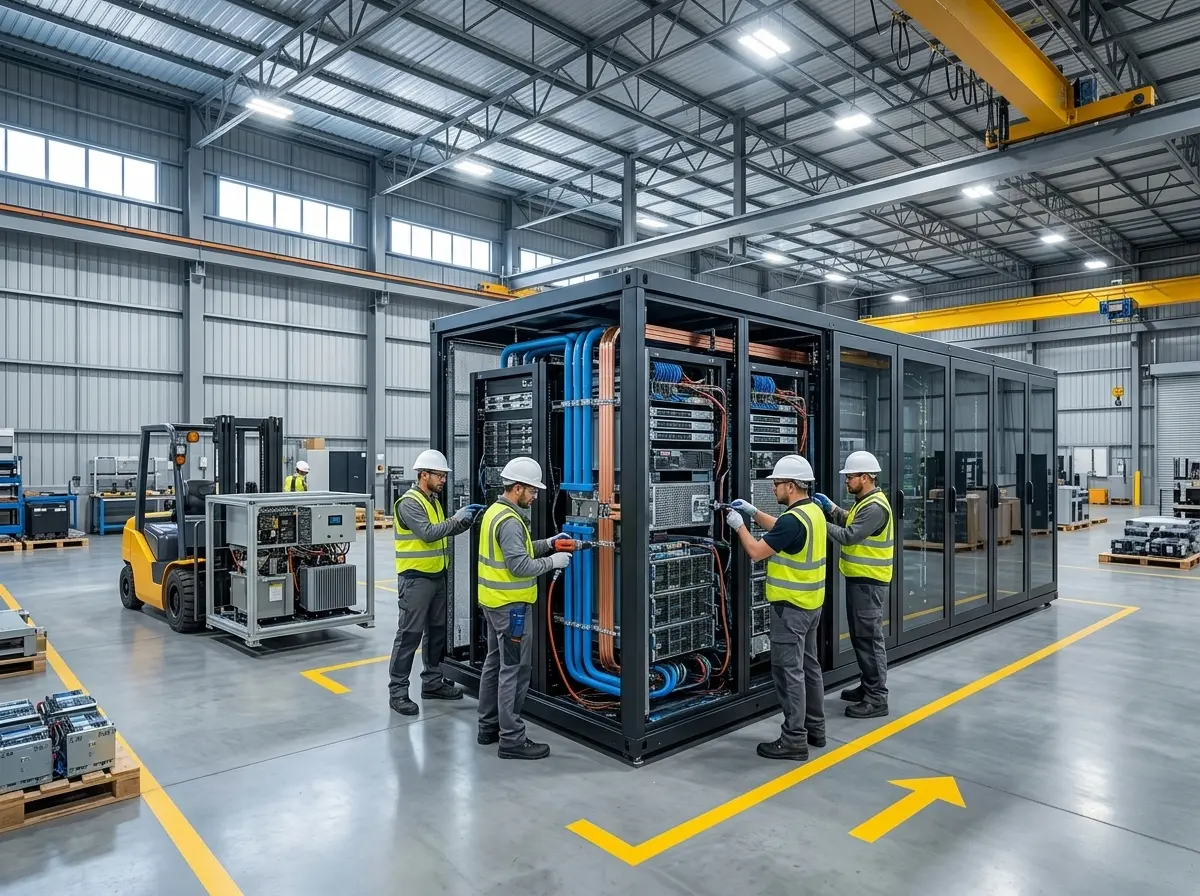
Factories Grew 3.5 Times in Two Years
Schneider has poured capital into manufacturing capacity to match the demand spike. Factory square footage for prefabricated modules rose 270 percent in the last two years. Global prefab footprint expanded 3.5 times to more than 1 million square feet.
| Facility or Metric | Detail |
|---|---|
| Westchester, Ohio | New dedicated location opened |
| Red Oak, Texas | Joint integration factory with Compass Datacenters |
| Global prefab footprint | More than 1 million square feet after 3.5× growth |
| Prefab headcount target | Double to more than 2,000 employees |
| Motivair acquisition | Controlling interest closed early 2025 for liquid cooling |
The company also bought a controlling stake in Motivair, a specialist in direct-to-chip liquid cooling, for $850 million. That deal closed in early 2025 and brought high-density thermal solutions under the same roof as power modules. Motivair has since opened additional U.S. production space in Buffalo.
Omdia ranked Schneider the top manufacturer of prefabricated power modules globally and the leader for modular data centers in North America as of its May 2026 report. The manufacturing build-out supports that claim with actual floor space and trained staff.
Multi-Year Contracts Mimic Aircraft Production
One-off purchase orders are fading. Operators now sign multi-year supply capacity agreements that schedule steady module deliveries, sometimes 10 units a month for years. Schneider compares the model directly to aircraft manufacturing: long-term volume commitments let the supplier right-size headcount, lock material supply chains, and standardize production.
| Partner | Deal Value and Scope | Year |
|---|---|---|
| Compass Datacenters | Multi-billion dollar multi-year technology agreement, joint Red Oak factory | Expanded 2023 |
| Switch | $1.9 billion supply capacity agreement for prefabricated power modules and Uniflair chillers | 2025 |
| Digital Realty | $373 million for UPS, low-voltage switchgear and prefabricated power skids | 2025 |
The $1.9 billion supply capacity agreement with Switch is Schneider’s largest cooling engagement to date. It includes the first North American deployment of Uniflair chillers and three years of full service support. Switch designs AI factories that reach 2 MW per rack.
These contracts give Schneider visibility to plan production runs. Customers receive consistent quality and, over time, lower unit costs from standardization. Both sides trade some design freedom for speed and reliability.
Power Density Still Sets the Pace
Faster pods do not erase the deeper constraints. GPU racks now draw 40-100 kW and higher. Blackwell-class systems push whole sites toward multi-gigawatt loads. Grid interconnection waits in primary markets often exceed four years.
JLL’s 2026 Global Data Center Outlook projects the industry will add nearly 100 GW of new capacity by 2030, roughly doubling global stock at a 14 percent CAGR. Total investment could approach $3 trillion once IT fit-out is included. Construction costs alone already run about $11.3 million per MW for the shell and core.
As AI continues to reshape the digital landscape, we see an opportunity not just to meet demand, but to define what the next generation of data centers can achieve.
Vandana Singh, SVP of Secure Power North America at Schneider Electric, said that after the Switch deal. The company pairs modular power with advanced liquid cooling so operators can raise density without a matching rise in energy waste.
Even so, many AI data centers still tied to the grid face the same long-lead transformers and utility queues. Behind-the-meter generation and battery storage are rising as bridge solutions. Modular pods help once power arrives, but they cannot invent megawatts.
Who Gains When Builds Become Products
Integrated suppliers that own power, cooling and factory capacity pull ahead. Schneider can now offer a full liquid-ready stack after the Motivair deal. Partners such as Compass, Switch and Digital Realty lock in reliable module flow and shorten their own project risk.
- Hyperscalers and large colos gain predictable delivery schedules and lower change-order costs
- Prefab specialists capture multi-year volume that traditional contractors rarely see
- Liquid-cooling specialists inside larger groups scale faster than pure-play peers
- Traditional stick-build firms lose share on speed-critical AI halls unless they partner or retool
Smaller regional builders face higher barriers. They lack the factory footprint and balance-sheet strength for multi-year commitments. Labor also concentrates: Schneider alone plans to add more than 1,000 prefab roles. Skilled trades that once moved site-to-site now sit inside fixed manufacturing plants.
Cooling innovation continues in parallel. Some operators explore nuclear-assisted cooling efficiency gains for extreme densities, another sign that thermal management has become as strategic as power distribution.
From One-Off Builds to Standardized Production
The industry has talked about modular data centers for years. AI density finally forced the change from niche to default for new high-performance capacity.
- 2023, Schneider and Compass expand to a multi-billion multi-year technology agreement and plan the Red Oak joint factory.
- 2024-early 2025, Schneider acquires controlling interest in Motivair for $850 million, adding direct-to-chip liquid cooling.
- June 2024 onward, Red Oak integration facility opens; Westchester plant comes online; factory footprint multiplies.
- November 2025, Switch $1.9 billion and Digital Realty $373 million supply capacity agreements announced at Schneider’s Innovation Summit.
- July 2026, Schneider publishes the modular AI pod playbook, claiming 60 percent time cuts and top Omdia rankings.
The pattern matches other capital-intensive industries that moved from craft construction to factory lines when volume and consistency became non-negotiable. Data centers are following the same path under AI pressure.
Operators who master the new supply model will bring capacity online while rivals wait on concrete and custom engineering. The pods themselves are only the visible product. The deeper shift is the industrial production system now forming around them.
Schneider’s EcoStruxure modular data center portfolio and the prefabricated IT pods cut installation to days approach give the clearest current example of that system at work.


Workers Still Trust Judgment Over the AI Tools They Use

DigitalOcean’s $894 Million Backlog Rewrites the Old Cloud

Companies Froze Job Design and Called AI a People Problem

AI Capex Looks Unique Because the Chips Wear Out

Samsung Medison’s HERA Z10 Aims at the Sonographer Shortage

GPT-6 Astra Ships as OpenAI’s First Critical Cyber Model

Palms Sells Clean Air Without Ending Casino Smoking

OnlyFans Promo Bots on X Now Pass the Humanity Tests

Datamaran Drops the ESG Label After Winning the Argument

Xiaomi’s Own Chip Lands While Apple Argues Over Color

Oracle Cuts 21,000 Jobs in a Year, Cites AI in 10-K Filing

Fable 5 and Mythos 5 Return as US Lifts Anthropic Export Controls

SpaceX’s Google Deal Turns a Rocket Company Into a Cloud Landlord

CD Projekt Red Co-CEO: Redemption Arc Isn’t Done, Witcher 4 in 2027

XPL Rallies 30% Ahead of Plasma One Card Tier Launch

Google Search Profiles Build a Follow Graph Inside Discover

DGO App Brings Rs 549 Mobile Pass for FIFA World Cup 2026 in Nepal

Moonshot AI Targets $30 Billion in China’s Fastest AI Funding Sprint

Oppo’s ColorOS 17 Eligibility List Leaves A-Series Buyers Behind

Microsoft Xbox Layoffs Start in July as Sharma Slams 3% Margin
-
 AI3 months ago
Oracle Cuts 21,000 Jobs in a Year, Cites AI in 10-K Filing
-
 AI2 months ago
Fable 5 and Mythos 5 Return as US Lifts Anthropic Export Controls
-
 AI3 months ago
SpaceX’s Google Deal Turns a Rocket Company Into a Cloud Landlord
-
 GAMING3 months ago
CD Projekt Red Co-CEO: Redemption Arc Isn’t Done, Witcher 4 in 2027
-
 CRYPTO3 months ago
XPL Rallies 30% Ahead of Plasma One Card Tier Launch
-
 NEWS3 months ago
Google Search Profiles Build a Follow Graph Inside Discover
-
 APPS3 months ago
DGO App Brings Rs 549 Mobile Pass for FIFA World Cup 2026 in Nepal
-
 AI3 months ago
Moonshot AI Targets $30 Billion in China’s Fastest AI Funding Sprint