
APPS
Tinder Is Booking the Run Clubs Sold as Its Replacement
Swipe apps lost paying users in 2026, but Tinder is wrapping run clubs and hobby nights into the app the startups say will replace it.

Match Group’s paying users fell 6 percent to 13.3 million in the second quarter, while Tinder started wrapping run clubs and hobby nights into the app itself. A Nashville startup spent August claiming that move belongs to the thing replacing dating apps.
The paid-user bleed is real. The replacement story is not. Tinder is already booking the same Saturdays.
Match Group Still Gets Paid as Payers Leave
Match Group posted second-quarter results on August 4, 2026. Revenue was $853 million, down 1 percent. Paying users fell 6 percent to 13.3 million, and revenue per payer rose 6 percent to $21.13. Adjusted EBITDA rose 14 percent to $331 million, a 39 percent margin. Net income rose 36 percent to $171 million.
Tinder still does most of the work and most of the damage. Direct revenue there was $457 million, down 1 percent, with payers down 5 percent to 8.5 million. Daily active users fell 4 percent, the smallest drop in 10 quarters. Women on Tinder’s monthly active list were down 8 percent, three points better than the 11 percent drop in the first quarter.
Hinge is the exception inside the same company. Its revenue rose 22 percent. That is not a category in collapse. It is a portfolio in which the original swipe product is shrinking and the more effortful one is not.
Bumble’s August 5, 2026 figures were worse. Revenue was $210.5 million, down 15 percent. Paying users fell 16 percent to 3.16 million. The Bumble app itself held 2.08 million payers, down 17 percent. Average revenue per paying user ticked up 1 percent to $21.96. The quarter included a $169.3 million impairment and a $127.9 million net loss. Adjusted EBITDA was $72.9 million, down 23 percent.
WHO STILL GETS PAID IN Q2
| Brand | Q2 2026 revenue | Revenue change | Paying users | Payer change |
|---|---|---|---|---|
| Match Group | $853 million | down 1% | 13.3 million | down 6% |
| Tinder | $457 million | down 1% | 8.5 million | down 5% |
| Bumble | $210.5 million | down 15% | 3.16 million | down 16% |
Match Group told investors to expect third-quarter revenue of $885 million to $895 million, another year-over-year decline. Bumble pointed to $205 million to $213 million. Price increases are carrying the receipts. Bodies on the other side of the glass are not.
A 1,000-Download App in Music City
Find Labs, Inc. put a name on that gap on August 19, 2026. Founder Winder Hughes said dating apps had turned romance into a stack of strangers, and that Find starts with a run club, a night out, or a local event people already attend. The product is launching in Nashville, Tennessee and is built around more than 300 shared interests, from pickleball and trivia to run clubs and book clubs. Users mark that they are going, chat before the event, and treat the Saturday they already planned as the first meeting.
The store listings are the scale check the pitch skipped. Google Play showed 1,000-plus Google Play downloads, a 3.0 rating, and 12 reviews. Apple’s listing showed a 4.0 score from 96 ratings on the App Store. LinkedIn lists the company at 2 to 10 people, founded in 2023. Everyone has to verify before they can message.
FIND AT A GLANCE
- Launch market: Nashville, with a public plan to add cities as club partners sign on.
- Store scale: 1,000-plus Google Play downloads and 96 App Store ratings.
- Product hook: 300-plus interest communities tied to events already on a user’s calendar.
- Staff: A privately held team of 2 to 10 people at Find Labs, Inc.
Hughes is describing a real product. He is not describing a successor to Tinder. Find also cites conversion rates of 60 to 80 percent for matchmaker-style introductions, against under 10 percent for app-born connections. Those figures do not appear in Match Group’s or Bumble’s filings, and Find did not publish the study behind them.
WHAT WE KNOW
- The payer drop: Match Group and Bumble both lost paying users in the second quarter of 2026.
- The burnout poll: A 2024 OnePoll survey of 1,000 U.S. adults who had used a dating app in the prior year found 78 percent felt exhausted by the apps sometimes, often, or always.
- The Find footprint: The app is live, verified, and still measured in thousands of downloads.
WHAT IS UNCONFIRMED
- The 60 to 80 percent rate: Find’s matchmaker conversion comparison has no public dataset attached to it.
- City expansion: Find says more markets will follow Nashville; it has not named dates or a partner count.
That is a launch, not a changing of the guard. The guard is busy copying the launch.
Tinder Is Booking the Same Saturday
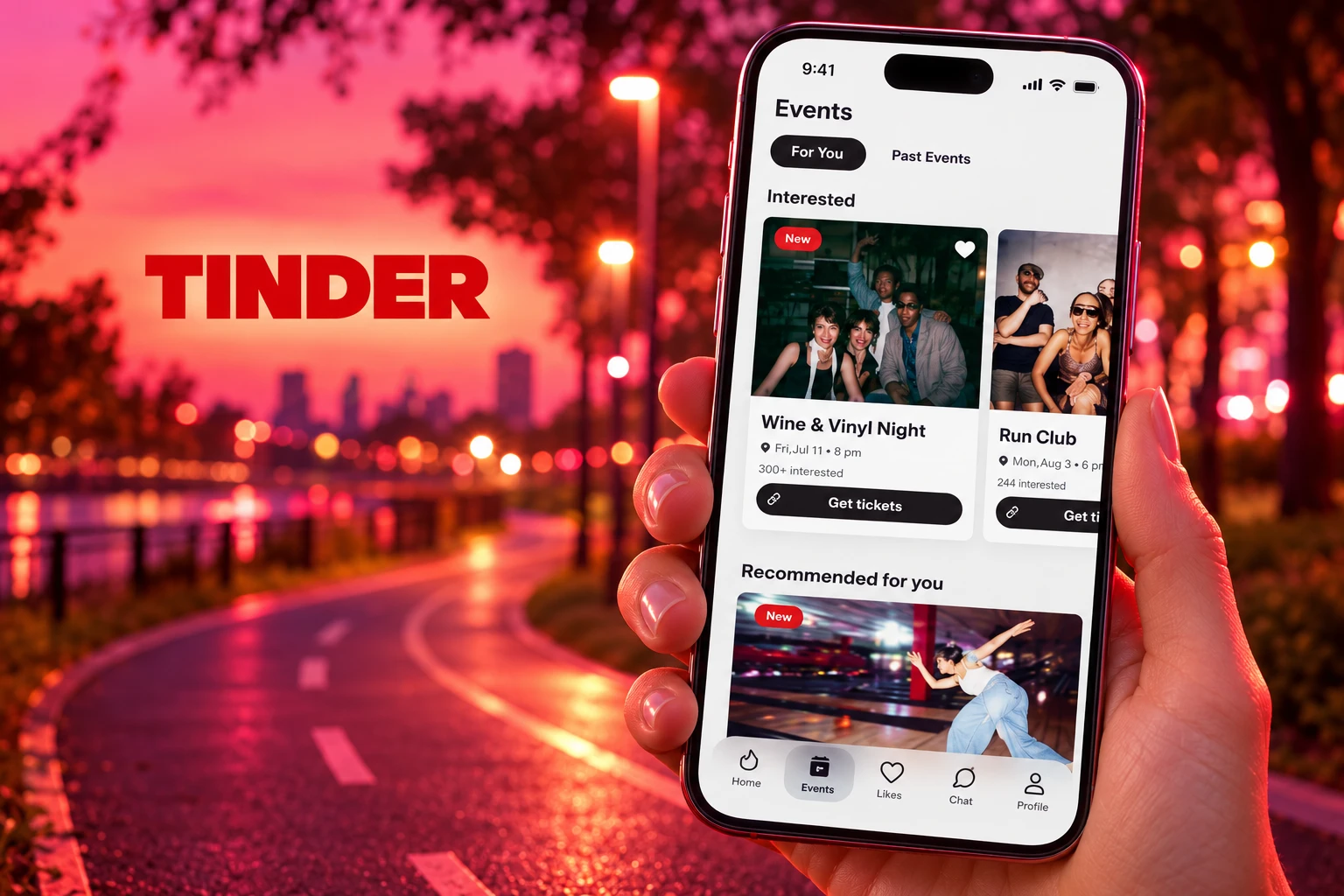
Tinder opened an Events tab in Los Angeles in March 2026. On July 23, 2026, it said the tab was live in nine more cities: New York City, Dallas, Denver, Kansas City, Phoenix, Berlin, Munich, Zurich, and Geneva. The plan is 26 cities by the end of September. Independent organizers still create, manage, and ticket the nights. Tinder puts them in the app, lets photo-verified users mark Interested, and lets them match after they check in.
The Los Angeles test is the only market Tinder has scored in public. More than 60 events ran there. They drew engagement from 66 percent of eligible active users. Adoption skewed young: 71 percent of younger Gen Z users ages 18 to 24 engaged, against 63 percent of users 25 and older, and 53 percent came back. A 60-person candlelight ceramics class sold out within a day. Group runs, hikes, DJ nights, and game nights pulled demand too.
Chief Product Officer Mark Kantor put the strategy in the same sentence Find uses for itself.
Going to an event with friends or meeting around a shared interest makes dating feel less intimidating and more fun, and when people already have something in common, making a real connection becomes more natural.
Mark Kantor, Chief Product Officer, Tinder press release, July 23, 2026
TINDER EVENTS ROLL OUT
- March 2026: Tinder launches the Events tab in Los Angeles after its Sparks product keynote.
- March to July 2026: More than 60 Los Angeles events run, with 66 percent of eligible active users engaging.
- July 23, 2026: Events go live in nine more U.S. and European cities, bringing the map to 10 markets.
- End of September 2026: Tinder plans to have Events in 26 cities.
Match Group chief executive Spencer Rascoff told analysts on the August 4, 2026 call that internal research showed nearly half of singles aged 18 to 29 want to share in-person experiences with people who could become closer connections. He said the company was doubling down on lower-pressure ways to meet in real life. Tinder already has the users, the verification layer, and the city list. Find has Nashville.
Why Run Clubs Became Dating Inventory
The clubs did not hold a vote. They became inventory because the phone stopped converting.
OnePoll’s 2024 sample is the burnout number every pitch now borrows. Of 1,000 U.S. adults who had used a dating app in the previous year, 78 percent said they felt emotionally, mentally, or physically exhausted by the apps sometimes, often, or always. The split was 79 percent among Gen Z, 80 percent among millennials, 80 percent among women, and 74 percent among men. The top reason, at 40 percent, was failing to find a decent connection. Respondents said they spent about 51 minutes a day on the apps. Tinder was the most-used service in that group, at 49 percent.
That is a lot of minutes for a product whose job is supposed to end in a room. The obvious next room was already full of people who share a pace, a book, or a bar tab. Strava’s 2024 Year in Sport report said global run-club membership rose 59 percent and new clubs on the platform rose 3.5 times, with one in five people in a related survey dating someone they met through a club. Book clubs and hobby nights picked up the same rumor. None of those groups were built as dating funnels. They now get treated as one.
WHERE THE MEET-CUTE MOVED
- Run clubs: Shared mileage, a standing Saturday, and a coffee after, with no profile stack in between.
- Book clubs and hobby nights: A reason to talk before anyone asks what you do.
- Tinder Events: Ceramics, pickleball, brewery meetups, and group runs, listed inside the swipe app.
- Find communities: The same calendar, with a chat that opens because both people already tapped I’m Going.
- Bar tables with a clock: Apps that skip the chat and put six to 10 people at a partner venue.
The second-order cost sits with the clubs. A Tuesday ceramics class that sells out because Tinder pushed it is a good night for the studio. It is also a night that now arrives pre-sorted by dating intent. Organizers keep the ticket money. Tinder keeps the graph of who showed up, who matched, and who came back.
Surf, Breeze, and a Night That Starts at the Bar
Find is not even the only small app telling this story. Surf, built around shared workouts and a Hyrox partnership, showed about 28,800 downloads worldwide in 2026, per Sensor Tower, with monthly active users too low to track. Users see a grid of about 30 profiles and can sign up for mixed-doubles blind dates in cities from Sydney to New York. A 33-year-old runner named Rob Perez, who used the Hyrox format in Ottawa, said he was tired of decoding fitness habits out of the same photos and prompts on Bumble, Tinder, and Hinge.
Breeze, founded in 2020 in the Netherlands, cuts the chat. Users get about seven profiles a day and a time and place at a partner bar. It has started grouping six to 10 people by interest. Co-founder Marco van der Woude put the product in one line that also describes Tinder Events, Find, and every run club that got turned into a dating market.
The hardest part of dating isn’t meeting people, it’s the pressure we’ve attached to it. A table of eight is a night out first and a date second. Worst case you have a fun evening, and best case you meet the love of your life.
Marco van der Woude, co-founder, Breeze
Feeld has been listing comedy nights, clubbing, bouldering, and hikes next to its profiles. Abigail Gaskin, the company’s director of brand marketing, said there is only so much you can do online, and that people want a little friction: getting dressed and going somewhere. That is the whole category argument in 2026. It is also an argument Tinder can fund with partnerships instead of a new network.
The swipe stack was built to keep people in the stack. Every extra prompt, every Events badge, every I’m Going tap is an attempt to graduate them without letting them delete the app. The startups sell deletion. The incumbent sells a tab.
Hinge Grew by Making People Work for It
If swipe were simply over, Hinge would be shrinking with Tinder. It is not. Sensor Tower’s first-half 2026 download tally had Hinge up 25 percent, Tinder down 2 percent, and Bumble down 15 percent. Match Group’s own Hinge revenue, up 22 percent, is the earnings version of the same split. Extra prompts and tighter likes are a pain. They also filter the room.
Bumble has been talking about quality over quantity since its first-quarter reset, when founder and chief executive Whitney Wolfe Herd said the company had chosen engaged members over scale. The second quarter still showed 3.16 million payers. Talking about a reset does not refill the funnel. Tinder’s answer is to put the funnel in a ceramics studio and a fun run, then keep the matching layer.
That is the irony the Nashville pitch cannot carry. People are tired of strangers in a stack. The large apps heard that, and they are booking the rooms those people already enter. A 1,000-download app can sit next to a Saturday run in one city. Tinder can sit next to 26 cities by the end of September, with the same shared-interest line and a much longer list of who else is going.
The clubs will keep filling. The tab will keep score.

Instagram Plus Tests a Read-Only Mode That Cuts Stories

Altman Asks the Public to Accept Some AI Harm

Google Freezes OSS VRP Product Reports After AI Flood

AI Agents Make Payment Rails the Scarce Prize

Turkey’s Crypto Boom Now Runs Through Three Banks

Fable 5 Came Back Under a Commerce On-Off Switch

Google’s SpaceX GPU Lease Has a Sept. 30 Deadline

Plasma One’s XPL Locks Face a 1.81 Billion Cliff

DGO’s Rs 549 World Cup Pass Cost Fans Sleep and Data

Moonshot AI’s $30 Billion Ask Became a $35 Billion Close
-
 AI4 months ago
Fable 5 Came Back Under a Commerce On-Off Switch
-
 AI5 months ago
Google’s SpaceX GPU Lease Has a Sept. 30 Deadline
-
 CRYPTO4 months ago
Plasma One’s XPL Locks Face a 1.81 Billion Cliff
-
 APPS5 months ago
DGO’s Rs 549 World Cup Pass Cost Fans Sleep and Data
-
 AI5 months ago
Moonshot AI’s $30 Billion Ask Became a $35 Billion Close
-

 NEWS5 months ago
ColorOS 17 Device List Spans Oppo, OnePlus and Realme
-

 GAMING4 months ago
The RTX 4050 Under Rs 70,000 Hides a Wattage Gap
-
 AI4 months ago
Boris Cherny’s Loops Still Demand a Higher Production Bar