
NEWS
Meta’s Teen Time Limits Leave the Living Room Open
Meta’s two-hour teen cap covers Instagram and Facebook apps, not smart TVs or videos over 22 minutes, the path YouTube already lives on.

Meta’s teen settlement caps Instagram and Facebook at two hours a day, then leaves the living-room screen and any video longer than 22 minutes off the clock. Chief U.S. District Judge Yvonne Gonzalez Rogers signed the consent judgment on August 26, 2026, ending a trial that had opened eight days earlier in the Northern District of California.
Two months before that signature, Meta put Instagram on Samsung televisions and began testing longer videos made for the couch. The same company then told YouTube, already the biggest streamer on American TV, to take a one-hour phone-style cap.
Meta Caps Teens at Two Hours a Day
Meta said a bipartisan group of 52 attorneys general joined the deal across U.S. states, territories, and the District of Columbia. In participating jurisdictions, the product changes apply automatically to users under 18 on Instagram and Facebook. Most terms run 10 years. The time limit and night block start on a five-year clock unless peers sign on.
The company described a default two-hour daily time limit that a parent has to lift. Time spent scrolling Facebook and Instagram counts toward one combined total, including extra accounts Meta detects. Direct messages sit outside that clock, Meta said, so teens can still reach friends and family.
Night Mode blocks the apps from midnight to 6 a.m. local device time. School Mode mutes notifications from 8 a.m. to 3 p.m., with exceptions for direct messages and account-security alerts. California’s attorney general also described a separate mute window from 10 p.m. to 7 a.m. Teens get a prompt after every 15 minutes of continuous use, then again when daily time hits 60 minutes and 90 minutes.
PHASE I VERSUS PHASE II
| Rule | Phase I | Phase II, if peers match |
|---|---|---|
| Daily cap | 2 hours across Facebook and Instagram | 60 minutes per app, 120 minutes combined |
| Night block | Midnight to 6 a.m. | 10 p.m. to 7 a.m. |
| How long it lasts | 5 years | 10 years |
| Who can loosen it | A parent | A parent |
Phase II is the industry hook. The consent judgment names Snap, TikTok, and YouTube as core industry members. If they take matching time rules, Meta’s own defaults get tighter and last longer. An independent auditor will test Meta’s follow-through each year for five years. The company also pledged an independent research foundation that can receive consented user data on teen well-being.
Meta priced the payment at about $18 billion over 10 years. About $12.7 billion, 70 percent, goes to participating states across the decade. About $5.3 billion, 30 percent, stays back until YouTube and TikTok each adopt a one-hour daily limit, night mode, and age-assurance measures, and each pay a matching sum. Meta said it expects a legal expense of about $10 billion in the third quarter of 2026.
The 22-Minute Carve-Out
The daily cap is not a cap on everything a teen can open. The consent judgment defines Longform Content as a piece of video or audio that lasts at least 22 minutes and that Meta has determined, with a high degree of reliability, was not padded to clear the line. Compilations of shorter clips do not qualify. Neither does a clip that sits on a still image or on silence to cross 22 minutes.
Eric Goldman, associate dean for research and a professor at Santa Clara University School of Law, noted that a future YouTube deal might try to cover logged-in video wherever it plays. Meta’s clock, as written, still would not count a 25-minute watch after a teen has already burned the two-hour Reels allowance. Messaging is the other clean miss. Instagram Direct and Messenger keep running after Night Mode, the time limit, and School Mode have shut the feeds.
That pairing is not a drafting accident. Reels and Feed are the surfaces states wanted to interrupt. A 22-minute video looks, on paper, more like a show a parent already knows how to argue about. It is also the format YouTube built a business on, and the format Instagram said in June it wanted on television.
YouTube Already Treats the TV as Home
YouTube did not need this settlement to discover the living room. In its January 21, 2026 letter, the company said it has been No. 1 in U.S. streaming watch time for nearly three years, citing Nielsen. CEO Neal Mohan told investors on May 14, 2026, that living-room devices account for over a billion hours of YouTube watch time every day worldwide, including 200 million hours in the United States.
YOUTUBE ON THE BIG SCREEN
- Global TV time: Over a billion hours a day on living-room devices, Mohan said in May 2026.
- U.S. slice: 200 million of those hours are in the United States each day.
- Shorts on TV: YouTube said in May 2026 that viewers watch over 2 billion hours of Shorts on TVs every month.
- Shorts at large: The 2026 letter put Shorts at 200 billion daily views across screens.
The Shorts figure is the one that cuts against the idea that television is only long, calm, appointment viewing. Vertical clips already play on the biggest screen in the house, in volume.
Over 2 billion hours of YouTube Shorts are now watched on TVs every single month. Live at #Brandcast, @nealmohan broke down how the living room experience is changing. pic.twitter.com/vfAkO6nYvQ
— Updates From YouTube (@UpdatesFromYT) May 13, 2026
YouTube’s own parent tools already treat Shorts as a separate lever. The January letter said parents would be able to cap how much time kids and teens spend scrolling Shorts, including setting that timer to zero. That is a parent-set brake, not a default two-hour lock written by 52 attorneys general. Executives at Google declined to comment on whether a Meta-style deal would reach YouTube’s TV apps.
Instagram Followed Onto Samsung TVs in June
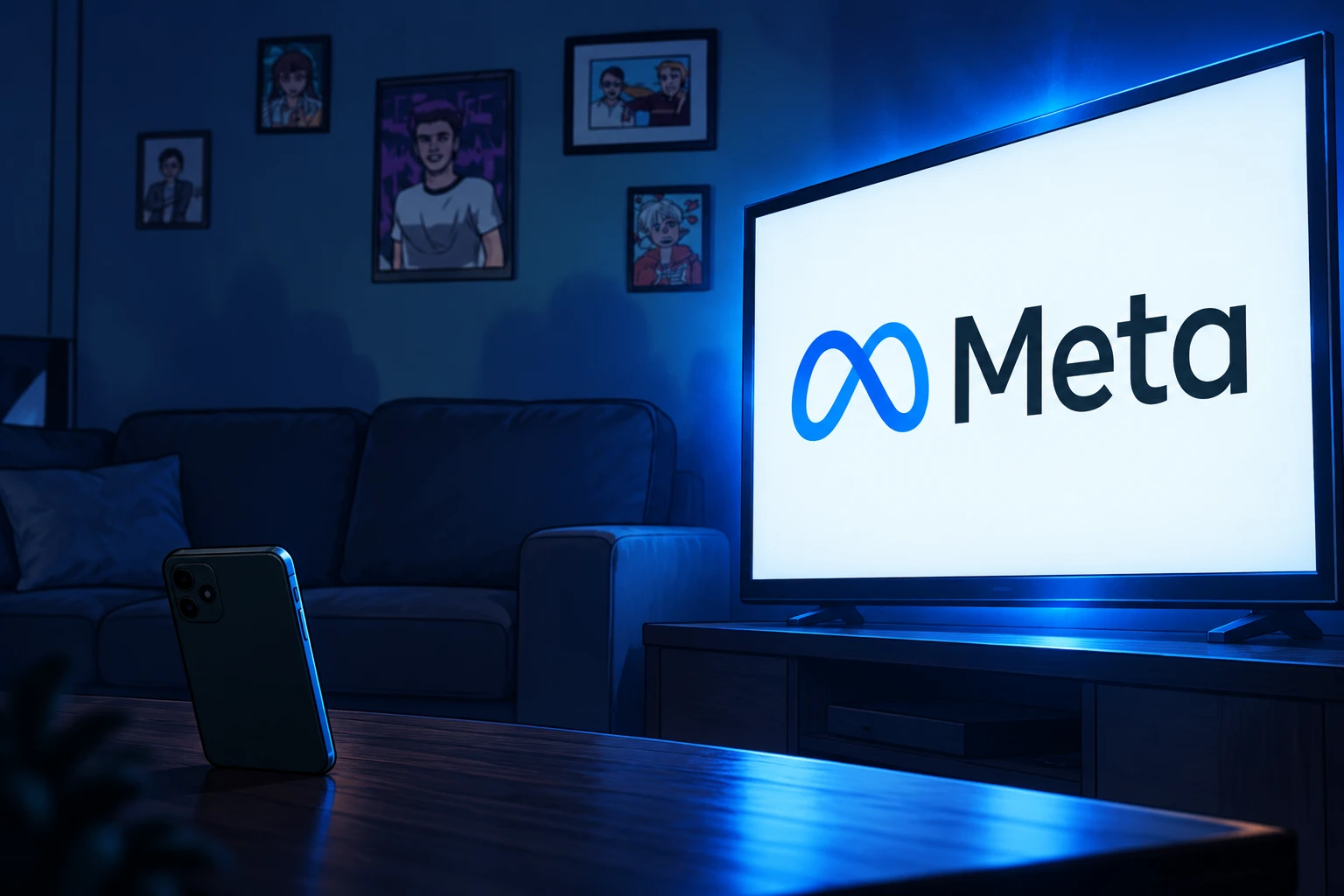
Meta did not wait for the settlement to chase the same screen. On June 22, 2026, it said Instagram for TV on Samsung TVs would ship in the United States on 2020 and newer sets. Combined with Amazon Fire TV and Google TV, Meta said Instagram then reached the majority of connected-TV devices in the country.
INSTAGRAM’S PATH TO THE LIVING ROOM
- December 2025: Instagram for TV launches on Amazon Fire TV.
- February 2026: The app expands to Google TV devices in the United States.
- June 22, 2026: Samsung Smart TVs, 2020 and newer, get the app, with Reels casting, interest channels, and Stories on the big screen in test.
The June post is blunt about the point of the product. Friends and family watch together, pass the remote, and swap recommendations in the room. Meta said it was testing a dedicated home for horizontal video and exploring longer-form creator shows, episodic series, and Live on TV. Longer video is the exact category the August consent judgment later parked outside the teen clock.
A feed designed for a shared couch is a different habit from a phone a teen will not put down. It is still Instagram, still Reels, still the same login if anyone bothers to use one. The company spent the first half of 2026 teaching that app to live in the room where the settlement’s night block is hardest to enforce.
Does the Deal Cover a Smart TV App?
The consent judgment answers this in the definitions, not in a press line. “Meta SMP” means the existing and future web and app versions of Instagram and Facebook, plus certain future spin-offs that meet a separate test. Direct messaging is carved out on purpose. So is “any other product or service of Meta” that does not meet that definition, even if it is wired into Instagram or Facebook.
Smart TV interfaces are not named. Charlie Germano, counsel and chief technologist at BBB National Programs, read that silence the way a compliance lawyer would.
Smart TVs may present an interesting gap in the settlement’s scope. The agreement specifically refers to the web and app versions of Facebook and Instagram, along with other specified services and technologies, but it does not appear to expressly cover smart TV interfaces.
Charlie Germano, Counsel and Chief Technologist, BBB National Programs
Germano added that, on the current wording, smart TVs appear to fall outside the deal unless the court or the independent auditor later says otherwise. He also asked whether those sets could become a way to meet the paper requirements while leaving the TV interface untouched. His answer was that it appears they could.
Age checks do not rescue that gap on their own. Massachusetts Attorney General Andrea Joy Campbell said the enhanced age-assurance system will not require government identification. A shared television still has no reliable teen identity. A family profile, a parent’s login, or no login at all all look the same to a set that was built for the living room.
Rivals Still Have Not Taken the One-Hour Bargain
Meta’s public case is that a one-app lock does not work. C.J. Mahoney, Meta’s chief legal officer, tied the whole design to copycats.
Because teens move fluidly across dozens of apps, we need an industry-wide solution. We therefore call on our industry peers, TikTok and YouTube, to implement this new framework, right away.
C.J. Mahoney, Chief Legal Officer, Meta
The $5.3 billion holdback is the cash version of that sentence. It does not pay out unless YouTube and TikTok each take a one-hour daily limit, night mode, and age assurance, and each write a matching check. Until they do, Meta keeps that slice and keeps a two-hour default instead of a one-hour default. The louder reading is competitive: leftover teen minutes should not migrate to the apps that refused the lock.
Through early September 2026, neither YouTube nor TikTok had announced that it would join. Snap sits in the judgment’s core-member list for Phase II, but it is not on the $5.3 billion hook. Amy Jordan, a distinguished professor of journalism and media studies at Rutgers University, said the Meta deal is a form of self-regulation, so Meta does need others to follow, “lest they be labelled the bad guy in this scenario.”
Other governments have not waited for that club. Lawmakers in Paris have already passed France’s under-15 social media ban, a rule aimed at the user rather than at one device. Mexico’s rejection of a hard ban for children shows the other pole. The U.S. settlement is a product rewrite plus a bill, not a statute that follows a teen from the phone to the TV.
Family Accounts and the Shared Remote
Even if the auditor later drags smart TVs into scope, the living room still fights the design. TV is a communal box. Kids use the household profile. Teens watch YouTube without signing in and still get a recommendation engine that knows their taste. Jordan’s own research cuts the other way on effort: most teens, she said, do not want to scroll without end, and one point of friction makes them less likely to bother. A set that never asks who is holding the remote never creates that friction.
WHERE THE CLOCK DOES NOT RUN
- Long video: A 22-minute watch, if Meta accepts it as genuine longform, does not add to the two-hour total.
- Chat: Instagram Direct and Messenger stay open after feeds lock.
- Other Meta products: Anything that is not a web or app version of Instagram or Facebook is outside the Meta SMP definition.
- The TV interface: Smart TV apps are not named, pending the court or the auditor.
- No login: A signed-out YouTube session on a shared set has no teen account for Night Mode to hold.
The consent judgment gives Meta six months from the effective date to put the limits in place. That clock is running. YouTube and TikTok have not signed. Instagram already plays on Samsung, Fire TV, and Google TV, and Meta is still shaping longer shows for that app. The auditor can still pull those screens in. Until that happens, the two-hour cap is a phone rule sitting next to a television that keeps going.

Instagram Plus Tests a Read-Only Mode That Cuts Stories

Altman Asks the Public to Accept Some AI Harm

Google Freezes OSS VRP Product Reports After AI Flood

AI Agents Make Payment Rails the Scarce Prize

Turkey’s Crypto Boom Now Runs Through Three Banks

Fable 5 Came Back Under a Commerce On-Off Switch

Google’s SpaceX GPU Lease Has a Sept. 30 Deadline

Plasma One’s XPL Locks Face a 1.81 Billion Cliff

DGO’s Rs 549 World Cup Pass Cost Fans Sleep and Data

Moonshot AI’s $30 Billion Ask Became a $35 Billion Close
-
 AI4 months ago
Fable 5 Came Back Under a Commerce On-Off Switch
-
 AI5 months ago
Google’s SpaceX GPU Lease Has a Sept. 30 Deadline
-
 CRYPTO4 months ago
Plasma One’s XPL Locks Face a 1.81 Billion Cliff
-
 APPS4 months ago
DGO’s Rs 549 World Cup Pass Cost Fans Sleep and Data
-
 AI5 months ago
Moonshot AI’s $30 Billion Ask Became a $35 Billion Close
-

 NEWS5 months ago
ColorOS 17 Device List Spans Oppo, OnePlus and Realme
-

 GAMING4 months ago
Xbox Cuts 3,200 Jobs After Five Years of Thin Returns
-

 GAMING4 months ago
The RTX 4050 Under Rs 70,000 Hides a Wattage Gap