
AI
The College Essay Lost Its Job as a Writing Test
Formula-trained personal statements now mimic chatbots, so colleges treat AI as fraud while dropping essay scores and leaving most applicants without a clear rule.

Only 2 percent of colleges officially let applicants use generative AI to write admissions essays, a 2025 Kaplan survey of 220 officers found. Thirty percent ban that use. Another 68 percent have no policy at all.
The fight is usually framed as cheating. Did a senior paste a chatbot draft, and can anyone prove it? That question hides a quieter change. After two decades of shared templates, the personal statement already sounded like everyone else, and language models learned that voice. Offices still call machine-written pages fraud. They also stopped treating those pages as proof of how a student writes.
The Common App’s Quiet Fraud Clause
Since August 2023, the Common App’s fraud policy has treated AI the way it treats a ghostwriter. Fraud includes submitting plagiarized essays, or intentionally passing off as original work another person’s thoughts, or the substantive content or output of an AI platform. The platform does not run a public, system-wide detector on every file. It makes the student certify the file is their own work.
Yale’s admissions office repeats that line and then draws a usable border. Grammar checks, spelling passes, and early topic suggestions do not count as fraud. Submitting personal statements or other written responses composed by text-generating software may result in admission revocation or expulsion. Notre Dame’s undergraduate admissions page makes a similar split: brainstorming and copy-edits are allowed, while generated, drafted, or substantially written passages are not.
The word that does the work is “substantive.” A spellcheck is not the problem. A model that supplies the story, the argument, or the voice is. Jenny Rickard, then Common App’s chief executive, has said the organization will look at the full picture of intent rather than publish a dictionary definition of that word. Students still have to guess where brainstorming ends and authorship begins.
THE ADMISSIONS AI CALENDAR
- November 30, 2022: ChatGPT launches, one day before many winter graduate deadlines.
- August 2023: Common App updates its fraud policy to name AI output as misrepresentation.
- July 10, 2023: Stanford researchers show popular detectors mislabel non-native English writing.
- 2024 cycle: Duke stops giving essays a numerical rating as a writing sample.
- July-August 2025: Kaplan polls 220 officers and still finds most campuses have no essay-AI rule.
- 2025-26 cycle: Duke adds an optional supplement asking when a student would, or would not, use AI.
- September 18, 2026: A Harvard and NYU team posts evidence that AI-written essays are common in one master’s pool and that those applicants are admitted less often.
Each of those dates points the same way. The rulebook got stricter on paper. The essay’s job in the file got smaller.
Kaplan’s Survey Leaves Applicants Guessing
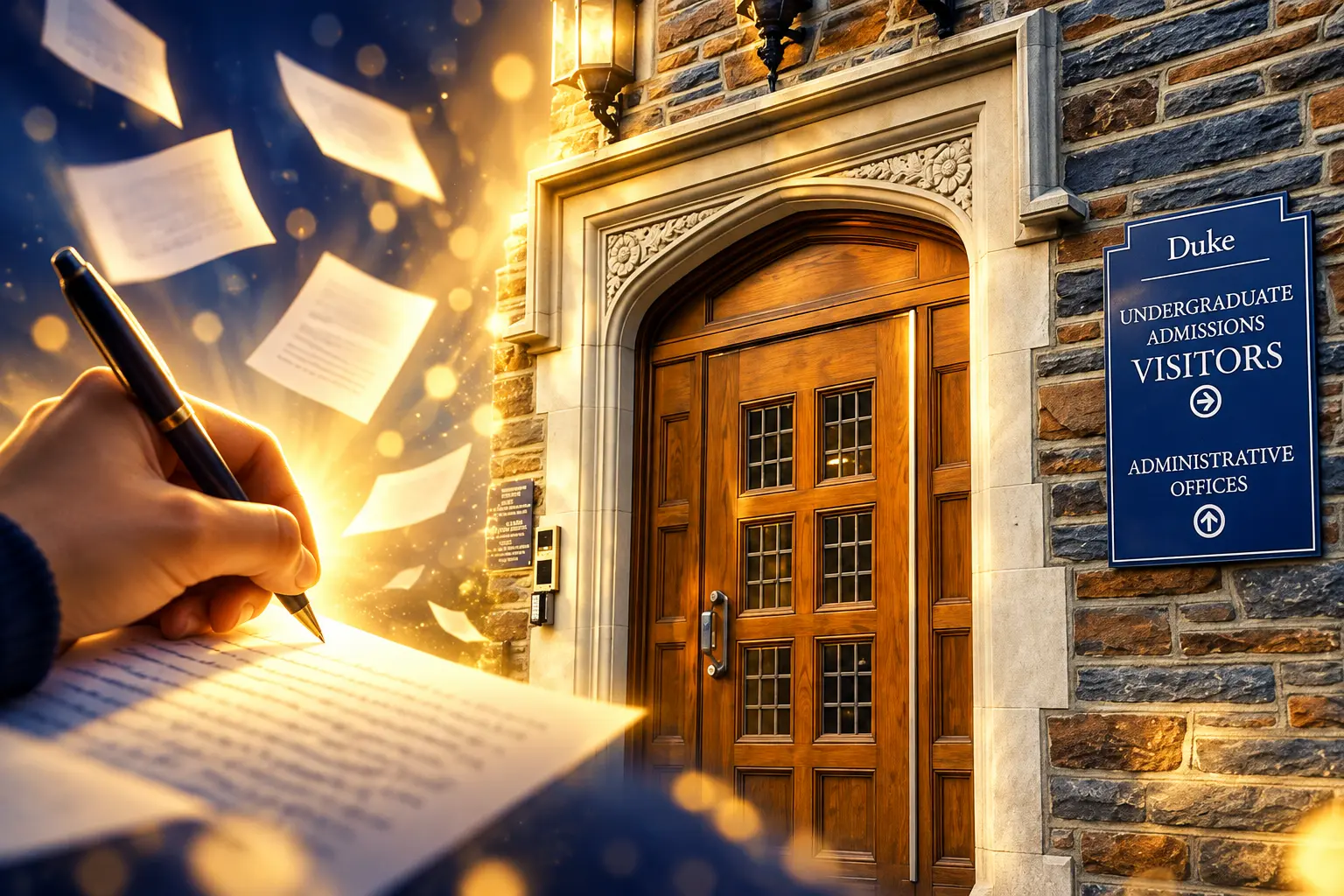
Kaplan emailed officers at 220 national, regional, and liberal arts colleges in July and August 2025, then published the results on November 3, 2025. The writing question is the one families actually need, and it is the one schools dodge. An official policy allowing applicants to use generative AI to only 2 percent of colleges say they have; 30 percent ban that use, up from 25 percent in Kaplan’s 2024 figures; 68 percent still have none, compared with 72 percent a year earlier.
KAPLAN 2025 ESSAY-AI RULES
| Use | Officially allowed | Officially banned | No policy |
|---|---|---|---|
| Writing the essay | 2% | 30% | 68% |
| Brainstorming ideas | 27% | 4% | 69% |
| Feedback on a student’s own draft | 21% | 5% | 73% |
Brainstorming is the softest category, with 27 percent of officers saying their college allows it. Feedback on a draft the student already wrote is allowed at 21 percent of those campuses. In both rows, the “no policy” share still sits near seven in ten. Kaplan rounded the percentages, which is why the feedback row does not add to 100.
Half the officers said they have an unfavorable view of generative AI in admissions essays. Twenty-six percent were neutral. Fourteen percent were favorable. One officer told Kaplan the writing often fails to match other parts of the file, which raises a blunt question about how strong a writer the student actually is. Jason Bedford, a Kaplan senior vice president, called it surprising that nearly three years after ChatGPT’s debut, most colleges still take a hands-off approach, and said the vacuum lets some students overuse the tools while others avoid them out of fear.
A 2024 Kaplan survey found that just 9 percent of schools used generative AI detection software when evaluating admissions essays. The 2025 release did not repeat that question. The pattern is still the one families live with. A national form calls AI output fraud. Most campuses never say, in public, how they will look.
Duke Stopped Scoring the Essay as Writing
Duke made the second-order move early. For the 2024 cycle, Christoph Guttentag, then dean of undergraduate admissions, said the office would no longer give essays a numerical rating. The old system scored applicants from one to five in six categories, including essays and tests, for a total of 30. The remaining scored categories were curriculum strength, grades, activities, and recommendations.
Essays are very much part of our understanding of the applicant, we’re just no longer assuming that the essay is an accurate reflection of the student’s actual writing ability.
Christoph Guttentag, then dean of undergraduate admissions at Duke
He named two reasons: generative AI, and paid college consultants who shape the file. The essay stayed in the folder. It lost its job as a writing test. Kathy Phillips, later interim dean of undergraduate admissions, told the campus paper in 2025 that the office does not think of AI as an inherently bad tool, because a model can only write about what a student puts into it. She said readers are more interested in content than in presentation, and that they want a sense of who the student is in their own words.
For the 2025-26 cycle, Duke added an optional supplement that asks for a situation in which the applicant would or would not choose to use AI, and what shapes that thinking. Phillips also said undergraduate admissions staff were not using AI to evaluate applications, even as the office looked at whether models might later help with more objective pieces such as transcripts. That is a different bet from campuses that have started to score short answers with a model trained on old files. Juan Espinoza, vice provost for enrollment management at Virginia Tech, has said a human reader has good days and bad days, and that an AI scorer does not get tired.
So the same technology sits on both sides of the desk. Students are told not to let it write. Some offices are testing whether it can help them read. Duke’s answer was to stop pretending the page measures prose skill.
Why Human Essays Keep Failing AI Detectors
Seven widely used GPT detectors, tested by Weixin Liang, Mert Yuksekgonul, Yining Mao, Eric Wu, and James Zou at Stanford, misclassified more than half of 91 human-written TOEFL essays as AI-generated, a 61.3 percent false-positive rate published in Patterns. The same tools were near-perfect on 88 U.S. eighth-grade essays. All seven detectors agreed on 18 of the 91 TOEFL pages. At least one tool flagged 97.8 percent of them. When the team had ChatGPT rewrite those TOEFL essays, the average false-positive rate fell to 11.6 percent.
WHAT THE STANFORD TEST SHOWED
- The sample: 91 human TOEFL essays and 88 U.S. eighth-grade essays, run through seven popular detectors.
- The miss: Average false-positive rate of 61.3 percent on the TOEFL set, versus near-perfect scores on the eighth-grade set.
- The pile-up: All seven tools called 18 of 91 human essays AI-authored.
- The twist: After a ChatGPT rewrite, the false-positive rate fell to 11.6 percent, a 49.7-point drop.
Predictable word choice, even rhythm, and limited vocabulary are features of careful second-language writing. They are also features detectors treat as machine tells. The cleanest way to look “human” to the software, in that study, was to send the human prose through a model. That is a rotten standard for a college file.
Parents already hit the same wall with English-first drafts. In November 2025, John Konrad wrote that his daughter hand-wrote her college essays, typed them, then watched a detector return scores above 80 percent likely AI. Replies to that complaint were grim in a practical way: vary the sentences, add mess, sound less like a good writer. A separate family story that circulated in 2026 flipped the outcome. A human draft got flagged. A classmate’s chatbot draft came back as original.
Matt Woodworth, a college coach and former Duke admissions officer, has told seniors not to write the essay with ChatGPT because an experienced reader who has seen thousands of files will know. Liza Libes, who works with student essays each fall, said she kept finding the construction “It’s not just this, it’s that,” a chatbot signature, including from students who insisted the words were theirs. If the only prose a teenager reads is model prose, the imitation does not need a paste button.
Several research universities have already treated detector scores as too shaky for misconduct calls, including Vanderbilt, which disabled Turnitin’s AI detector in 2023, and Georgetown. Stanford never licensed the feature. The tools remain easy for a nervous senior to open in a browser. They are a weak basis for an offer, or for taking one back.
$3 Billion Still Buys the Same Template
The homogenization did not start in a chatbot window. It started in a market. Navagant’s Q4 2025 industry note put U.S. admissions consulting revenue at $3.0 billion in 2025, with a forecast of $3.2 billion by 2029. Nicole LaPorte, who has written at length about independent counselors, has described average comprehensive fees around $6,500, and multi-year concierge packages, sometimes starting in middle school, that can reach $200,000. Counts from the Independent Educational Consultants Association put full-time U.S. independent counselors at about 3,500 in 2015 and 8,500 to 10,000 by the end of 2024.
Those hours often go into the same three plots, because the plots are what “essays that worked” galleries reward.
THE INTERCHANGEABLE PLOT
- The club: A student founds a group, then closes on leadership.
- The ward: A volunteer shift at a hospital closes on compassion.
- The house: A family strain closes on vulnerability, growth, or authenticity.
The kids in those stories are not always faking the life. The writing stops at the lesson. Heightened images fill the middle, a humblebrag fills the résumé paragraph, and the last third names an abstract quality. Language models train on the same galleries. When a page sounds like AI, the tell is often that it could be swapped into the next folder without anyone noticing.
Paid coaching can still help a student find a specific habit, a contradiction, a moment of discomfort. It can also industrialize the opposite: pick “resilience” first, then hunt for a memory that fits the word. AI made that assembly line cheaper. It did not invent it. Families who cannot buy the assembly line now face a second tax. Their prose, if it is formal, translated, or simply well-drilled by a public-school English teacher, is the prose detectors already punish.
A Master’s Program Already Penalizes the Tell
Undergrad offices still argue from policy pages. A September 18, 2026 paper by Calvin Isley and Sharad Goel at Harvard and Johann D. Gaebler at NYU measured a real pool. They studied 7,462 applications, from 2020 through 2025, to a large U.S. public policy master’s program. The program required a personal attestation, and from 2023 it barred generative AI. Using GPTZero at a high-confidence “AI written” threshold, they found that 56 percent of applicants submitted at least one essay classed as primarily AI-generated in the 2025 cycle. The share was 69.3 percent among international applicants and 38.6 percent among domestic applicants. From 2023 onward, the flagged share climbed by about 20 percentage points a year.
Almost none of the pre-ChatGPT essays tripped the tool, which is evidence of a low false-positive rate in that setting. Essay quality still rose after the model appeared, especially for international applicants, on a composite built with the program’s own officers. Applicants with flagged essays were admitted less often than comparable non-users. In a follow-up experiment, officers could often tell AI writing, and they scored essays they believed were AI-generated more harshly. The program later overhauled its process after seeing the results.
That is not a census of the Common App. It is a warning from a neighboring market with five short essays, a signed ban, and a detector running in hindsight. Use is common. Quality ticks up. The people who sound like the machine still pay for it. Lee and coauthors, cited in the same paper, had already estimated that about 8 to 10 percent of the text in Common App essays at one competitive engineering school showed language-model patterns in the year after ChatGPT’s release. The master’s numbers suggest the floor has moved.
The Signal That Still Survives
Officers keep saying they want a person, not a lesson. Yale’s policy page puts it in one sentence: AI tools are ignorant of the unique person applying, and fluent prose is not the same thing as a mind. The surviving test is smaller than the old writing sample. It is whether a paragraph is rooted in one life, whether the student is thinking on the page instead of announcing a moral, and whether the details could not be copied onto the next application.
That is harder to buy, and harder to generate, than a clean theme. It is also the only part of the essay that still does work once scores, detectors, and templates have eaten the rest. The 2026-27 cycle is already being read under those terms. A slick closer about growth will sound like a thousand other closers, including the ones a model can emit in seconds. A specific boredom, a specific mistake, a specific way of noticing, still has a chance to sound like one student.

Instagram Plus Tests a Read-Only Mode That Cuts Stories

Altman Asks the Public to Accept Some AI Harm

Google Freezes OSS VRP Product Reports After AI Flood

AI Agents Make Payment Rails the Scarce Prize

Turkey’s Crypto Boom Now Runs Through Three Banks

Fable 5 Came Back Under a Commerce On-Off Switch

Google’s SpaceX GPU Lease Has a Sept. 30 Deadline

Plasma One’s XPL Locks Face a 1.81 Billion Cliff

DGO’s Rs 549 World Cup Pass Cost Fans Sleep and Data

Moonshot AI’s $30 Billion Ask Became a $35 Billion Close
-
 AI3 months ago
Fable 5 Came Back Under a Commerce On-Off Switch
-
 AI4 months ago
Google’s SpaceX GPU Lease Has a Sept. 30 Deadline
-
 CRYPTO4 months ago
Plasma One’s XPL Locks Face a 1.81 Billion Cliff
-
 APPS4 months ago
DGO’s Rs 549 World Cup Pass Cost Fans Sleep and Data
-
 AI4 months ago
Moonshot AI’s $30 Billion Ask Became a $35 Billion Close
-

 NEWS4 months ago
ColorOS 17 Device List Spans Oppo, OnePlus and Realme
-
 GAMING4 months ago
Xbox Cuts 3,200 Jobs After Five Years of Thin Returns
-

 GAMING4 months ago
The RTX 4050 Under Rs 70,000 Hides a Wattage Gap