
COMPUTERS
Quantinuum Bets Quanta Can Industrialize Quantum Hardware
Quantinuum is betting Quanta can factory-build its next machines, a wager the IPO papers already named, while CHIPS money tries to onshore the ion traps.

Quantinuum named Quanta Computer as its factory partner on August 13, 2026, for trapped-ion machines that still start life as lab systems. The collaborative development deal covers hardware, systems engineering, and manufacturing for later generations, and joint design work is already underway.
The June listing papers had already listed Quanta as an outsourcing partner. The new release still does not say how many machines, at what price, or by which date.
Quantinuum Hands the Factory Problem to Quanta
The companies framed the work as a path from today’s systems to machines that enterprises can actually install and run. They want later hardware to be modular, manufacturable, and scalable, rather than a one-off build in a physics hall. Quantinuum, listed as QNT on Nasdaq since June 2026, is putting that claim on a Taiwanese contract manufacturer whose daily work is already cloud racks, not ion traps.
It is time for quantum computing to transition from breakthroughs in physics achieved in the lab to breakthroughs in system manufacturing that can be deployed and operated at scale.
Dr. Rajeeb Hazra, President and CEO, Quantinuum, August 13, 2026 announcement
Hazra added that Quanta has a record of industrializing advanced computing kit, and that the plants, engineers, and supply chains for large machines need to grow in step with the processors. The press release came from Quantinuum. Quanta did not put a named executive on the wire.
That silence fits the job. Quanta is being asked to put quantum hardware on a factory floor, not to invent a new qubit. The physics still sits with Quantinuum in Broomfield, Colorado, and with a web of chip and laser suppliers.
The $50 Million Ticket From August 2025
The August pact was not a cold call. On August 12, 2025, Quanta’s board approved a purchase of 1,867,840 Series B preferred shares in Quantinuum at US$26.7689 each, about US$50 million (about NT$1.465 billion). The filing put the holding at roughly 0.49% on a fully diluted basis, paid from Quanta’s own cash.
That ticket landed inside a larger Series B that also brought in NVentures, Nvidia’s venture arm, at a US$10 billion pre-money value. A year later, Quantinuum’s IPO prospectus described a hybrid model that already named Quanta: early units of each generation assembled and checked in-house, then volume work handed to outsource partners, with Quantinuum keeping integration, test, and performance sign-off.
On the second-quarter call, the company spoke of a new joint development agreement with a leading global electronics manufacturer, without naming it. The August 13 release supplied the name. Honeywell, which merged its quantum hardware group with Cambridge Quantum in 2021 to form the company, said in July it was still a 47% owner and would say more about that stake in early 2027, a reminder of Honeywell still holding voting control after the listing.
Quanta’s Real Business Is AI Racks
Quanta is not a quantum specialist. It is one of the firms that actually builds the servers hyperscalers order when they want Nvidia iron in a hall. S&P Global Market Intelligence, using Visible Alpha consensus, expects Quanta’s 2026 sales to reach NT$3.7 trillion, with servers at NT$3.1 trillion and AI servers at NT$2.5 trillion. In that mix, servers are about 84% of the company, and AI systems about 80% of the server book.
THE SCALE GAP
- Quanta 2026 sales: S&P sees NT$3.7 trillion, driven by AI racks for cloud buyers.
- Quantinuum 2025 sales: US$30.9 million, against a net loss of US$192.6 million.
- Cash on hand: US$677.0 million at March 31, 2026, after the run-up to the listing.
- Headcount: about 700 people at Quantinuum, more than 70% of the technology team holding a PhD or a master’s degree.
A company of that size does not need quantum revenue this year. What it needs is a seat on the next class of box its cloud customers might someday rack beside GPUs. The quantum work is a side option on a factory that is already expanding lines in North America, Taiwan, and Thailand for AI servers.
Ion Traps Stay Onshore, Boxes Go to Taipei
The factory bet is split in two, and the two halves are not the same job. Quanta is being asked to help make the outer machine: enclosures, interfaces, modular hardware, the kind of repeatable build that turns a trapped-ion stack into something that can ship. The inner parts, the ion traps, cryogenic electronics, and lasers, are on a different track.
WHO BUILDS WHICH LAYER
| Party | Job on the stack | Where it sits |
|---|---|---|
| Quantinuum | Design, early-unit build, integration, and test | In-house, Broomfield and other sites |
| Quanta Computer | Volume systems hardware and manufacturing know-how | Taiwan-based global ODM plants |
| GlobalFoundries | Next-gen ion traps and control chips on 300mm wafers | U.S. foundry lines |
| Monarch Quantum | Lasers, optics, and integrated photonics | U.S. supply |
| Honeywell Aerospace | Sol trap candidates already through a fab | U.S. aerospace plants |
On September 8, 2026, the U.S. Department of Commerce posted a final award of up to $100 million to Quantinuum under the CHIPS and Science Act. The notice says the research targets bottlenecks in trapped-ion scale-up: low-loss integrated photonics, semiconductors that work in the cold, and optical parts at the wavelengths those ions need. Quantinuum said the same award brings in GlobalFoundries for 300mm ion-trap and control-electronics work, and Monarch Quantum for lasers and optics.
Tim Day, Monarch’s chief executive, said large trapped-ion machines have to leave “complex, sprawling optical setups” for integrated photonics engines that can be made the same way twice. That is a chip-and-laser problem. It is not the problem Quanta is being hired to solve. Infineon and Honeywell Aerospace were already on the parts list before either announcement.
Helios Is Already Inside Oracle Cloud
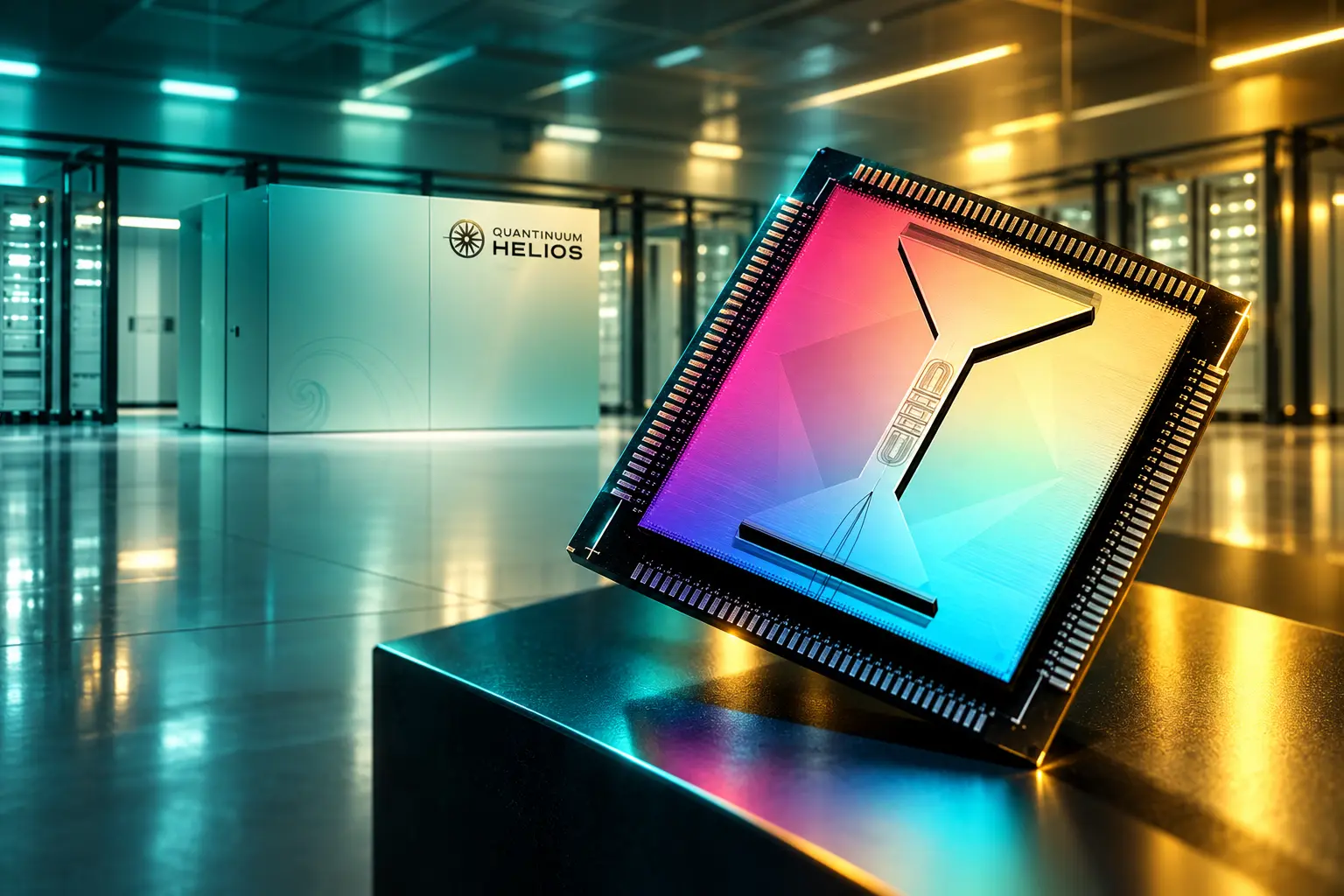
The machine that has to be copied is Helios, launched in November 2025. The prospectus gives it 98 physical qubits, 48 logical qubits, and 99.921% average two-qubit gate fidelity as of December 31, 2025, a physical-to-logical overhead the company calls 2:1. Two days before the Quanta release, Quantinuum said Helios would go into a U.S. Oracle Cloud Infrastructure data center so hybrid jobs could sit next to Oracle’s GPUs and HPC gear.
THE YEAR THE BET WAS LAID
- August 12, 2025: Quanta’s board clears the Series B stock buy, about US$50 million for a 0.49% stake.
- June 2026: Quantinuum lists on Nasdaq as QNT; the prospectus names Quanta as a volume-manufacturing partner.
- August 11, 2026: Helios is slated for an Oracle Cloud hall; the earnings call teases an unnamed electronics JDA.
- August 13, 2026: The JDA is named. Quanta is the partner. No volumes, prices, or dates appear.
- September 8, 2026: Commerce finalizes up to $100 million in CHIPS money, and Quantinuum posts Helix results on the same Helios hardware customers already use.
The same September 8 technical note matters for the wager, because a factory is useless if the code still dies in memory. Quantinuum said it ran its Helix error-correction architecture on Helios and recorded a per-qubit, per-round error of 4.6 x 10^-5 with no post-selection. Logical Clifford gates came in at 2.8 x 10^-4, better than the physical baseline, again with no post-selection. The company presents Helix as the architectural path to Apollo.
What the August Deal Still Does Not Say
Read the August 13 text end to end and the commercial core is missing. There is no unit forecast, no dollar value, no share of cost, no plant location, and no date on which a Quanta-built frame is supposed to leave a line. Joint engineering is “already underway,” which is a process, not a shipment.
That gap is the point of the wager, not a reason to ignore it. Quantinuum is a US$30.9 million-revenue company trying to turn a trapped-ion architecture into something a cloud operator will accept as a rack, and it is using an ODM that already speaks that language. It is also refusing, in its own filing, to give up the last test. Early units stay in-house. Partners take volume once the generation has been proven.
Anyone who treats the release as a purchase order will be disappointed. Anyone who treats it as the moment Quantinuum admitted that physics papers will not build Sol or Apollo is reading the same papers the company filed in June.
2027 Is When the Factory Bet Gets Tested
The prospectus and later remarks set a short public clock. Helios is the revenue system now. Sol is due in 2027, described as a two-dimensional grid machine aimed at up to 100 logical qubits. Apollo is due in 2029, the first fully fault-tolerant generation, aimed at hundreds of logical qubits. Honeywell Aerospace has already sent a Sol trap candidate back from the fab for a validation suite, with no showstoppers reported on that first pass.
THE PUBLIC ROADMAP
- Helios, 2025: 98 physical qubits, 48 logical qubits, 99.921% two-qubit fidelity, now headed into an Oracle hall.
- Sol, 2027: First 2D-grid machine, up to 100 logical qubits, the generation for which Quanta is in the production path.
- Apollo, 2029: Fault-tolerant target, hundreds of logical qubits, the system Helix is meant to serve.
If Quanta is going to matter, it will show up as repeatable hardware around Sol, not as a logo on an August press release. Quantinuum still has to keep integration and test. GlobalFoundries and Monarch still have to turn traps and lasers into parts that arrive on time. The August deal placed the factory half of that stack with an AI-server maker that already has the customers, the lines, and a year-old equity stub. It did not say when the first box built that way will power on.
Disclaimer: This article is news reporting and analysis of a corporate partnership, public filings, and government awards. It is informational only and is not investment advice, a solicitation, or a recommendation to buy or sell Quantinuum, Quanta Computer, Honeywell, GlobalFoundries, or any other security. Readers who are weighing a financial decision should consult a licensed financial adviser or broker who can review their own facts. Revenue, ownership, award, and roadmap figures are taken from the company and government sources cited here and can change with later filings, deliveries, or contract terms.

Instagram Plus Tests a Read-Only Mode That Cuts Stories

Altman Asks the Public to Accept Some AI Harm

Google Freezes OSS VRP Product Reports After AI Flood

AI Agents Make Payment Rails the Scarce Prize

Turkey’s Crypto Boom Now Runs Through Three Banks

Fable 5 Came Back Under a Commerce On-Off Switch

Google’s SpaceX GPU Lease Has a Sept. 30 Deadline

Plasma One’s XPL Locks Face a 1.81 Billion Cliff

DGO’s Rs 549 World Cup Pass Cost Fans Sleep and Data

Moonshot AI’s $30 Billion Ask Became a $35 Billion Close
-
 AI4 months ago
Fable 5 Came Back Under a Commerce On-Off Switch
-
 AI5 months ago
Google’s SpaceX GPU Lease Has a Sept. 30 Deadline
-
 CRYPTO4 months ago
Plasma One’s XPL Locks Face a 1.81 Billion Cliff
-
 APPS4 months ago
DGO’s Rs 549 World Cup Pass Cost Fans Sleep and Data
-
 AI5 months ago
Moonshot AI’s $30 Billion Ask Became a $35 Billion Close
-

 NEWS5 months ago
ColorOS 17 Device List Spans Oppo, OnePlus and Realme
-
 GAMING4 months ago
The RTX 4050 Under Rs 70,000 Hides a Wattage Gap
-

 AI4 months ago
Boris Cherny’s Loops Still Demand a Higher Production Bar