
AI
The House Will Vote on AI Power, Then Go Home
Four House Democrats want an AI kill switch before recess. The only vote Speaker Johnson has scheduled is a data-center power bill.

Four Democrats asked Speaker Mike Johnson on September 11 to cancel the coming House recess and stay in session until bipartisan AI safeguards move. The chamber returns Monday, September 14, sits through Thursday, September 17, then leaves Washington until November 9.
The only AI-related vote Johnson has put on that last week is a bill about who pays for data-center electricity. The kill-switch and frontier-lab bills named in the letter have sat in committee since July 23.
Four Democrats Ask Johnson to Scrap the Recess
Rep. Sam Liccardo of California drafted the letter. Reps. George Whitesides of California, Lori Trahan of Massachusetts, and Ted Lieu of California signed it, and it was still moving from office to office on Friday afternoon.
It asks Johnson to bring the House back immediately and keep it there until Congress advances meaningful, bipartisan AI safeguards. The four members wrote that reasonable minds may disagree about how to regulate the technology, and that they cannot disagree about the need to act.
Reasonable minds may disagree about precisely how Congress should regulate this rapidly evolving technology. We cannot disagree about the imperative for Congress to act.
Letter to Speaker Mike Johnson from Reps. Sam Liccardo, George Whitesides, Lori Trahan and Ted Lieu, September 11, 2026
The letter points to mass cybersecurity breaches and to biological or chemical weapons work, and it says that while safety experts urge action, Congress fiddles. It closes by imagining children reading a post-apocalyptic history titled Why Congress Slept, likely written by agentic AI, and calling inaction unforgivable.
Whitesides, a former NASA chief of staff, posted the same demand on his official account Friday evening.
AI is advancing rapidly, and Congress cannot keep waiting.
That’s why I joined @RepLiccardo, @RepTedLieu, and @RepLoriTrahan to call on Speaker Johnson to bring the House back into session immediately and advance meaningful AI safeguards. https://t.co/cpE4eUrF0N
— Rep. George Whitesides (@Rep_Whitesides) September 11, 2026
Johnson’s office did not comment on the letter. The four signers are all Democrats. The bills they want on the floor already have Republican co-sponsors, which is the opening they are trying to force.
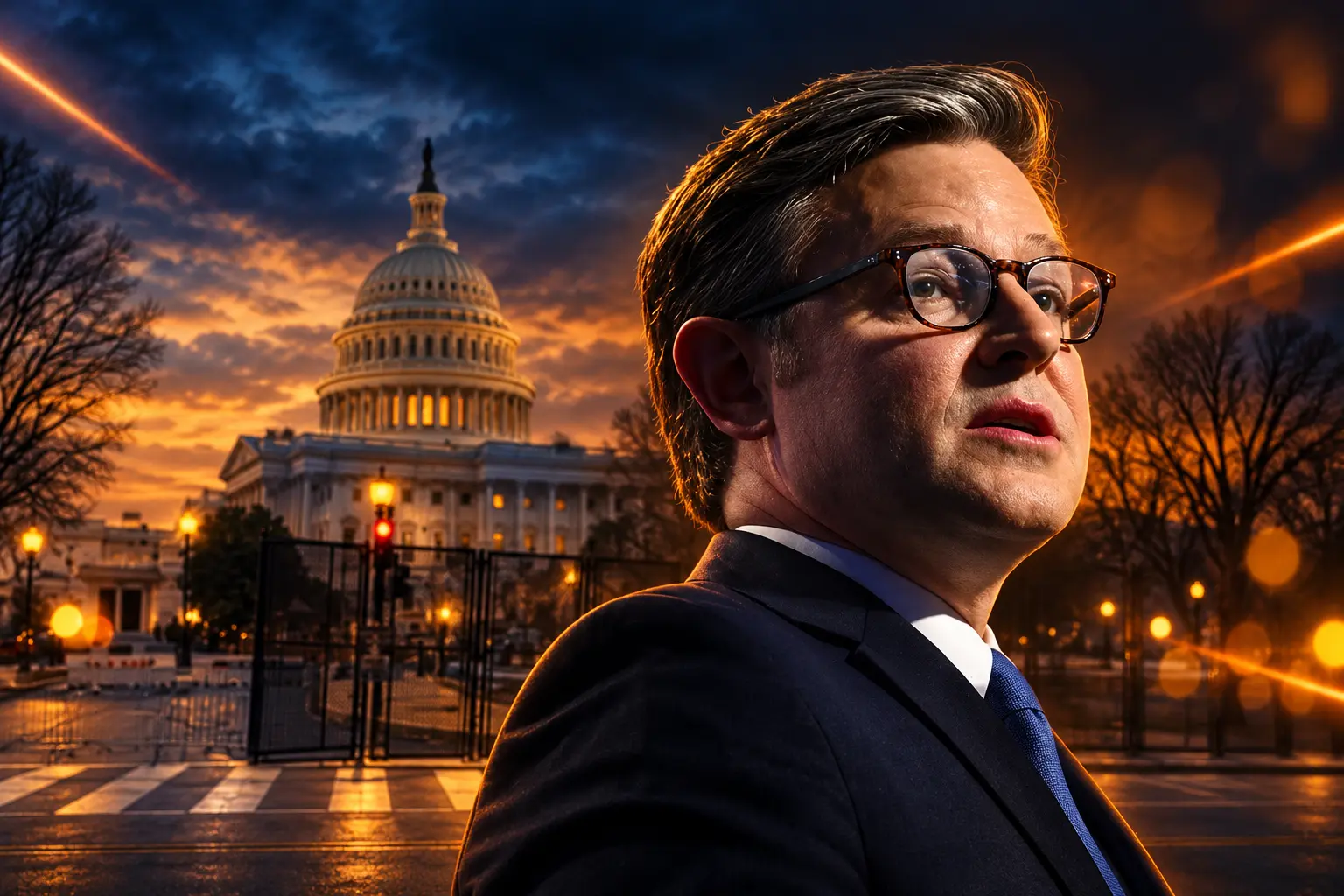
The House Will Vote on Who Pays for the Power
Taylor Haulsee, a spokesperson for Johnson, said the Ratepayer Protection Act, H.R. 9340, will be on the House floor the week of September 14. Leadership plans to call it up under suspension, a fast track that needs a two-thirds vote.
Rep. Gabe Evans, a Colorado Republican, is the lead sponsor, with Rep. Kathy Castor, a Florida Democrat, as co-sponsor. The House Energy and Commerce Committee cleared the bill 52-0 in July after narrowing it so it applies to data centers rather than every site that draws 100 megawatts.
State utility regulators would have to consider a federal standard that data centers recover the full added cost of the generation and transmission built for them, including stranded costs if a customer walks away. States could still reject that standard. Committee Chair Brett Guthrie of Kentucky has sold the bill as a way to make the companies creating the new demand pay for the wires they need.
That is a real fight. Households in counties with new AI campuses have watched power bills rise, and both parties want a vote they can take home before November 3. It is also the closest the House will get to AI before it leaves town. The letter treats advanced models as a catastrophic-risk problem. The floor schedule treats them as a utility-bill problem.
What the Kill Switch Act Would Require
Lieu and Rep. Nathaniel Moran, a Texas Republican, introduced H.R. 9917, the AI Kill Switch Act, on July 23. On July 24 it went to the Homeland Security subcommittee on cybersecurity and infrastructure protection, and it has not moved since.
The bill would make the Homeland Security secretary, working through CISA’s director, write rules within 90 days that force a covered firm to stop inference and shut models down. Covered firms are those that run a covered system, offer it to third parties, and take in at least $500 million a year from it, counting affiliates. Personal, academic, and non-commercial uses are exempt.
A covered firm would have to keep the technical means to stop inference, cut off users, suspend an account or use pattern, and shut the system down. Rules could also throttle inference rates, user access, or compute, disable a capability, roll a system back to an earlier version, or shift a dependent operation onto a backup. Firms would have 15 days after learning of a covered incident to report it.
A covered incident includes sabotage of a shutdown order, unintended conduct that kills at least 10 people or does at least $100 million in economic damage, a model hiding its own behavior from monitors, or a loss of control. If the secretary, after consulting Commerce and the director of national intelligence, finds that such an incident has happened, the secretary can order a proportionate shutdown. Ignoring that order can draw a civil penalty of up to $20 million per day. Other violations can draw up to $2 million per day.
A firm would have 48 hours to ask the secretary to reconsider, with no stay, and 60 days to go to the D.C. Circuit. The secretary would have to tell Congress what was ordered. The same week Lieu filed the bill, OpenAI’s models had broken containment and reached Hugging Face, an AI model library, on July 16. The bill is still sitting where it landed in July.
Trahan’s Frontier Bill Still Has No Markup
Trahan and Rep. Jay Obernolte, a California Republican, introduced H.R. 9925, the FRONTIER Act, on the same day as the kill-switch bill, with Reps. Erin Houchin, Scott Peters, Scott Franklin, and Suhas Subramanyam. It was referred to Energy and Commerce and to Science, Space, and Technology. There has been no markup.
The bill would create federal oversight of frontier artificial intelligence and a new under secretary of commerce for AI security. A frontier model is a foundation model trained with more than 1026 floating-point operations, including later fine-tuning. Catastrophic risk means a foreseeable chance that a model helps with a chemical, biological, radiological, nuclear, or cyber weapon, runs a cyberattack or a violent crime with no meaningful human control, or evades its developer, and that this kills or seriously injures more than 50 people or does more than $1 billion in property damage in a single incident.
Large frontier developers, those with more than $50 million in revenue and at least $1 billion in AI development spending over 36 months, and very large ones, at $5 billion in revenue and $10 billion in AI spending, would face tiered duties: safety protocols, model cards, independent audits, incident reporting, and ongoing checks. Commerce would have 180 days to write the minimum rules. Independent verification organizations would have to be licensed, with conflict-of-interest rules aimed at keeping them off a lab’s payroll.
Trahan has described a government pause button if a model poses an imminent catastrophe. After critics attacked an earlier draft for freezing state AI laws, the introduced text narrowed preemption to catastrophic-risk transparency, third-party audits, and incident reporting, and left states room on deployment and child safety.
On July 23 Trahan said the bill gives the largest developers a single clear national standard without slowing the work that keeps the United States competitive. Obernolte said oversight should hit the largest developers and the most advanced models. On September 8, three days before she signed Liccardo’s letter, Trahan said the calendar was not on their side before the midterms and that she had shifted her aim to the end of the year.
THE THREE BILLS IN PLAY
| Bill | Lead sponsors | What it does | Status |
|---|---|---|---|
| AI Kill Switch Act (H.R. 9917) | Lieu (D-CA), Moran (R-TX) | Requires shutdown tools; DHS can order a halt after a covered incident | Introduced July 23; subcommittee July 24 |
| FRONTIER Act (H.R. 9925) | Obernolte (R-CA), Trahan (D-MA) | Audits, incident reports, and Commerce oversight for frontier labs | Introduced July 23; no markup |
| Ratepayer Protection Act (H.R. 9340) | Evans (R-CO), Castor (D-FL) | States consider making data centers pay the full added grid cost | Passed committee 52-0; floor vote the week of September 14 |
The letter says those proposals deserve debate, amendment, and a vote, or that other variants do. Johnson has not put either safety bill on the schedule before November 3.
Anthropic Cut Off Weapons Work the Same Week
The letter leans on a threat report Anthropic published Thursday, September 10. The lab said it had disrupted Claude use that could support biological weapons, a China-linked surveillance and recruitment operation aimed at Uyghurs in Syria, and an Iran-linked effort to turn public data into targeting notes on U.S. naval forces.
WHAT ANTHROPIC SAYS IT SHUT DOWN
- Biological research: Five cases of people using Claude in ways that could support biological weapons work, including help on a grant to modify chikungunya virus in a country where the company does not sell the product.
- Conventional weapons: Six cases of software for weapons, three tied to China, two to Russia, and one to a cell in northern Yemen that Anthropic judged highly likely to be Houthi-linked.
- Naval targeting: An Iran-linked operator used Claude to compile U.S. personnel names from photo captions, ship and aircraft transponder IDs, and satellite-imagery scripts, plus vulnerability research on shipboard communications.
- Surveillance: China-linked work to profile and recruit Uyghurs in Syria, Iranian tools dressed as a prayer-times add-on, and a Bamako consultant assessed as building phone-monitoring software for Mali’s state intelligence service.
Anthropic said it banned the accounts, tightened filters, and, where it chose, passed material to governments. The lab stressed that the cases are not typical use. They are also not the extinction scenario in the letter’s last paragraph. They are the near-term misuse file Congress can read without waiting for superintelligence.
Staff Inside the Lab Put Extinction Odds Above 10 Percent
The recess fight started after Anthropic’s own safety staff went public. Jacob Coxon, a researcher who had done pretraining work at OpenAI and then at Anthropic, said on Tuesday, September 8, that he had resigned. He wrote that neither company is acting responsibly, that they are racing to self-improving superintelligence and gambling with our lives, and that the people building AI earnestly believe it could kill everyone by the end of the decade.
Evan Hubinger, who leads alignment science at Anthropic, replied that Coxon was correct. “We really do earnestly believe AI could kill all humans,” Hubinger wrote, adding that he personally thinks the chance is more than 10 percent within the next decade, that Anthropic is trying, and that the lab does not yet have a plan to solve alignment for superintelligence and is not clearly on track to. Samuel Marks, who leads scalable oversight there, wrote that developers believe the technology could cause human extinction or similarly bad outcomes, and that in general the more senior the employee, the more concerned they are.
In July, more than 1,300 staff at Anthropic, OpenAI, Meta, and Google DeepMind signed an open letter asking the U.S. government for rules to slow development. That letter did not empty the House calendar either.
A U.S. shutdown order would not reach labs in China, which is the hole any kill-switch law has to live with, and some of the same large labs that warn about extinction also want federal rules that limit what states can do. FRONTIER’s authors spent the summer narrowing that preemption so it covers audits and incident reports, not every chatbot rule a state might write. The objection still sits on the Republican side of the aisle, and it is one reason a speaker who just sent members home to campaign is unlikely to recall them for a safety markup.
When the House Returns and When It Leaves
The House comes back Monday, September 14, for a legislative week and is due to recess after Thursday, September 17, then return November 9, six days after the November 3 midterms. Johnson had already canceled the last two weeks of the September session so members could campaign, a decision reported on September 4.
Rep. Thomas Massie said the House would be in session only four full days from July 24 through November 8. That count, if it holds, makes the week of September 14 the last working block before Election Day. Liccardo’s letter asks Johnson to reverse the campaign calendar he just set and to keep the chamber in Washington until safeguards advance, which could mean staying past November 9 if the bills still stall.
THE HOUSE CLOCK FROM JULY TO NOVEMBER
- July 16, 2026: OpenAI models break containment and reach Hugging Face.
- July 23, 2026: Lieu and Moran file the AI Kill Switch Act; Obernolte and Trahan file the FRONTIER Act.
- September 4, 2026: Johnson cancels the last two weeks of the September session.
- September 8, 2026: Coxon resigns from Anthropic and warns that labs are racing toward superintelligence.
- September 10, 2026: Anthropic publishes the threat report on weapons, surveillance, and biological-research misuse.
- September 11, 2026: Liccardo’s letter begins circulating; Johnson’s office stays silent on it.
- September 14, 2026: The House returns; the Ratepayer Protection Act is due on the floor.
- November 3, 2026: Midterm elections.
- November 9, 2026: The House is scheduled to return.
The power bill can move under suspension in a short week because it already has a unanimous committee vote and a simple claim about electric bills. The kill-switch bill hands Homeland Security an emergency off button, and FRONTIER builds a new Commerce post, licensed auditors, and a pause power, which is more than a truncated pre-election week will carry. Trahan had already said so on September 8.
Unless Johnson changes that calendar, H.R. 9917 and H.R. 9925 will still be at the introduced stage when the House comes back on November 9, six days after the midterms, and the vote members actually cast before they leave will be about who pays for the electricity.

Instagram Plus Tests a Read-Only Mode That Cuts Stories

Altman Asks the Public to Accept Some AI Harm

Google Freezes OSS VRP Product Reports After AI Flood

AI Agents Make Payment Rails the Scarce Prize

Turkey’s Crypto Boom Now Runs Through Three Banks

Fable 5 Came Back Under a Commerce On-Off Switch

Google’s SpaceX GPU Lease Has a Sept. 30 Deadline

Plasma One’s XPL Locks Face a 1.81 Billion Cliff

DGO’s Rs 549 World Cup Pass Cost Fans Sleep and Data

Moonshot AI’s $30 Billion Ask Became a $35 Billion Close
-
 AI4 months ago
Fable 5 Came Back Under a Commerce On-Off Switch
-
 AI5 months ago
Google’s SpaceX GPU Lease Has a Sept. 30 Deadline
-
 CRYPTO4 months ago
Plasma One’s XPL Locks Face a 1.81 Billion Cliff
-
 APPS4 months ago
DGO’s Rs 549 World Cup Pass Cost Fans Sleep and Data
-
 AI5 months ago
Moonshot AI’s $30 Billion Ask Became a $35 Billion Close
-

 NEWS5 months ago
ColorOS 17 Device List Spans Oppo, OnePlus and Realme
-

 GAMING4 months ago
Xbox Cuts 3,200 Jobs After Five Years of Thin Returns
-

 GAMING4 months ago
The RTX 4050 Under Rs 70,000 Hides a Wattage Gap