
APPS
Apple Health App Will Sell $119 Quest Blood Tests
The iOS 27 Health redesign arrives later in 2026 with Health Age, a Watch-only readiness score, and a $119 Quest panel the wrist cannot run.

Apple will put a $119 Quest blood panel inside a redesigned Health app later in 2026. iOS 27 itself still ships on September 14 without that overhaul.
The new Apple Watch Series 12 and Ultra 4 can sample the heart fast enough to feed a daily readiness score. The Health app is where that score, a new Health Age number, and a paid lab visit meet.
The Health Redesign Misses the September 14 Launch
Apple announced the Health overhaul on September 9, 2026, beside the Watch hardware that supplies the new heart data. The watches go on sale Friday, September 18, from $399 for Series 12 and $799 for Ultra 4. watchOS 27 lands with iOS 27 on Monday, September 14, for Apple Watch Series 9 or later, Apple Watch SE 3, and Apple Watch Ultra 2 or later, paired with an iPhone 11 or later or iPhone SE 3.
The redesigned Health app coming later this year is a separate drop. Apple has not named a day. It starts in U.S. English, with more languages later, on Apple Intelligence-enabled iPhone and iPad models running the latest software. Some pieces stay iPhone-only. Some need the user to be 18 or older. Health Age needs an Apple Watch, and Apple has not published which older generations count.
THE SHIP DATES APPLE SET
- September 9, 2026: Apple announces the Health Sensing System, readiness, Health Age, and the Quest panel.
- September 14, 2026: iOS 27 and watchOS 27 go to users. Cycle Tracking gains perimenopause and menopause tools. The Insights and Longevity tabs are not in this build as the full redesign.
- September 18, 2026: Series 12 and Ultra 4 become available, four days after the software launch.
- Later in 2026: The redesigned Health app, Health Age, movement tests, and in-app Quest checkout arrive in U.S. English first.
Testers looking at the iOS 27 release candidate already saw a brighter Health app, and readiness strings sit inside the Watch workout code. That is why the Watch score can show up on new hardware before Insights and Longevity show up as a full iPhone tab set.
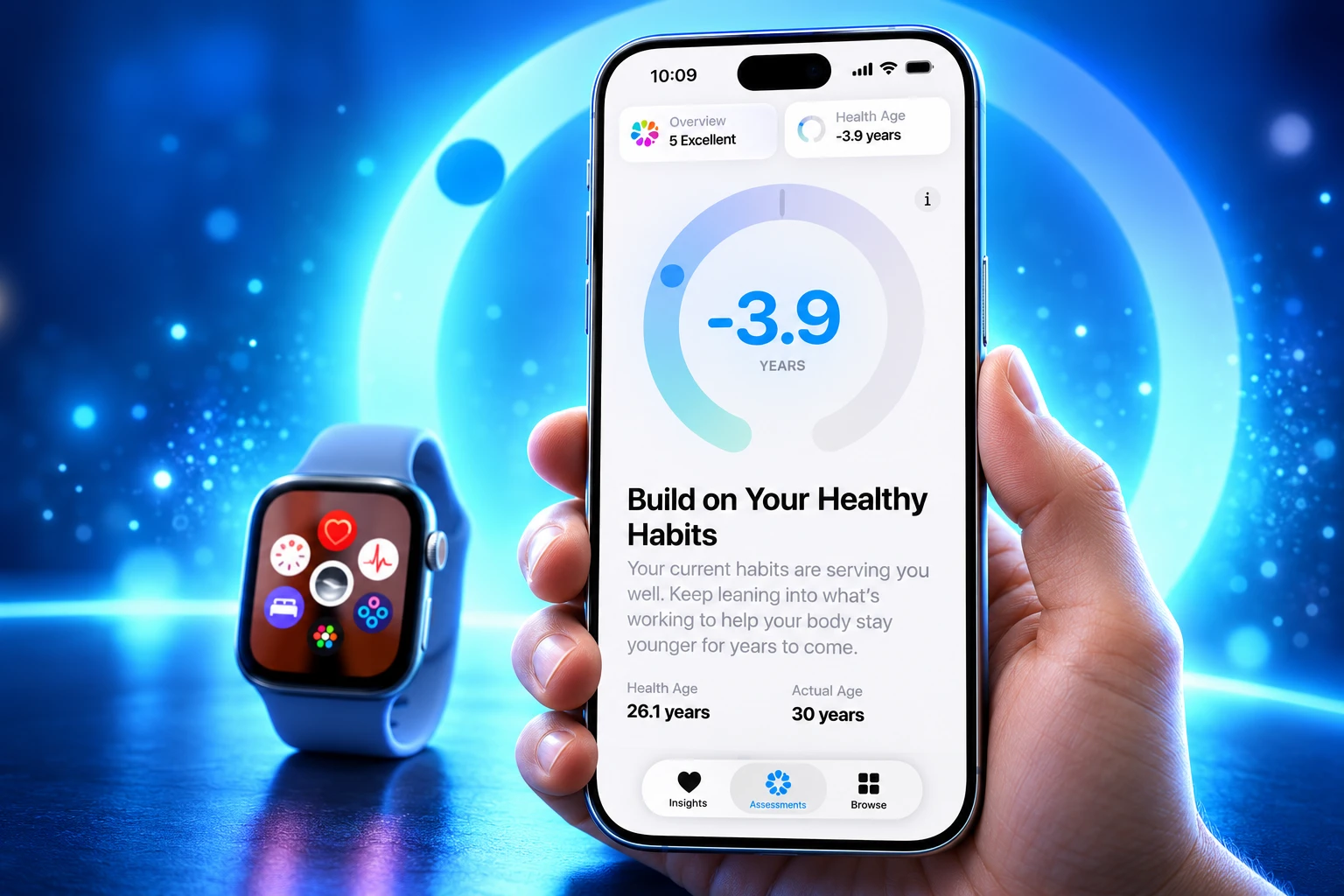
Heart Rate Every Five Seconds, HRV Every Five Minutes
Series 12 and Ultra 4 add a Health Sensing System with new optical and electrical heart sensors, larger green LEDs, photodiodes in a ring, and more electrode area for ECG skin contact. The S11 chip runs the sampling. Apple says the watches now take heart rate every five seconds all day, even while the wearer is moving, and that those readings also tighten Exercise and Move ring math.
Heart rate variability, the gap between beats that Apple treats as a stress and recovery signal, is now taken as often as every five minutes, which Apple calls 24x more often. The Watch splits that into Recovery HRV for day-to-day strain and overall HRV for longer cardiovascular context. Overnight Vitals now holds Recovery HRV against a personal baseline. A daytime Vitals view lets someone flip between night and day and, Apple says, catch a shift before it shows up in the next overnight pass.
THE NEW SAMPLING RATES
- Heart rate: Every five seconds, all day, on Series 12 and Ultra 4 only.
- HRV: As often as every five minutes, which Apple calls 24x more often, with Recovery HRV and overall HRV as separate views.
- Readiness: A 0 to 10 score that updates through the day, with Recover, Pace Yourself, Ready, or Go For It as the four readouts.
- The study: 1,460 people enrolled and 1,254 gave at least one paired measurement against a Polar H10 chest strap.
Apple published a head-to-head heart rate accuracy study from July and August 2026. People wore an Apple Watch on one wrist and a rival on the other, with wrist side randomized so the Watch sat on the dominant hand about half the time. The set was Garmin Forerunner 970, Google Pixel Watch 4, Huawei Watch 5, Samsung Galaxy Watch 8, WHOOP 5, and an Oura Ring 5 on an index finger. Apple says those brands cover about 90 percent of the worldwide smartwatch category plus two screenless wearables.
Five sites ran the work: two near Cupertino, plus San Diego, Austin, and Selangor, Malaysia. A contract research group ran 59 percent of the analyzed group. Among the 1,254, 20 percent had Fitzpatrick skin tone V or VI, 35 percent were female, mean age was 39 plus or minus 12 years, and mean BMI was 26 plus or minus 5. People with tattoos or large moles at the sensor site were left out, a known weak spot for optical heart rate that the study therefore does not measure.
Apple, which ran the study, says Series 12 and Ultra 4 beat every comparator on overall workout and overall daily-living error for both RMSE and MAE. Session-average heart rate followed the same pattern in 11 of 12 comparisons. The one exception was Huawei Watch 5 on overall workout averages, where Apple’s number looked better but was not statistically significant. Independent labs have not repeated the protocol yet.
Health Age Is the Number the Wrist Cannot Finish
The Health app has stored years of sleep, heart, and workout rows that most people never open. Apple Intelligence is the layer that is supposed to turn that pile into sentences. A new Insights tab keeps a summary that updates through the day across heart, sleep, readiness, fitness, vitals, and cycle data. A For You block is meant to push a personal next step, such as a better wind-down after several late nights, or intervals on a morning run if cardio is the goal.
Longevity is the longer view. It scores long-term data from iPhone, Apple Watch, AirPods, clinical records, and third-party apps against current clinical guidance, then fills a visual for each bucket so a user can see where they sit.
THE SEVEN LONGEVITY BUCKETS
- Heart health: Watch metrics plus any lab lipids the user adds.
- Sleep: Night data already sitting in Health, now pulled into the same scorecard.
- Mental wellbeing: Logged state and related Health records, not a new sensor.
- Movement health: Activity plus the new at-home physical tests.
- Metabolic health: Watch context plus blood markers such as A1c when labs are on file.
- Hearing: iPhone and AirPods exposure data, which a wrist never captured.
- Nutrition: Logged intake, not a Watch reading.
Health Age lives inside that tab. It compares Watch metrics such as VO2 max, resting heart rate, sleep, and HRV with chronological age. Apple also names A1c and LDL as lab inputs that can enrich the same number. That is the tell. A wrist can watch recovery. It cannot draw blood. The score is built to get sharper when a lab file lands, which is why the app is about to sell one.
After yearly labs, Apple says the app will play a video from its own clinical experts on that person’s LDL, what the figure means, and what to change. The same pattern holds if a movement test flags balance: a video, then an exercise plan matched to ability. The Health app is no longer a folder. It is a coach that needs inputs the Watch does not have.
Who Gets Readiness Without a Series 12?
Readiness is the daily product of the new sensors. It folds recent activity, training load, vitals, and sleep score into one 0 to 10 number and one of four lines: Recover, Pace Yourself, Ready, or Go For It. The figure updates after a hard workout or a swing in daytime vitals, and it shows which inputs pulled it down. Apple says the math came from the Apple Heart and Movement Study with its own exercise scientists and physicians.
That score, the five-second heart rate stream, and the five-minute HRV stream need Series 12 or Ultra 4. Older watches still get watchOS 27. They do not get that sensing stack. Health Age needs some Apple Watch, but Apple has not said Series 11 is enough. The VO2 max estimate in the new movement tests needs an Apple Watch, AirPods Pro 3, or a third-party heart rate device.
The Health redesign sits on the Apple Intelligence side of the line. Apple already drew that iOS 27 split across iPhone models in the beta cycle, and the Health redesign stays on the Intelligence side of it. A phone that can run iOS 27 but not Apple Intelligence keeps the older Health app.
WHAT EACH NEW HEALTH PIECE NEEDS
| Feature | Hardware and software it needs | When Apple says it arrives |
|---|---|---|
| Insights and Longevity tabs | Apple Intelligence iPhone or iPad, latest software; some pieces iPhone-only | Later in 2026, U.S. English first |
| Health Age | An Apple Watch; generation list unpublished | With the redesigned Health app |
| Readiness, 0 to 10 | Series 12 or Ultra 4 | With the new watches, also shown in Health Insights later |
| Heart rate every 5 seconds, HRV every 5 minutes | Series 12 or Ultra 4 | With the new watches |
| Movement tests (flexibility, strength, balance, mechanics, VO2 max) | iPhone camera on device; VO2 max also needs Watch, AirPods Pro 3, or a third-party heart sensor | With the redesigned Health app |
| Quest blood panel | U.S. users, not all states, $119 at about 2,000 Quest sites | With the redesigned Health app |
| Perimenopause and menopause Cycle Tracking | iOS 27; age 40 and over for the pattern alert | September 14, 2026 |
The upgrade pressure is not the whole Health app. It is the daily score that Whoop and Oura already trained people to check before they train. Apple put that score on new silicon.
A $119 Quest Panel Walks In Through the App
Users can already import lab PDFs and synced records. The new path is purchase. Later in 2026, U.S. Health app users will be able to buy and schedule a Quest panel with over 50 biomarkers for $119 at about 2,000 patient service centers. Quest says the panel is built for preventive insight, with markers for heart and metabolism and organ function, plus blood pressure, height, weight, and waist and hip size taken at the visit. Results show up in the Health app shortly after the draw. The offer is not available in every U.S. state, and Quest has not published the full marker list yet.
Apple is not the clinician on the order. Quest works with third-party providers that review and approve every test. At the user’s request, those providers will talk through results and next steps at no extra charge. The $119 price is a consumer checkout inside Health. Quest has not said a health plan will cover it, which is the first question people asked when an Apple Health engineering manager posted the ordering screens on September 9.
By embedding the Quest lab testing experience within the Apple Health app, we are making testing simpler, smarter and more available to people who want to connect biomarker and biometric insights to own their health.
Richard Adams, Senior Vice President and General Manager, Consumer, Quest Diagnostics, company announcement
Quest pointed to federal figures that chronic conditions such as heart disease and diabetes affect as many as three in four American adults. The company says it already serves half the physicians and hospitals in the United States and one in three adult Americans each year, with nearly 60,000 employees. The Health app is a new storefront on that network, not a new lab.
Kristina Fox, an engineering manager on Apple’s Health team, posted close-ups of the in-app lab flow the afternoon of the event. The screens are a shop, a scheduler, and a results pane. That is a different job from storing a PDF a doctor already ordered.
The Same Quest Visit Already Costs $99 at Oura
Apple is late to putting a Quest draw inside a wearable app. Oura already lets members book 50 health biomarkers inside the Oura app at more than 2,000 Quest sites, at a $99 list price, and fold those results into ring data. WHOOP sat in Apple’s own heart-rate study as a comparator and already sells its own lab add-on. Health Age occupies the same slot those bands use for a body-age style score, which is why some Watch owners now talk about dropping a second strap if the new Health tabs actually coach them.
TWO QUEST PANELS, TWO APPS
| Apple Health panel | Oura Health Panels | |
|---|---|---|
| List price | $119 | $99 |
| Markers | Over 50 (full list unpublished) | 50 |
| Lab | Quest, about 2,000 U.S. sites | Quest, more than 2,000 U.S. sites |
| Where you buy | Health app on iPhone and iPad | Oura app, members only |
| What it feeds | Health Age, Longevity, expert videos | Oura’s own insights against ring data |
| When | Later in 2026 | Already selling |
Apple’s edge is not the needle. It is the installed base of iPhones that already hold medical records, and a Watch that, on the new models, writes heart rate every five seconds into the same file. Oura’s edge is that the draw already exists, costs $20 less at list, and does not wait on a late-2026 software drop. Anyone buying Series 12 for readiness still needs the later Health app before the $119 panel and Health Age show up in one place.
The iPhone Camera Runs the Movement Tests at Home
The other input Apple cannot take from a wrist is how the body moves. The redesigned Health app adds at-home tests for flexibility, strength, balance, movement mechanics, and VO2 max. The iPhone camera watches the person follow a trainer on screen, with live audio and visual cues, while Watch heart data can join the VO2 max run. Apple says the models run on the phone, no video is recorded, stored, or shared, and a user gets an exercise plan when the test ends. It frames the suite as a way to see how well the body is moving or to track recovery after an injury, work that usually needs a physical therapist visit.
Cycle Tracking is the piece that does not wait. With iOS 27 on September 14, the Health app adds perimenopause and menopause logging, symptom tracking, and alerts for cycle changes that include perimenopause. Users 40 and over can get a notice if logged patterns look like perimenopause, so they can raise it with a doctor. Logging bleeding after menopause triggers a prompt to speak with a doctor. Those tools sit on the September software train, not the later Insights redesign.
By combining breakthrough sensing on Apple Watch with Apple Intelligence in the Health app, we’re able to translate complex biometric data into clear guidance for users.
Sumbul Desai, M.D., vice president of Health and Fitness, Apple newsroom
Apple also folds Workout Buddy so it runs on the Watch without the iPhone nearby, lets AirPods Pro 3 pass heart rate through iPhone GymKit to compatible treadmills and bikes, and says new machine-learning models fix treadmill distance from the first step. Those are September software notes. They are not Health Age.
The funnel is now in the open. New watches write denser heart data. A later Health app turns that data into Insights, a 0 to 10 readiness readout, and a Health Age figure that gets sharper with A1c and LDL. A $119 Quest visit, signed by a third-party clinician, is how Apple fills the gap the wrist cannot. Apple has not named a day for that app, only that it arrives later in 2026, in U.S. English first.
Disclaimer: This article is news reporting on Apple’s September 9, 2026 health announcements and related company materials. It is for information only and is not medical advice, a diagnosis, or a recommendation to buy a Watch, order a lab panel, or change treatment. Readiness, Health Age, Insights, and Quest results are consumer wellness tools, not a substitute for care from a licensed physician, and a clinician should review any lab order or score before a reader acts on it. Feature lists, prices, study figures, and launch windows reflect Apple’s and Quest’s public statements as of the dates named above and can change before the Health redesign ships.

Instagram Plus Tests a Read-Only Mode That Cuts Stories

Altman Asks the Public to Accept Some AI Harm

Google Freezes OSS VRP Product Reports After AI Flood

AI Agents Make Payment Rails the Scarce Prize

Turkey’s Crypto Boom Now Runs Through Three Banks

Fable 5 Came Back Under a Commerce On-Off Switch

Google’s SpaceX GPU Lease Has a Sept. 30 Deadline

Plasma One’s XPL Locks Face a 1.81 Billion Cliff

DGO’s Rs 549 World Cup Pass Cost Fans Sleep and Data

Moonshot AI’s $30 Billion Ask Became a $35 Billion Close
-
 AI4 months ago
Fable 5 Came Back Under a Commerce On-Off Switch
-
 AI5 months ago
Google’s SpaceX GPU Lease Has a Sept. 30 Deadline
-
 CRYPTO4 months ago
Plasma One’s XPL Locks Face a 1.81 Billion Cliff
-
 APPS4 months ago
DGO’s Rs 549 World Cup Pass Cost Fans Sleep and Data
-
 AI5 months ago
Moonshot AI’s $30 Billion Ask Became a $35 Billion Close
-
 NEWS5 months ago
ColorOS 17 Device List Spans Oppo, OnePlus and Realme
-

 GAMING4 months ago
Xbox Cuts 3,200 Jobs After Five Years of Thin Returns
-
 GAMING4 months ago
The RTX 4050 Under Rs 70,000 Hides a Wattage Gap