
NEWS
The UN Marks 9/11 by Admitting Terrorists Outran It
Twenty-five years after 9/11, the Security Council warned terrorist groups now run on AI and drones, as its global strategy review broke consensus in July.

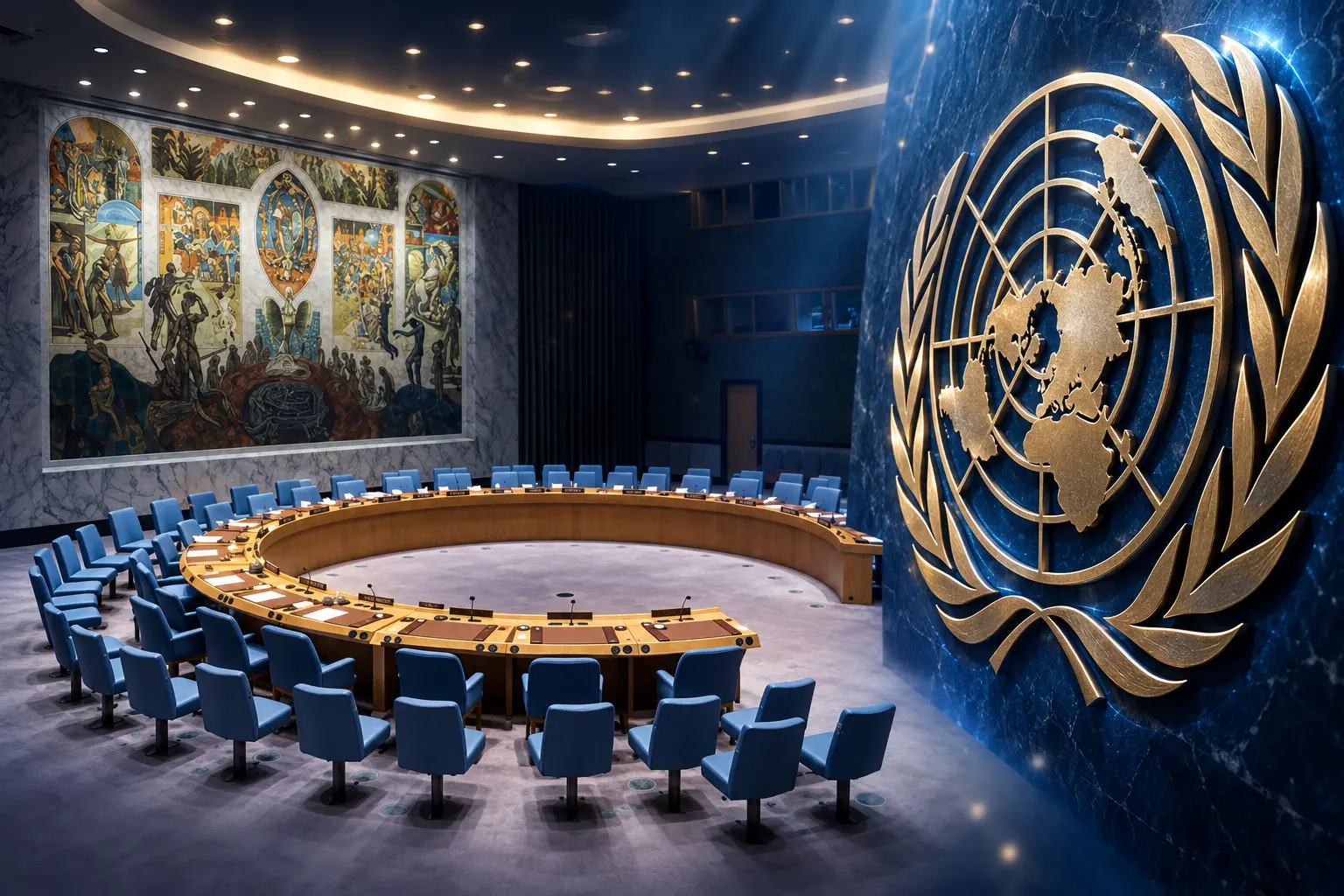
The UN Security Council marked 25 years since the September 11 attacks on Friday with a warning that terrorist groups now run on AI, drones and encrypted platforms. Eihab Omaish, officer-in-charge of the UN Office of Counter-Terrorism, told the 15-member body the threat had become “more diffuse, more decentralized and increasingly enabled by new technologies,” even after the loss of terrorist leaders and territory.
The session, the Council’s 10221st meeting, opened with a minute of silence for the victims. Members then adopted a presidential statement on the changing threat, which the UN News Centre called the first thematic presidential statement on terrorism in five years. The attack sites lie a few miles south of UN Headquarters. Secretary-General António Guterres, who issued a tribute on 10 September before travelling to India, called the 2001 strikes “an assault on humanity itself” and said the fight remains “a shared, unfinished task.”
Briefers Told the Council the Threat Is More Scattered
French Ambassador Jérôme Bonnafont, whose country holds the Council presidency in September, said Da’esh, Al-Qaida and their affiliates still mount cross-border attacks while they exploit new tools. Terrorists are “hijacking new technologies,” he said, using sharper propaganda, drawing younger recruits and tapping new ways to move money. He also said they use “our own innovations against us,” and he asked the Council to take back the lead it seized after 2001 and to build a system that can match that shift.
Natalia Gherman, Assistant Secretary-General and head of the Counter-Terrorism Committee Executive Directorate, described groups that split their structures, spread operations, mix their funding and feed on weak states. She said CTED now sees a larger role for loose cells, thin networks and lone actors whose path to violence is harder to spot. Maritime routes and critical infrastructure, she added, are used with criminal networks to move people, weapons and illicit goods.
Despite the loss of terrorist leaders and territory and stronger international cooperation, the threat had become more diffuse, more decentralized and increasingly enabled by new technologies.
Eihab Omaish, officer-in-charge, UN Office of Counter-Terrorism, Security Council, 11 September 2026
Christina Markus Lassen of Denmark said the groups had adapted faster than many institutions, pointing to online recruitment, cryptocurrency, drones and AI. “If they can adapt this quickly, so must we,” she said, and she pressed for sanctions lists that match current leaders rather than old names. Sun Lei, charge d’affaires of China’s mission, said the threat now shows “decentralization, fragmentation and the misuse of emerging technologies,” and he warned against tying terrorism to any one country, ethnic group or religion.
Chris Elmore, the UK minister for the Americas, multilateral affairs and human rights, reminded the chamber that resolution 1373 still sits at the centre of the post-2001 system, and that intelligence sharing, tighter finance rules and aviation security have stopped attacks. In the United Kingdom, he said, agencies have disrupted dozens of plots. Through Prevent, thousands of people have been pulled off a path toward violence. In Iraq the UK has trained more than 120,000 Iraqi forces and provided more than $670 million in humanitarian and stabilisation aid. He still warned that Da’esh and Al-Qaida exploit conflict and new technology, and that measures which crush rights can feed the grievances those groups use.
The meeting was carried on video.
THE 25-YEAR COUNTER-TERROR CLOCK
- 11 September 2001: Attacks in New York, Arlington and Pennsylvania kill nearly 3,000 people from more than 90 countries.
- 28 September 2001: The Council adopts resolution 1373, 17 days later, and creates the Counter-Terrorism Committee.
- 2006: The General Assembly adopts the Global Counter-Terrorism Strategy by consensus as A/RES/60/288.
- 1 July 2026: The ninth review of that Strategy, resolution 80/286, passes 140 to 3 with 1 abstention, the first review put to a recorded vote.
- 10 September 2026: CTED publishes a trends report warning of an “acceleration gap” in terrorist propaganda.
- 11 September 2026: The Council holds meeting 10221 and adopts a thematic presidential statement on the evolving threat.
Gherman told members the Council has passed more than 20 further counter-terrorism resolutions since 1373, and that those 2001 duties remain “as relevant today as they were 25 years ago.” Relevance is not the same as speed, and that gap was the real subject of Friday’s briefing.
What CTED’s Acceleration Gap Means for AI
A day before the ambassadors sat down, CTED released a trends report on terrorist propaganda titled “Beyond Messaging: Terrorist Propaganda as Operational Infrastructure.” The paper treats propaganda as part of recruitment, radicalization, fundraising, attack planning and even local rule, not as a side communications shop. That is the record the briefers walked into.
The report finds that content work is more spread out, more adaptive and more technical. Groups move across a mix of platforms and digital services, then change course when governments or companies take content down. It flags growing use of AI to sharpen recruitment, tailor messages, reach more languages and raise money. It also tracks recruitment inside games and game-adjacent apps, a rise in graphic violence and nihilistic subcultures as a path into terrorism, and more mixing of extremist ideologies online. Children and young people are a clear target, including through peer-to-peer pitches built to look like youth content.
In Africa and in Central and South Asia, the paper says, propaganda is used to back local control, mine grievances, raise cash and shape who looks like an authority. It also tracks gendered pitches, including misogynistic corners of the internet and techniques aimed at women. The warning that matters for Friday’s debate is the phrase CTED put in plain type: an “acceleration gap” between how fast terrorist actors change and how fast states, laws and platforms can answer. The report was prepared under resolutions 2617 (2021) and 2810 (2025).
Gherman carried that finding into the chamber. She said groups now use new tools not only for propaganda and recruitment but for attack planning, intelligence and finance. Unmanned aircraft have become cheaper, easier to get and more effective. “Terrorist and violent extremist actors are exploiting social media platforms, gaming environments, and other virtual spaces to identify vulnerabilities and recruit individuals, especially young people,” she said. “Advances in artificial intelligence and automated content generation are further increasing in speed, scale, and precision.” Cash couriers and hawala-style systems still move money, she added, while actors also tap online payments, crowdfunding, mobile money and virtual assets, plus extortion, kidnapping, trafficking and the sale of natural resources.
Drones, Crypto and the Tools Groups Already Use
The presidential statement and the briefers named the same kit. It is not speculative. The Council wrote down internet misuse and drone attacks on public places; CTED and Denmark added AI and crypto on the record the same afternoon.
HOW THE CHAMBER MAPPED THE NEW KIT
| Tool | How groups use it now | Who put it on the record |
|---|---|---|
| Artificial intelligence | Faster recruitment, tailored pitches, more languages, fundraising | CTED 10 September report; Denmark; GIFCT |
| Unmanned aircraft | Strikes and incursions on infrastructure and public places; moving drugs and arms | Presidential statement; Gherman |
| Internet, apps and encrypted channels | Propaganda, recruitment, planning | Presidential statement; Omaish |
| Virtual assets and online payments | Finance beside cash and hawala, plus crowdfunding and mobile money | Gherman; Denmark |
Bonnafont asked the Council to build “more effective systems” against that mix. Lassen said sanctions have to catch up with living leadership, not the charts of a decade ago. Elmore pointed to resolution 2462 on terrorist financing and to closer work among governments, the UN, civic groups, and the tech and finance sectors. He also said AI can help defenders spot terrorist content, map money networks and protect people at risk, which is the other half of the same tools debate.
Naureen Chowdhury Fink, executive director of the Global Internet Forum to Counter Terrorism, went further than the diplomats on the role of the kit itself.
Emerging technologies are no longer a key tool for terrorists; they are the key tool.
Naureen Chowdhury Fink, Executive Director, Global Internet Forum to Counter Terrorism, UN Security Council, 11 September 2026
She said advances in AI could deepen that shift, and that the same systems can give defenders resources they did not have before. She called for a whole-of-society approach and said human rights and security reinforce each other. That is a different claim from the 2001 model, which ran on borders, lists and police powers. Friday’s argument is that the fight now runs through models, drones and payment apps, and that a private tech forum is briefing the Council on how.
The Assembly’s July Vote Broke a 20-Year Habit
The anniversary also lands in the 20th year of the Global Counter-Terrorism Strategy. Guterres used his 10 September tribute to say so. Member States adopted that Strategy in 2006 without a vote. They have reviewed it on a set cycle ever since, and until this year they did so by consensus. On 1 July 2026 the General Assembly adopted the ninth review of the Strategy as resolution 80/286. The recorded vote was 140 in favour, 3 against (Argentina, Israel and the United States) and 1 abstention (Japan, whose delegate later said a technical error had blocked a yes vote).
The text is a rollover of the 2023 eighth review. Co-facilitators from Finland and Morocco put forward a copy of the last review, minus two COVID-19 paragraphs, after talks could not agree on updates. The United States called the resolution “bloated, outdated and lacks focus” and asked for a vote. Israel said the world had changed since 2023. The Strategy itself still has four pillars: conditions that help terrorism spread; measures to prevent and combat it; state capacity and the UN’s role; and human rights and the rule of law as the basis of the fight.
WHERE EXPERTS DISAGREE
- The United States: The review is not fit for purpose, ignores Washington’s red lines and leans on what that delegation called distracting narratives, including gender language.
- Israel: The text is long, repetitive and behind the threat that has evolved since the 2023 review.
- The 140-vote majority: Keep the 2023 human rights, gender and civic-space language intact even if the price is a frozen text and a broken consensus custom.
That split is the political weather Friday’s statement had to fly through. The Council can still agree a thematic text on drones and the internet. The wider membership can no longer agree, without a vote, on the document that is supposed to guide the whole UN system. Omaish told the Council that 25 years of work show prevention must sit beside security, that partnerships still matter, and that counter-terrorism must uphold international law. “Despite progress, they are not grounds for complacency,” he said.
A group of more than 30 UN independent human rights experts, in a statement issued on 10 September, paid tribute to victims and then said too many states had answered 2001 with “unnecessary and disproportionate responses that have seriously undermined rights, civil society, civic space, democracy and the rule of law.” “‘Wars on terror’ have stretched foundational rules of international law beyond their breaking point,” they wrote. Elmore made a narrower version of the same point from the UK seat: measures that undermine rights or civic space can fuel the grievances terrorists exploit.
Why the UN Still Has No Shared Definition of Terrorism
Victoria Lieta Liolocha of the Democratic Republic of the Congo brought the chamber back to the attacks that never made the 2001 memorials. She cited continued strikes by the Allied Democratic Forces, including killings, kidnappings, violence against women and children, and forced displacement. Collective action, she said, still requires agreement on what the international community is fighting, and there is still no universally accepted definition of terrorism. She asked for a consensus that can confront the threat without ambiguity and still respect international law.
That gap is not new. The General Assembly set up an Ad Hoc Committee on international terrorism in resolution 51/210 of 17 December 1996. Talks on a draft comprehensive convention on terrorism have been rolled from session to session ever since, including under resolution 79/129 of 4 December 2024, which asked the Sixth Committee at the 80th session to keep a working group on the draft. The deadlock is not over a missing list of bombs. It is over whether the definition covers national armed forces and self-determination movements, and over what counts as “state terrorism.”
Ben Saul, the Special Rapporteur on human rights while countering terrorism, issued an updated model definition of terrorism on 8 January 2026 as A/HRC/61/52, revising a 2010 model meant to keep national laws inside human rights lines. A model from a rapporteur is not a treaty. Liolocha’s point on Friday was that the Council can warn about AI and still lack a shared legal object for the warning. Pakistan’s ambassador, Asim Iftikhar Ahmad, used the same meeting to argue that his country had “broke the back” of Al-Qaida and that seven Pakistanis were among the 2001 dead. The two speeches, one on definition and one on credit for 2001, show how the old fight and the new tools still talk past each other.
A Tech Forum Now Shapes How the Council Fights Online
Fink’s presence was the clearest sign that the 2001 machine has a new centre of gravity. GIFCT is an industry forum that works with platforms on terrorist content. On 11 June 2025, Gherman and Fink signed a memorandum of understanding that ties CTED and GIFCT on the misuse of information and communications technologies, including recruitment, incitement, financing, planning and preparation. GIFCT also joined CTED’s Global Research Network. The Council is still the body that lists names and writes resolutions. The operational fight over content, models and takedowns now runs through a forum the ambassadors do not chair.
That is why Fink could tell the Council that emerging technologies are “the key tool,” and why CTED’s own paper says propaganda is now operational infrastructure. The post-2001 answer was to freeze funds, stop travel and share police data. The 2026 answer, on the Council’s own evidence, is to watch models, drones, games and payment apps, and to do it with companies in the room. Elmore’s list of partners already puts “the technology and financial sectors” next to the United Nations. Lassen’s demand to move “from commitments to implementation” is aimed at that lag, not at another commemorative text.
The public conversation around the anniversary did not follow the briefers. Recycled 9/11 conspiracy claims still travel farther than a warning about AI-enabled recruitment. The Council’s own update sat in a quiet official post while the substance of Friday’s briefing stayed inside the chamber.
Security Council LIVE: 25 years on from 9/11, ambassadors mark the anniversary with a counter-terrorism briefing – spotlighting militants' increasing use of AI and drones – & adopts its first thematic presidential statement on terrorism in 5 years.https://t.co/xWldimeAwF
— UN News (@UN_News_Centre) September 11, 2026
Members Put Internet Misuse and Drone Attacks in Writing
The presidential statement is the one product Friday produced that will sit in the document record. In it the Council said it was deeply concerned by the intensification, growing complexity and evolving nature of terrorist attacks, by a rising death toll, by a wider geographic spread and by the threat of foreign terrorist fighters. It voiced deep concern at the growing use of new technologies for terrorist purposes, while recognising that the same innovations can help the defence side.
WHAT THE STATEMENT PUT ON PAPER
- Internet and ICT: Particular concern at increased use by terrorists and their supporters of the internet and other information and communications technologies.
- Drones: Growing misuse of unmanned aerial systems to attack and enter critical infrastructure and soft targets or public places, and to traffic drugs and arms.
- Duty to cooperate: Member states should act together to prevent and counter the use of new information and communications technologies, and other technologies, for terrorist purposes.
- Scope: Terrorism should not be associated with any religion, nationality, culture or group, and the fight cannot be won by military force, security operations or intelligence alone.
Bonnafont asked the Council to reclaim the role it took after 2001. The record in the room was more awkward than that ask. Leaders are dead and territory has been retaken, and Omaish still had to describe a threat that is more scattered. CTED, a day earlier, had already named an acceleration gap. In July the Assembly could not renew its core strategy without a vote. Liolocha still had to note that the UN has no agreed definition of the thing it has spent 25 years fighting. The presidential statement names the internet and the drone. It does not close those gaps.
Gherman said 1373 is as relevant as it was 25 years ago. Relevance without pace is what Friday documented. Lassen’s line still hangs over the text the Council adopted: if the groups can adapt this quickly, so must the body that wrote the 2001 rules.
Frequently Asked Questions
What Is a UN Security Council Presidential Statement?
It is a consensus product issued in the name of the Council president, weaker in form than a resolution but still an agreed Council text. Friday’s statement is the first thematic presidential statement on terrorism in five years, distinct from the Africa-focused statement S/PRST/2025/2 adopted on 24 January 2025.
When Did the UN Create the Counter-Terrorism Committee?
On 28 September 2001, through resolution 1373, 17 days after the attacks. The resolution ordered states to criminalize terrorist financing, freeze related funds, deny safe haven and share information. CTED, the committee’s executive directorate, has about 40 staff and a mandate extended to 5 January 2029 by resolution 2810 (2025).
What Are the Four Pillars of the UN Global Counter-Terrorism Strategy?
Measures to address conditions that help terrorism spread; measures to prevent and combat terrorism; measures to build state capacity and strengthen the UN’s role; and measures to ensure respect for human rights and the rule of law as the basis of the fight. The Strategy was adopted in 2006 as A/RES/60/288 by consensus.
Why Has the UN Never Agreed a Legal Definition of Terrorism?
Negotiations on a comprehensive convention have continued since 1996 and stall on whether the definition covers national armed forces and self-determination movements. The Sixth Committee was again asked, including by resolution 79/129 of 4 December 2024, to keep a working group on the draft rather than close the file.
What Is the Global Internet Forum to Counter Terrorism?
It is an industry forum that works with digital platforms on terrorist content. On 11 June 2025 it signed a memorandum of understanding with CTED covering misuse of information and communications technologies for recruitment, incitement, financing, planning and preparation, and it joined CTED’s Global Research Network.

Instagram Plus Tests a Read-Only Mode That Cuts Stories

Altman Asks the Public to Accept Some AI Harm

Google Freezes OSS VRP Product Reports After AI Flood

AI Agents Make Payment Rails the Scarce Prize

Turkey’s Crypto Boom Now Runs Through Three Banks

Fable 5 Came Back Under a Commerce On-Off Switch

Google’s SpaceX GPU Lease Has a Sept. 30 Deadline

Plasma One’s XPL Locks Face a 1.81 Billion Cliff

DGO’s Rs 549 World Cup Pass Cost Fans Sleep and Data

Moonshot AI’s $30 Billion Ask Became a $35 Billion Close
-
 AI4 months ago
Fable 5 Came Back Under a Commerce On-Off Switch
-
 AI4 months ago
Google’s SpaceX GPU Lease Has a Sept. 30 Deadline
-
 CRYPTO4 months ago
Plasma One’s XPL Locks Face a 1.81 Billion Cliff
-
 APPS4 months ago
DGO’s Rs 549 World Cup Pass Cost Fans Sleep and Data
-
 AI4 months ago
Moonshot AI’s $30 Billion Ask Became a $35 Billion Close
-

 NEWS5 months ago
ColorOS 17 Device List Spans Oppo, OnePlus and Realme
-

 GAMING4 months ago
Xbox Cuts 3,200 Jobs After Five Years of Thin Returns
-

 GAMING4 months ago
The RTX 4050 Under Rs 70,000 Hides a Wattage Gap