
AI
AMD’s EPYC Playbook Now Runs Against NVIDIA’s AI Lead
NVIDIA’s $89.0 billion data center quarter still dwarfs AMD, but EPYC’s server-CPU gains show why Helios is the second-source sequel, not a sideshow.

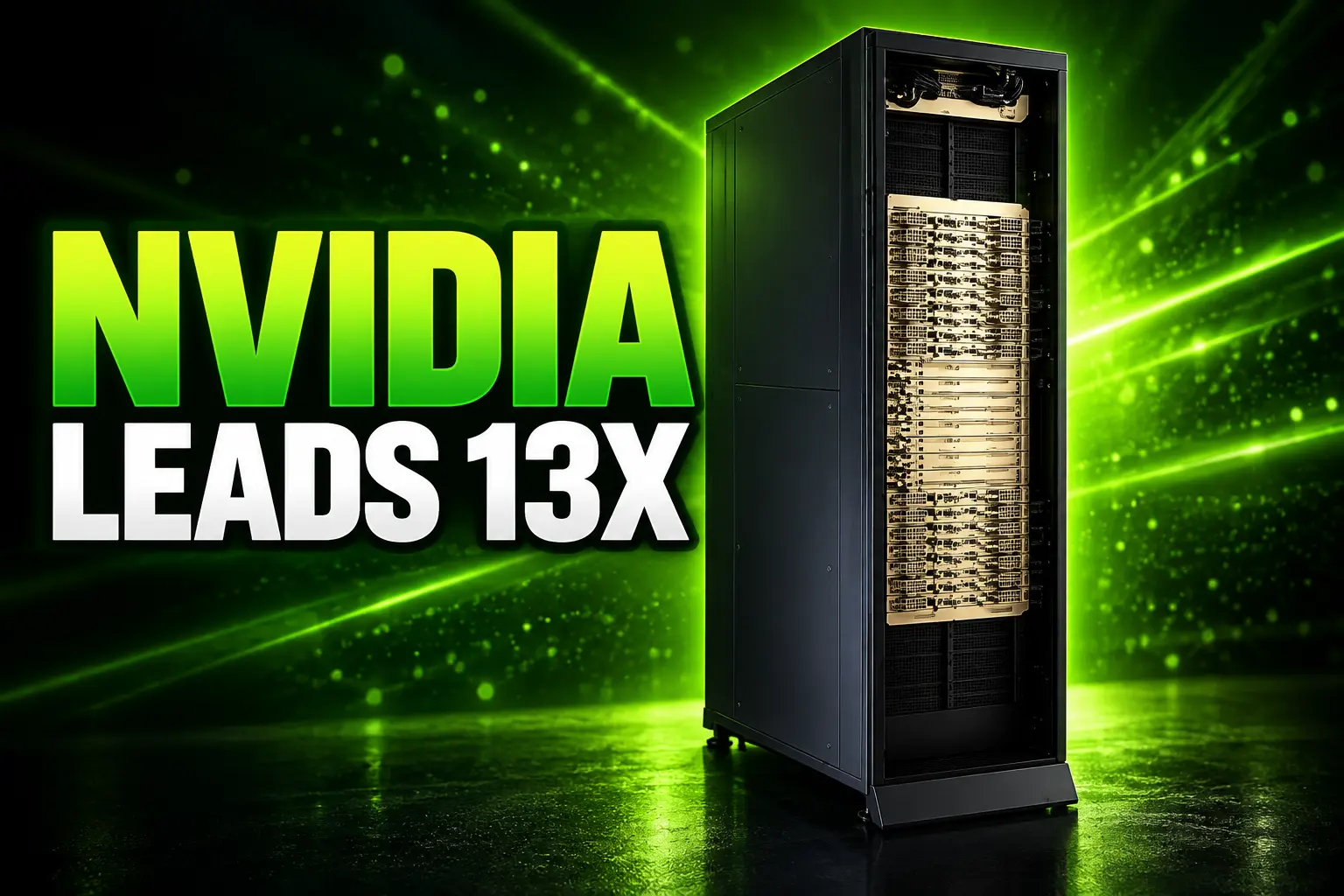
NVIDIA’s data center group booked $89.0 billion in its fiscal second quarter, about 13 times AMD’s entire data center take. That print, for the period ended July 26, 2026, is the number every comparison uses to close the book on NVIDIA versus AMD as an AI stock. It should not.
AMD already ran this play against Intel in server CPUs, and it now holds 46.4% of EPYC-versus-Xeon units. Helios is the same second-source pitch, this time aimed at NVIDIA’s rack.
Two Earnings Prints and a 13-Times Gap
The two reports landed in August on slightly different calendars. AMD’s second quarter ended June 27, 2026. NVIDIA’s ended a month later. Both companies said demand for AI infrastructure is still rising. The scale is not close.
NVIDIA’s second-quarter fiscal 2027 results showed $96.2 billion in revenue, up 106% from a year earlier and 18% from the prior quarter. Data center sales of $89.0 billion were 117% higher than a year ago and just over 92% of the company. Edge computing added $7.2 billion. GAAP and non-GAAP gross margin both landed at 75.0%, up from 72.4% and 72.5% a year earlier. GAAP operating income was $63.7 billion. GAAP net income was $59.7 billion, or $2.46 a diluted share. Non-GAAP earnings were $2.22.
AMD’s quarter was a record of a different size. Revenue was $11.5 billion, up 50% year over year and 13% sequentially. The company posted data center revenue of $6.7 billion, up 107%, and that segment was 58% of sales, against about 42% a year earlier. Non-GAAP gross margin was 56%. Non-GAAP earnings were $1.66 a share, against $1.38 on a GAAP basis. Data center operating income was $2.1 billion, a 31% margin.
THE AUGUST PRINTS, SIDE BY SIDE
| Metric | NVIDIA Q2 FY2027 | AMD Q2 2026 |
|---|---|---|
| Revenue | $96.2B (+106% YoY) | $11.5B (+50% YoY) |
| Data center | $89.0B (+117%) | $6.7B (+107%) |
| Gross margin | 75.0% GAAP and non-GAAP | 54% GAAP, 56% non-GAAP |
| Diluted EPS | $2.46 GAAP, $2.22 non-GAAP | $1.38 GAAP, $1.66 non-GAAP |
| Next-quarter guide | $108.0B ±2% | $13B ±$300M |
| Next-quarter margin | 74.0% ±50 bps | ~56% non-GAAP |
NVIDIA told investors to plan for about $108.0 billion of revenue in the current quarter, plus or minus 2%, with gross margin near 74.0%. That midpoint is about 12% above the quarter it just finished, and the outlook assumes no data center compute sales to China. AMD pointed to about $13 billion, plus or minus $300 million, roughly 41% higher than a year ago and 13% higher sequentially, with non-GAAP gross margin still near 56%. At those midpoints NVIDIA’s next quarter is still about eight times AMD’s.
CFO Jean Hu said AMD expects data center sales to speed up in the second half of 2026. Chair and CEO Lisa Su said the company is heading into that stretch with EPYC demand rising, Instinct deployments scaling, and Helios beginning to ramp. NVIDIA returned about $26.0 billion to shareholders in the quarter and still had about $99.0 billion left on its buyback authorization. Free cash flow was $21.3 billion.
EPYC Already Did This to Intel
The reason the gap does not settle the stock debate is sitting in Mercury Research’s server CPU table, not in the GPU column. AMD spent the better part of a decade turning EPYC from a challenger socket into a default second source. Hyperscalers bought it so they would not live on one vendor. Enterprises followed once the software stack caught up.
Dean McCarron, principal analyst at Mercury Research, said AMD’s total unit shipments and total market share hit new records in the second quarter of 2026. In servers, the firm’s broad x86 count puts AMD at 34.5% of units, up from 33.2% in the first quarter and 27.3% a year earlier. Intel still ships 65.5%. Narrow the tape to EPYC versus Xeon, and AMD’s unit share reaches 46.4%, up 2.9 points sequentially and 9.2 points year over year. That is the core data center CPU market, and it is now a near split.
THE SERVER CPU SHARE PATH
- 2017: First EPYC chips ship into a market Intel had long owned.
- Q2 2025: AMD holds 27.3% of x86 server CPU units on Mercury’s broad count.
- Q1 2026: Broad server unit share reaches 33.2%.
- Q2 2026: Broad share is 34.5%; EPYC versus Xeon unit share is 46.4%.
That path is why EPYC servers that OEMs now ship show up in enterprise catalogs as a standard option rather than a science project. AMD said Q2 was its fifth straight quarter of record server CPU revenue, with cloud and enterprise sales each growing more than 70% year over year. Management now expects server CPU revenue to grow more than 80% year over year in the second half of 2026 and more than 70% in 2027, off a higher base.
IDC’s 2026 estimates still put NVIDIA around 81% of AI data center chip revenue and AMD around 10%, with custom hyperscaler silicon filling most of the rest. The GPU scoreboard looks like Intel’s server business in the late 2010s. The CPU scoreboard shows what happened after customers decided they needed a second name on the purchase order.
Helios Puts 72 Instinct GPUs in One Rack
AMD is not selling a single-card answer to NVIDIA’s CUDA stack. It is selling a rack. The 72 Instinct MI455X GPUs in one rack sit with EPYC Venice CPUs, Pensando networking, and the ROCm software stack, liquid-cooled as one system. AMD lists 31 TB of HBM4, 1.4 exaFLOPS of FP8, and 2.9 exaFLOPS of FP4 in that design. Each MI455X carries 432 GB of HBM4.
Su told analysts Helios delivers up to 15% more throughput at the same rack power and up to 30% more tokens per dollar than the competition, on AMD’s own inference tests. Those are vendor figures, not a third-party bake-off. The more useful tell is who is on the purchase list. AMD named Anthropic, Cirrascale, HUMAIN, Meta, Microsoft, OpenAI, Oracle, Tensorwave, and Vultr as Helios buyers.
On the August 4 call, Su said Helios was in production, with initial shipments due later in the third quarter and a larger ramp in the fourth quarter, then through 2027. She also said customer pull was tracking ahead of AMD’s first forecast. The company’s data center segment, still a blend of EPYC CPUs and Instinct GPUs, is guided to more than double in 2027. Su later said that “more than double” should land well above 100%, with the extra coming from AI accelerators on Helios.
AMD still does not break Instinct out of the $6.7 billion. Anyone treating Q2 as proof that GPU share has already moved is reading a blended number. The CPU chapter is in the P&L. The GPU chapter is in the contracts.
NVIDIA Is Shipping Rubin Into a $108 Billion Quarter
NVIDIA’s answer is already on the dock. The company said it started production shipments of Vera Rubin in early August, with the Vera CPU, LPX, and STX as new growth drivers. Founder and CEO Jensen Huang tied the platform to a buildout he described as fully underway.
AI has reached its inflection point. It’s doing useful work. Its tokens are productive and profitable. Now, compute is revenue. And demand is accelerating. This time last year, one lab alone was driving the buildout; today, we have a golden age of new AI labs and startups, multiple frontier labs scaling in parallel, a thriving open-model ecosystem and physical AI coming online, with strong momentum across the U.S. and around the world. The AI infrastructure buildout is at full steam. Vera Rubin, now in full production, was built to power exactly this moment.
Jensen Huang, founder and CEO, NVIDIA Q2 FY2027 release
CFO Colette Kress said on the earnings call that Vera Rubin should account for about 20% of data center revenue in the third quarter, with purchase orders already in from every major hyperscaler, AI cloud, and system OEM. She called it the fastest product ramp in NVIDIA’s history. NVIDIA’s own slide deck put the hyperscale and ACIE revenue split at $48.7 billion and $40.3 billion. Hyperscale more than doubled from a year earlier. The AI clouds, industrial, and enterprise bucket is now large enough that NVIDIA’s growth is no longer a story about four cloud giants alone.
Kress also did something the company had not done before, and guided a year ahead. She put fiscal 2028 revenue growth at about 70% and said demand could support a doubling if supply were not the limit. NVIDIA lined up Apollo, BlackRock, Blackstone, Brookfield, Goldman Sachs, and KKR to mobilize more than $500 billion of third-party capital for AI factories over time, subject to definitive agreements. The firm is trying to turn the GPU from a component into an asset class that banks will finance.
Vera is also a CPU. That is the quiet counter-move. AMD spent years taking server sockets from Intel. NVIDIA is now putting its own CPU in the AI rack, which is a direct run at the franchise EPYC just won. The historical pattern runs both ways.
OpenAI, Meta and Anthropic Buy From Both
The customers funding NVIDIA’s $89.0 billion quarter are the same names on AMD’s Helios slide. That is the second-source habit in plain sight. They keep writing the large NVIDIA checks because the software and the networking still cluster there. They also book AMD so they are not trapped if supply, price, or a regulator gets in the way.
AMD’s data center mix has been shifting toward that dual-track for several quarters, and the August call put numbers on the AI side of it. OpenAI and Meta already sit in multi-gigawatt Instinct deployments across product generations. Anthropic agreed to deploy up to 2 gigawatts of MI450-series GPUs in Helios racks, with the first gigawatt due in the first half of 2027, plus a joint engineering effort that uses Claude to tune ROCm. Microsoft said it will put Helios on Azure for frontier inference.
THE GIGAWATT SECOND SOURCE
- OpenAI: Multi-gigawatt Instinct and Helios deployments, with AMD listing the lab among the first Helios buyers.
- Meta: Multi-generation, multi-gigawatt Instinct plan, including a custom MI450-class GPU inside Helios with Venice CPUs.
- Anthropic: Up to 2 gigawatts of MI450-series GPUs in Helios, first gigawatt in the first half of 2027.
- Microsoft: Helios at scale on Azure, plus new EPYC virtual-machine series and more Pensando DPUs.
Su was asked whether those names concentrate the AI book too tightly. She said the frontier labs take capacity through several cloud providers, and that a longer list of customers wants Helios at ordinary, not gigawatt, scale. The worry on the other side of the tape is the same concentration in reverse. NVIDIA’s own OpenAI capacity commitments are large enough that a change in one lab’s build plan moves the narrative, even when the rest of the book is growing.
Custom chips sit in the same customer meetings. Google’s TPU, Amazon’s Trainium, and in-house parts at Microsoft and Meta are the other way a buyer avoids a single GPU vendor. They do not show up as AMD revenue. They do show up as a ceiling on how much of the AI accelerator market any merchant GPU name can keep.
The Multiple Gap After Both Reports
The stocks have not been priced as twins. Financial Modeling Prep figures circulating in early September put NVIDIA near a $5.3 trillion market value and AMD near $824 billion. Forward earnings multiples were about 24.6 times for NVIDIA and 58.3 times for AMD. Trailing multiples sat near 27 to 28 times for NVIDIA and well above 100 times for AMD, depending on the tape.
WHAT THE TAPE IS PAYING
- Forward P/E: About 24.6× NVIDIA versus 58.3× AMD, per Financial Modeling Prep.
- Scale: One NVIDIA data center quarter is about 13 times AMD’s data center segment.
- Margin: 75.0% at NVIDIA versus 56% non-GAAP at AMD, a 19-point gap.
- Share: IDC’s 2026 cut still has NVIDIA around 81% of AI data center chips and AMD around 10%.
AMD shares dropped after the August 4 print, even with a beat, because the third-quarter guide did not stretch as far as the most optimistic models and because Helios revenue is still in front of the company. NVIDIA’s stock slipped on its own release, then firmed once Kress walked through the financing package. Neither move changed the arithmetic above.
Su has put the AI accelerator market at about $1.4 trillion by 2030. If that path holds, a 10% merchant slice is a very large number, and a 46.4% CPU position keeps paying AMD while the GPU slice is still being built. NVIDIA’s 70% fiscal 2028 growth marker, offered as a supply-limited floor, is the incumbent’s version of the same bet: the buildout is not done, and Rubin is meant to take a fifth of data center sales in a single quarter on the way up.
Helios racks were due to start shipping later in the third quarter. Rubin racks are already shipping. The next useful comparison is not which logo won August. It is whether those dual-source contracts turn into Instinct revenue in 2027 at the same time NVIDIA is trying to grow a company that just ran at $96.2 billion a quarter.
Disclaimer: This article is news reporting and analysis of company filings, earnings releases, and market data. It is informational only and is not investment advice, a recommendation to buy or sell NVIDIA or AMD shares, or a forecast of future returns. Readers should consult a licensed financial adviser or broker who can consider their own objectives, time horizon, and risk limits before making any trade. Revenue figures, guidance, market-share estimates, and valuation multiples reflect the cited company and data-provider sources around these reports and can change with the next print, a supply shock, or a shift in AI capital spending.

Instagram Plus Tests a Read-Only Mode That Cuts Stories

Altman Asks the Public to Accept Some AI Harm

Google Freezes OSS VRP Product Reports After AI Flood

AI Agents Make Payment Rails the Scarce Prize

Turkey’s Crypto Boom Now Runs Through Three Banks

Fable 5 Came Back Under a Commerce On-Off Switch

Google’s SpaceX GPU Lease Has a Sept. 30 Deadline

Plasma One’s XPL Locks Face a 1.81 Billion Cliff

DGO’s Rs 549 World Cup Pass Cost Fans Sleep and Data

Moonshot AI’s $30 Billion Ask Became a $35 Billion Close
-
 AI4 months ago
Fable 5 Came Back Under a Commerce On-Off Switch
-
 AI4 months ago
Google’s SpaceX GPU Lease Has a Sept. 30 Deadline
-
 CRYPTO4 months ago
Plasma One’s XPL Locks Face a 1.81 Billion Cliff
-
 APPS4 months ago
DGO’s Rs 549 World Cup Pass Cost Fans Sleep and Data
-
 AI4 months ago
Moonshot AI’s $30 Billion Ask Became a $35 Billion Close
-

 NEWS5 months ago
ColorOS 17 Device List Spans Oppo, OnePlus and Realme
-

 GAMING4 months ago
Xbox Cuts 3,200 Jobs After Five Years of Thin Returns
-
 GAMING4 months ago
The RTX 4050 Under Rs 70,000 Hides a Wattage Gap