
GAMING
Miami-Dade Fights the Vice City Brand It Already Wears
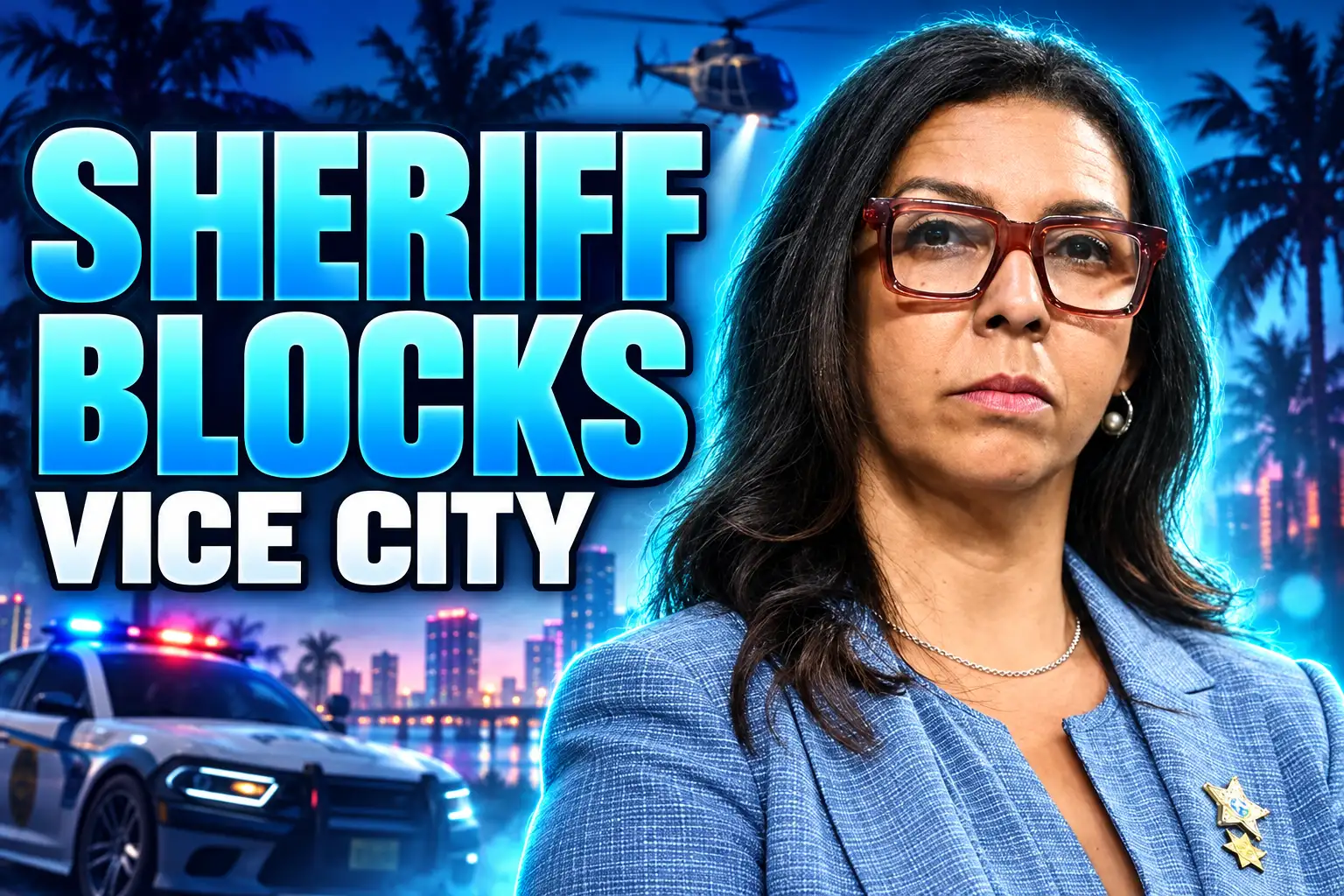
Sheriff Rosie Cordero-Stutz is blocking a GTA 6 Vice City airport pitch, after county staff already invited Rockstar onto public property.

Miami-Dade Sheriff Rosie Cordero-Stutz told the county on September 3 to drop a GTA 6 marketing pitch that would dress Miami International Airport as Vice City. She joined Commissioner Juan Carlos Bermudez in a joint statement that treated Grand Theft Auto as a crime story her deputies already fight on real streets.
Mayor Daniella Levine Cava’s office says talks with Rockstar Games could bring revenue and a wide audience, and that nothing is signed. The argument is not whether Vice City looks like Miami. It is whether the county should stamp that name on the airport, the trains, and the manhole covers.
Miami-Dade County Is Not Vice City
The line that traveled fastest was Cordero-Stutz’s own: “Miami-Dade County is not Vice City.” A September 3 county news release from Bermudez’s office put that fight on the record, calling on the mayor’s office to reject any use of county resources, buildings, or the public brand to promote Grand Theft Auto VI.
Cordero-Stutz did not review gameplay. She listed the crimes the franchise sells as sport, then tied them to the work her office does every shift.
Grand Theft Auto is a video game franchise built around criminal activity. Its fictional world includes murder, robbery, drug trafficking, carjacking, violence against law enforcement, and other conduct that the men and women of the Miami-Dade Sheriff’s Office work every single day to prevent. At a time when law enforcement is working every day to reduce violent crime, prevent robberies and car thefts, combat drug trafficking, and build stronger relationships between our deputies and the communities we serve, I believe we need to seriously consider the message we send when our own government promotes a fictional identity centered around many of those same crimes.
Rosie Cordero-Stutz, Miami-Dade Sheriff, September 3 statement
Bermudez, the District 12 commissioner and a former mayor of Doral, went at the airport idea by name. “I still cannot believe that we are even considering temporarily rebranding important County assets, including Miami International Airport, as ‘Vice City Airport,’” he said. He asked for a public accounting of any talks with Rockstar, including costs, public benefits, and which county assets would be used.
He later put it in plainer language. “I’m not an anti-gamer,” Bermudez said. “But the thing is, this glorifies not only injuries to our first responders, in particular to our police, which I think is abhorrent, but it also glorifies running over a pedestrian.” On camera he added that Miami-Dade “is not a video game; it’s a community,” and that the goal “is to be paradise and not to be paradise lost.”
The June Pitch to Rockstar
The sheriff is not shadowboxing a rumor. Rockstar reached out about launch promotions, and the mayor’s office answered with a concrete tour of county-owned stages. Carlos Suarez, the mayor’s communications director, confirmed staff had “some conversations with Rockstar about potential opportunities around the launch of GTA VI.” Chris Hudtwalcker, Levine Cava’s chief of staff, has been leading those talks.
A public-records dump turned up the county’s June 29 pitch. It asked Rockstar to pay for a short-term transformation of public places into Vice City set pieces, timed to a game that still has a November 19 launch date on PlayStation 5 and Xbox Series. Suarez was careful about process and greedy about the upside in the same breath.
“Nothing has been formally agreed to or approved, and any idea would have to go through the appropriate review and approval process,” he said. “Given Miami-Dade’s clear influence on the game, we think there could be a unique opportunity to generate revenue for the County while showcasing Miami-Dade to a massive audience.”
The deck never named a price. It did name the stages, right down to luggage tags and sewer lids.
WHERE THE PITCH WANTED VICE CITY
| County site | What staff offered Rockstar |
|---|---|
| Miami International Airport | A wrapped display aircraft, Vice City arrivals screens, themed baggage claim, carts, tags, and launch signage, sold as an “immersive arrival experience” |
| Metromover and Metrorail | Cars wrapped in Vice City colors, plus station signs at the Stephen P. Clark Government Center, Brickell, and Bayfront Park |
| Downtown and Brickell streets | Artist-designed utility-box wraps and custom sewer or stormwater manhole covers |
| PortMiami Terminal J | A Port Gellhorn-style mural or installation using cargo containers, cranes, cruise ships, and the working waterfront |
| Rickenbacker Beach | A photo frame, sculpture, or overlook using Biscayne Bay, palms, boats, and sunset views |
| Tropical Park | A “family-appropriate” car-culture event with classic cars, lowriders, motorcycles, DJs, food, and branded photo spots |
The airport page in the deck is the one Bermudez cannot shake. It does not only add posters. It asks travelers to land in Miami and be told they have arrived in Vice City, which is the whole political problem in one gate screen.
Why the Sheriff Is Fighting the Airport Rebrand
Cordero-Stutz is not a guest in this argument. She is the first woman elected Miami-Dade sheriff, the first Hispanic woman elected sheriff in Florida, sworn in on January 7, 2025 after winning on November 5, 2024. She joined the department in 1996. The crimes she listed in the statement are the crimes her office is funded to stop.
Grand Theft Auto VI is a tourist magnet before anyone wraps a single train. Rockstar put a long in-game showcase, the Grand Theft Auto 6 Extended Look, on Netflix on August 27. The map is a sun-bleached stand-in for South Florida, with riffs on Ocean Drive, the airport, and the Everglades. Players already know where Vice City lives. The county’s pitch only makes that knowledge official.
That is the bind. A wrapped Metromover would be catnip for visiting players and for anyone with a phone. It would also put the county seal next to carjacking as entertainment, on property paid for by the same public the sheriff polices. Bermudez has already said he would vote no if the plan ever reaches the commission, and that it has not been scheduled for a public meeting.
Local players are not a bloc. Michael Cambridge, a Miami fan of the series, said the Florida setting is why the game matters to him, then hesitated on an official county campaign because of the violence and because younger kids would see the branding. The sheriff is making that hesitation into policy.
Courthouses Asked to Be Left Off the Map
Law enforcement is not the only branch trying to stay off the poster. The same day as the sheriff’s statement, Chief Judge Ariana Fajardo of the Eleventh Judicial Circuit and Clerk Juan Fernandez-Barquin wrote Levine Cava and asked that courthouses be carved out of any Vice City work.
“We do not believe our courthouses should be incorporated into a promotional campaign for a video game whose central themes include criminal activity, violence, law enforcement pursuits and other fictionalized depictions of crime,” they wrote. The letter asked that “all Miami-Dade County courthouses and court-related facilities be expressly excluded from any current or future discussions, proposals, marketing, filming, branding, signage, or other promotional activities associated with Grand Theft Auto VI or the Vice City brand.”
They did not tell the mayor to kill the talks. The same letter said a Rockstar pact could bring “significant” economic opportunities that could “fiscally benefit Miami-Dade County.” The courts want the cash conversation without becoming a level in the game, which is a narrower ask than the sheriff’s.
WHAT THE OPPONENTS ARE DEMANDING
- The sheriff: Drop any county branding that sells a crime sandbox as Miami-Dade’s public face.
- Bermudez: No temporary “Vice City Airport” name, and a full public file on talks, costs, benefits, and which assets would be used.
- The bench and clerk: Keep every courthouse and court building out of filming, signs, and Vice City art, even if a deal proceeds.
- The commission path: Bermudez says he will vote no if a plan is ever agendized, and that none has been.
That split matters because it is not a clean no from county government. It is a no from the elected sheriff and one commissioner, a keep-us-out from the courts, and a still-open maybe from the mayor’s office.
Haitian Miami Took Vice City to Court in 2003
South Florida has been in this argument since the first Vice City disc hit stores. Grand Theft Auto: Vice City shipped in October 2002 as a crime epic in a neon stand-in for Miami, with Tommy Vercetti shooting his way through pastel streets. Within a year the fiction had real enemies in the same metro area now being pitched as a theme park.
Haitian groups in New York, Boston, and Palm Beach County protested a mission that told players to “kill the Haitians” and “kill the Cubans.” Florida’s attorney general looked at hate-crime statutes. Thirty-four elected officials, many from South Florida, wrote Walmart, Target, Best Buy, and other chains and asked them to pull the game. By December 2003 the title had sold an estimated 11 million copies. Rockstar and parent Take-Two apologized to Haitians and to Haiti’s government and said they would cut the lines from later copies. Retailers kept selling the original until the patched version arrived.
North Miami Mayor Joe Celestin, who is Haitian American, pushed a city fine of $250 on shops that sold or rented violent games to minors without a parent’s OK. He said the problem was a bounty that paid players for killing Haitians. In a separate fight, Miami-Dade Commissioner Dorrin D. Rolle, whose district included the real Liberty City, said he was exploring legal options after a Grand Theft Auto map used that name for “the worst city in the world.” Liberty City police commander Brenda Williams said crime in the neighborhood had already fallen, and that the game was handing out a reputation the streets no longer earned.
Those fights did not retire Vice City. They proved the map was already more famous than the rebuttal.
FROM THE FIRST VICE CITY TO THIS PITCH
- October 2002: Rockstar ships Grand Theft Auto: Vice City, a Miami-coded crime sandbox.
- December 2003: Haitian protests, a 34-official letter to retailers, and a Rockstar apology over “kill the Haitians” lines, after about 11 million copies sold.
- June 29, 2026: Miami-Dade staff submit a Vice City takeover deck to Rockstar covering the airport, transit, PortMiami, and parks.
- August 27, 2026: Rockstar’s Netflix showcase puts the new Vice City in living rooms a week before the political fight goes public.
- September 3, 2026: Cordero-Stutz and Bermudez tell the county to reject the branding, and the chief judge asks that courthouses be left out.
The 2003 fight was about content. The 2026 fight is about whether the county should collect a check for hosting that content on its own concrete. The map did not get kinder. The government got interested in the traffic.
Budget Day Put the Sheriff Across From the Mayor
The Vice City row landed on the same Thursday as the first hearing on Miami-Dade’s 2026-27 budget. The county funds the sheriff’s $1.2 billion budget. Levine Cava, a Democrat, proposed a 6% increase in tax funding. Cordero-Stutz, a Republican, wants 12%. Both were courting commission votes while the marketing fight broke.
THE MONEY UNDER THE ARGUMENT
- Sheriff budget: The county underwrites a $1.2 billion Miami-Dade Sheriff’s Office.
- Mayor’s offer: A 6% rise in tax funding for that office in the 2027 plan.
- Sheriff’s ask: A 12% rise, tabled in the same week she attacked the Vice City pitch.
- Tourism base: The Greater Miami Convention & Visitors Bureau counted 28.3 million visitors in 2025 and $32.2 billion in economic impact, with $22.7 billion in visitor spending and more than 216,000 jobs, about 8% of county output.
Bermudez is a Republican often mentioned as a 2028 mayor candidate once Levine Cava is term-limited. The branding fight is also a preview of that race: one side talking tourism math, the other talking the county’s name. The pitch never said what Rockstar would pay. Against a visitor economy already measured in tens of billions, that missing number is doing a lot of work. Bermudez’s question, “For just some dollars?”, only lands if the dollars stay secret.
Levine Cava’s staff can still argue, correctly, that players will come with or without manhole art, and that a paid activation is how a government captures some of that spend. Cordero-Stutz’s answer is that some attention is not worth putting on a county asset. Those are not the same job, which is why they are not the same no.
Saying No Still Prints the Vice City Name
The joke writing itself is that Miami-Dade spent decades trying to outrun Miami Vice and the cocaine-cowboy years, then watched a British studio turn that leftover myth into one of the best-selling crime toys on earth. Now the same government that wants the tourists is being told by its own sheriff to stop saying the name out loud.
Vice City does not need a Metromover wrap to attach itself to this place. The 2002 game did that. The new one will do it again on November 19, on the two consoles Rockstar has locked in, with no signed county pact required. The June 29 deck even admitted the point it was trying to monetize: “Create an immersive arrival experience that immediately establishes Miami as the real-world inspiration for Vice City.”
The sheriff’s press push did the establishing for free. “Vice City Airport” is now a phrase in a county news release. So is the list of crimes. So is the image of a wrapped plane that does not exist. Players who wanted the takeover read the refusal as proof the city is already the bit. The county asked Rockstar onto its property first, then discovered that the property comes with a sheriff, a commissioner with a 2028 calendar, and a chief judge who will take the economic argument and still refuse to let a courthouse wear a logo.
Suarez can keep saying no deal is approved, because none is. Cordero-Stutz can keep saying Miami-Dade is not Vice City, because that is her job. Grand Theft Auto VI still launches on November 19, still set in a Florida that everyone already recognizes, and the quote the world has in hand is the one that tried to kill the ad.

Instagram Plus Tests a Read-Only Mode That Cuts Stories

Altman Asks the Public to Accept Some AI Harm

Google Freezes OSS VRP Product Reports After AI Flood

AI Agents Make Payment Rails the Scarce Prize

Turkey’s Crypto Boom Now Runs Through Three Banks

Fable 5 Came Back Under a Commerce On-Off Switch

Google’s SpaceX GPU Lease Has a Sept. 30 Deadline

Plasma One’s XPL Locks Face a 1.81 Billion Cliff

DGO’s Rs 549 World Cup Pass Cost Fans Sleep and Data

Moonshot AI’s $30 Billion Ask Became a $35 Billion Close
-
 AI4 months ago
Fable 5 Came Back Under a Commerce On-Off Switch
-
 AI4 months ago
Google’s SpaceX GPU Lease Has a Sept. 30 Deadline
-
 CRYPTO4 months ago
Plasma One’s XPL Locks Face a 1.81 Billion Cliff
-
 APPS4 months ago
DGO’s Rs 549 World Cup Pass Cost Fans Sleep and Data
-
 AI4 months ago
Moonshot AI’s $30 Billion Ask Became a $35 Billion Close
-

 NEWS4 months ago
ColorOS 17 Device List Spans Oppo, OnePlus and Realme
-

 GAMING4 months ago
Xbox Cuts 3,200 Jobs After Five Years of Thin Returns
-

 GAMING4 months ago
The RTX 4050 Under Rs 70,000 Hides a Wattage Gap