
NEWS
Meta’s Trillion-Dollar Threat Ends in Teen Time Limits
Meta closed a 29-state youth trial with a $17 billion deal that puts a two-hour cap and a midnight lock on Instagram and Facebook for teens.

Meta closed a 29-state youth-safety trial on August 26, 2026 with a deal of up to $17 billion and a two-hour cap for teens. California Attorney General Rob Bonta led a group of 51 attorneys general that had opened the case eight days earlier in Oakland.
The scare number that followed the apps onto every phone, $1.4 trillion, never became a judgment. What landed instead is a court-backed teen mode on Instagram and Facebook, written so the hardest limits kick in only if rival apps copy them.
A Two-Hour Cap Replaces a Trillion-Dollar Threat
U.S. District Judge Yvonne Gonzalez Rogers had an advisory jury ready and a six-week slate of witnesses on the calendar, including Meta chief executive Mark Zuckerberg and Instagram chief Adam Mosseri. On August 26 she took a consent judgment instead. Meta later said the judge’s approval was on the record by August 27.
Bonta’s office put the money at up to $17 billion over ten years. California’s own share is $1.5 billion to $2.1 billion, earmarked for preventing or treating mental-health harms in young people tied to social media. Colorado Attorney General Phil Weiser said his state will receive close to $615 million over nine years on the youth claims.
Meta did not admit wrongdoing. The company still faces separate suits from families and school districts. The state case that was supposed to test whether likes, infinite scroll, and recommendation ranking amount to a consumer-protection violation is over.
THE FIGURES THAT NEVER MET IN COURT
| Claim on the docket | Figure | Who put it there |
|---|---|---|
| Statutory-max civil penalties | $1.4 trillion | Meta, in a pretrial filing |
| Four-state working figure | about $200 billion | Lead attorneys general, before trial |
| Consent judgment | up to $17 billion over 10 years | California Department of Justice, August 26, 2026 |
Meta told the court a sanction of that $1.4 trillion size had no analog in the history of consumer-protection enforcement. The four lead states, California, Colorado, Kentucky, and New Jersey, had been multiplying per-violation fines in their own statutes across a headcount of young users. That arithmetic is how a pair of free apps starts to look like a trillion-dollar problem. It is also why the company had an incentive to end the trial before the judge had to pick a number.
What Changes on Instagram and Facebook for Teens?
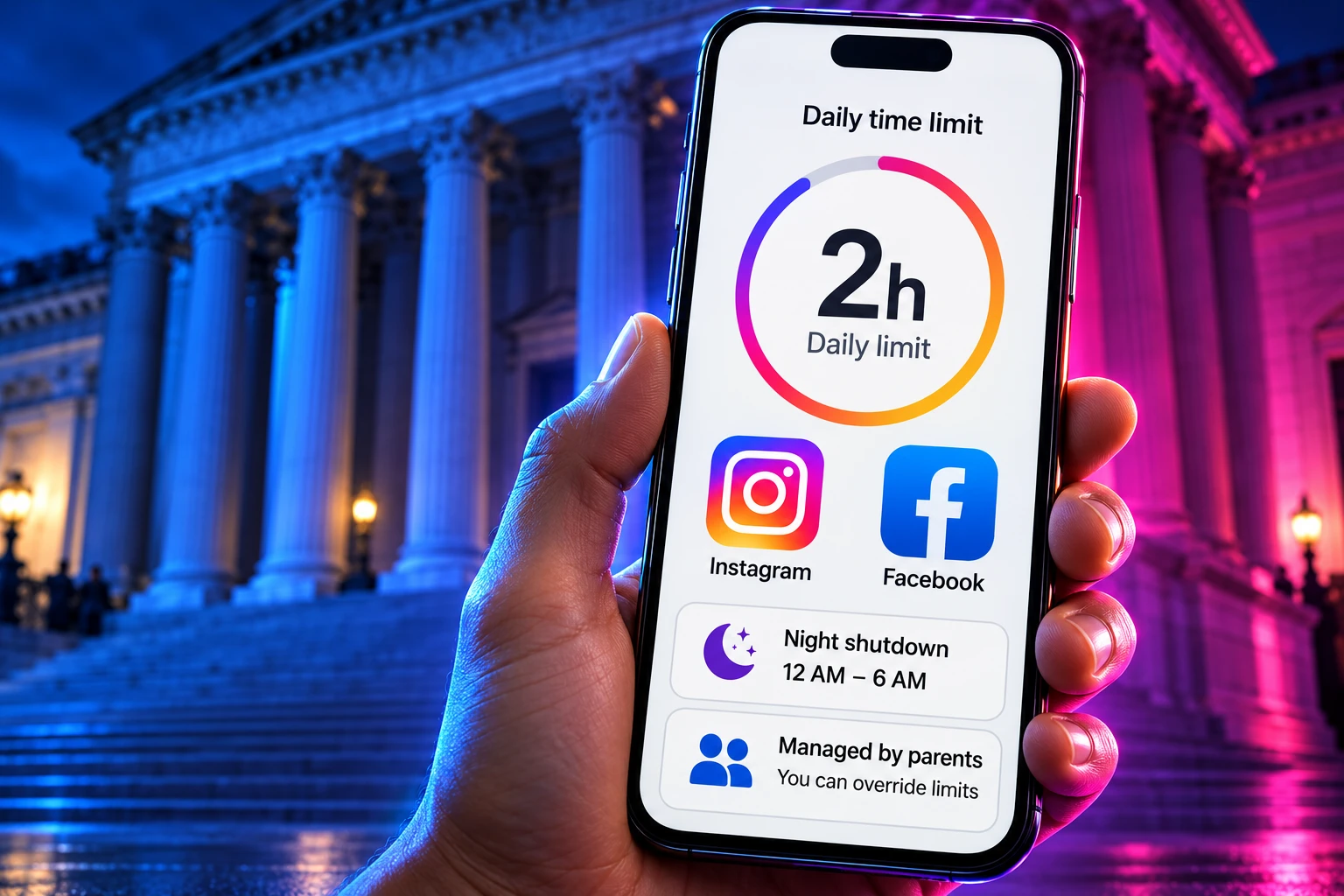
For users under 18 in participating U.S. states and territories, Meta will ship a default two-hour daily time limit that only a parent can turn off. Time on Instagram and Facebook is pooled, and the company says it will count scrolling even if it detects multiple accounts. Night Mode blocks the apps from midnight to 6 a.m. unless a parent lifts it.
TEEN DEFAULTS ON THE TWO APPS
| Feature | Default for users under 18 | Who can lift it |
|---|---|---|
| Daily time | two hours, combined across Instagram and Facebook | A parent |
| Night Mode | midnight to 6 a.m., no Feed, Stories, Explore, or Reels | A parent |
| School-day alerts | notifications blocked 8 a.m. to 3 p.m., August 15 to June 15 | Built as a default |
| Night alerts | notifications blocked 10 p.m. to 7 a.m. | A parent, on the night block |
| Scroll breaks | pauses after 15 minutes of continuous use, then at 60 and 90 minutes | Part of the five-year cap |
Weiser’s office spelled out the scroll breaks as mandatory pauses after 15 minutes of continuous use, then again at 60 and 90 minutes, a device the states wanted as a brake on endless scrolling. Those daily caps last five years. If Snapchat, TikTok, and YouTube take comparable terms, the daily limit on each Meta app drops to one hour, Night Mode stretches from 10 p.m. to 7 a.m., and the clock on those terms runs ten years.
OTHER DEFAULTS THE STATES LOCKED IN
- Like counts: Numbers of likes or reactions are not shown to users under 18.
- Cosmetic filters: Image filters that mimic plastic surgery are banned for that age group.
- Chronological feed: Users under 18 get an option for a feed that is not ranked to keep them scrolling.
- Harm reports: Meta must answer 90% of teen reports of potentially harmful content within six hours.
- Age checks: The company must build stronger tools to find users under 18 and to take children under 13 off the apps.
- Auditor: An independent auditor gets broad access and reports to the states each year for five years.
Bonta said the product work would start within months, not after another round of appeals. He also won an injunction against further false or misleading statements about Meta’s safety tools. C.J. Mahoney, Meta’s chief legal officer, framed the same package as a parent-controlled industry standard that still needs company from the rest of the feed.
I’m pleased to announce that Meta has reached an agreement with a bipartisan group of state attorneys general from around the country on a new set of rules governing teens’ use of social media. The framework we’ve negotiated will empower parents to easily manage how their children access our platforms. Our new Time Limit commitments, Night Mode features and usage limits during school hours set the right path forward for our whole industry, but this framework will only work if all our peers join us.
C.J. Mahoney, Chief Legal Officer, Meta newsroom statement
That last clause is doing real work. A two-hour lock on Instagram is only as strong as the next icon on the same home screen.
Two Days of Safety Testimony, Then a Deal
Opening statements on August 18 put two theories in the same Oakland courtroom. Megan O’Neill, a California deputy attorney general, told the advisory jury Meta’s plan was to hook users, hold them, harvest their data, and hide the truth from the public. Paul Schmidt, a lawyer for Meta, said some users struggle, and that research tying those feelings to the apps is not clean.
The states’ first witness was Arturo Béjar, a former Meta safety engineer who had already testified against the company in earlier trials. Meta tried to keep him off the stand over deleted Signal chats with former employees. Gonzalez Rogers called that bid a Hail Mary and let him testify.
THE EIGHT DAYS THAT ENDED THE TRIAL
- 2023: Twenty-nine states file the federal case over youth harms and child data.
- June 2026: Gonzalez Rogers denies Meta’s bid to end the core claims and grants the states a partial win on COPPA notice and parental consent.
- August 16, 2026: The judge refuses to bar Béjar over Signal auto-delete settings.
- August 18, 2026: Trial opens in Oakland on the consumer-protection claims of California, Colorado, Kentucky, and New Jersey, plus COPPA claims from all 29 states.
- August 18-19, 2026: Béjar testifies that safety tools were optional, that under-13 enforcement was a don’t-ask culture, and that Zuckerberg did not answer a 2021 warning.
- August 26, 2026: The states and Meta file the executed consent judgment in the Oakland case. The advisory jury never deliberates.
Béjar worked at the company from 2009 to 2015 and returned as an Instagram well-being contractor from 2019 to 2021. He told the jury he had briefed Zuckerberg on product issues scores of times, and that he mailed the chief executive on October 5, 2021, hours after Zuckerberg publicly denied putting profit ahead of safety. “If Mark makes something a priority, mountains move in months,” he said. Asked whether Zuckerberg wrote back, he said no.
At the end of the day, it was the company culture that Mark had created that made it so that it was practically impossible to deliver features that addressed the wellbeing and safety issues.
Arturo Béjar, former Meta safety engineer, Oakland trial testimony
He compared the well-being tools Meta did ship to brakes stored in the trunk. Time-management settings from 2018 and Teen Accounts from 2024 sat in the record as the company’s answer. The states’ point was that those tools were opt-in, so almost nobody used them, while ranking, alerts, and infinite scroll stayed on by default. Settling after two days of that testimony spared Meta a longer public exam of the same documents, and spared the judge a written ruling on whether “social media addiction” had to be a listed diagnosis for a deception claim to stand.
Federal Privacy Law Still Stops at Age 13
The trial mixed two legal tracks that still get collapsed in headlines. All 29 states pressed the Children’s Online Privacy Protection Act, the federal child-privacy statute. Only the four lead states tried their unfairness and deception claims at this sitting. Other states with their own consumer-protection counts had been looking at a later trial date.
COPPA, IN THIS CASE
- Who it covers: Children under 13, not teenagers aged 13 to 17.
- What it requires: Operators need verifiable parental consent before collecting a child’s personal information, with limited exceptions.
- What counts: Names and emails, and also persistent identifiers that recognize a user over time, plus photos, voice files, and precise location.
- What the states added: They said Meta kept under-13 users on general-audience apps, skipped notice and consent, and used that data, including for model training.
Congress wrote COPPA in 1998. The Federal Trade Commission’s first rule took effect on April 21, 2000, and staff guidance is blunt that the statute does not follow a user past the thirteenth birthday. That gap is why the four states had to bring unfair-practice and deception counts to reach teens, and why the consent judgment’s two-hour cap is written for users under 18 rather than only for children the federal privacy rule already names.
In June 2026, Gonzalez Rogers granted the states a partial summary-judgment win that Meta had not met COPPA’s notice and parental-consent duties, and she left the rest, including whether the apps are addictive and whether Meta lied about that, for trial. The settlement means she never had to convert that June ruling into a penalty line. It also means Meta can say it resolved the claims without a finding that Instagram or Facebook is an addictive product as a matter of law.
TikTok and YouTube Are Named in the Fine Print
Mahoney’s statement is the tell. Meta will run Time Limit, Night Mode, and School Mode on its own apps. It is also telling TikTok and YouTube to do the same, on the theory that teens move across dozens of apps and a lock on two of them just shifts the session.
Colorado’s papers name a third rival, Snapchat, as a trigger for the tighter one-hour cap and the longer night window. Georgia Attorney General Chris Carr, who joined the same deal, said Meta should not be the last platform at the table. The structure is a carrot and a prod at once: keep the five-year, two-hour version if the rest of the industry sits still, and drop to one hour for a decade if they sign on.
Holding part of a state payout until competitors copy a product rule is an odd way to end a consumer case. It is also the only way the two-hour cap survives contact with a teenager’s home screen. A parent who leaves the Meta defaults in place still hands the same phone a TikTok icon, a YouTube icon, and a Snapchat icon. The states accepted that leak in exchange for defaults that start without a parent hunting through settings.
On September 13, 2026, Norway’s government asked Meta for a two-hour limit and a midnight-to-6 a.m. block for Norwegian minors, the same pair of numbers the Oakland papers use. Other governments now have a template they did not have in mid-August. That is the part of the deal that travels. The check stays in the U.S. state treasuries. The product spec can be copied in a press conference on another continent.
Béjar’s unused brakes sit in the background of that export fight. Optional well-being tools did not move the states. Defaults did. Meta is now trying to make those defaults an industry floor so it is not the only feed that goes dark at midnight.
Cases the Consent Judgment Does Not Close
Gonzalez Rogers still oversees the larger federal multidistrict docket on adolescent social-media claims, MDL-3047, which takes in thousands of suits by people, school districts, and local governments against several platforms. This consent judgment ends the state attorneys general track against Meta. It does not pay those other plaintiffs.
Parents who want the old, unlimited Instagram can still unlock it. The two-hour cap and the night block are defaults, not a statute that bans the apps. A household that never opens the parent tools will see the new limits. A household that does will see the same infinite scroll the states spent three years attacking, with a paper trail that the parent chose it.
The dollar figure is small next to the $1.4 trillion Meta put in the record, and small next to a year of the company’s ad sales. That is the honest read of the check, and it is why the product schedule matters more than the payment calendar. A parent who does nothing will, within months of the August 26 papers, get a combined two-hour clock, a dark stretch after midnight, quiet school hours, hidden like counts, and a pause that interrupts a long session. A parent who taps through the gates will not.
Weiser called the injunctive terms more than any court had ordered, or was likely to order, after a full trial. That is the trade the states made when they picked a deal eight days in: they took defaults they could enforce with an auditor, and they left the trillion-dollar verdict on the table.
Frequently Asked Questions
Does COPPA Protect Teenagers Aged 13 to 17?
No. Congress limited the Children’s Online Privacy Protection Act to children under 13, and Federal Trade Commission staff guidance says the rule does not cover ordinary teen sites. Persistent identifiers have counted as personal information under the rule since the 2013 amendments, which is why a general-audience app can still fall under COPPA if it has actual knowledge it is collecting data from a child under 13.
What Does Night Mode Block on the Apps?
Meta’s own description is specific: from midnight to 6 a.m., teens cannot post or view Feed, Stories, Explore, or Reels unless a parent lifts the block. The company presented that as a default in participating states after the judge approved the deal, not as a setting a teen can dismiss with one tap.
Do School District and Family Lawsuits End With This Deal?
They do not. The August 26 papers resolve the attorneys general cases that were in Oakland and the parallel state claims that joined the settlement. Individual personal-injury suits and school-district cases in the wider multidistrict litigation remain on their own tracks.
Did the Settlement Also Cover Older Data-Sharing Claims?
Yes, on a separate line. Colorado’s announcement says the same package also closed state claims over Meta’s sharing of nonpublic Facebook user information with third parties, including the Cambridge Analytica period before the 2016 election, and that Colorado will receive an additional $11.4 million on that track, apart from its youth-harm payments.
Disclaimer: This article is news reporting on a completed consumer-protection settlement and related court proceedings. It is informational only and is not legal advice, nor is it a guide to parental controls, privacy compliance, or any claim a reader may have against Meta or another platform. Anyone considering a lawsuit, a settlement claim, or a change to a child’s account settings should consult a licensed attorney or, for account tools, the parent or guardian who controls the account. Figures, deadlines, and product rules reflect the public statements and papers cited here as of the dates on those documents and can change if the court or the parties amend the judgment.

Instagram Plus Tests a Read-Only Mode That Cuts Stories

Altman Asks the Public to Accept Some AI Harm

Google Freezes OSS VRP Product Reports After AI Flood

AI Agents Make Payment Rails the Scarce Prize

Turkey’s Crypto Boom Now Runs Through Three Banks

Fable 5 Came Back Under a Commerce On-Off Switch

Google’s SpaceX GPU Lease Has a Sept. 30 Deadline

Plasma One’s XPL Locks Face a 1.81 Billion Cliff

DGO’s Rs 549 World Cup Pass Cost Fans Sleep and Data

Moonshot AI’s $30 Billion Ask Became a $35 Billion Close
-
 AI4 months ago
Fable 5 Came Back Under a Commerce On-Off Switch
-
 AI4 months ago
Google’s SpaceX GPU Lease Has a Sept. 30 Deadline
-
 CRYPTO4 months ago
Plasma One’s XPL Locks Face a 1.81 Billion Cliff
-
 APPS4 months ago
DGO’s Rs 549 World Cup Pass Cost Fans Sleep and Data
-
 AI4 months ago
Moonshot AI’s $30 Billion Ask Became a $35 Billion Close
-

 NEWS5 months ago
ColorOS 17 Device List Spans Oppo, OnePlus and Realme
-

 GAMING4 months ago
Xbox Cuts 3,200 Jobs After Five Years of Thin Returns
-

 GAMING4 months ago
The RTX 4050 Under Rs 70,000 Hides a Wattage Gap