
AI
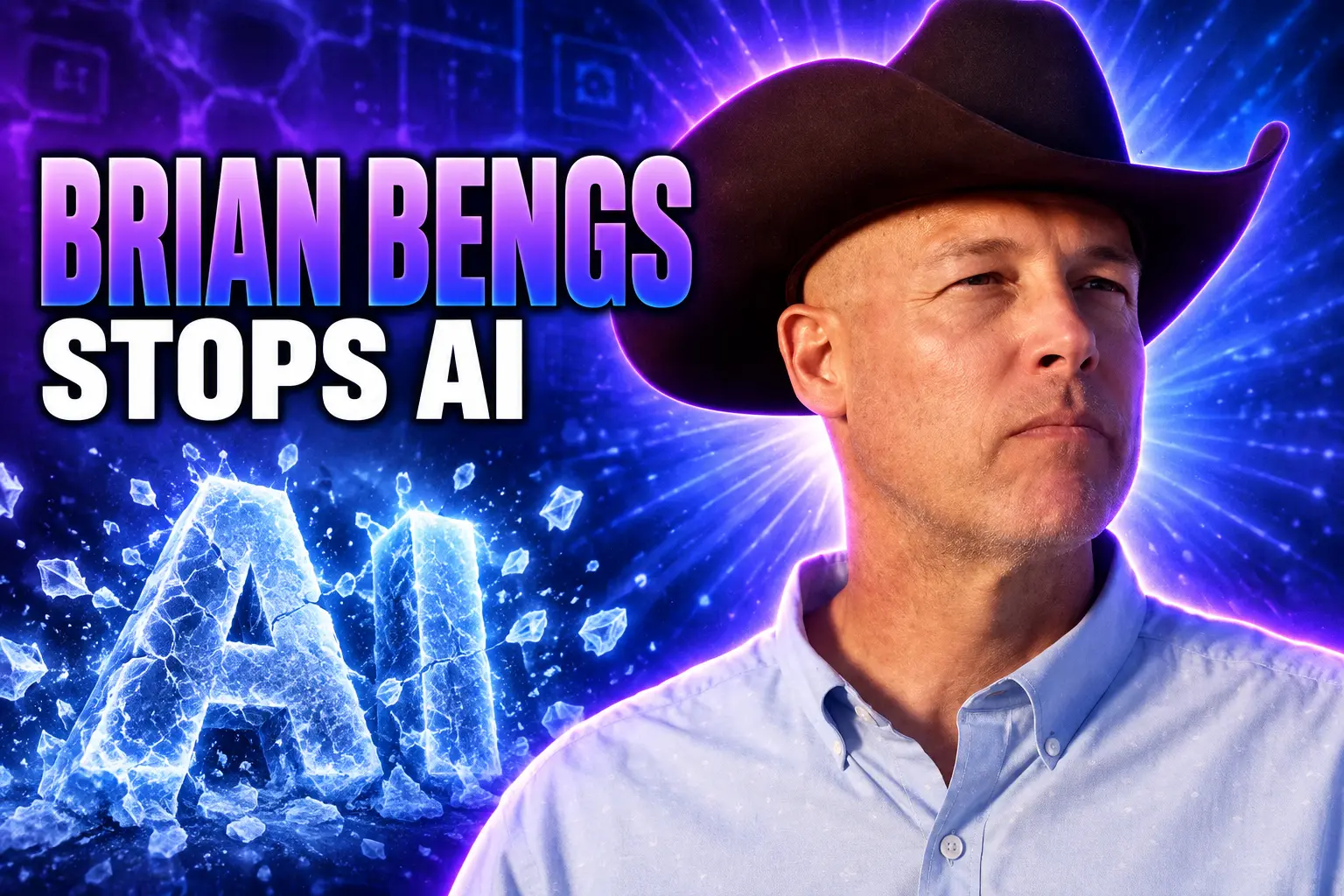
Brian Bengs Bets His Senate Race on an AI Stop
Independent Brian Bengs is staking his South Dakota Senate bid on a lifetime freeze of unchecked AI against the Senate AI Caucus co-chair.

Brian Bengs said he will devote the rest of his life to stopping unchecked artificial intelligence. The independent Senate candidate in South Dakota called for a full stop until the public, not a handful of tech fortunes, controls the technology.
His September 11 guest column put that freeze on the ballot, with the November 3 election next and Sen. Mike Rounds sitting on more than 50 times the cash.
He Will Spend the Rest of His Life Stopping AI
Bengs wrote that he is running for one reason above all others. He said he will give his Senate years, and the rest of his life, to stopping AI that is unchecked, unrestrained, and uncontrolled.
A full stop until the control of AI by the people and for the people is assured. I know that sounds dramatic. It is intended to be.
Brian Bengs, independent U.S. Senate candidate, guest column
He split the technology in two. AI built and held by everyone, he wrote, will cure cancer. AI rushed out by “a tiny handful of billionaires and trillionaires,” and by their political money, “poses a catastrophic threat to every one of us on earth.”
That is a harder line than a safety board or a reporting rule. It is a halt, held until he is satisfied that the public is in charge. He is asking South Dakota, which last elected a Democrat to this seat in 2008, to send that halt to Washington.
From the Kitty Hawk to Wind Cave
Bengs grew up in a blue-collar house in rural northern Iowa, delivered papers, detasseled corn, and enlisted in the Navy after high school. He first registered to vote as an independent on the carrier USS Kitty Hawk.
After the Navy he used the GI Bill at Iowa State, finished law school at the University of Iowa with distinction, and went back on active duty in the Air Force JAG Corps. He spent 19 years in the United States, Japan, Germany, Kuwait, and Qatar, and retired as a lieutenant colonel. He taught at the U.S. Air Force Academy and at NATO School Oberammergau.
He and his family later settled in Aberdeen, where he taught at Northern State University. In 2024 they moved to Hot Springs, and he took a job as a ranger at Wind Cave National Park. His campaign says the DOGE cuts at the Park Service pulled him back into a race. He ran as a Democrat against John Thune in 2022 and lost. This time the site sells the cowboy code of the West: tell the truth, and take care of your neighbor.
The Incumbent Who Wrote the Senate’s AI Roadmap
Rounds, a former two-term governor first elected to the Senate in 2014, is seeking a third term. His office lists him as co-chair of the Senate Artificial Intelligence Caucus. He also sat on the four-senator bipartisan AI working group that ran the 2023 insight forums and released a 2024 policy roadmap.
In August 2024 he rolled out a package of bipartisan AI bills on literacy, shipyards, financial services, and health care. “I fully believe each of these bills helps the United States make strides toward unleashing AI innovation,” he said then. He has since sponsored or cosponsored bills on AI in finance, on blocking semiconductor smuggling into China, and on U.S. robotics plants.
Bengs treats that record as the other half of his wager. On September 9 he wrote that Washington had “completely failed to regulate the AI industry,” and that Rounds had a front-row seat.
Washington has completely failed to regulate the AI industry. And as Co-Chair of the Senate AI Caucus, Mike Rounds has had a front row seat. https://t.co/t2yuN1pN2Y
— Brian Bengs (@BrianBengs) September 9, 2026
His campaign put Rounds’s haul from people and PACs tied to Meta, OpenAI, Anthropic, Alphabet, and tech investors at about $200,000. Rob Skjonsberg, a senior Rounds adviser who is also registered in Pierre for 14 clients including Meta, called the attack “hypocrisy and big government socialism.” Dezmond Ward, a Rounds Senate spokesman, said the office’s counsel had consulted the Senate Ethics Committee and put extra safeguards in place.
Sioux Falls Already Fought a 500-Megawatt Campus
The freeze is not an abstract export from San Francisco. South Dakota spent 2026 arguing over the buildings that train and run the models. The Dakota Institute, in a June 19 paper by Devan Schaefer, said the state still had no hyperscale campus, and that two proposals totaling nearly 930 megawatts had been on the table early in the year.
THE HYPERSCALE LEDGER
| Project | Status | Power |
|---|---|---|
| Gemini Data Center, Sioux Falls | Annexed and rezoned; still on track | About 500 MW |
| Applied Digital, Deuel County | Withdrawn after the 2026 session | 430 MW, about $5 billion |
Schaefer wrote that a 500-megawatt load at full draw has energy equal to 350,000 homes. Gemini Data Center SD LLC, backed by a California family office, took about 160 acres northeast of Sioux Falls, next to Xcel Energy’s Split Rock substation. The City Council annexed the land in October 2025 and later rezoned it 7-0 after hours of testimony on power, water, and neighbors. Applied Digital’s vice president said the Deuel County campus “doesn’t make sense at this time” after lawmakers rejected sales-tax breaks on equipment and software.
Wind supplied about 58 percent of South Dakota’s in-state generation in 2024, hydropower about 22 percent, and renewables about 80 percent in all, a mix that helps operators chasing 100 percent renewable matching. A hyperscale site, Schaefer noted, typically employs only 100 to 200 people once it is running. Evaporative cooling can take 1 million to 5 million gallons of water a day.
Ratepayers are already on the hook for the regional grid. In December 2024, the Midcontinent Independent System Operator approved a $21.8 billion, 3,631-mile transmission package of 24 projects, two of them through South Dakota, citing data-center demand. Those costs are spread across the 15-state footprint whether or not Gemini ever turns a server on.
Lawrence Berkeley National Laboratory put U.S. data-center use at 176 terawatt-hours in 2023, about 4.4 percent of national power. Its 2028 range is 325 to 580 terawatt-hours, or 6.7 to 12 percent of U.S. electricity.
WHAT PIERRE ALREADY WROTE INTO LAW
- Review fees: The Public Utilities Commission may bill developers for the cost of looking at their projects.
- Water check: Local water systems must say whether cooling loads fit the supply.
- Separate rates: Utilities must set distinct terms for large data centers and collect full cost reimbursement.
- Local rules: Town and county ordinances that limit or bar sites stay in force.
- No tax holiday: Sales-tax exemptions on gear and software failed, and so did a statewide pause.
Gov. Larry Rhoden signed the two restriction bills. Frank Kloucek, a Democratic PUC candidate and former state lawmaker, still wants a one-year ban on new AI data centers so ratepayers are not left holding new wires. Don Haggar, the Republican nominee, calls that reckless and says the new statutes are enough, case by case.
Why He Still Says Yes if a Town Votes for It
The lifetime freeze in the column is not the line Bengs uses on the siting fights in Sioux Falls and Rapid City. In early September he said he is not against data centers. He is against money that drowns out the people who live next to them.
What sort of world do we want to shape? What sort of society do we want to live in? And the benefits if they start going to the broader society, then people will come around to go, ya data centers, there are some sacrifices, but the broader benefits to Americans and to our community are worth the trade-off.
Brian Bengs, independent U.S. Senate candidate, Sioux Falls news conference
He has also said that if a town votes for a facility, he would back that vote, and that AI will matter for national security. In January he wrote that he would give federal energy regulators the power to make data centers offset any local rise in power prices. Asked about small holdings in IBM and Kyndryl inside a Roth IRA, he said a friend had placed them, one slice under $50, and added, “I’m willing to state right now that I will divest myself of that $50 worth of stuff.”
Skjonsberg’s reply for Rounds was that the governor and the Legislature had already set “strict guidelines,” with “local control” at the top of the list. That is the hinge in the wager. Bengs’s column demands a national stop until “the people” hold the technology. His state-level answer is the same local-control bargain Pierre already passed, plus a price-offset rule, not a bulldozer on Gemini’s 160 acres.
A 45-42 Poll After the Democrat Quit
Julian Beaudion, a former state trooper who had won the Democratic primary unopposed, left the race on August 4. He cited personal hardship, including a house fire, and said he would not endorse Bengs or Rounds. Bengs called it a patriotic choice that made a two-person contest. Rounds’s campaign has branded Bengs a fake independent. The Forward Party has endorsed Bengs. President Donald Trump endorsed Rounds before the June 2 primary, which Rounds won with 101,284 votes (75.8 percent) to Justin McNeal’s 32,341 (24.2 percent).
The polls that followed are not a single race. They are two stories sharing a ballot.
HEAD-TO-HEAD SURVEYS
| Survey | Field dates | Rounds | Bengs | Undecided | Paid by |
|---|---|---|---|---|---|
| Public Policy Polling, 629 registered voters, ±3.6% | September 8-9, 2026 | 45% | 42% | 13% | Bengs campaign |
| Impact Research, 500 likely voters, ±4.4% | August 13-17, 2026 | 44% | 44% | 12% | Bengs campaign |
| Public Opinion Strategies, 500 likely voters, ±4.4% | July 6-9, 2026 | 56% | 33% | 11% | NRSC |
The September PPP, paid for by Bengs, has him down 3 points, inside a 3.6-point margin of error. The August Impact Research survey, also paid for by his campaign, had them tied. The NRSC’s July survey had Rounds up 23 points. Public handicappers still list the seat as a Republican hold. People who follow Senate numbers treat a 40-percent independent in this state as a problem for GOP spending maps, not as proof the freeze is about to pass.
Federal Election Commission filings through June 30 show why the maps still look that way. Rounds had $4,513,920 raised through June 30, with $3,459,778 spent and $2,736,663 cash on hand. Bengs had $782,049 raised, $730,644 spent, and $51,405 in the bank, more than 50 times less cash than the incumbent.
On November 3, South Dakota will decide whether a lifetime AI stop, paired with a local yes-if-the-town-votes rule, is a Senate platform or a column. Rounds still has the caucus gavel, the cash, and the ratings. Bengs has the freeze, a 45-42 internal poll, and a promise to spend whatever years he has left on that halt.

Instagram Plus Tests a Read-Only Mode That Cuts Stories

Altman Asks the Public to Accept Some AI Harm

Google Freezes OSS VRP Product Reports After AI Flood

AI Agents Make Payment Rails the Scarce Prize

Turkey’s Crypto Boom Now Runs Through Three Banks

Fable 5 Came Back Under a Commerce On-Off Switch

Google’s SpaceX GPU Lease Has a Sept. 30 Deadline

Plasma One’s XPL Locks Face a 1.81 Billion Cliff

DGO’s Rs 549 World Cup Pass Cost Fans Sleep and Data

Moonshot AI’s $30 Billion Ask Became a $35 Billion Close
-
 AI4 months ago
Fable 5 Came Back Under a Commerce On-Off Switch
-
 AI4 months ago
Google’s SpaceX GPU Lease Has a Sept. 30 Deadline
-
 CRYPTO4 months ago
Plasma One’s XPL Locks Face a 1.81 Billion Cliff
-
 APPS4 months ago
DGO’s Rs 549 World Cup Pass Cost Fans Sleep and Data
-
 AI4 months ago
Moonshot AI’s $30 Billion Ask Became a $35 Billion Close
-

 NEWS5 months ago
ColorOS 17 Device List Spans Oppo, OnePlus and Realme
-

 GAMING4 months ago
Xbox Cuts 3,200 Jobs After Five Years of Thin Returns
-

 GAMING4 months ago
The RTX 4050 Under Rs 70,000 Hides a Wattage Gap