
GAMING
Xbox Cuts 3,200 Jobs After Five Years of Thin Returns
Asha Sharma is cutting 3,200 Xbox jobs through June 2027 after a 3% margin and $20 billion of five-year spend, excluding Activision, failed to lift sales.

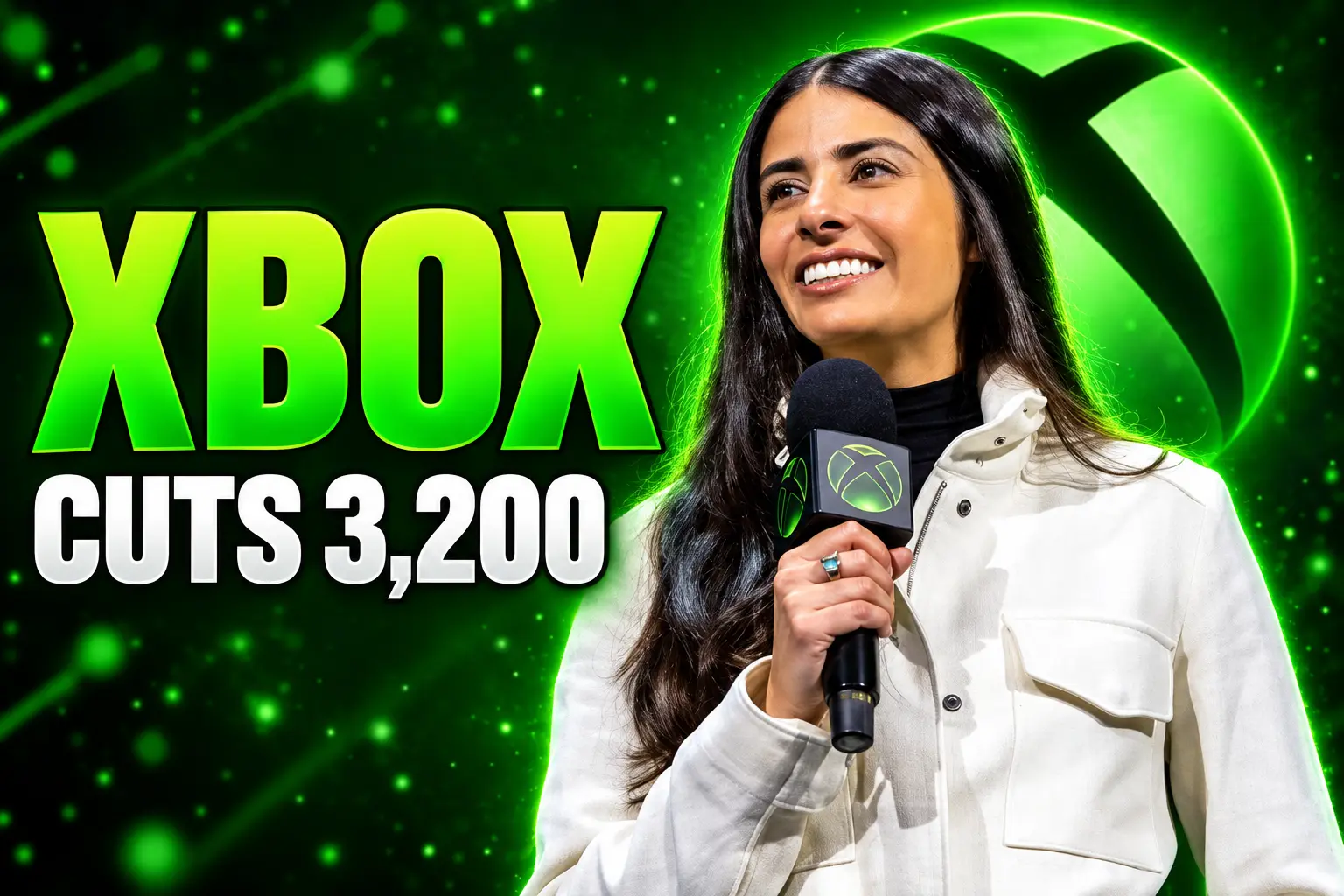
Xbox will cut about 3,200 jobs through June 30, 2027, after CEO Asha Sharma told staff the gaming business is not healthy. About 1,600 of those roles were eliminated on July 6, 2026, the same day four studios were told they would leave.
The notices followed a June 10 staff memo in which Sharma and content chief Matt Booty said Xbox would finish the fiscal year at about a 3% accountability margin after more than $20 billion of five-year spend, excluding Activision Blizzard King, while annual revenue fell by nearly half a billion dollars.
Xbox Cut 3,200 Jobs in Its Largest Reset
Sharma, who became Xbox CEO in February 2026 after running product for Microsoft’s AI tools, called the move the most significant restructure in Xbox history. About 1,600 Xbox roles ended on July 6, inside a company-wide cut of 4,800 jobs that day. The other 1,600 Xbox roles come out through fiscal 2027, which closes June 30, 2027.
THE JULY 6 COUNT
- Xbox total: About 3,200 roles removed through fiscal 2027.
- First wave: About 1,600 role eliminations on July 6, 2026.
- Second wave: About 1,600 more through June 30, 2027.
- Company-wide that day: 4,800 Microsoft roles, a separate total that includes the first Xbox wave.
Those terms match the July 2026 Xbox job cuts Sharma posted to staff and then to Xbox Wire. She wrote that the decisions did not reflect the talent of people who joined through acquisitions or came because they loved the brand, and that a year-long restructure was required because the changes could not all land in a single day.
Reductions hit Activision, Bethesda and ZeniMax, Blizzard, King, Mojang, and Xbox Game Studios, with investment shifted toward higher-priority projects. No publicly announced first-party games or projects were cancelled as part of the cuts. Mojang and King, the two studios Sharma called the largest by monthly active players, now report directly to her.
A 3% Margin After $20 Billion in Spending
The June 10 memo, titled “Next 100 Days: Xbox Reset,” is the document the July cuts rest on. Sharma and Booty wrote that Xbox would end the fiscal year at about a 3% accountability margin, down year-over-year. Excluding Activision Blizzard King, they said, the division had spent over $20 billion in five years on content, platform, and hardware subsidy, while annual revenue declined by nearly half a billion dollars. “Going forward, this cannot continue,” they wrote.
Accountability margin is Microsoft’s internal profit measure for a business. Sharma later told staff Xbox was operating at margins 3-10 times lower than comparable platform and publishing businesses, and that in a typical year the company lost 64 cents for every dollar it invested in studios. More than one billion people play Xbox and its games each year, for 72 billion hours across console, PC, mobile, and streaming, excluding much of China, so the problem she named was not a missing audience. It was a cost structure that never caught the spend.
Microsoft’s own segment numbers show the same slide. In the quarter ended March 31, 2026, gaming revenue decreased $380 million, or 7%, with Xbox content and services down 5% and Xbox hardware down 33% on lower console volume. After the fiscal year closed, a restated Xbox line put fiscal 2026 revenue at $21.79 billion, down from $23.46 billion in fiscal 2025, a drop of $1.67 billion, or 7%.
XBOX REVENUE THROUGH FISCAL 2026
| Period | Line | Change |
|---|---|---|
| Quarter ended March 31, 2026 | Gaming revenue | Down $380 million, or 7% |
| Quarter ended March 31, 2026 | Xbox hardware | Down 33% |
| Quarter ended March 31, 2026 | Xbox content and services | Down 5% |
| Quarter ended June 30, 2026 | Xbox content and services | Down 10% |
| Fiscal 2026 | Xbox content and services | Down 5% |
| Fiscal 2026 vs fiscal 2025 | Xbox (restated) | $21.79 billion vs $23.46 billion |
In the quarter ended June 30, 2026, days before the first 1,600 notices, Xbox content and services revenue decreased 10%, the steepest quarterly drop for that line in the fiscal year. More Personal Computing, the group that includes Xbox, Windows, and search, fell 4% to $12.9 billion, while Microsoft as a whole reported $90.0 billion in quarterly revenue, up 18%.
Why Call of Duty Left Game Pass on Launch Day
Sharma’s first public product break with the old model landed on April 21, 2026, when Game Pass Ultimate fell from $29.99 a month to $22.99 and PC Game Pass fell from $16.49 to $13.99. Future Call of Duty titles stopped joining those tiers on launch day and will be added during the following holiday season, about a year later. Titles already in the library stay. The April cut did not fully reverse the 50% rise from $19.99 that took Ultimate to $29.99 in October 2025.
The July memo names the strategy that price cut began to unwind. Xbox entered the current console generation with a smaller install base and a higher cost structure, then bet on Game Pass, multi-platform releases, and a broader content portfolio. Those businesses “created meaningful value,” Sharma wrote, and “did not grow at the pace we expected.” As that happened, the core business weakened, and the company added more teams, more investment, and more time.
Call of Duty was the clearest test of that bet, because putting a full-price annual shooter on a subscription on day one trades boxed and digital sales for the hope of more subscribers. Pulling it back by about a year is how Xbox starts collecting that sale again. The cheaper Game Pass price is the other half of the same move: keep the catalog from shrinking too fast while the service stops carrying the industry’s most expensive day-one disc.
Double Fine Walked When the Game Pass Mission Changed
The studio list is where the $20 billion spend becomes a headcount story. Since 2018, Xbox had expanded its studio map while the number of games released each month across the industry outpaced the prior ten years combined. Sharma wrote that it is neither possible nor desirable to own every great independent studio, and that Xbox is not the best home for every type of studio.
STUDIOS LEAVING XBOX
- Compulsion Games: Returns to independence with its IP, catalog, and runway after shipping South of Midnight.
- Double Fine Productions: Returns to independence with its IP and catalog, including Psychonauts and Keeper.
- Ninja Theory: Enters new ownership with funding to complete and grow Senua.
- Undead Labs: Enters new ownership with funding to complete and grow State of Decay 3.
- Arkane Lyon: Management began required consultation with its Works Council on strategic options.
Double Fine founder Tim Schafer later described the split as a “creative awakening” and said the two sides had shared “a mutually beneficial mission, which is just to put great games on Game Pass, and then their mission changed.” He also said he could not imagine any amount of profitability, short of a Minecraft-scale hit, that would have kept Double Fine inside Xbox. That is the content math Sharma put on paper: mid-size studios that existed to fill a subscription catalog do not fit a year in which the company says it lost 64 cents on the dollar.
The player-facing half of the same reset, cheaper Game Pass, a console-first line, and a halt to treating every screen as an Xbox, is what owners keep pointing to as the salvage. The studio half is colder. Teams that were hired to feed day-one Game Pass are being shown out so Halo, The Elder Scrolls, Minecraft, and Call of Duty can be funded to compete, which is the reassessment Sharma flagged in June when she said franchise stewards had not been funded well enough to win.
Fourteen Layers, a New COO, and 50% Less Vendor Spend
Headcount was only one of three resets in the July memo. Sharma said work in some parts of Xbox still passed through as many as 14 layers of management, and that platform teams are 40% larger than they were at the start of this generation even as the player base and playtime declined. Layers will fall to no more than 5, and where possible 3. Vendor spend is to drop 50%, with a cleaner code base and shared services.
Our business today is not healthy. We are operating at margins that are 3-10x lower than comparable platform and publishing businesses. We entered Gen 9 with a smaller install base and a higher cost structure. To grow, we bet on Game Pass, multi-platform, and a broader portfolio of content. While those businesses have created meaningful value, they did not grow at the pace we expected.
Asha Sharma, Xbox CEO, July 6 staff memo
Helen Chiang, who spent nearly two decades at Xbox from Xbox Live through Mojang and Minecraft, was named the first chief operating officer with end-to-end profit-and-loss responsibility across content, hardware, platform, and services, reporting to Sharma. Dave McCarthy, who led platform work for 17 years, is retiring. Sharma told staff that in order to grow, Xbox “made a bunch of bets,” then “simply spread ourselves too thin.”
The same cost drive is already in the subscription. From November 2026, Game Pass plans add monthly cloud gaming hour caps of 15 hours on Ultimate, 10 on Premium, and 5 on Essential, a change Xbox said would affect 4% of subscribers, with extra hours sold in the store. Players will also be able to buy cloud time without a Game Pass plan. Unlimited cloud was a Game Pass talking point; the cap is how a 3% margin business stops giving that hour away.
What Console Storage at 5x Means for Helix
Hardware is the third bill, and it is not a studio problem. When Sharma joined in February 2026, the price Xbox paid for console storage was already over 2x what it paid the prior fall. Those costs then doubled again. For the 2027 holiday season, she wrote, Xbox expects another increase that takes storage to over 5x the prices paid only two years earlier. Memory has followed a similar path, a squeeze visible in memory pricing already hitting Xbox hardware.
Sharma said Xbox has been hit harder than many peers because of choices made over the last half decade, and that the company is currently unable to make as many consoles as players want to buy. She asked for a new business model and new partnerships for hardware while remaining committed to Helix, the next Xbox. The June memo is blunt that a subsidy-heavy console, sold cheap and recovered later in software, is a harder sell when the NAND inside it has gone to 5x.
That is why a 33% hardware revenue drop in the March quarter and a content-and-services drop that steepened to 10% by June sit in the same memo as studio spin-offs. The console is still the “center of how our showcase experiences are defined,” Sharma and Booty wrote, and they pointed to Gears of War: E-Day in 2026 and Clockwork Revolution in 2027 as the return of signature exclusives. Helix still has to ship into that component market.
The Remaining 1,600 Cuts Run Through June 2027
July 6 was not Xbox’s first round of job cuts since the Activision Blizzard deal, and it is not the last date on this calendar. Sharma said Xbox will return to growth in 2027, and that this year the company will invest as much in Xbox as it ever has, with more focus. The remaining 1,600 roles are how that focus is enforced through the fiscal year.
FOUR YEARS OF XBOX CUTS
- January 2024: About 1,900 gaming roles are cut after the Activision Blizzard deal closes.
- September 2024: About 650 more roles come out across publishing and studio support.
- July 2025: A company-wide cut of about 9,000 Microsoft jobs hits Xbox studios and cancels in-progress games including Everwild.
- July 6, 2026: About 1,600 Xbox roles end; four studios leave; 1,600 more Xbox roles are scheduled through June 30, 2027.
The June memo asked staff not to hide hard truths or do the same thing and expect different results. The July memo ended on a harder line: “History is full of companies that mistake longevity for inevitability. We will not be one of them.” What remains is a smaller Xbox, a subscription that no longer gives away Call of Duty on day one, a console plan that has to survive 5x storage, and a roster of 1,600 people whose jobs are still on the fiscal 2027 list.

Instagram Plus Tests a Read-Only Mode That Cuts Stories

Altman Asks the Public to Accept Some AI Harm

Google Freezes OSS VRP Product Reports After AI Flood

AI Agents Make Payment Rails the Scarce Prize

Turkey’s Crypto Boom Now Runs Through Three Banks

Fable 5 Came Back Under a Commerce On-Off Switch

Google’s SpaceX GPU Lease Has a Sept. 30 Deadline

Plasma One’s XPL Locks Face a 1.81 Billion Cliff

DGO’s Rs 549 World Cup Pass Cost Fans Sleep and Data

Moonshot AI’s $30 Billion Ask Became a $35 Billion Close
-
 AI3 months ago
Fable 5 Came Back Under a Commerce On-Off Switch
-
 AI4 months ago
Google’s SpaceX GPU Lease Has a Sept. 30 Deadline
-
 CRYPTO4 months ago
Plasma One’s XPL Locks Face a 1.81 Billion Cliff
-
 APPS4 months ago
DGO’s Rs 549 World Cup Pass Cost Fans Sleep and Data
-
 AI4 months ago
Moonshot AI’s $30 Billion Ask Became a $35 Billion Close
-

 NEWS4 months ago
ColorOS 17 Device List Spans Oppo, OnePlus and Realme
-

 GAMING4 months ago
The RTX 4050 Under Rs 70,000 Hides a Wattage Gap
-

 AI3 months ago
Boris Cherny’s Loops Still Demand a Higher Production Bar