
NEWS
Pixel 11 Prices Climb and End Google’s Bargain Era
Leaked Pixel 11 pricing lifts every model about $100 and kills 128GB storage, forcing Google’s Tensor G6 and Gemini features to justify the new premium alone.

Leaked European and US retail listings put the base Google Pixel 11 at $899 with 256GB as the new floor, a clean $100 jump from the Pixel 10. The Pro opens at $1,099, the Pro XL at $1,299 in most detailed leaks, and the Pro Fold at $1,899. Pre-orders open right after the Made by Google event on August 12, with wide availability set for August 20.
Google once sold flagships on a clear price gap. That gap just narrowed, and the second effect is larger than the sticker itself.
Four Models, Four Higher Starting Prices
Android Headlines published what it described as full US and EU price tags and specifications on August 1. Those figures line up with Amazon-style listings and Reddit compilations circulating since July. Memeburn tracked the same European retail data and landed on nearly identical base numbers, though its Pro XL figure sat $100 lower at $1,199. The weight of recent listings favors the higher XL mark.
| Model | US Start | Base Storage | Key Battery |
|---|---|---|---|
| Pixel 11 | $899 | 256GB | 4,985 mAh |
| Pixel 11 Pro | $1,099 | 256GB | 4,850 mAh |
| Pixel 11 Pro XL | $1,299 | 256GB | 5,115 mAh |
| Pixel 11 Pro Fold | $1,899 | 256GB | 4,806 mAh |
All four run the Tensor G6. RAM options reach 16GB on higher configs. Pro and Pro XL share a 50MP main, 48MP ultrawide with macro, and 48MP 5x periscope. The base model keeps a simpler dual setup. Displays stay in the 6.3-inch class for the smaller two phones and climb to 6.8 inches on the XL, all with high peak brightness and adaptive refresh.
Colors lean bolder: Fuchsia, Moss, Midnight Haze and Pine appear across the leaks alongside more restrained options. The Fold sits in a tougher competitive pocket against the Galaxy Z Fold 7 at $1,799 and cheaper OnePlus foldables.
The 128GB Tier Disappears Completely
Every Pixel 11 configuration starts at 256GB. The 512GB and 1TB options remain on Pro models. Last year’s base Pixel 10 still offered 128GB at $799. Google is charging more while shipping storage that costs only a few dollars more in NAND.
- Pixel 10 base: $799 / 128GB available
- Pixel 11 base: $899 / 256GB minimum
- Pro storage ladder now opens higher and tops out at 1TB on XL and Fold
- No microSD or expandable option on any model
The storage bump partly explains the price step. It does not fully cover a round $100 across the board. Component cost pressure, especially memory, has hit the entire industry this year. Google simply chose not to absorb it the way it once did.
Tensor G6 Lands on 2nm First
Reports from Economic Daily News and supply-chain coverage say the Tensor G6 is built on TSMC’s N2 2nm process. That would make the Pixel 11 series the first phones to ship the node, ahead of Apple’s expected A20 timeline by roughly a month. Last year’s Tensor G5 on TSMC 3nm last year already delivered up to 60% stronger TPU performance and clearer on-device Gemini Nano gains. The node shrink should improve power efficiency and sustained AI performance without larger batteries.
Early Geekbench 7 numbers circulating for a Pixel 11 Pro XL sample show roughly 2112 single-core and 5196 multi-core with a 7-core layout and a PowerVR-derived GPU. Single-core sits modestly above recent Pixel 10 Pro XL runs; multi-core is mixed. Firmware, thermal limits and scheduler work still sit ahead of launch, so those scores are directional only.
A MediaTek modem is also widely expected, addressing one of the longest-running Pixel complaints. Better efficiency plus a stronger modem is the practical payoff buyers will feel first: longer screen-on time from the same or similar cell sizes, and fewer thermal throttles during long Gemini sessions or camera bursts.
Pixel Glow Brings the Light Back
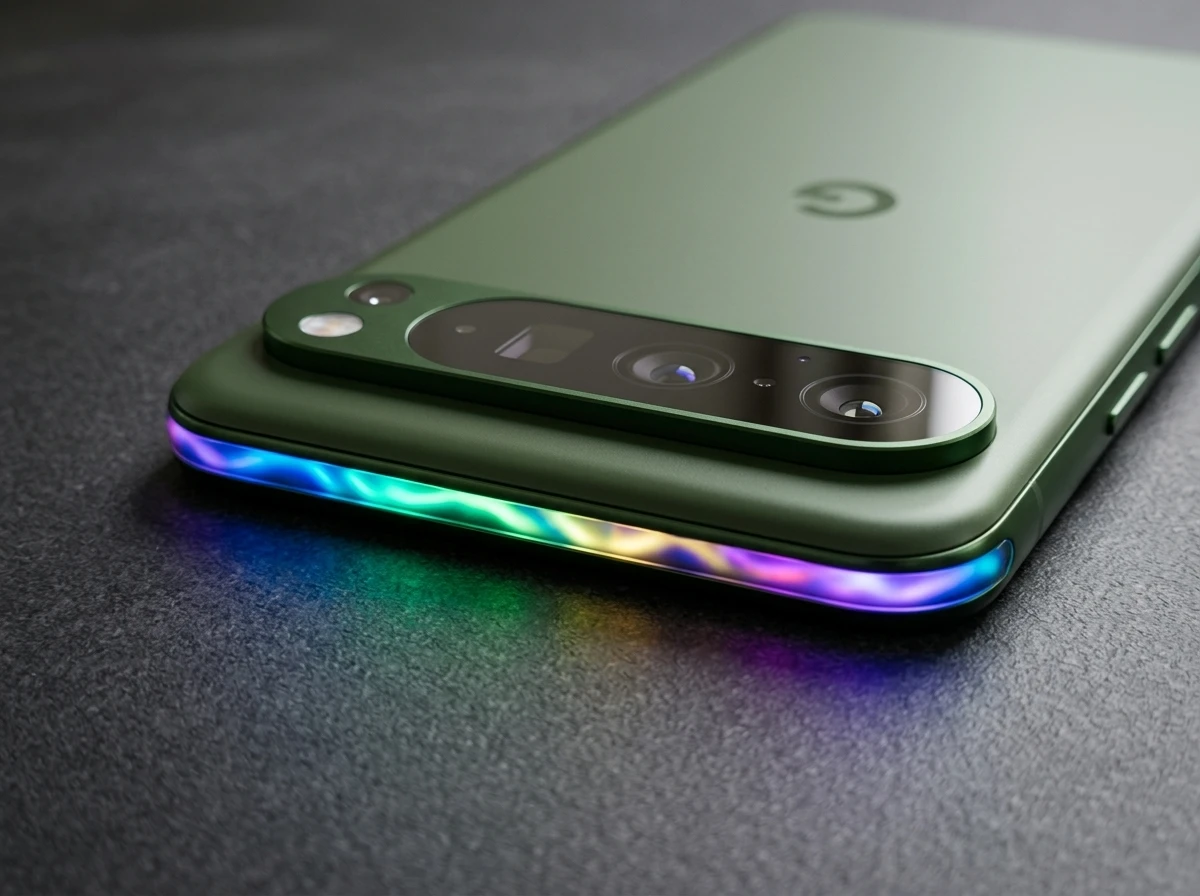
Google has confirmed Pixel Glow in official teasers. An RGB LED matrix sits inside the rear camera bar and lights for notifications, calls and charging status when the phone is face down. It revives the classic Android notification LED that disappeared from most flagships around 2018, now integrated into the hardware island instead of a separate bezel lamp.
The feature draws obvious comparisons to Nothing’s Glyph system, though Google appears to keep the implementation simpler and more notification-focused. Some early reaction on X treated the light as underwhelming once close-up footage appeared.
This is how the Pixel Glow will actually look like on the Pixel 11 Series And it’s literally just a tiny dot on the right? What’s even the point of adding this?
That post from @Cartidise drew hundreds of likes and captured a common thread: the light is welcome in principle, yet its size and placement leave some unconvinced it replaces Always-On Display habits. Google’s own teaser language emphasizes subtle color cues for important activity. Customization depth remains unconfirmed until the event.
The same camera bar that once housed a thermometer on prior Pros now carries the glow hardware on the new generation, according to multiple leaks. Design language stays familiar while the light gives the rear a more expressive signature. For more on how Google is pitching the feature, the site’s coverage of the official Pixel Glow teaser details tracks the recent videos.
The Fold Climbs and the Tracker Arrives
At $1,899 the Pixel 11 Pro Fold sits $100 above Samsung’s current top foldable in many comparisons. Google’s case rests on tighter Gemini integration across the inner display and the software polish that has improved with each Fold generation. Hardware thickness and weight remain competitive according to the thinner Pixel 11 Pro Fold renders already circulating, with an unfolded profile near 5 mm in one dimension.
The more surprising accessory may be the Pixel Tag. Listings and images show a small pill-shaped Bluetooth tracker expected around $35, matching AirTag territory. It plugs into the broader Android Google Find Hub network for trackers, a crowdsourced system that already helps locate offline devices and accessories. That ecosystem reach is the practical edge against Apple’s closed network for anyone living outside a full iPhone household.
- Pixel Tag: ~$35, Find Hub compatible, model numbers already in European catalogs
- Pixel Watch 5: confirmed for the same stage, design language teased alongside the phones
- No charger in the box across the phone lineup, consistent with recent years
- Qi2 wireless charging support listed on the slab models
Google is bundling the phones with a wider accessory story rather than relying on the handsets alone.
Who Still Gets the Better Deal
Owners on a Pixel 9 or Pixel 10 will see iterative camera work, the Glow light, modem gains and the 2nm efficiency bump. Those upgrades feel nice rather than mandatory for most. Owners still on a Pixel 7 or earlier pick up two full chip generations, meaningfully better low-light photography, modern AI features and the modem fix in one jump. That group still faces a higher entry ticket than previous upgrade cycles offered.
The sharper question sits with shoppers comparing a new Pixel against a mid-range Android or last year’s flagship discounts. On-device Gemini Nano, call screening, real-time translation and advanced photo tools remain scarce below $600-700. That software layer is now the entire remaining justification for paying flagship money. Hardware specs look competitive but no longer bargain-priced against the Galaxy S26 Ultra or iPhone 18 Pro class.
Memory cost pressure is real across the industry. Google’s choice to pass it through while raising the storage floor simply removes the old pricing lever that once pulled fence-sitters. After August 12 the company will have to prove the Tensor G6 and Gemini experiences are worth the new numbers on their own. Pre-order traffic and early return rates in the first 30 days will show whether that bet lands.
The phones themselves look ready. The pricing story is the one that already changed.


South Korea Retail Investors Face Reckoning After KOSPI AI Rally Collapses

Surrey AI Maps Three Heart Attack Paths and Their Molecular Roots

Germany Locks Neutral Apple ATT Prompts Across Most of Europe

Apple’s 5% EU Fee Quietly Rewrites Alternative App Store Math

Apple’s EU Fee Truce Cuts Complexity but Leaves Rivals Fuming

Pixel 11 Pro Fold Trades Thinness for Durability and Seven-Year Stay

Mayo AI Flags HCM Obstruction From Everyday Ultrasound Videos

Indian Brands Quietly Scale Landmark Screens and Home Tech

Navin Vatsa Turns Grief Into a Lifetime of Quiet Seeing

Google Bets Pixel 11 Agentic AI Will Redefine Phones

Oracle Cuts 21,000 Jobs in a Year, Cites AI in 10-K Filing

Fable 5 and Mythos 5 Return as US Lifts Anthropic Export Controls

SpaceX’s Google Deal Turns a Rocket Company Into a Cloud Landlord

CD Projekt Red Co-CEO: Redemption Arc Isn’t Done, Witcher 4 in 2027

XPL Rallies 30% Ahead of Plasma One Card Tier Launch

Google Search Profiles Build a Follow Graph Inside Discover

DGO App Brings Rs 549 Mobile Pass for FIFA World Cup 2026 in Nepal

Moonshot AI Targets $30 Billion in China’s Fastest AI Funding Sprint

Oppo’s ColorOS 17 Eligibility List Leaves A-Series Buyers Behind

Microsoft Xbox Layoffs Start in July as Sharma Slams 3% Margin
-
 AI2 months ago
Oracle Cuts 21,000 Jobs in a Year, Cites AI in 10-K Filing
-
 AI2 months ago
Fable 5 and Mythos 5 Return as US Lifts Anthropic Export Controls
-
 AI3 months ago
SpaceX’s Google Deal Turns a Rocket Company Into a Cloud Landlord
-
 GAMING2 months ago
CD Projekt Red Co-CEO: Redemption Arc Isn’t Done, Witcher 4 in 2027
-
 CRYPTO3 months ago
XPL Rallies 30% Ahead of Plasma One Card Tier Launch
-
 NEWS3 months ago
Google Search Profiles Build a Follow Graph Inside Discover
-
 APPS3 months ago
DGO App Brings Rs 549 Mobile Pass for FIFA World Cup 2026 in Nepal
-
 AI3 months ago
Moonshot AI Targets $30 Billion in China’s Fastest AI Funding Sprint