
APPS
Apple’s EU App Store Truce Still Taxes the Exit
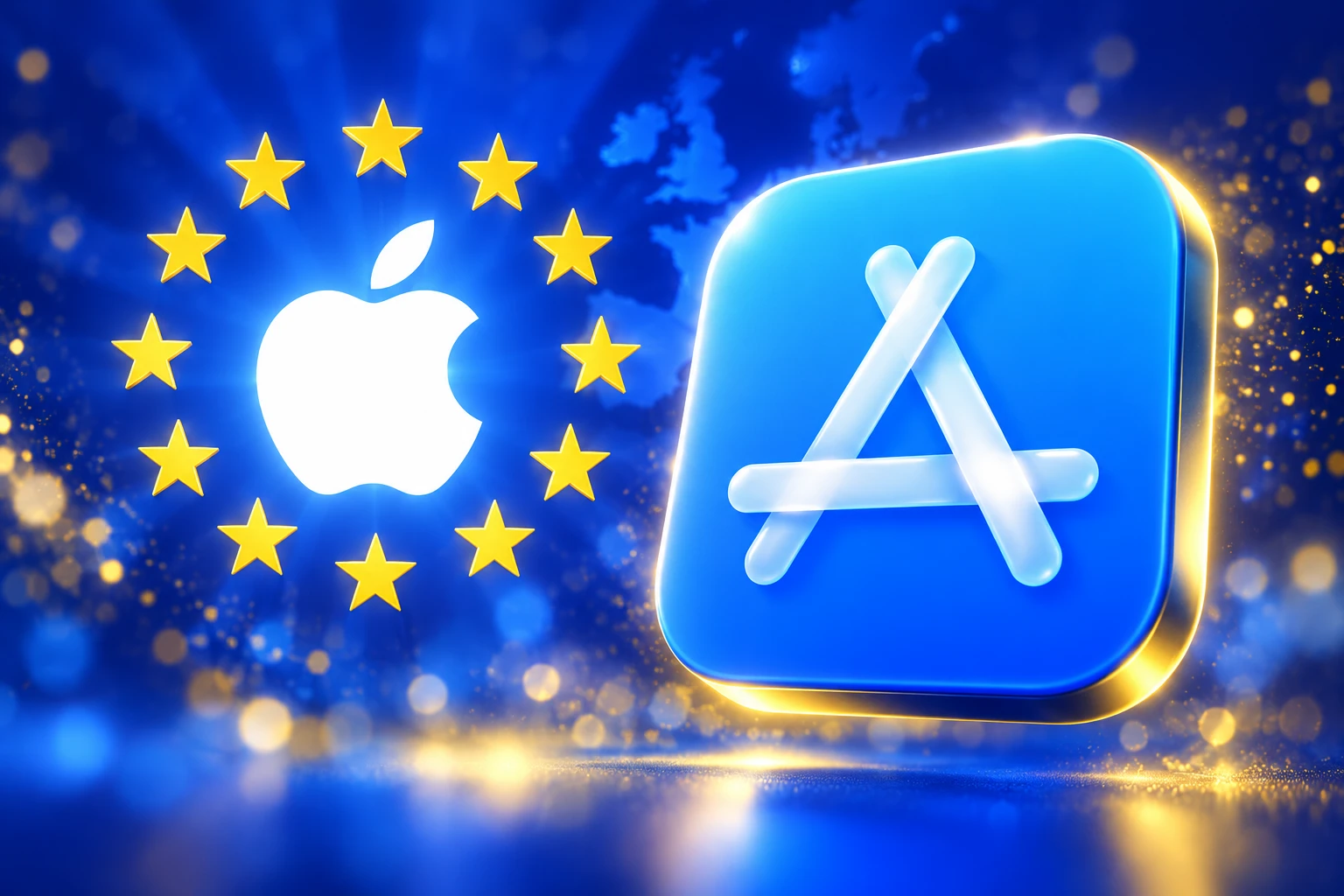
Apple’s DMA deal replaces the Core Technology Fee with a 5 percent charge on off-store sales, while a 15 percent link-out fee remains.

Apple will charge a 5 percent Core Technology Commission on digital sales in EU apps sold outside the App Store from October 1. The European Commission welcomed the new terms and said it will watch how they are rolled out.
Apple also set a 15 percent fee on purchases completed after a user leaves an App Store app. That is the same class of steered sale the Commission fined the company €500 million for in April 2025, when it held that those contracts had to be free of charge.
What Developers Pay After October 1
Apple is putting every EU developer on one commission card. The Core Technology Fee, a per-install charge on very large apps, is gone. So are the initial acquisition fee and the store services fee. In their place sits a short list of percentage cuts on digital goods and services, which go into effect on October 1.
Apps that stay on the App Store and use Apple In-App Purchase will pay 26 percent. Apple says the vast majority of developers, including those in the App Store Small Business Program, the Mini Apps Partner Program, or the Video Partner Program, and auto-renewing subscriptions after the first year, will pay 15 percent. That 26 percent line is a cut from the classic 30 percent App Store rate the Commission recorded under Apple’s original terms.
THE NEW EU RATE CARD
| How the sale happens | Standard rate | Reduced rate |
|---|---|---|
| App Store app, Apple In-App Purchase | 26% | 15% |
| App Store app, other in-app payment | 20% | 10% |
| App Store app, user finishes on the web | 15% | 10% |
| Rival marketplace or the web | 5% CTC | 5% CTC |
The reduced column applies to the programs named above. Apple listed the year-two subscription cut only on the In-App Purchase line, so that 15 percent figure should not be read across the whole table.
Developers can now offer Apple In-App Purchase next to other payment options, which the company had not allowed in the EU. They pick In-App Purchase, in-app alternative processing, a web link, or a mix, and they must keep that mix for 12 months. That lock is the quiet part of the card. A studio that tests a cheaper web checkout is stuck with that setup for a year, which makes a slow walk away from Apple’s own payments harder than a one-line rate cut implies.
The Fine Was for Charging on Steering
The Digital Markets Act’s Article 5(4) is short. A gatekeeper must let business users talk to customers they acquired through the platform, promote other offers, and close those contracts even if the sale happens somewhere else.
A gatekeeper shall allow business users, free of charge, to communicate and promote offers, including under different conditions, to end users acquired via its CPS or through other channels, and to conclude contracts with those end users, regardless of whether, for that purpose, they use the CPSs of the gatekeeper.
Article 5(4), Regulation (EU) 2022/1925, as restated in the Commission decision of 23 April 2025
The Commission applied that rule to Apple’s App Store in case DMA.100109. It found that Apple limited how developers could steer users and that it charged a fee on steered transactions beyond pay for an initial acquisition. The summary of that decision says developers must be able to conclude contracts with those end users free of charge.
None of Apple’s then-current EU contracts passed. The original terms banned steering and kept a 30 percent or 15 percent cut on in-app digital sales. The March 2024 “new business terms” allowed one link-out per app per member state, wrapped it in a warning sheet, and still charged a recurring commission on purchases within seven days of the tap, plus a 3 percent processing fee if the app used In-App Purchase, plus the Core Technology Fee of €0.50 per annual install. Music streaming terms charged 27 percent after a link-out. The Commission said those fees were not limited to an initial acquisition and were not in line with its value.
HOW THE DMA FILE GOT HERE
- March 7, 2024: DMA duties apply to Apple’s designated App Store service.
- March 2024: Apple adds alternative EU terms, including the €0.50 Core Technology Fee.
- April 23, 2025: The Commission issues a non-compliance decision and a €500 million fine, with a 60-day cease-and-desist clock.
- April 2026: The Coalition for App Fairness says Apple has relabelled fees rather than dropping the tax on steering.
- August 18, 2026: Apple announces the unified EU card after what it calls close collaboration with the Commission.
- October 1, 2026: The new rates and rules take effect.
A Commission spokesperson said the body welcomes Apple’s changes, which follow a close dialogue after the April 2025 steering decision and preliminary findings on alternative distribution. The same statement said the Commission will monitor effective implementation, and that EU users have a right to full and effective choice of alternative app distribution channels. Apple, for its part, said the changes resolve its disagreements with the Commission over business terms and alternative distribution.
Japan and Brazil Already Run This Card
Tim Sweeney, CEO of Epic Games, wrote that Apple had launched “a new junk fee structure in EU, mirroring the terms in Brazil and Japan.” The rate tables on Apple’s own developer pages back the comparison. The EU did not invent a local compromise. It imported a stack Apple had already deployed for Brazil’s CADE settlement and Japan’s Mobile Software Competition Act.
THE SAME STACK IN THREE MARKETS
| Charge | EU from October 1 | Japan and Brazil |
|---|---|---|
| App Store sale with Apple payments | 26% (15% in programs) | 21% commission plus 5% processing (10% plus 5% in programs) |
| User finishes on a website | 15% (10% in programs) | 15% store-services fee (10% in programs), for sales within seven days of the tap |
| App sold on a rival store | 5% Core Technology Commission | 5% Core Technology Commission |
The 26 percent EU In-App Purchase rate matches the Japan and Brazil total of a 21 percent commission plus a 5 percent processing fee, billed as one line instead of two. The off-store 5 percent Core Technology Commission is the same figure in all three. So is the 15 percent hit on a web checkout from an App Store app. Apple’s EU announcement does not restate the seven-day window that still sits in the Japan and Brazil license language, so that window should not be assumed for Europe.
Epic Games has long sold the Epic Games Store as a 0 percent to 12 percent alternative, a range Sweeney set out when the first DMA terms appeared. A 5 percent Apple cut on a rival iOS store still leaves a gap, but it is a gap Apple collects on commerce it does not host. That is the part Sweeney calls unlawful under the DMA, because the statute’s “free of charge” line is about steered contracts, not about whether 5 percent looks cheaper than 26 percent.
A Parental Gate Sits on the Exit
Apple says it worked with the Commission on child-safety rules for alternative payments, and those rules sit on the paths the DMA opened. Apps in the Kids category cannot offer an out-of-app website purchase, and any in-app alternative payment flow must sit behind a parental gate. For users under 13, out-of-app offers are banned and alternative in-app payments need a parent. For users 13 to 17, both the in-app alternative and the web offer need a parental gate. Some EU storefronts raise the 13-year line to 16, and Apple says the same gates then apply at that higher age.
Sweeney argued those rules add “prohibitions and friction to herd kids into high-junk-fee Apple payments.” The Kids-category ban on web checkout does exactly that for the one App Store shelf aimed at children: the only remaining checkout is Apple’s. For everyone else, the parental gate is an extra step on the cheaper path, not on In-App Purchase.
Every app that leaves the App Store still has to pass Apple Notarization, a baseline review the company is keeping. Apple describes it as a check on basic function and on serious threats, using automated scans and human review for malware, crashes, privacy abuse, and fraud. Store apps still go through full App Review on top of that. Apple encrypts and signs alternatively distributed binaries, and it says it can block launch and new installs if malware shows up later. Notarization is also how iOS builds the install sheet that names the developer, age rating, and screenshots before a sideloaded app lands.
Apple will still update the install flow in the EU in fall 2026, including an API that lets a developer start a website download from inside an app, and a rule that lets EU users keep installing alternative marketplaces and alternatively distributed apps for 90 days while traveling outside the Union. The company is opening the door wider. It is not taking its hand off the latch.
Who Can Open a Rival iOS Store
Starting October 1, a company can run an alternative iOS marketplace or ship apps from its own site if it meets any one of a longer list of tests, and it no longer needs an EU legal entity. Apple’s developer documentation now spells out who can run an alternative marketplace, replacing an older pair of hurdles that demanded two years in the Developer Program and more than 1 million first annual EU installs, or heavy financial backing.
THE NEW WAYS TO QUALIFY
- Credit score: Meet a moderate financial-stability bar as scored by Dun & Bradstreet.
- Public company: Be publicly traded, or be owned by a publicly traded company.
- Venture backing: Have received venture funding from an established investment firm.
- Audited books: Have completed a financial audit by a licensed accountant.
- Public body: Be a government entity, educational institution, or nonprofit approved for a fee waiver.
- Bank paper: Provide a stand-by letter of credit of USD 1,000,000, or the local equivalent.
- Scale: Have 1 million first annual installs worldwide.
The letter of credit and the worldwide install count are still on the list, so the old money-and-scale tests did not vanish. They are now two options among seven. Web distribution, which exists only in the EU, still has no marketplace operator behind it, which is the reason Apple gives for keeping Notarization on every binary. IAP is not available on apps that leave the store, and those sales fall under the 5 percent Core Technology Commission.
Developer Groups Want the Ruling in Writing
The Coalition for App Fairness, whose members include Epic Games and Spotify, said Apple’s new terms “defeat the purpose of the DMA by keeping fees high and blocking true competition.”
Apple’s new terms defeat the purpose of the DMA by keeping fees high and blocking true competition. The EC's acceptance would be a profound failure and missed opportunity to deliver on the law's promise of fair and open digital markets. We urge regulators to reconsider. #DMA
— Coalition for App Fairness (@appfairness) August 18, 2026
In April 2026, a year after the fine, Gene Burrus, the coalition’s global policy counsel, said developers in the United States could already steer users to better deals free of charge while European developers were still taxed under relabelled fees. That inversion is the political problem Brussels now owns. The August card drops the €0.50 install fee and the extra named add-ons, then puts a clean 15 percent on the link-out and a clean 5 percent on the rival store. Critics read that as the same charge with the serial numbers filed off. Apple reads it as pay for tools, technologies, and services that exist whether or not the App Store hosts the transaction.
Epic Games Newsroom put the statutory point in one post: the law requires link-outs “free of charge” and “effective use” of competing stores, and “Apple’s terms deliberately violate the Digital Markets Act.” If the Commission accepts the terms and drops enforcement, Epic said, “the law will become meaningless.”
Apple announced new junk fees in the EU that do nothing to open up the mobile app ecosystem to competition, as required by Digital Market Act.
Apple will charge:
• 20% fee on alternative in-app payment options
• 15% fee on links to make purchases outside apps
• 5% Core…— Epic Games Newsroom (@EpicNewsroom) August 18, 2026
In September 2026, the Coalition for App Fairness and the European Games Developer Federation, joined by other developer groups, sent the Commission an open letter on the August terms. The letter’s core complaint is the 15 percent steering fee, and it also objects to the 5 percent Core Technology Commission as a new deterrent on rival stores. The groups asked the Commission to say, in a formal reasoned conclusion, whether the April 2025 findings are closed.
WHERE THE TWO SIDES DISAGREE
- Apple: The unified card resolves disagreements with the Commission, cuts complexity, and still pays the company for value it creates on and off the App Store.
- The Commission: It welcomes the changes and will monitor how they work, while restating that EU users have a right to full and effective choice of other distribution channels.
- Epic and the Coalition for App Fairness: A 15 percent fee on link-outs and a 5 percent tax on rival stores still break Article 5(4) and keep real store competition from arriving.
That split will not be settled by the rate table. It will be settled by whether the Commission treats the August card as the end of DMA.100109 or as another draft. Until that written conclusion exists, Apple has a portable fee menu that already runs in Japan and Brazil, and EU developers have a 12-month clock on whatever checkout they pick before October 1.

Instagram Plus Tests a Read-Only Mode That Cuts Stories

Altman Asks the Public to Accept Some AI Harm

Google Freezes OSS VRP Product Reports After AI Flood

AI Agents Make Payment Rails the Scarce Prize

Turkey’s Crypto Boom Now Runs Through Three Banks

Fable 5 Came Back Under a Commerce On-Off Switch

Google’s SpaceX GPU Lease Has a Sept. 30 Deadline

Plasma One’s XPL Locks Face a 1.81 Billion Cliff

DGO’s Rs 549 World Cup Pass Cost Fans Sleep and Data

Moonshot AI’s $30 Billion Ask Became a $35 Billion Close
-
 AI4 months ago
Fable 5 Came Back Under a Commerce On-Off Switch
-
 AI5 months ago
Google’s SpaceX GPU Lease Has a Sept. 30 Deadline
-
 CRYPTO4 months ago
Plasma One’s XPL Locks Face a 1.81 Billion Cliff
-
 APPS4 months ago
DGO’s Rs 549 World Cup Pass Cost Fans Sleep and Data
-
 AI5 months ago
Moonshot AI’s $30 Billion Ask Became a $35 Billion Close
-

 NEWS5 months ago
ColorOS 17 Device List Spans Oppo, OnePlus and Realme
-

 GAMING4 months ago
Xbox Cuts 3,200 Jobs After Five Years of Thin Returns
-
 GAMING4 months ago
The RTX 4050 Under Rs 70,000 Hides a Wattage Gap