
AI
The Deadliest Heart Attack Path Runs Through the Lungs
A Surrey AI study of 12,701 heart attack survivors found a smoking-linked path with 43.9 percent mortality, pointing care away from the cath lab.

Heart attack survivors in a UK Biobank study split onto three five-year illness paths, and the deadliest one is not mainly a heart path. Researchers at the University of Surrey clustered the records of 12,701 people with a recorded heart attack and found a smoking-linked, multi-organ course with a 43.9 percent death rate.
The work, in the Journal of the American Medical Informatics Association, presents an AI tool that can personalize follow-up from the day of the attack. The sharper result is who that follow-up belongs to: lungs, stop-smoking services, and GPs in poorer postcodes, not only the cardiology clinic.
A Heart Attack, Then Three Different Illnesses
Lead author Dr Anthony Onoja, a research fellow at Surrey, and senior author Professor Nophar Geifman, professor of health and biomedical informatics, pulled every participant with an ICD-10 heart-attack code (I21) from UK Biobank application 83988. They lined up diagnoses in the five years after the attack as sequences, then grouped people who accumulated similar conditions in a similar order.
The published paper, using explainable temporal modelling of post-attack records, names three courses. Acute cardiorenal-respiratory disease with metabolic illness (ACUTE-CARD) took 63.4 percent of the cohort, 8,052 people. Smoking-related multisystem multimorbidity (SMO-CARD) took 23.1 percent, 2,929 people. Cardiometabolic disease with arrhythmic-ischemic burden (CARDIOMIX) took 13.5 percent, 1,720 people.
THE THREE FIVE-YEAR PATHS
| Path | People (share) | All-cause death | CVD death | Median SMART | Median IMD |
|---|---|---|---|---|---|
| ACUTE-CARD | 8,052 (63.4%) | 12.8% | 6.8% | 11.2 | 13.5 |
| CARDIOMIX | 1,720 (13.5%) | 20.6% | 11.8% | 11.2 | 12.7 |
| SMO-CARD | 2,929 (23.1%) | 43.9% | 16.2% | 14.0 | 15.6 |
Across the full 12,701, 2,673 people died (21.0 percent) and 1,224 deaths were classed as cardiovascular (9.6 percent). The largest group is the one cardiology already knows how to treat: blood pressure, lipids, diabetes, and episodic heart or lung flares. It is also the group that died least.
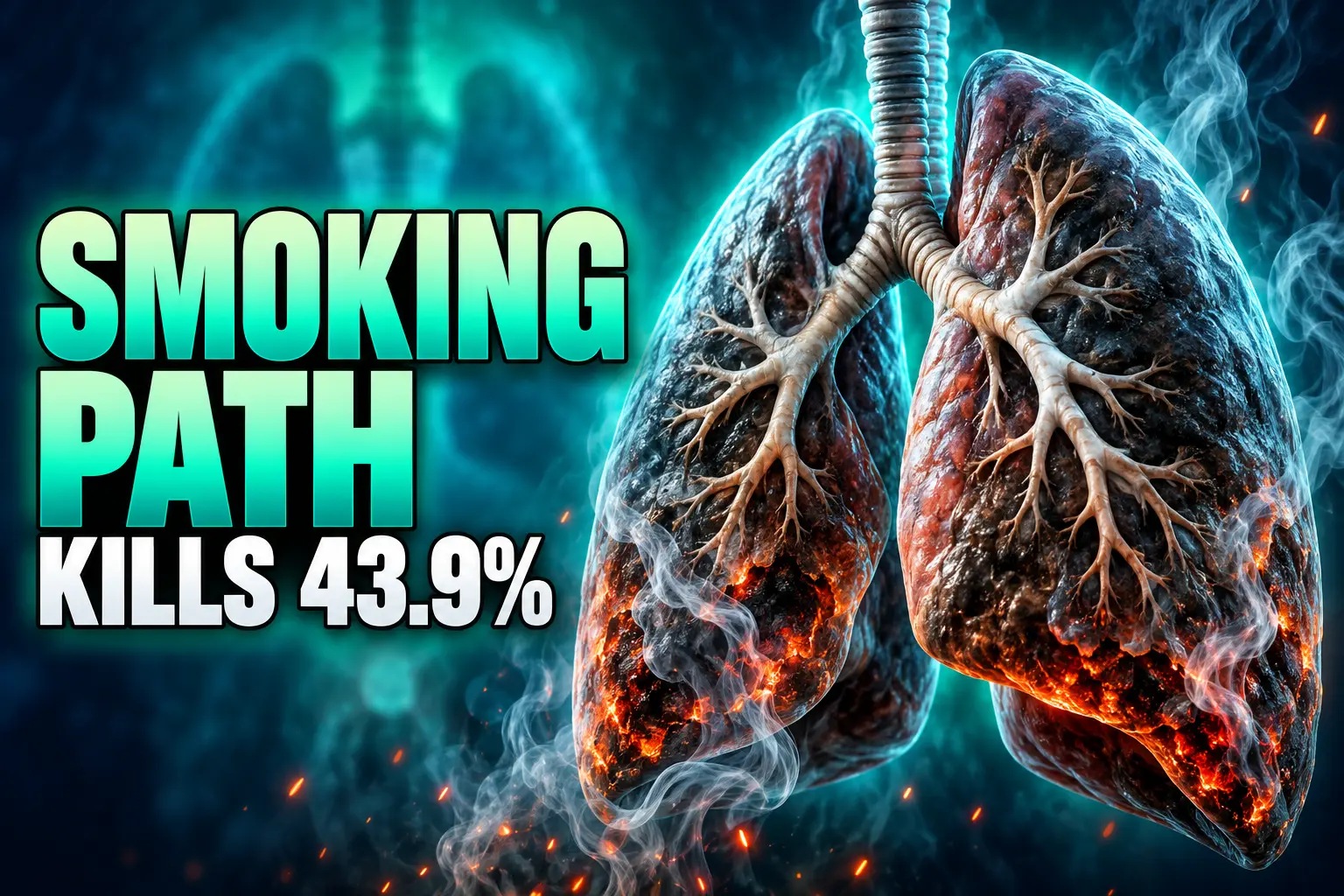
43.9 Percent Die on the Smoking Path
SMO-CARD is older (median age 64 against 61 in the other two), more deprived (median Index of Multiple Deprivation 15.6 against 13.5 and 12.7), and heavier with prior disease. Diabetes sat at 15.7 percent in this cluster against 3.5 percent in ACUTE-CARD. Coronary disease sat at 22.6 percent against 3.9 percent. Stroke sat at 12.8 percent against 4.4 percent.
The diagnostic themes are not a second infarct waiting to happen. They run through nicotine dependence, pneumonia, pleural effusion, musculoskeletal pain, mobility limits, kidney injury, heart failure, and atrial fibrillation. Onoja said the team could see this course at the attack itself from prior diagnoses and basic demographics, and that respiratory disease, older age, and higher deprivation scores were the markers that picked out the highest-risk group.
All-cause death in SMO-CARD was more than three times the 12.8 percent rate in the largest group. Cardiovascular death was 16.2 percent against 6.8 percent. A clinic that only intensifies antiplatelets and statins is treating the smaller part of that risk.
Genetic checks were used to test whether the labels were just coding artefacts. Phenome-wide scans mapped each cluster to different molecular routes: immune activation and tissue remodelling in the largest group, insulin signalling and lipid transport in the arrhythmia group, and chronic inflammation and degeneration in the smoking-related group. The genes line up with the clinic notes. They do not, on their own, name the team that should own the follow-up visit.
How the Model Knows at the First Attack
The clustering used diagnosis sequences indexed by age at each code, compared with dynamic time warping, then labelled with topic modelling. A second stage tried to guess, from the year before the attack plus age, sex, body-mass index, and deprivation, which of the three courses a person would join.
WHAT THE PIPELINE ACTUALLY DID
- The window: Diagnoses were split into the year before the attack and the five years after, for every one of the 12,701 people.
- The grouping: Post-attack ICD-10 sequences were clustered; people had a median of 8 later diagnoses (range 0 to 66) and 4 earlier ones (range 0 to 47).
- The guess: Pre-attack codes and demographics trained four classifiers, and the published paper reports an XGBoost AUC-ROC of 0.906 (95 percent CI 0.895 to 0.916), with CatBoost close behind at 0.900 (0.889 to 0.910).
- The read-out: SHAP values for the large cardiometabolic cluster put ischaemic heart disease, dyslipidaemia and obesity, hypertension, and rhythm problems at the top of the pre-attack clues.
Onoja called the tool “incredibly effective at finding and predicting the highest-risk group,” and also said the work is “still early in this journey.” An AUC above 0.90 on a hold-out slice of UK Biobank is a strong lab result. It is not a bedside device, and it is not a reason to retire the scores cardiologists already type into a browser.
Clinics Still Lean on the SMART Score
Geifman put that limit in plain language. The SMART family of scores, built to estimate the 10-year risk of another vascular event in people who already have arterial disease, remained the strongest single predictor of death in this cohort. The three paths added something a single number cannot: why the risk is high, and which organ system is carrying it.
We found that these tools are still the strongest single predictor of mortality in our study, but the trajectories added detail that a stand-alone score cannot provide. The patterns we have identified show that we can capture more than just a patient’s risk but, crucially, why, and where intervention could be needed.
Nophar Geifman, Professor of Health and Biomedical Informatics, University of Surrey
Median SMART was 11.2 in both ACUTE-CARD and CARDIOMIX, and 14.0 in SMO-CARD. After full adjustment for age, sex, deprivation, blood pressure, kidney function, diabetes, and existing arterial disease, the extra signal from the path labels got weaker. That is the honest ranking: the score still wins the death forecast. The clusters win the referral question.
Cardiology is still organised around the night the artery closes. The five-year slog through lungs, joints, kidneys, and poor housing has no single consultant. A label that says SMO-CARD at discharge is useful only if someone other than the infarct team picks it up.
A 41 Percent Rehab Ceiling After Heart Attacks
The NHS already knows follow-up is thin. In 2023, 41 percent of eligible acute coronary patients in England joined cardiac rehabilitation, NICE said, and uptake is worse among women, younger people, ethnic minority groups, and people in deprived areas, the same mix the smoking path over-represents.
THE REHAB GAP THE LABEL RUNS INTO
- The ACS rate: 41 percent of eligible people with heart attack or angina joined rehab in England in 2023.
- The date: On 4 December 2025, NICE conditionally backed seven digital cardiac rehab platforms for a three-year evidence window.
- The named tools: Activate Your Heart, D REACH-HF, Digital Heart Manual, Gro Health HeartBuddy, KiActiv, myHeart, and Pumping Marvellous Cardiac Rehab Platform.
- The catch in the guidance: Extra support may be needed for older people, those with disabilities, people experiencing homelessness, and people who do not have English as a first language, the groups closest to SMO-CARD.
Dr Anastasia Chalkidou, HealthTech programme director at NICE, said traditional programmes are not reaching everyone who could benefit, particularly women, younger patients, and people from ethnic minority backgrounds. Digital kits may help the patient who cannot take a weekday bus to a gym class. They help less if the person is 64, short of breath, and living in a postcode the deprivation index already flagged.
A trained clinician still has to judge fitness for a digital programme. People who choose an app keep a right to ordinary rehab. The Surrey label does not change that gate. It only says the person most likely to die in five years is also the person rehab already loses.
Why the Death Rate Is a Low Estimate
UK Biobank recruited about 500,000 volunteers aged 40 to 69 between 2006 and 2010. They are, on average, healthier, wealthier, and less deprived than the people who actually fill infarct wards. The JAMIA paper says that bias can understate how common and how tangled these courses are, and can shrink the weight of deprivation as a predictor.
Median age at the recorded attack in this extract was 69. All-cause death of 21.0 percent over the study window is grim for a volunteer cohort and still likely kinder than a typical NHS list. If SMO-CARD is 23.1 percent here, a clinic population with more smokers and more crowded housing will throw a larger share onto that path.
Onoja said hospitals could, in future, spot these courses early and build tailored care. The paper does not offer a deployed product, an NHS procurement route, or a trial that tests whether tagging SMO-CARD at discharge cuts deaths. The preprint carried the usual warning that unreviewed work should not guide practice; the peer-reviewed version is stronger science, not a service specification.
Respiratory Teams Inherit the Deadliest Cohort
Read the three labels as a routing slip. ACUTE-CARD, 8,052 people, stays with cardiology and metabolic clinics: lipids, blood pressure, diabetes, and the usual second-prevention pack. CARDIOMIX, the smallest group, needs rhythm surveillance and kidney watch as well as that pack. SMO-CARD needs a respiratory clinic, a stop-smoking service that actually holds the patient, physio for mobility, and a GP list that can see more than the stent.
The AI’s useful output is not a shinier SMART number. It is a name for the 2,929 people whose next threat is lungs, inflammation, and deprivation, and whose 43.9 percent death rate will not move if the only extra resource is another cardiology slot. Until rehab, respiratory medicine, and primary care share that label, the model is a paper diagnosis of a system that already knows it misses the same patients.
Frequently Asked Questions
What clustering method found the three heart attack paths?
The team compared post-attack ICD-10 sequences with dynamic time warping k-means, testing two to nine groups, then used latent Dirichlet allocation with two topics per cluster to name the themes. Pre-attack codes were rolled into 27 organ-system counts before the classifiers ran, which is why a clinic could, in principle, score a path from records that already exist on the day of the infarct.
How close were XGBoost and CatBoost on path prediction?
In the published JAMIA analysis, XGBoost led with an AUC-ROC of 0.906 (95 percent CI 0.895 to 0.916) and CatBoost reached 0.900 (0.889 to 0.910). Those intervals overlap, so the practical gap between the two tree models is small; both beat the simpler logistic and random-forest baselines the authors also trained.
What information does the SMART2 score use?
SMART2 estimates 10-year recurrent atherosclerotic events from age, sex, current smoking, diabetes, systolic blood pressure, non-HDL cholesterol, which arterial beds are already diseased, kidney function (eGFR), hsCRP, and years since the first clinical arterial event. It was updated and checked across regions using 64,513 cardiovascular events in 377,399 people with established arterial disease, and it is built for a second event, not for a five-year map of lungs and joints.
How low is rehab uptake for heart failure compared with heart attack?
NICE said 13 percent of eligible people with heart failure in England joined cardiac rehabilitation in 2023, against 41 percent of eligible people with acute coronary syndrome. NHS planning still talks about lifting access from about 50 percent toward 85 percent by 2028; a smoking-path tag will not meet that target if the extra seats go to the fittest 63.4 percent.
Disclaimer: This article is news reporting and analysis of a published research paper and related NHS guidance. It is informational only and is not medical advice, a diagnosis, a treatment plan, or a recommendation to change medication, rehab, or smoking care. Readers who have had a heart attack, or who are making decisions about secondary prevention, should speak with their cardiologist, GP, or cardiac rehabilitation team before acting on any figure or label described here. Cluster sizes, death rates, model scores, and rehab uptake reflect the named papers and NICE statements as published and may be revised if the authors, UK Biobank, or the health service issue updates.

Twelve South’s $40 Cube Fills the Wired CarPlay Gap

The Yemen Cell Kept Claude’s Flight Code After the Ban

Unofficial AI Pages Beat Marshall County’s Sheriff to Every Scare

The SEC Crypto Rule Leaves Exchanges Still Exposed

Brian Bengs Bets His Senate Race on an AI Stop

Fable 5 Came Back Under a Commerce On-Off Switch

Google’s SpaceX GPU Lease Has a Sept. 30 Deadline

Plasma One’s XPL Locks Face a 1.81 Billion Cliff

DGO’s Rs 549 World Cup Pass Cost Fans Sleep and Data

Moonshot AI’s $30 Billion Ask Became a $35 Billion Close
-
 AI3 months ago
Fable 5 Came Back Under a Commerce On-Off Switch
-
 AI4 months ago
Google’s SpaceX GPU Lease Has a Sept. 30 Deadline
-
 CRYPTO4 months ago
Plasma One’s XPL Locks Face a 1.81 Billion Cliff
-
 APPS4 months ago
DGO’s Rs 549 World Cup Pass Cost Fans Sleep and Data
-
 AI4 months ago
Moonshot AI’s $30 Billion Ask Became a $35 Billion Close
-

 NEWS4 months ago
ColorOS 17 Device List Spans Oppo, OnePlus and Realme
-

 GAMING4 months ago
Xbox Cuts 3,200 Jobs After Five Years of Thin Returns
-

 GAMING3 months ago
The RTX 4050 Under Rs 70,000 Hides a Wattage Gap