
AI
South Korea Tied Household Wealth to Two Chipmakers
Korea’s AI rally listed 16 two-times funds on Samsung and SK hynix three weeks before the peak, then sent wedding savings, polls.

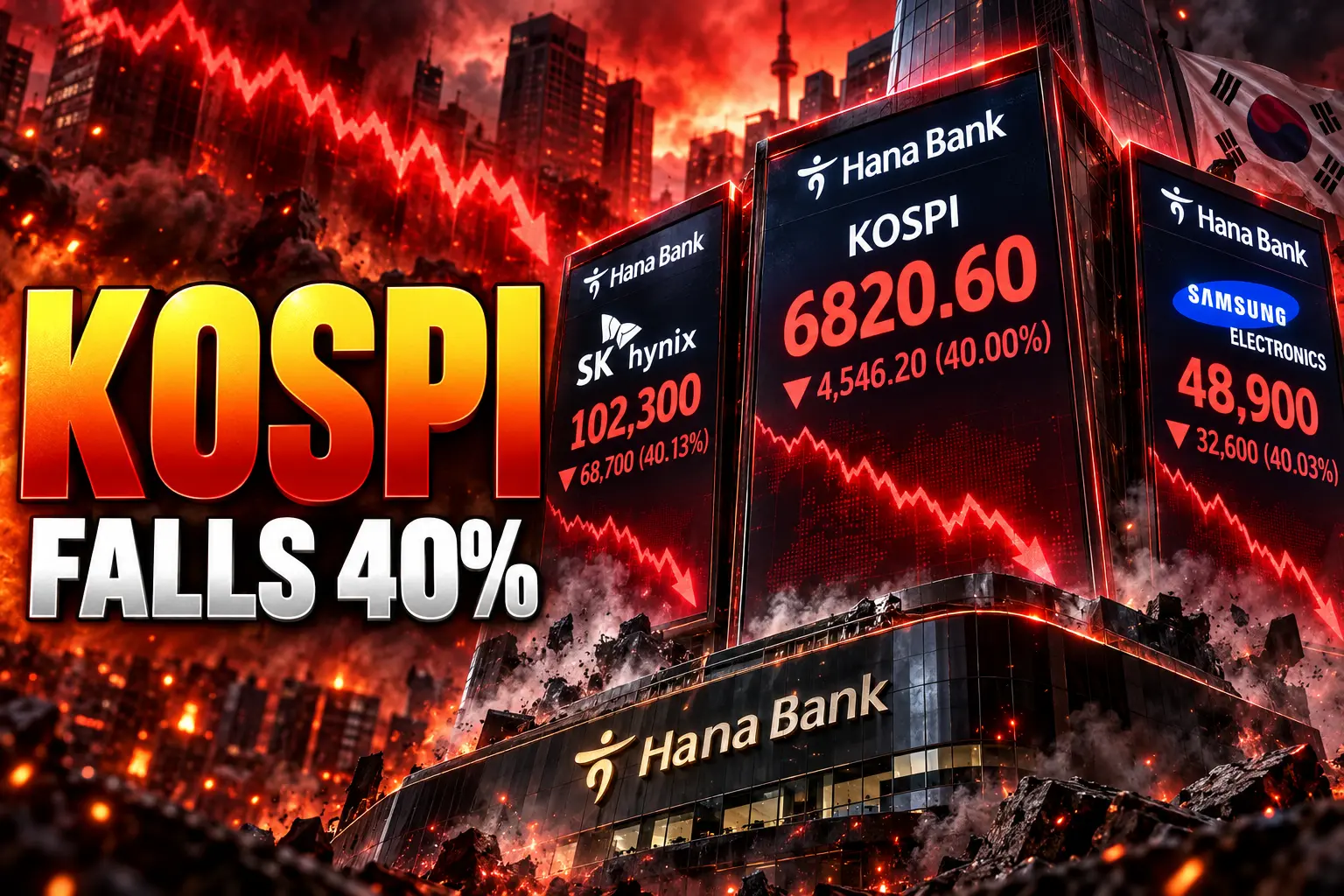
South Korea’s KOSPI fell nearly 40 percent from a June 19 peak of 9,385.59, and wedding savings parked in two chipmakers went with it.
Eun-bi, a civil servant in her thirties, had pulled most of her savings into SK hynix and a U.S. semiconductor fund to pay for an April 2027 wedding. After the slide she was weighing a smaller ceremony, or no honeymoon. The same drive that pulled households into the index also listed sixteen two-times funds on the two names already sitting in most Korean accounts, three weeks before that peak, so presidential polls, margin desks, and overseas hedge funds now reprice with high-bandwidth memory sentiment.
The Index That Doubled, Then Gave It Back
The KOSPI rose 101.14 percent in the first six months of 2026, cleared 5,000 in January and 8,000 in May, and closed at 9,063.84 on June 18, its first finish above 9,000. The next session it printed an all-time intraday high of 9,385.59. By July 30 it was back below 5,595. July’s 34.01 percent monthly drop was the steepest on record, worse than the 27.24 percent fall in October 1997 during the Asian financial crisis.
The bounce was real and incomplete. On July 31 the index jumped 17 percent to 6,549 after three sessions of heavy selling. It later poked above 7,000, then failed to hold the round number. On August 18 it reached 7,216.62 and closed at 6,869.83, a reversal of about 347 points. On September 8 it traded at 7,047.03 in the afternoon after a high of 7,171.52, the first reclaim of 7,000 in 15 sessions, and then faded again.
KOSPI MARKS THROUGH THE AI RUN
| Date | What it marked | |
|---|---|---|
| June 18, 2026 | 9,063.84 close | First close above 9,000 |
| June 19, 2026 | 9,385.59 intraday | Record peak |
| July 30, 2026 | Below 5,595 | Most of the rally gone |
| August 18, 2026 | 7,216.62 high, 6,869.83 close | Failed hold above 7,000 |
| September 8, 2026 | 7,171.52 high, 7,047.03 afternoon | First reclaim of 7,000 in 15 sessions |
Even on the June 18 record close, 791 of 917 traded stocks fell. The average Korean share was not at a high. Two memory makers were.
Sixteen 2x Funds Listed Three Weeks Before the High
On May 27, with the KOSPI already above 8,000, eight managers including Samsung Asset Management, Mirae Asset, Korea Investment, KB, Kiwoom, Hana, Shinhan, and Hanwha listed 16 single-stock leveraged and inverse funds on Samsung Electronics and SK hynix. They were the first of their kind at home. Hana’s SK hynix two-times product closed 19.46 percent higher. About 10 trillion won changed hands in the new single-stock products that day, and Samsung Asset took more than half of it: 4.388 trillion won into KODEX SK hynix leverage and 1.948 trillion won into the Samsung twin.
The Korea Financial Investment Association’s education site crashed as traffic surged the night before. Industry officials said more than 130,000 people had already finished the two-hour class required to trade the products. Cabinet rules that allowed 2x single-stock funds had been approved on April 21, with a 200 percent cap, so the listings could start from May 22. The Financial Services Commission later said the point was to pull home demand that had been going to similar products listed abroad. Three weeks later the cash market peaked.
The KODEX SK hynix leverage product still showed about 2.6 trillion won in net assets on September 13, built from SK hynix stock, SK hynix futures, and cash. That is a live book, not a closed experiment.
FROM LISTING DAY TO THE CASH FLOOR
- May 27, 2026: Sixteen single-stock leveraged and inverse funds on Samsung and SK hynix begin trading.
- June 19, 2026: KOSPI prints 9,385.59. Margin loans are already at record highs.
- July 16, 2026: Authorities halt new single-stock leveraged products until the market settles, triple the cash deposit, and add training and tighter tracking bands after 19 sidecar halts since listing and 37 on the year.
- July 31, 2026: The 30 million won cash deposit starts early, moved up from August 5. Existing holdings are grandfathered; new buys need cash only, not stock collateral.
- August 19, 2026: Mock trading becomes mandatory and liquidity providers must keep premiums and discounts inside 2 percent, down from 3 percent.
Byun Je-ho, director general of the FSC’s Capital Market Bureau, briefed reporters after Finance Minister Koo Yun-cheol and FSC Chairman Lee Eog-weon reviewed the products.
When the products were launched on May 27, semiconductor stocks were already experiencing heightened volatility. The two factors combined led to much more concentrated demand than had been expected, leaving us with little choice but to introduce safeguard measures to protect both the market and investors.
Byun Je-ho, director general, FSC Capital Market Bureau, Seoul briefing
The FSC also said the swings were not unique to the two Korean names, pointing to larger moves in Micron and Kioxia over the same stretch. A cash floor still changed the local tape. After July 31, trading in the sixteen products shrank and buying rotated into index inverse funds that still double a daily move. The leverage habit did not retire. It changed vehicles.
Two Chipmakers Now Set the National Mood
Samsung Electronics and SK hynix account for more than half of the KOSPI by market value. In the July rout they drove 71 percent of the index’s losses, falling a combined 48 percent against a 26 percent drop for the rest of the market. One later tally put their share of a 2,257.8 trillion won wipeout in market value at 76 percent. Phillip Wool, head of research at Rayliant Global Advisors, put the structure in one line: Korea’s equity market is basically synonymous with the AI hardware trade.
That is why a civil servant funding a wedding and a president reading a weekly poll are watching the same two tickers. Bora Kim, head of Asia at Leverage Shares, said Korean investors in their 30s and 50s were already running concentrated U.S. tech bets and were not new to leverage. Listing a two-times fund on the two stocks already sitting in nearly every Korean portfolio, she said, created a sense of familiarity that clouded judgement of the risk.
Eun-bi did not buy the domestic two-times products, and only because she had run out of cash. She still does not blame President Lee Jae Myung for encouraging stock buying. She does want to spread bets across sectors, watch through the second half of 2026 and the first half of 2027, and convert back to cash before the wedding.
The Forced Sales, Then the Return of Borrowed Money
Borrowed buying turned the slide into a forced sale. The Korea Financial Investment Association put outstanding margin loans at a June peak of 38.6 trillion won ($27.6 billion). By the end of July the balance was 28.9 trillion won, after brokerages sold out clients who could not meet calls. Around the June high, margin tied to Samsung Electronics was 4.76 trillion won and SK hynix 4.33 trillion won, about 9.1 trillion won combined, up from about 2.53 trillion won at the end of 2025.
HOW THE MARGIN BOOK MOVED
- June peak: Total margin loans reached 38.6 trillion won, after first breaking 38 trillion won on May 29, two days after the new funds listed.
- End of July: The book had fallen to 28.9 trillion won as liquidations hit.
- August 4 trough: The balance touched 27.4 trillion won, then started climbing again.
- August 26: KOFIA printed 33.10 trillion won, with about 80 percent, or 26.25 trillion won, in the KOSPI market, while broker loan rates near 10 percent followed a Bank of Korea move to 3.00 percent.
The KOSPI margin-loan balance series built from KOFIA still showed more than 25 trillion won of KOSPI-market debt in September. Investor deposits slipped below 100 trillion won in late August, to 98.92 trillion won, while margin was rising, a mix that usually means cash is thin and the book is not.
This was a second act, not a first. In 2020, retail buyers known as ants purchased a record 64.72 trillion won as foreigners sold, and they accounted for 67.1 percent of KOSPI trades by mid-December that year. In 2026 the scale was larger. Active trading accounts rose from about 86.6 million at the end of 2024 to 110.8 million by July, about 28 percent in 19 months, more than two accounts for every person in a country of about 51.6 million. From January 1 through July 31, individuals were net buyers of 94.2 trillion won of KOSPI shares while foreigners were net sellers of about 152.1 trillion won. In July, as the index posted its worst month since 2008, retail buying of U.S. stocks hit $4.6 billion, above the $2.7 billion monthly average in 2025, and topped buying of domestic shares for the first time since February.
The Bank of Korea had already counted leveraged equity investment by individuals at a record 60 trillion won at the end of May. Daily turnover hit 106.2 trillion won that month. A cash floor in July trimmed one product set. It did not take households out of a two-name market.
How Lee Jae Myung’s KOSPI 5,000 Pledge Recoiled
Lee took office on June 4, 2025, after a campaign built on lifting a market that had lagged global peers. He pledged a KOSPI 5,000 era, bought 40 million won of domestic index ETFs, and promised another 1 million won a month for five years. When the index first crossed 5,000 in January, the presidential office treated the paper gain as proof the plan was working. Spokesperson Kang Yu-jung said he would stand with 14 million retail investors until leaving office.
The products that supercharged the last month of the rally were approved on his watch. Cho Kuk, a former justice minister who left Lee’s Democratic Party to found the Rebuilding Korea Party, called the listing a policy failure on August 5.
Young people who invested trusting the government’s intent were caught in a leverage trap the government itself laid, and are left with debt and trauma they may never shake off. The stock market must not become a casino.
Cho Kuk, leader, Rebuilding Korea Party, Facebook post, August 5, 2026
Lee’s ratings fell with the tape and then kept falling for other reasons. Realmeter had him at 43 percent in a survey conducted August 10-14, then the low of his presidency, and listed the stock slide and the leveraged ETFs among the causes, alongside a property-tax fight and criminal-procedure reforms. Gallup Korea, in fieldwork on September 8-10, put approval at 38 percent and disapproval at 51 percent, the first reading below 40 percent since he took office. That later drop was also tied to cabinet nominees. The market is no longer the only bruise. It is now a standing one.
Benjamin Engel, an assistant professor of Korean politics at Dankook University in Yongin, said politicians are often blamed for swings they do not control, and that people were over-borrowing into an obvious decline. He also said that once households watch the KOSPI this closely, the index becomes a new factor in Korean politics. That is the bill for a campaign that treated 5,000 as a civic project.
Buybacks Hold the Floor While Offshore Leverage Still Bites
The bid under the wreckage is the two companies buying their own shares. SK hynix’s board on August 19 approved a 40 trillion won open-market repurchase of up to 24.07 million shares, about 3.3 percent of the stock, from August 20 through November 19, with all of it to be cancelled. Samsung’s board on August 21 approved a 2026 shareholder return estimated at 90 trillion to 110 trillion won return, which it called the largest ever by a Korean company, about five times its 20.3 trillion won record in 2020. About 30 trillion won is slated as cash dividends in the third quarter. The board also approved a 15 trillion won buyback for employee stock, running on-exchange from August 24 to November 21.
From August 20 through August 28, “other corporations,” the bucket that captures those treasury programs, net-bought 10.187 trillion won of KOSPI shares, about 1 trillion won a day. In the same window foreigners net-sold 7.6685 trillion won and retail investors 2.7974 trillion won. Kwon Beom-seok, a senior researcher at Samsung Securities, said that if the two firms kept up the pace, that corporate bid could run about 30 trading days. Nearly 45 trillion won of the combined 55 trillion won in scheduled on-market buying was still ahead after that first week. Households are selling into the companies’ own bid.
Seoul is no longer the only place the leverage lives. In its Monetary Policy Report to parliament, the Bank of Korea said concentration in chip stocks, foreign rebalancing, and the build-up and unwind of domestic leverage drove the January-to-July swings. It then pointed offshore. Hong Kong-listed leveraged ETFs on Samsung and SK hynix saw combined market value rise more than twenty-fold in the first half of 2026. BlackRock’s U.S.-listed Korea ETF, with about a quarter of its book in SK hynix, took in $2.8 billion in a single week in July. The central bank named Situational Awareness, a U.S. AI-focused hedge fund, as a holder that had used leverage of up to four times in global memory names and then unwound in the July selloff. Banks hedging total-return swaps, it said, trade Korean stock, futures, and options, which can feed back into the cash market.
“Leveraged investment targeting domestic stocks expanded not only domestically but also in international financial markets, creating unexpected spillover effects,” the Bank of Korea said. That is the part a May listing in Seoul cannot switch off. The FSC halted new domestic clones. It cannot halt a Hong Kong two-times fund or a New York swap book.
Eun-bi still thinks the market will function again once the short-term overheating passes. The structure she is waiting on has not changed. Two chipmakers still set the index, the margin book is rising off its August low, the companies themselves are the buyers through mid-November, and the central bank is now writing memos about hedge funds and Hong Kong ETFs. A wedding in April 2027 is a date on a calendar. The KOSPI is a daily vote on two memory stocks, and it now counts outside the exchange as well.
Disclaimer: This article is news reporting and analysis of public market data, company filings, and official statements. It is informational only and is not a recommendation to buy, sell, or hold KOSPI stocks, Samsung Electronics, SK hynix, leveraged or inverse ETFs, or any margin loan. It does not constitute investment, tax, or trading advice and should not be used as a forecast of future prices or of any wedding or household budget tied to those prices. Readers should consult a licensed financial adviser or investment professional, and if needed a credit counsellor, before using borrowed money or leveraged products. Figures and statuses reflect the named official and market sources on the dates given and can change in the next session.

Twelve South’s $40 Cube Fills the Wired CarPlay Gap

The Yemen Cell Kept Claude’s Flight Code After the Ban

Unofficial AI Pages Beat Marshall County’s Sheriff to Every Scare

The SEC Crypto Rule Leaves Exchanges Still Exposed

Brian Bengs Bets His Senate Race on an AI Stop

Fable 5 Came Back Under a Commerce On-Off Switch

Google’s SpaceX GPU Lease Has a Sept. 30 Deadline

Plasma One’s XPL Locks Face a 1.81 Billion Cliff

DGO’s Rs 549 World Cup Pass Cost Fans Sleep and Data

Moonshot AI’s $30 Billion Ask Became a $35 Billion Close
-
 AI3 months ago
Fable 5 Came Back Under a Commerce On-Off Switch
-
 AI4 months ago
Google’s SpaceX GPU Lease Has a Sept. 30 Deadline
-
 CRYPTO4 months ago
Plasma One’s XPL Locks Face a 1.81 Billion Cliff
-
 APPS4 months ago
DGO’s Rs 549 World Cup Pass Cost Fans Sleep and Data
-
 AI4 months ago
Moonshot AI’s $30 Billion Ask Became a $35 Billion Close
-

 NEWS4 months ago
ColorOS 17 Device List Spans Oppo, OnePlus and Realme
-

 GAMING4 months ago
Xbox Cuts 3,200 Jobs After Five Years of Thin Returns
-

 GAMING3 months ago
The RTX 4050 Under Rs 70,000 Hides a Wattage Gap