
CRYPTO
XLM Bought a 2027 DTCC Slot and Missed the Tape
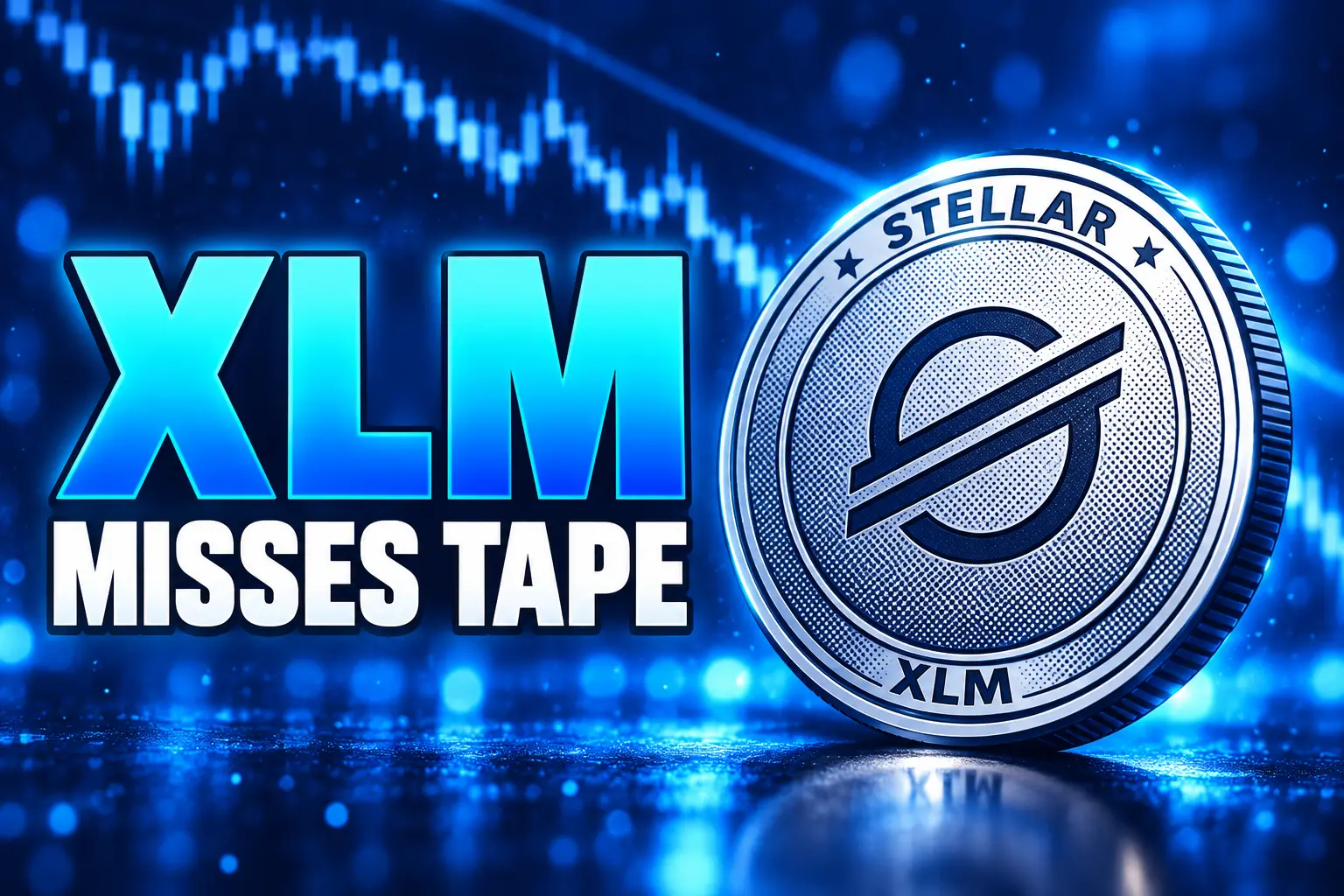
XLM sits at $0.179, 39.7% below its May DTCC spike, because that deal is a 2027 slot while live tokenized trades already ran on other chains.

Stellar’s XLM token changes hands at $0.179, still 39.7% below the $0.297 high printed on May 30 after DTCC named the network. The May 27 plan still points to the first half of 2027, which is the slot holders actually bought.
Live tokenized trades of DTC-held stocks and Treasuries already ran in July on Canton and a private Besu network. The commercial service is due in October, and Stellar is not on that tape.
The DTCC Date XLM Holders Bought
On May 27, 2026, DTCC and the Stellar Development Foundation said they would enable tokenization of assets custodied at The Depository Trust Company on the Stellar public blockchain. The firms said they expect DTC-tokenized assets in the first half of 2027, not this quarter.
That date sits on top of a longer clock. In December 2025 the U.S. Securities and Exchange Commission gave DTC a no-action letter to run a defined tokenization service for three years. On May 4, 2026, DTCC said limited production trades would come in July and that the service itself would launch in October 2026. Stellar was added three weeks later as one more chain in a multi-chain plan, not as the venue for those first prints.
DTCC’s depository arm provided custody and asset servicing in 2025 for issues from over 150 countries and territories valued at $114 trillion. Its subsidiaries processed securities transactions valued at $4.7 quadrillion that year. Those figures describe the pool DTC already holds. They are not a bid for XLM.
THE DTCC CLOCK XLM IS ON
- December 2025: DTC receives an SEC no-action letter to tokenize a defined set of highly liquid assets it already holds.
- May 4, 2026: DTCC sets limited production trades for July and a service launch for October, with more than 50 firms in its industry working group.
- May 27, 2026: DTCC and the Stellar Development Foundation announce a Stellar connection, with assets expected on that network in the first half of 2027.
- May 30, 2026: XLM prints a local high of $0.297 on the back of that headline.
- July 15, 2026: DTCC converts DTC-held securities into tokens and uses them in production trades on Canton and LFDT’s Besu.
- October 2026: DTCC still points to a commercial launch of the Tokenization Service.
- First half of 2027: DTC-tokenized assets are expected to become available on Stellar.
Nadine Chakar, global head of DTCC Digital Assets, said the firm wants several networks, not a single winner. “We are excited to integrate multiple L1 and L2 networks to ensure interoperability and open access for users of the DTC tokenization service,” she said in the May 27 release.
Live Trades Already Printed on Canton and Besu
The July event is the part the May XLM tape never priced as a rival date. DTCC said it converted assets held at DTC into tokens and used them in live production trades on July 15. More than 30 firms took part. The digital conversions ran on LFDT’s Besu, which DTCC called its private network, and on Canton, a public network. Stellar was not named among the venues that day.
Frank La Salla, president and CEO of DTCC, tied the day to the October launch, not to Stellar. “The DTCC Tokenization Service will institutionalize tokenized markets on day one,” he said. By July the industry working group had grown to more than 100 members and partners, up from the 50-plus names listed in May.
WHAT THOSE JULY TRADES ACTUALLY DID
- Collateral pledge: DTC-held securities were tokenized and pledged in a production setting.
- Securities lending: A lending workflow ran against the same tokenized inventory.
- Treasury repo DVP: U.S. Treasury and repo delivery-versus-payment printed as a live use case.
- Equity DVP and DVD: Equity delivery-versus-payment and delivery-versus-delivery both cleared.
- Token transfer and margin: An equity token transfer and CCP margin workflows ran in the same window.
BlackRock, Goldman Sachs, J.P. Morgan, Nasdaq, the New York Stock Exchange, Circle, Ondo Finance, and Vanguard were among the names DTCC listed. The point for XLM is narrower. The first regulated prints of DTC-tokenized U.S. paper already happened, and they happened on rails that do not need a Stellar account.
Why XLM Still Trades Like a 2027 Option
Holders still talk about the DTCC deal as if the token is already inside the machine. The machine that printed in July does not require XLM. The Stellar work, per both firms, is an evaluation of use cases ahead of a 2027 connection, including Russell 1000 stocks, index ETFs, and Treasuries if those classes clear DTC’s rules.
That is a real pipeline. It is also a later pipeline. October’s commercial launch, if it arrives on the date DTCC has repeated since May, will still be a Canton and Besu story on day one. Stellar’s invitation is to join after that, as one more public chain in a service designed to move digital twins of DTC-held securities into participant wallets of choice.
WHERE THE DTCC TOKENS HAVE GONE
| Rail | Role in the service | First production mark | What XLM has to do with it |
|---|---|---|---|
| Canton (public) | Live conversions in July | July 15, 2026 | None |
| LFDT Besu (DTCC private) | Live conversions in July | July 15, 2026 | None |
| Stellar (public) | Planned connectivity | First half of 2027 (expected) | Fees and reserves if and when flow lands |
A bank, a fund, or a broker can hold the tokenized twin of a Treasury or an ETF and never buy a bag of XLM. The security stays a DTC asset with the same entitlements DTCC keeps repeating. The chain is a delivery path. XLM is the native unit of that path only on Stellar, and Stellar is the path that has not opened yet.
Sellers Hung Around After the May Spike
The cash market already voted on the gap between headline and calendar. XLM rallied into $0.297 by May 30, then gave the month back. May 2026 closed +64.04%. June closed -27.19%. Spot taker flow, on CryptoQuant’s 90-day spot taker CVD, turned negative from June as aggressive sellers dominated the tape.
The bounce many short-term traders wanted into $0.161 to $0.164, the 50% retrace of that spike, failed when buyers could not even force a clean test of the $0.16 supply zone. Price slipped through the 78.6% retrace at $0.173. A daily close under $0.155 was the level that invited more selling. The $0.139 shelf was the next obvious stop on that map.
That map did not finish as a straight slide. XLM now trades at $0.179, up 12.6% over 30 days and down 2.5% over seven days, with a $6.25 billion market cap, 34.83 billion coins circulating against a 50 billion cap, and $71.18 million of 24-hour volume. The month is green because August already tagged the low-$0.15s and bounced. The May high is still a long way up.
THE TAPE AGAINST THE MAY HIGH
- Last print: $0.179, with the 30-day change at +12.6% and the seven-day change at -2.5%.
- May 30 high: $0.297, leaving the token 39.7% below the DTCC-news peak.
- Failed bounce zone: $0.161 to $0.164, with $0.16 supply rejecting the first try.
- Downside map still on the chart: $0.155 on a break, then $0.139 if sellers get another run.
Chaikin Money Flow on the daily sat below -0.05 through August, a read of capital leaving the market, and the Money Flow Index hovered near 20, a read of weak buying. Those flow prints can sit next to a “bullish” swing structure left over from May. The structure is a leftover of one news spike. The flow is what paid for it.
Tokenized Stocks Do Not Need a Bag of XLM
Stellar still has a native-token job, and it is smaller than the custody number in the press release. Every transaction on the network needs transaction fees paid in lumens. The network minimum is 100 stroops per operation, which is 0.00001 XLM. Fees go into a locked fee pool. No operator, including the Stellar Development Foundation, spends that pool.
Accounts also have to hold a minimum balance. One base reserve is 0.5 XLM. A bare account must keep two base reserves, or 1 XLM, and each extra subentry adds another 0.5 XLM. That is how the token sits under the rail: as spam control, rent, and a locked minimum, not as the asset being tokenized.
Institutions can push that job even further to the edge. Fee-bump transactions let a second account pay the fee so the user never holds XLM. Sponsored reserves let a sponsor cover the minimum balance. A DTC participant that only wants a digital twin of a Russell 1000 name can, in principle, touch Stellar without building an XLM treasury. The May tape priced the opposite idea.
The $114 Trillion Clip Versus the $0.179 Coin
Denelle Dixon, CEO and executive director of the Stellar Development Foundation, framed the May deal as a rail into regulated market plumbing, not as a purchase order for the token.
DTCC is the backbone of global capital markets, and integrating their tokenization service with Stellar connects public blockchain networks to regulated market infrastructure. Stellar’s proven compliance-minded architecture, open infrastructure and risk management capabilities are aligned with market demands and expectations. Our network was built for this moment.
Denelle Dixon, CEO and Executive Director, Stellar Development Foundation, May 27, 2026 joint release
That quote is true as far as it goes. DTCC is the backbone. Stellar is being connected. The clip that still circulates around the token treats the $114 trillion custody figure as if it will be marked to market in XLM. Divide that pool by 34.83 billion coins and you can invent any price you want, including the $2,280 fantasy that keeps getting cut into short videos. DTC is not moving its vault into a single public token. It is issuing digital twins that keep the same investor protections as the securities it already holds, and it is sending those twins to more than one chain.
A bank pilot or a tokenized fund on Stellar can look busy on a dashboard and still barely touch XLM demand. The user sees dollars, a fund share, or a Treasury. The network sees a fee in the fifth decimal place and, if the account is not sponsored, a 1 XLM floor. That is the gap the May spike refused to price, and it is the gap the June sellers did.
October’s Launch Leaves Stellar Off the Tape
DTCC has not moved the October date. The July 15 prints were the dress rehearsal it said it needed, and the working group is larger than it was when XLM ran to $0.297. If the Tokenization Service opens on that October calendar, the first commercial flow of DTC-tokenized U.S. paper will belong to the rails that already cleared in July.
Stellar’s file is still the 2027 file: evaluate Russell 1000 names, major ETFs, and Treasuries, then connect a public chain that DTCC likes for compliance controls, throughput, and low cost. Chakar’s multi-chain line is the constraint. A later Stellar slot can be real and still leave this token as a 2027 option on a service that is trying to go live in a matter of weeks.
XLM can sit at $0.179, 12.6% higher on the month, and still be a coin that bought the wrong date. The $0.139 shelf stays on the chart if the October launch lands as another reminder that the trades are happening somewhere else. The $0.297 high stays the other marker, the price of treating a 2027 connection as a 2026 bid.
Disclaimer: This article is news reporting and market analysis of Stellar (XLM) and DTCC’s tokenization timeline. It is informational only and is not investment advice, a solicitation to buy or sell any token, or a forecast of returns. Readers should consult a licensed financial adviser or other qualified investment professional who can consider their own objectives and risk tolerance before making any trading decision. Prices, circulating supply, launch dates, and partnership statuses reflect the cited company releases and market prints as of the dates named in the piece and can change without notice.

Instagram Plus Tests a Read-Only Mode That Cuts Stories

Altman Asks the Public to Accept Some AI Harm

Google Freezes OSS VRP Product Reports After AI Flood

AI Agents Make Payment Rails the Scarce Prize

Turkey’s Crypto Boom Now Runs Through Three Banks

Fable 5 Came Back Under a Commerce On-Off Switch

Google’s SpaceX GPU Lease Has a Sept. 30 Deadline

Plasma One’s XPL Locks Face a 1.81 Billion Cliff

DGO’s Rs 549 World Cup Pass Cost Fans Sleep and Data

Moonshot AI’s $30 Billion Ask Became a $35 Billion Close
-
 AI4 months ago
Fable 5 Came Back Under a Commerce On-Off Switch
-
 AI4 months ago
Google’s SpaceX GPU Lease Has a Sept. 30 Deadline
-
 CRYPTO4 months ago
Plasma One’s XPL Locks Face a 1.81 Billion Cliff
-
 APPS4 months ago
DGO’s Rs 549 World Cup Pass Cost Fans Sleep and Data
-
 AI4 months ago
Moonshot AI’s $30 Billion Ask Became a $35 Billion Close
-

 NEWS4 months ago
ColorOS 17 Device List Spans Oppo, OnePlus and Realme
-
 GAMING4 months ago
Xbox Cuts 3,200 Jobs After Five Years of Thin Returns
-
 GAMING4 months ago
The RTX 4050 Under Rs 70,000 Hides a Wattage Gap