
COMPUTERS
Quanta and Quantinuum Bet Manufacturing Will Unlock Quantum Scale
Quanta Computer joins Quantinuum to industrialize hardware for large-scale fault-tolerant quantum systems.

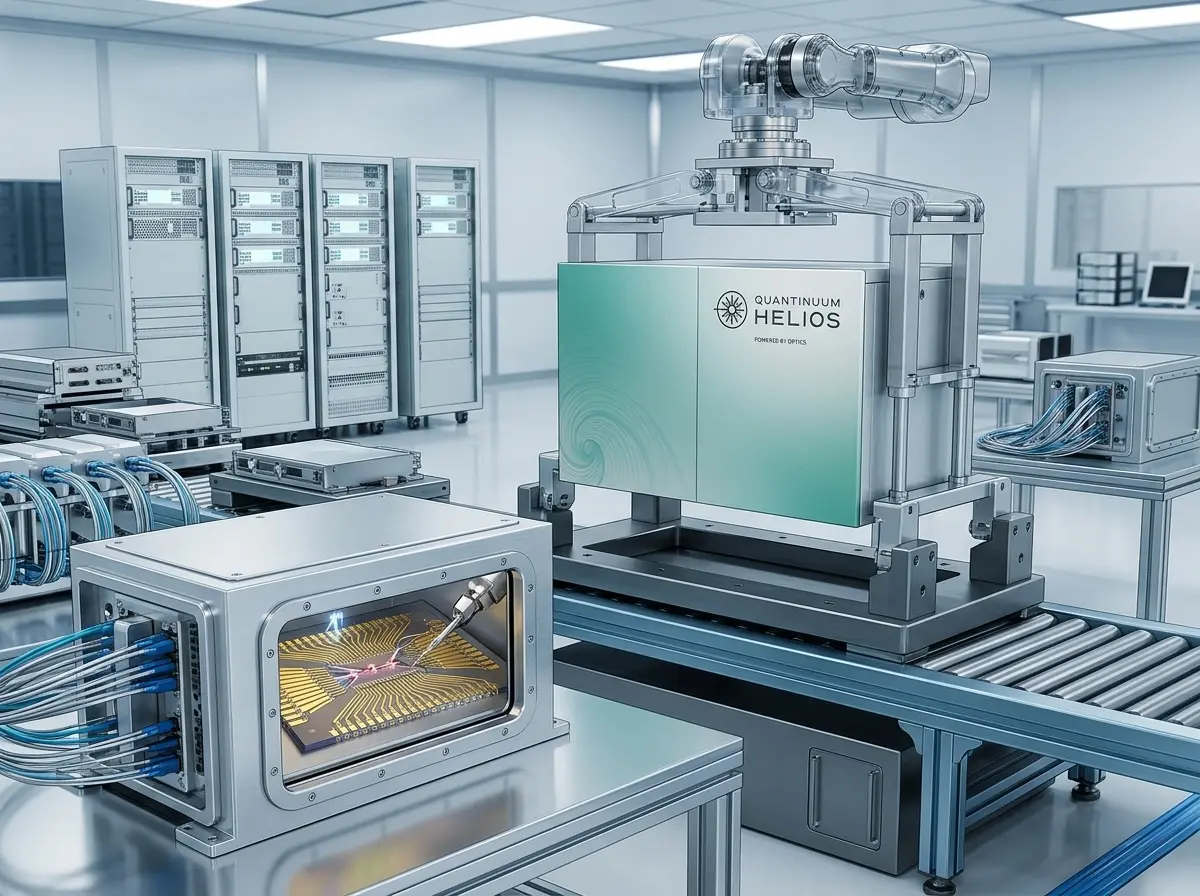
Quanta Computer and Quantinuum signed a collaborative development agreement on August 13, 2026, to jointly build the hardware infrastructure, systems engineering and manufacturing capabilities needed for large-scale, fault-tolerant quantum computers. Joint engineering work is already underway with the explicit goal of making future systems more modular, manufacturable and scalable.
The move pairs Quantinuum’s trapped-ion technology with one of the world’s largest contract manufacturers of servers and AI racks. It treats factory-scale production as a first-order problem rather than a later afterthought.
That framing matters because the partners are not waiting for a finished physics roadmap before tackling build and service questions. They are running both tracks at once.
What the Companies Agreed to Build Together
Under the deal the two firms will co-develop critical hardware infrastructure supporting future generations of Quantinuum’s quantum systems. The aim is a practical pathway from today’s machines to commercially deployable systems that can support broad enterprise and scientific use.
No dollar amounts, equity stakes or delivery timelines appear in the announcement. The focus stays on systems engineering and the manufacturing ecosystem.
It is time for quantum computing to transition from breakthroughs in physics achieved in the lab to breakthroughs in system manufacturing that can be deployed and operated at scale.
Dr. Rajeeb Hazra, President and CEO of Quantinuum, said Quanta has earned a global reputation for industrializing some of the most advanced computing technologies. Working together, he added, can help ensure the manufacturing ecosystem, engineering expertise and supply chains evolve in parallel with the technology itself.
In plain terms, the agreement puts chassis design, control electronics integration, packaging and line processes on the same calendar as qubit and error-correction work. Parallel progress is the point of the collaboration, not a side benefit.
Quanta Already Owns a Small Stake and Massive Scale Muscle
This is not Quanta’s first move. In August 2025 the Taiwan-based firm invested roughly $50 million for about 1.87 million Series B preferred shares, a stake of roughly 0.49 percent on a fully diluted basis, funded from its own capital.
Quanta is a Fortune Global 500 manufacturer of advanced computing and cloud infrastructure. Through Quanta Cloud Technology it designs and builds high-density AI servers and full rack-scale systems for the biggest cloud and enterprise buyers, including heavy NVIDIA-based platforms.
- Notebook and server ODM volume at global scale for decades
- AI rack expertise covering power, cooling, networking and high-density integration
- Multi-continent manufacturing footprint that already ships complex compute platforms by the container load
- Proven ability to turn novel accelerator designs into repeatable, serviceable products
That skill set now gets pointed at quantum hardware that still lives closer to laboratory craftsmanship than to high-volume production lines.
The earlier equity check gave Quanta a window into Quantinuum’s roadmap. The new agreement converts that window into joint engineering on the factory floor. Ownership and production discipline now sit on the same side of the table.
Helios Sets the Performance Bar the New Hardware Must Serve
Quantinuum’s current flagship, Helios, launched in November 2025. It delivers 98 fully connected physical qubits and record fidelities: single-qubit gate fidelity of 99.9975 percent and two-qubit gate fidelity of 99.921 percent across all pairs. The system also demonstrated 48 fully error-corrected logical qubits at a 2:1 physical-to-logical encoding ratio using concatenated codes.
Helios switched to barium ions from ytterbium, added commercial ion junctions for better routing, and integrated real-time decoding on NVIDIA Grace Hopper GPUs. It is available via cloud and on-premise, with hybrid options that already pair it to classical accelerators.
Stats snapshot
- 98 fully connected physical qubits on Helios
- 99.921% two-qubit gate fidelity across all pairs
- 48 logical qubits at 2:1 encoding
- ~700 Quantinuum employees, over 70 percent of the tech team holding advanced degrees
The company has publicly laid out a roadmap to universal fault-tolerant systems by 2030, centered on the Apollo generation with thousands of physical qubits and hundreds of logical qubits capable of million-gate circuits.
| System | Approx. era | Physical qubits | Notable feature |
|---|---|---|---|
| H-series (H1/H2) | Earlier commercial | Up to 56 | High-fidelity QCCD baseline |
| Helios | 2025 | 98 | Junctions, Ba+ ions, 48 logical at 2:1 |
| Apollo (target) | By 2030 | Thousands | Full fault tolerance, million-gate circuits |
Those next machines will need more than better physics. They will need chassis, control electronics, cryogenics or vacuum packages, power delivery and modular assemblies that can be built, tested, shipped and maintained like any other high-end compute product.
Helios already mixes trapped-ion hardware with Grace Hopper decoding and hybrid classical links. That mix previews the integration load Quanta will face when qubit counts climb and assemblies must stay serviceable in the field.
Manufacturing Becomes the Parallel Constraint
Quantum progress has long been framed as a race for lower error rates and more qubits. The Quanta deal reframes the problem. Even perfect logical qubits remain stuck if the physical systems that host them cannot be produced in volume with consistent quality and controllable cost.
Industry observers have already flagged supply-chain choke points: specialized lasers, exotic materials, precision vacuum components, dilution refrigerators or ion-trap packaging, and the skilled assembly processes that still look more like instrument making than electronics manufacturing. Design for manufacturability has lagged behind algorithmic and device breakthroughs.
Quanta’s role is to pull those systems into the same industrial discipline that turned custom AI accelerators into rack-scale products shipping by the thousands. Modular design, repeatable processes, qualified supply chains and global serviceability become the new performance metrics alongside two-qubit fidelity.
This is the second-order shift. Fidelity and error correction keep advancing, including work that has already pushed quantum error correction moving into hardware. Without a matching manufacturing base, the commercial window simply slips.
The hardware stack that must absorb that discipline is already visible in the systems description:
- Chassis and modular mechanical assemblies
- Control electronics and real-time decode paths
- Cryogenics or vacuum packages around the ion traps
- Power delivery sized for dense, thermally demanding racks
- Test, ship and field-service flows that match high-end servers
Each item is ordinary in classical compute. Each is still special-purpose in much of quantum hardware. Closing that gap is the manufacturing brief.
Who Gains Position in the Emerging Stack
Quantinuum gains a partner that already knows how to turn complex, power-hungry, thermally demanding hardware into products cloud operators will buy and operate. After Quantinuum’s $1.68 billion Nasdaq debut in June 2026 at a roughly $15.7 billion valuation, the company has both capital and public-market pressure to show a path beyond research systems.
Quanta gains an early seat at the next compute platform transition. The firm already dominates large slices of the classical and AI server market. A meaningful quantum manufacturing franchise would extend that franchise into the following decade.
Broader winners include the component suppliers that can qualify into a Quanta-style production system and the enterprise customers who eventually want on-premise or private-cloud quantum capacity rather than pure cloud access. Pure-play quantum hardware teams without industrial partners face a steeper climb when volume demand arrives.
The pattern echoes other recent moves in which traditional manufacturers lock in next-generation compute. Foxconn’s work with Intel on AI racks is one recent example of similar rack-scale AI manufacturing alliances that treat the factory as a strategic asset.
| Party | Near-term gain | Longer stake |
|---|---|---|
| Quantinuum | Industrial partner post-IPO | Path from Helios-class machines toward Apollo volume |
| Quanta | Joint engineering on quantum hardware | Franchise beyond classical and AI servers |
| Component suppliers | Qualification into a scaled line | Repeat orders if modular designs stick |
| Enterprise buyers | Clearer on-prem and private-cloud options | Serviceable systems, not one-off lab builds |
A Quiet Start on the Public Conversation
Hours after the release, conversation on X stayed thin and mechanical. Most posts simply restated the PR headline or tagged the $QNT ticker. The tone treated the news as infrastructure plumbing rather than a breakthrough announcement. That muted reaction itself is informative: the market is starting to price quantum as an industrial build-out story, not only a physics story.
Quantinuum has also been busy on the software and cloud side. A multi-year partnership with Oracle announced days earlier will place Helios inside an OCI AI data center for hybrid quantum-AI workloads. The manufacturing deal and the cloud deal pull in the same direction: make the systems operable and deployable at customer scale.
- August 2025, Quanta invests ~$50 million in Quantinuum Series B
- November 2025, Helios launches with 98 physical qubits and high logical-qubit counts
- June 2026, Quantinuum completes $1.68 billion IPO on Nasdaq as QNT
- August 11, 2026, Oracle hybrid quantum partnership announced
- August 13, 2026, Quanta collaborative development agreement announced; joint engineering already running
The sequence shows capital, performance, public markets and now industrial manufacturing arriving in rapid succession.
Cloud Access and Factory Work Share One Goal
The Oracle placement and the Quanta agreement landed two days apart. One puts Helios inside an OCI AI data center for hybrid quantum-AI workloads. The other puts joint teams on modular hardware, systems engineering and manufacturing scale.
Together they cover the two ways customers will meet the machines: through cloud access and through systems that can be built, shipped and kept running like other high-end compute. Hybrid options already pair Helios to classical accelerators; the factory work aims to make later generations easier to produce and service at that same hybrid edge.
Public-market investors watching the June 2026 Nasdaq debut now see a clearer operating story. Capital raised at a roughly $15.7 billion valuation needs a path past research systems. Cloud distribution and industrial manufacturing are two concrete answers drawn from the same week’s news flow.
Neither deal replaces the physics roadmap to Apollo. Both reduce the chance that strong lab results stall because no one can host or build the boxes at customer scale.
Trapped Ion Systems Learn the Rack Playbook
Quanta’s AI rack business already solves power, cooling, networking and high-density integration for NVIDIA-based platforms and other advanced servers. Quantum hardware brings different internals, from ion traps and commercial junctions to vacuum packages and specialized lasers, yet the outer problems rhyme.
Modular design is the bridge the agreement names out loud. If control electronics, vacuum or cryogenic packages, power stages and mechanical assemblies can be qualified as repeatable modules, line processes can improve without freezing the qubit generation underneath. That is how novel accelerators became container-load products in classical markets.
Helios already showed barium ions, commercial ion junctions and Grace Hopper real-time decoding working as one system. Scaling that integration from a flagship install base toward thousands of physical qubits on the Apollo target will stress every module boundary. Quanta’s multi-continent footprint and service habits are meant to absorb that stress.
Global serviceability then becomes part of the product definition. A fault-tolerant machine that cannot be maintained outside a founding lab is still a prototype. The collaboration treats that maintenance bar as a design input, not a post-shipment surprise.
The Industrial Pathway Now Runs Beside the Physics Roadmap
Quantinuum still has to deliver the next generations of higher qubit counts, better logical performance and full fault tolerance. Quanta still has to prove it can take vacuum packages, laser systems, control electronics and modular cryogenics or ion-trap assemblies and turn them into something that ships and services like a high-end server.
If both sides succeed, the limiting factor on commercial quantum computing stops being whether the physics works in a lab and becomes whether enough reliable machines can be built, installed and kept running. That is a manufacturing problem. The companies have now put a dedicated industrial partner on it.
The deal does not guarantee Apollo arrives on schedule or that fault-tolerant systems hit every enterprise desk by 2030. It does remove one classic failure mode of deep-tech transitions: brilliant prototypes that never leave the cleanroom because no one knew how to make the thousandth unit.
From the 2025 stake through Helios, the IPO, the Oracle cloud placement and this August agreement, the companies have stacked capital, performance proof, public markets, customer access and factory muscle in short order. The physics roadmap still runs. The industrial pathway now runs beside it with named owners on both sides.


South Korea Retail Investors Face Reckoning After KOSPI AI Rally Collapses

Surrey AI Maps Three Heart Attack Paths and Their Molecular Roots

Germany Locks Neutral Apple ATT Prompts Across Most of Europe

Apple’s 5% EU Fee Quietly Rewrites Alternative App Store Math

Apple’s EU Fee Truce Cuts Complexity but Leaves Rivals Fuming

Pixel 11 Pro Fold Trades Thinness for Durability and Seven-Year Stay

Mayo AI Flags HCM Obstruction From Everyday Ultrasound Videos

Indian Brands Quietly Scale Landmark Screens and Home Tech

Navin Vatsa Turns Grief Into a Lifetime of Quiet Seeing

Google Bets Pixel 11 Agentic AI Will Redefine Phones

Oracle Cuts 21,000 Jobs in a Year, Cites AI in 10-K Filing

Fable 5 and Mythos 5 Return as US Lifts Anthropic Export Controls

SpaceX’s Google Deal Turns a Rocket Company Into a Cloud Landlord

CD Projekt Red Co-CEO: Redemption Arc Isn’t Done, Witcher 4 in 2027

XPL Rallies 30% Ahead of Plasma One Card Tier Launch

Google Search Profiles Build a Follow Graph Inside Discover

DGO App Brings Rs 549 Mobile Pass for FIFA World Cup 2026 in Nepal

Moonshot AI Targets $30 Billion in China’s Fastest AI Funding Sprint

Oppo’s ColorOS 17 Eligibility List Leaves A-Series Buyers Behind

Microsoft Xbox Layoffs Start in July as Sharma Slams 3% Margin
-
 AI2 months ago
Oracle Cuts 21,000 Jobs in a Year, Cites AI in 10-K Filing
-
 AI2 months ago
Fable 5 and Mythos 5 Return as US Lifts Anthropic Export Controls
-
 AI3 months ago
SpaceX’s Google Deal Turns a Rocket Company Into a Cloud Landlord
-
 GAMING2 months ago
CD Projekt Red Co-CEO: Redemption Arc Isn’t Done, Witcher 4 in 2027
-
 CRYPTO3 months ago
XPL Rallies 30% Ahead of Plasma One Card Tier Launch
-
 NEWS3 months ago
Google Search Profiles Build a Follow Graph Inside Discover
-
 APPS3 months ago
DGO App Brings Rs 549 Mobile Pass for FIFA World Cup 2026 in Nepal
-
 AI3 months ago
Moonshot AI Targets $30 Billion in China’s Fastest AI Funding Sprint