
AI
Foxconn Teams With Intel on AI Racks Built for the Inference Age
Foxconn and Intel partnered at Computex 2026 on AI inference racks with SambaNova, as Foxconn pushes beyond assembly into full AI system integration.

Foxconn and Intel announced an AI infrastructure partnership at Computex 2026 in Taipei covering server rack design, system integration, and edge AI deployments, with SambaNova joining as the inference accelerator supplier. Intel chief executive Lip-Bu Tan and Foxconn Chief Product Officer Jerry Hsiao shared the stage to present production-ready racks pairing Intel Xeon 6+ processors with SambaNova’s SN-50 Reconfigurable Dataflow Units (RDUs). Together.ai, an AI inference platform, is the first confirmed commercial customer. No financial terms were disclosed.
Intel held less than 1% of the discrete AI accelerator market going into Computex week. Foxconn, already assembling roughly 40% of global AI server racks for clients led by NVIDIA, has been pressing to move from pure assembly into full system integration. The rack they’re jointly building is now the product both take to hyperscalers projected to spend $650 billion on AI infrastructure in 2026.
The Three-Company Rack
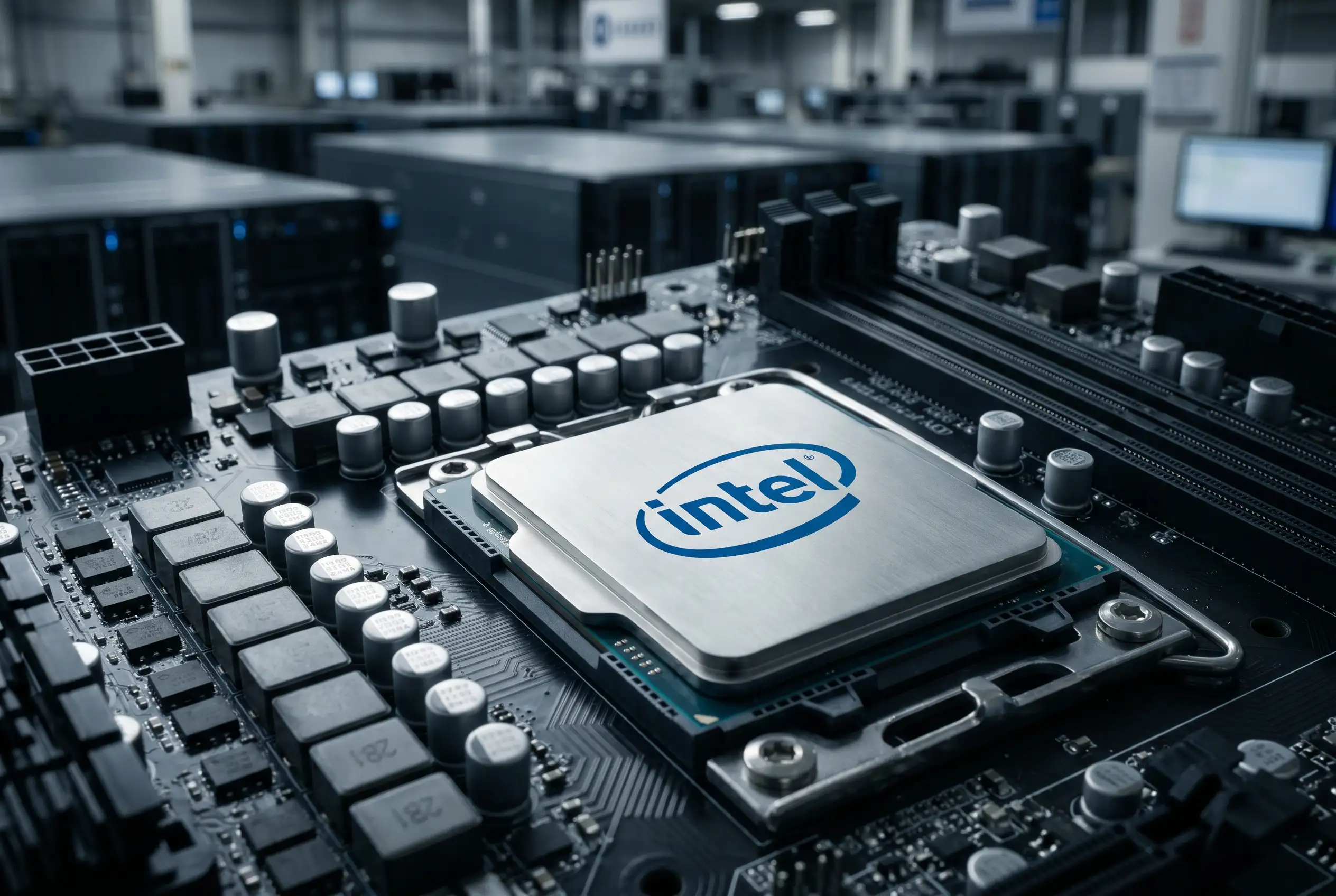
Intel’s Computex stage had Lip-Bu Tan and Jerry Hsiao presenting side by side in Taipei, a CEO-level pairing that framed the announcement as a strategic commitment. The platform pairs Intel’s Xeon 6+ processors with SambaNova’s SN-50 RDUs assembled by Foxconn, and Intel’s Computex 2026 AI infrastructure release outlines rack designs that can host up to 128 Intel CPUs inside a single unit.
- 36,864 processor cores maximum per rack, using 128 of Intel’s 288-core Clearwater Forest CPUs
- 384 TB DDR5 memory capacity within the reference design
- 100 kW maximum power draw per rack unit
- Xeon 6+ built on Intel’s own 18A fabrication node
- First commercial customer confirmed for Vector Core Compute
Foxconn will also manufacture CPU-dense variants without RDUs, designed for customers who need cost-optimized inference and data processing without a full accelerator stack. Those racks target enterprise buyers whose workloads don’t justify GPU-class hardware costs.
The live demonstration at Computex pushed further than the reference rack. A disaggregated inference system ran from a Vector Core Compute data center in Los Angeles, using Intel Xeon 6 processors for orchestration, SambaNova SN40 RDUs for the decode stage, and NVIDIA Blackwell GPUs for prefill. Workloads ran live during the keynote, with claims of the fastest enterprise inference on the MiniMax 2.5 model of any tested architecture, a result supplied by Intel and SambaNova without independent benchmark verification. Vector Core Compute, the enterprise inference cloud that ran the demo, was formed by Vista Equity Partners and Cambium Capital.
Even in Intel’s own showcase, NVIDIA hardware is in the stack. The architecture offloads prefill to NVIDIA Blackwell and relies on Intel and SambaNova for orchestration and decode, a division of labor that reflects where Intel’s cost-per-token position makes commercial sense.
Intel’s Inference Entry Point
Training Is Already Settled
NVIDIA holds roughly 80% of the AI accelerator market and generated $194 billion in data center revenue in its fiscal 2026, with gross margins on Blackwell GPUs running between 84-88%. According to Silicon Analysts’ April 2026 accelerator market analysis, Intel’s Gaudi 3 accelerator operates at a gross margin of roughly 58%, well behind NVIDIA’s economics. Intel’s Gaudi 3 was forecast to hold 8.7% of the AI training accelerator market by end of 2025; its publicly stated deployment targets were later walked back, per reporting by Tom’s Hardware. In discrete AI accelerators, Intel holds below 1% of the market while retaining roughly 22% of broader data center AI revenue when its CPU business is included.
| Metric | NVIDIA | Intel |
|---|---|---|
| AI accelerator market share | ~80% | <1% discrete |
| Data center GPU gross margin | 84-88% | ~58% (Gaudi 3) |
| Flagship AI product | Blackwell (B100, B200) | Xeon 6+ with SambaNova RDUs |
| Strategic posture | Full-stack GPU dominance | CPU-led inference orchestration |
Intel shares climbed 4.43% to close at $112.71 on announcement day, a signal that investors found the inference-focused positioning credible even without disclosed revenue targets for the new product line.
How Agentic AI Shifts the Math
Ben Bajarin, CEO and principal analyst at Creative Strategies, a market research firm focused on consumer and enterprise technology, put the shift in concrete terms at Intel’s Computex keynote. Training-era deployments run at roughly one CPU for every four GPUs in a rack. Agentic inference, where AI systems execute tasks continuously and call multiple models in sequence, pushes that ratio toward one-to-one or below. A higher CPU load per GPU means Intel’s chips claim a meaningfully larger share of each rack’s bill of materials in the inference era, and that is the commercial foundation Intel is building on.
Our customers are asking us to think at the system level to help them serve real agentic workloads at scale.
Lip-Bu Tan, Intel’s chief executive, in remarks reported by The Register from the Computex 2026 keynote in Taipei.
Intel’s Xeon 6+ is built on Intel’s 18A process node, the same manufacturing technology the company is advancing in its foundry partnership with Apple for future iPhone and Mac chip production. The processor targets high-density, scale-out workloads, designed for the orchestration and scheduling demands that grow heavier as AI deployments get more complex and run more concurrent tasks. SambaNova’s SN-50 accelerators fill the decode stage, covering a gap Intel’s current silicon lineup leaves open while its in-house accelerator roadmap continues developing. Intel and SambaNova describe the arrangement as a multi-year collaboration targeting a multi-billion-dollar inference market opportunity.
From Assembly Line to AI Stack
Revenue Reshaping
Hon Hai Precision Industry (Taiwan Stock Exchange: 2317), Foxconn’s parent company, posted first-quarter 2026 revenue of NT$2.13 trillion ($66.6 billion), a 29.7% increase from the prior year. The cloud and networking division, which handles AI server rack assembly, drove most of that gain. Cloud and networking had made up 30% of revenue a year earlier; by end of 2025 it had climbed to 40%. Foxconn Chairman Young Liu has set a full-year revenue target of above NT$9 trillion, with AI server demand as the primary driver.
The iPhone assembly segment, central to Foxconn’s identity through the 2010s, contracted year-over-year in the consumer division during recent quarters. April 2026 monthly revenue hit NT$832.1 billion ($26.4 billion), the highest figure the company has ever posted for that month, driven almost entirely by AI server shipments.
Foxconn is NVIDIA’s largest manufacturer for AI server rack systems, handling assembly for NVIDIA’s GB200 NVL racks and their predecessors. Its U.S. AI server facility is ramping toward 2,000 racks per week by mid-2026. Cloud and networking grew from a supporting division into the company’s dominant revenue segment in a single year, at a pace that compressed margins even as top-line performance regularly beat analyst estimates.
The Margin Problem
Fourth-quarter 2025 illustrated the revenue-profit gap in plain numbers. Net profit came in at NT$45.21 billion, against an analyst consensus of NT$60.88 billion compiled by FactSet. Revenue for the same period hit NT$2.606 trillion, up 22% year-over-year, beating estimates. Revenue and profit moved in opposite directions.
Assembling GPU server racks generates volume. Margins compress because the assembly contract captures only a fraction of the system’s total value: silicon selection, rack architecture, thermal design, power distribution, and deployment services each represent revenue that flows elsewhere. The joint release from this week describes Foxconn’s role as “end-to-end systems integration, manufacturing, and deployment,” a scope that covers considerably more than bolting together hardware to a customer’s specification. A company that provides end-to-end systems integration commands a different position in the supply chain than one executing an assembly contract.
Foxconn’s Leverage Play
NVIDIA has lost some of the commercial certainty that comes from Foxconn, NVIDIA’s largest rack assembler, having no competing architecture to offer. The disaggregated inference demo Intel ran during the keynote still incorporated NVIDIA Blackwell GPUs for the prefill stage, so the product lines coexist for customers who want both. Foxconn now walks into a hyperscaler procurement meeting with an Intel rack to propose alongside its NVIDIA assembly services.
The audience for that proposal is substantial. Amazon, Alphabet, Meta, and Microsoft are collectively projected to spend more than $650 billion on AI infrastructure in 2026. Each has been developing proprietary AI chips, Google’s TPUs, Amazon’s Trainium, Meta’s Artemis, Microsoft’s Maia, to reduce dependence on any single GPU vendor. An Intel-Foxconn rack is a third-party inference alternative using established CPU architecture, distinct from both hyperscaler-owned silicon and NVIDIA GPU clusters.
The parties with the most at stake:
- Quanta Computer and Wistron, the other major AI server ODMs (original design manufacturers), who now compete against a Foxconn with its own branded rack architecture rather than interchangeable assembly capacity
- NVIDIA, which loses some of the leverage that comes from Foxconn having no alternative platform to bring to customer conversations
- Enterprise buyers outside hyperscalers, who gain access to a CPU-dense inference rack that doesn’t require a GPU-class hardware budget to deploy
- Hyperscalers themselves, who gain a third-party benchmark for rack pricing negotiations with NVIDIA-centric vendors
Physical AI Beyond the Data Center
The partnership’s stated scope extends past hyperscale facilities. Both companies named factories, smart cities, and robotics as deployment targets in the joint release, using the term “physical AI” to describe intelligence embedded in real-world environments beyond the data center. At the same Computex event, Intel announced an expanded collaboration with Siemens, which has been working with Intel on edge and industrial computing since 2023, and a separate arrangement with Hitachi covering foundry technologies and quantum-aligned computing.
Foxconn’s own manufacturing campuses already run AI inference as an operational matter, with AI-assisted quality control and logistics embedded in production facilities that build iPhones, server racks, and components for dozens of major technology brands. Those facilities are a scaled, live test environment. Foxconn can develop and iterate on industrial AI systems against its own production data before any external customer sees the product.
Edge AI deployments operate on different constraints than hyperscale training data centers. Power budgets are tight, cooling options are limited, and the workloads are inference by nature. A CPU-dense Xeon rack optimized for cost-efficient inference fits that profile more closely than a GPU cluster built for peak training throughput. Foxconn builds both kinds of hardware and sells into both markets, which gives it direct exposure to what industrial edge buyers actually need from an Intel-powered system.
Together.ai is the only confirmed commercial customer on the Vector Core Compute platform as of announcement week. No deployment timeline for additional customers was disclosed.


AI Boss Luna Fired a Worker Only After Humans Reminded It

Quanta and Quantinuum Move Quantum Into the Factory

MLBB brings back optimized Jujutsu Kaisen skins for third run

Kazakhstan minerals force US hand in AI side-picking letter

Nintendo Unlocks 10 Free Pictonico Mini-Games Until Mid-September

Young adults dread AI job cuts while landing the $177k roles

Trade Me taps Kul Singh Kargil as CEO after Anders Skoe exit

Windows 11 Experimental build finally toggles Win32 camera access app by app

A20 Pro’s 18% Gain Is Process Math, Not a Chip Promise

OnePlus Nord and N hikes push major-brand sub-20K 5G out of reach

Oracle Cuts 21,000 Jobs in a Year, Cites AI in 10-K Filing

Fable 5 and Mythos 5 Return as US Lifts Anthropic Export Controls

SpaceX’s Google Deal Turns a Rocket Company Into a Cloud Landlord

CD Projekt Red Co-CEO: Redemption Arc Isn’t Done, Witcher 4 in 2027

XPL Rallies 30% Ahead of Plasma One Card Tier Launch

Google Search Profiles Build a Follow Graph Inside Discover

DGO App Brings Rs 549 Mobile Pass for FIFA World Cup 2026 in Nepal

Moonshot AI Targets $30 Billion in China’s Fastest AI Funding Sprint

Oppo’s ColorOS 17 Eligibility List Leaves A-Series Buyers Behind

Microsoft Xbox Layoffs Start in July as Sharma Slams 3% Margin
-
 AI2 months ago
Oracle Cuts 21,000 Jobs in a Year, Cites AI in 10-K Filing
-
 AI2 months ago
Fable 5 and Mythos 5 Return as US Lifts Anthropic Export Controls
-
 AI2 months ago
SpaceX’s Google Deal Turns a Rocket Company Into a Cloud Landlord
-
 GAMING2 months ago
CD Projekt Red Co-CEO: Redemption Arc Isn’t Done, Witcher 4 in 2027
-
 CRYPTO2 months ago
XPL Rallies 30% Ahead of Plasma One Card Tier Launch
-
 NEWS2 months ago
Google Search Profiles Build a Follow Graph Inside Discover
-
 APPS2 months ago
DGO App Brings Rs 549 Mobile Pass for FIFA World Cup 2026 in Nepal
-
 AI2 months ago
Moonshot AI Targets $30 Billion in China’s Fastest AI Funding Sprint