
GADGETS
Qi2 25W Magnets Quietly Rewrite Desk and Car Charging
Qi2 25W magnetic pads now match many wired speeds, but alignment and heat still decide real battery life and which accessories win in 2026.

Qi2 25W wireless chargers can now push a compatible smartphone from empty to 50 percent in about 30 minutes, closing most of the everyday speed gap with cables. Magnets lock the phone in place so coils stay aligned, and the Wireless Power Consortium says the step delivers nearly 70 percent more power than the first Qi2 generation.
That speed is the headline. The quieter change is what the magnets unlock on desks, dashboards and nightstands, and the heat they still force designers to fight.
How Induction Became a Magnetic Snap
Wireless charging still rests on electromagnetic induction. A coil in the pad creates a magnetic field. A second coil in the phone converts that field back into current that fills the battery. Early pads left alignment to guesswork. A few millimeters off and power dropped, heat rose, and charging slowed or stopped.
Qi2 fixed the core problem with the Magnetic Power Profile. Magnets pull the phone into the sweet spot automatically. The result is higher efficiency, fewer wasted watts turned into warmth, and a physical lock that lets stands and mounts hold the device while it charges. Most modern phones and pads now certify to this standard so a Samsung or Google phone works on the same pad as an iPhone.
Foreign-object detection remains mandatory. The pad checks for keys, coins or foil before ramping power, which keeps metal from heating up on the surface.
Fifteen Years from 5 W Novelty to 25 W Standard
The climb was stepwise, not sudden. Each revision added power, safety checks or design freedom while keeping older gear working where possible.
- July 2010, Qi 1.0 launches at 5 W with single-coil, array and moving-coil transmitter options.
- March 2012, Version 1.1 expands transmitter designs to 12 and hardens foreign-object detection; USB-powered pads appear.
- October 2015, Version 1.2 brings optional 15 W extended power and tighter thermal tests.
- January 2021, Version 1.3 restructures the docs, adds transmitter authentication and stronger FOD.
- April 2023, Qi 2.0 introduces the Magnetic Power Profile, 15 W baseline and magnetic attachment.
- April 2025, Version 2.2 raises the ceiling to 25 W with better power-adapter matching and FOD above 15 W.
- July 2025, Version 2.2.1 brands the 25 W mode as Qi2 25W; first certified devices ship soon after.
The full Qi specification version history shows how magnets arrived only after a decade of slow gains. Once they did, the accessory market moved fast.
Speed Numbers Meet the Heat Tax
WPC lab figures put a Qi2 25W charge from 0 to 50 percent at roughly 30 minutes under ideal conditions. Some flagship pads claim faster. Anker’s Prime 3-in-1 station lists a 22-minute half charge for an iPhone 17 Pro when its TEC cooling and 22-minute half charge system stays active.
| Method | Typical peak power | Approx. efficiency | Heat profile |
|---|---|---|---|
| Modern wired USB-C PD | 45-100 W+ | 85-95 % | Low at the phone |
| Legacy Qi 5-15 W | 5-15 W | 60-80 % | Moderate, rises with misalignment |
| Qi2 15 W magnetic | 15 W | Higher than loose Qi | Lower waste from alignment |
| Qi2 25 W magnetic | 25 W | Improved but still below wired | Needs active cooling for sustained speed |
Every lost percent becomes heat at the coils. Heat above roughly 40 °C accelerates lithium-ion aging. Phones throttle input to protect the cell, so a 25 W pad often settles lower once the temperature climbs. That is why 2026 high-power pads ship with fans, thermoelectric coolers or large metal sinks.
- Energy cost: wireless still draws noticeably more wall power than a good cable for the same battery gain.
- Battery wear: repeated heat cycles shorten long-term capacity faster than cool wired sessions.
- Cooling premium: the fastest pads now cost more because of fans and sensors, not just the magnets.
WPC itself notes that heat affects more than today’s charge level and can contribute to battery aging over time. Magnetic alignment cuts the worst waste by keeping coils centered, yet it cannot erase the physics of induction.
Heat can affect more than today’s battery level. Over time, it can contribute to battery aging. Qi2 uses magnetic alignment to position compatible devices and chargers correctly, helping power transfer more efficiently and reducing energy lost through poor alignment.
That line came from the official Wireless Power Consortium account on X in early August 2026. The crowd reaction is practical: car mounts and desk stations without cooling get returned; the ones with fans stay.
Magnets Turn Surfaces into Docks
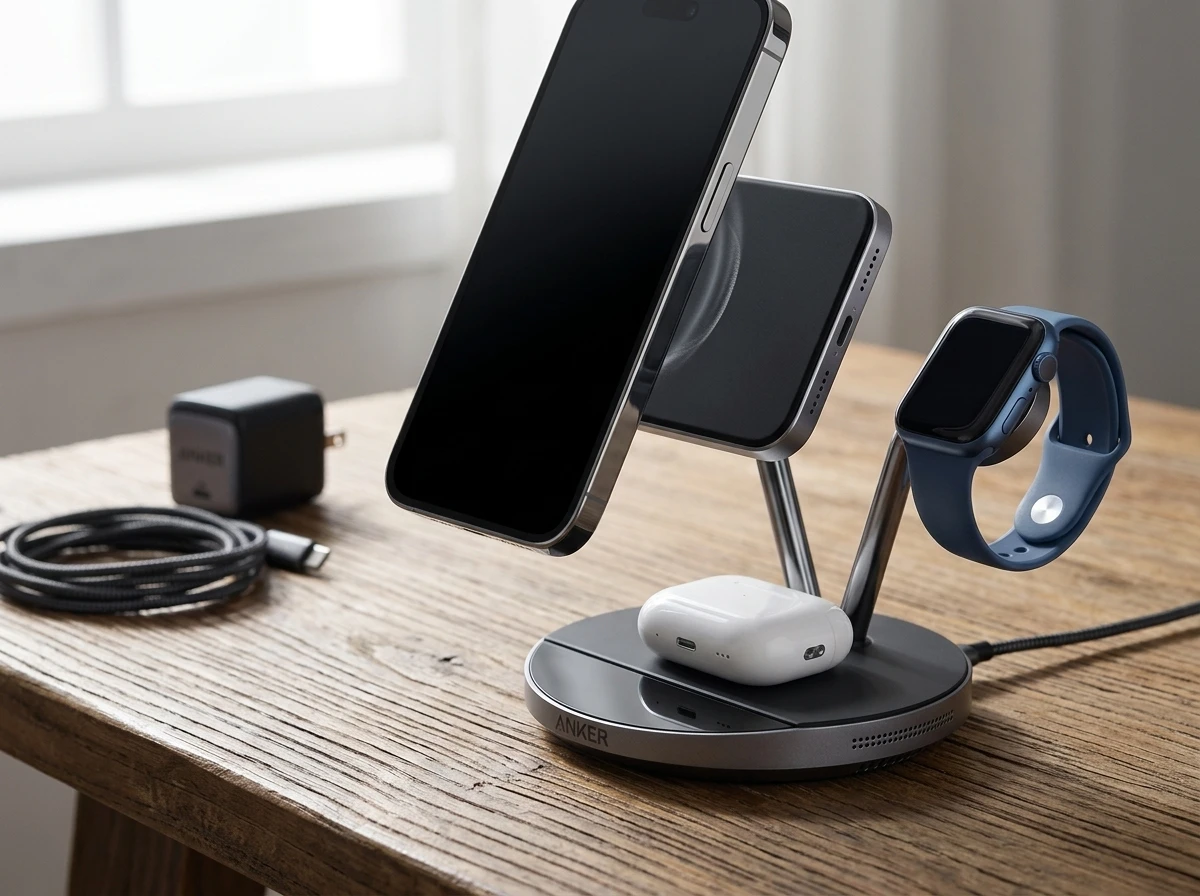
Speed is useful. The second-order effect is mechanical. Once the phone snaps and stays put, the pad becomes a stand, a navigation mount, a nightstand dock or a multi-device hub. Three-in-one stations that charge phone, watch and earbuds at once have become the default desk object. Foldable travel versions pack flat. Cars ship with built-in magnetic pads so the phone stays visible and powered without a cable dangling.
Accessory makers no longer fight proprietary protocols for every brand. A single Qi2 25W certification opens the whole phone market. WPC reported more than 1,200 new Qi2 products certified in 2025 alone and over 1.5 billion Qi2 devices (transmitters plus receivers) in the market within the first year of the original Qi2 launch. The WPC July 2025 media release called the certification queue unprecedented and noted Android phones joining the high-power magnetic ecosystem in volume for the first time.
Furniture and public spaces follow. Hotel nightstands, airport lounges and office desks increasingly hide coils under wood or glass. The magnet does the final millimeter of work.
Who Gains and Who Still Fights Heat
Phone makers gain cleaner industrial design and fewer failed charging ports. Port damage from constant plugging was one of the top repair drivers; wireless removes that mechanical stress. WPC leans on the e-waste angle: fewer broken cables and ports mean fewer early phone replacements.
Accessory brands that invested early in magnetic tooling and cooling win shelf space. Cheap uncertified pads lose. Consumers who verify the Qi2 logo and check the official database avoid the worst heat and compatibility traps. Car OEMs gain a clean dashboard solution that drivers actually use.
Battery health remains the open variable. Users who leave a phone on a warm 25 W pad all night still pay a longevity price. Smart charging features that stop at 80 percent or schedule cooler overnight top-ups matter more than ever. Some foldable owners already combine those habits with wireless for the same reason: the battery protection settings that stretch longevity pair naturally with cooler, magnetic pads.
Buying Rules That Still Hold in 2026
Power rating must match the phone. A 15 W pad on a 25 W-capable handset leaves speed on the table. Cases thicker than a couple of millimeters or containing metal kill the link; thin magnetic cases work. Active cooling is no longer optional for desk use if you want sustained 25 W.
- Confirm the official Qi2 or Qi2 25W logo and look the model up in the WPC certified products database.
- Prefer pads that list both magnetic profile and a real cooling method (fan or TEC).
- Match the input adapter wattage; many 25 W stations want 45-65 W USB-C supplies.
- Test overnight temperature; if the phone feels hot, drop to a lower mode or switch to cable for long sessions.
The Qi2 25W nearly 70% more power page on the consortium site remains the cleanest place to start before any purchase.
What Still Limits the Cable-Free Ideal
Efficiency physics has not disappeared. Wireless will keep drawing more wall watts and generating more heat than a short, well-designed cable. High-power sessions still need thermal management that adds cost, bulk and noise. Multi-device pads that claim simultaneous full speed often share a single power budget and throttle when all coils are busy.
Public infrastructure lags phones. Many shared pads are still older Qi and lack magnets, so the snap-and-go experience stays personal for now. And while ports last longer, the battery itself remains the wear item that heat accelerates.
That has not slowed adoption. Convenience, cleaner desks and the simple act of setting a phone down win most daily sessions. The magnets made the experience reliable enough that the remaining penalties feel acceptable to the majority of buyers.
Qi2 25W did not kill the cable. It made the cable optional for most of the day while quietly rewriting every surface a phone rests on.


South Korea Retail Investors Face Reckoning After KOSPI AI Rally Collapses

Surrey AI Maps Three Heart Attack Paths and Their Molecular Roots

Germany Locks Neutral Apple ATT Prompts Across Most of Europe

Apple’s 5% EU Fee Quietly Rewrites Alternative App Store Math

Apple’s EU Fee Truce Cuts Complexity but Leaves Rivals Fuming

Pixel 11 Pro Fold Trades Thinness for Durability and Seven-Year Stay

Mayo AI Flags HCM Obstruction From Everyday Ultrasound Videos

Indian Brands Quietly Scale Landmark Screens and Home Tech

Navin Vatsa Turns Grief Into a Lifetime of Quiet Seeing

Google Bets Pixel 11 Agentic AI Will Redefine Phones

Oracle Cuts 21,000 Jobs in a Year, Cites AI in 10-K Filing

Fable 5 and Mythos 5 Return as US Lifts Anthropic Export Controls

SpaceX’s Google Deal Turns a Rocket Company Into a Cloud Landlord

CD Projekt Red Co-CEO: Redemption Arc Isn’t Done, Witcher 4 in 2027

XPL Rallies 30% Ahead of Plasma One Card Tier Launch

Google Search Profiles Build a Follow Graph Inside Discover

DGO App Brings Rs 549 Mobile Pass for FIFA World Cup 2026 in Nepal

Moonshot AI Targets $30 Billion in China’s Fastest AI Funding Sprint

Oppo’s ColorOS 17 Eligibility List Leaves A-Series Buyers Behind

Microsoft Xbox Layoffs Start in July as Sharma Slams 3% Margin
-
 AI2 months ago
Oracle Cuts 21,000 Jobs in a Year, Cites AI in 10-K Filing
-
 AI2 months ago
Fable 5 and Mythos 5 Return as US Lifts Anthropic Export Controls
-
 AI3 months ago
SpaceX’s Google Deal Turns a Rocket Company Into a Cloud Landlord
-
 GAMING2 months ago
CD Projekt Red Co-CEO: Redemption Arc Isn’t Done, Witcher 4 in 2027
-
 CRYPTO3 months ago
XPL Rallies 30% Ahead of Plasma One Card Tier Launch
-
 NEWS3 months ago
Google Search Profiles Build a Follow Graph Inside Discover
-
 APPS3 months ago
DGO App Brings Rs 549 Mobile Pass for FIFA World Cup 2026 in Nepal
-
 AI3 months ago
Moonshot AI Targets $30 Billion in China’s Fastest AI Funding Sprint