
GADGETS
Navin Vatsa Keeps Winning for Pictures That Stay Quiet
Tamron billed Navin Vatsa as a Delhi mentor after two HIPA places, a Sony India title, and a Kodak film start that still shapes how he sees.

Tamron India listed Navin Vatsa as mentor for a 23 August 2026 Delhi session on visual storytelling, putting a black-and-white teacher in front of a lens brand’s crowd.
He is a Delhi-based street and travel photographer who began on a cheap Kodak film camera, left a university registrar’s desk, and now collects prizes from firms that sell colour, speed, and proof you were there.
He Started on a Cheap Kodak Film Camera
Vatsa told interviewer Arek Rataj in September 2017 that he had bought “a simple film camera of very low budget, Kodak-K10” about 12 years earlier and used it on family moments. He holds a master’s in computer applications, taught computer science to graduate and postgraduate students for over 9 years, and served Jagannath University in Jaipur as joint registrar for 7 years. The camera came before the career change, not after it.
The named model matches the 35mm Kodak VR35 K10 snapshot camera Eastman Kodak sold in the late 1980s. It is a program-auto body with a 35mm f/3.5 lens, a built-in flash, and a shutter that runs from 1/500 s to 1/8 s on DX-coded film from ISO 100 to 1000. The negative is 24 mm by 36 mm. Film advance is manual, which is odd on a camera that otherwise meters and focuses for you.
KODAK K10 FILM BODY
| Spec | Published detail |
|---|---|
| Format | 35mm film, 24 mm x 36 mm |
| Lens | 35mm f/3.5, autofocus |
| Shutter | 1/500 s to 1/8 s |
| Film speed | ISO 100 to 1000, DX coded |
| Exposure | Program auto, no manual exposure |
| Flash | Built-in |
| Power | 1x 6LR61 battery |
| Years sold | 1986 to 1988 |
That is a family snapshot tool, not a street kit. He has said he got “habitual to click” his son daily after work once the boy arrived in December 2006. The prints from that period, including a 2007 frame of mother and child that he later rephotographed from paper, are the pictures he still names as the ones he wants to see again.
November 2009 Stopped the Family Album
In the same 2017 conversation he said, “Unfortunately in November 2009, I lost my wife in an accident and suddenly life got changed.” He described almost 10 years of marriage coming to a halt and a void that lasted several years, with attention narrowed to his son and his job. Photography dropped out of the day.
He was a single parent of a 10-year-old when Rataj spoke to him. He said that about 3 years before that interview, once his son was “slightly mature and strong,” the old prints “pricked me so many times.” He bought a DSLR and decided “to make stories through photographs for rest of the journey of my life.” That restart sits around 2014. By 2017 he had already given the previous 3 years to the work full time.
THE BREAK AND THE RETURN
- About 2005: Buys the Kodak-K10 film camera for family pictures.
- December 2006: His son is born; he photographs the boy after work.
- November 2009: His wife dies in an accident; he stops shooting.
- Around 2014: He buys a DSLR and returns to photography full time.
- September 2017: He describes the camera as meditation that eases the void.
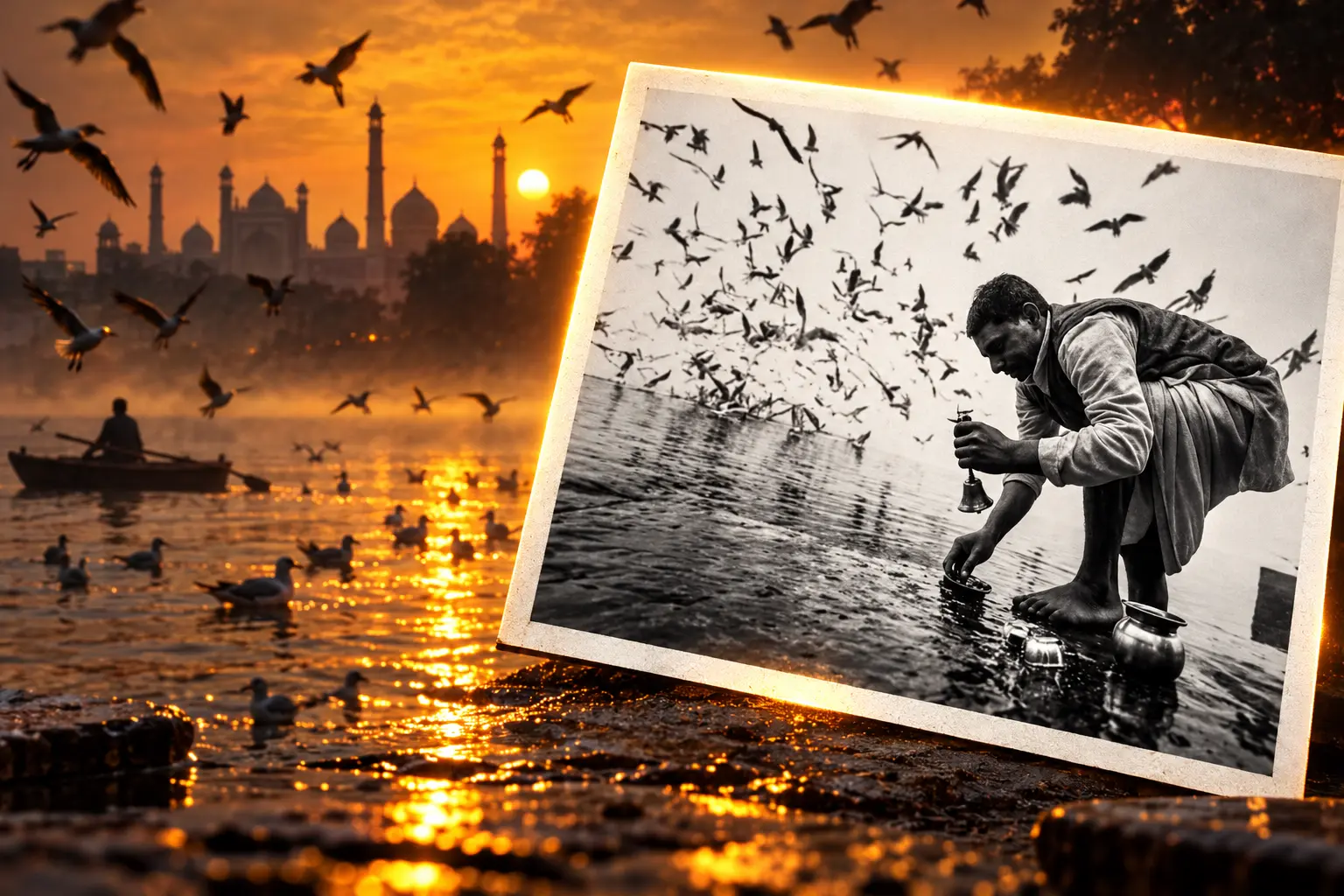
He still refuses Bruce Gilden’s line that photography is voyeuristic. On the Yamuna ghat in Delhi he watched a wrestler clean the stairs, bathe, and pray for 2 days, returning smiles, then dropped to the floor on the third day for one frame. The man asked if the camera was all right, then how he could be so fast. Vatsa told him it was his work, and the wrestler treated him as a regular after that.
Two HIPA Seasons Put Him on the Board
Public biographies call him a two-time HIPA winner. The published boards are more specific than the shorthand. HIPA, the Hamdan bin Mohammed bin Rashid Al Maktoum International Photography Award, listed Navin Kumar in fifth place in Mobile Photography for its ninth season, themed Water. His own account posted the mobile-category result in June 2020. The Water season’s published table set a fifth-place mobile prize of $4,000. The grand prize that season, $120,000, went to Jasmine Carey of Australia for a Tonga whale-and-calf photograph.
On 31 July 2022 HIPA named Navin Kumar of India third in the Nature category of its eleventh season. The grand prize that year, again $120,000, went to Henley Spiers of the United Kingdom. Secretary General Ali bin Thalith said the Nature season honoured work that could draw attention to environmental damage, and that HIPA had by then taken in half a million works across all seasons.
WHERE THE HIPA BOARDS PUT HIM
| Season | Theme | His result | That year’s $120,000 grand prize |
|---|---|---|---|
| 9th, listed 7 June 2020 | Water | 5th, Mobile Photography | Jasmine Carey, Australia |
| 11th, listed 31 July 2022 | Nature | 3rd, Nature | Henley Spiers, United Kingdom |
The other London credit is older and narrower. In 2017 he said a Travel photograph had been commended and shown at Somerset House. The venue’s own listing for the Sony World Photography Awards and Martin Parr show runs 21 April to 7 May 2017 exhibition dates, and it says the hang included winning, shortlisted, and commended work from that year’s contest. Sony India published one of his pictures in its 2016 annual calendar. In 2018 Sony India named him Indian Photo of the Year, a title that sits on his biographies and in his August 2026 remarks, and is separate from the global Sony World Photographer of the Year prize.
Black and White Is How He Thinks
Speaking in New Delhi on 20 August 2026, Vatsa pushed the talk away from kit. “It is not really about colour. It is a way of thinking,” he said. Hard light and visual clutter can force the conversion, he added, but the deeper reason is instinct. When colour drops out, the eye is left with light, shadow, texture, and form. The print gets quieter, and often stronger.
We live in a loud world. Black and white slows everything down. It asks the viewer to stay with the image instead of moving on.
Navin Vatsa, photographer, August 2026 interview
He is blunt about what he does not want from a frame. “Photography should bear witness. It should help us pay attention.” Light, he said, gives a photograph its structure; shadow gives it mystery. He does not want an image to explain itself completely. “I want it to leave a door open. Every viewer should find something of themselves in it.” Advice to younger shooters follows the same line. “Black and white is not a fashion. It asks for sensitivity, not style.” And then the sentence he keeps repeating in different rooms: “Before you learn to see in monochrome, you must first learn to see yourself.”
In 2017 he said he composes in colour and monochrome, and that the mono versions can “spread colors in the mind of viewers.” The later interview is cooler about spectacle. He is not hunting a loud picture. He is watching. “I do not photograph to prove I was somewhere. I photograph to understand how each encounter has changed the way I see.”
What Sony and Tamron Get From a Slow Photographer
The brands still want him in the room. Tamron India posted an event for 23 August 2026, 10:00 AM to 1:00 PM, at Harmony House, SACAC, Adchini, Malviya Nagar, New Delhi, billed as The Art of Visual Storytelling with mentors Navin Vatsa and Idris Ahmed. Seats were limited and registration was mandatory. The post went up on 18 August, two days before his black-and-white remarks were published.
A lens company asking a man who started on a 35mm snapshot body to talk about people, places, and perspectives is a clean fit for marketing, and a slightly awkward fit for his own rules. He has said the hard part is not cameras, lenses, or editing software. HIPA still put him fifth among mobile shooters. Sony still printed him on a calendar. The prize machine runs on gear and travel. His sentences run on patience.
THE BRAND AND TEACHING TIES
- Sony India calendar: One photograph published in the 2016 annual calendar.
- Sony India title: Named Indian Photo of the Year in 2018 on his biographies.
- Sony World hang: Commended Travel image in the 2017 Somerset House show.
- Tamron India: Listed as photography mentor, including the 23 August 2026 Delhi session with Idris Ahmed.
- National Geographic: Contributing photographer in the YourShot community.
He is from Muzaffarpur in Bihar and works out of Delhi. A 2023 recorded conversation with Vipin Baloni for Photo Journal India billed him on those terms and listed Tamron mentoring beside the HIPA seasons. The camera companies get a teacher who can talk about seeing. He gets a room of younger shooters who might otherwise learn the feed first.
Lalit Kala Called Him, Then the Ghat Did
The state art circuit has used him as a public teacher, not only as a prize name. India’s Ministry of Culture posted that he would be chief guest at the 29 August 2022 valedictory of a 10-day photography exhibition at Lalit Kala Akademi in New Delhi, at 3:00 PM, with Uma Nanduri, then chair of the academy. Azadi Ka Amrit Mahotsav carried the same notice. PhotoCommune later posted video from the closing, with Idris Ahmed in the same frame.
In December 2022 the ministry came back with a different kind of booking. A Photo Talk at Yamuna Ghat was set for 18 December 2022 from 7:00 AM, with Vatsa as the speaker. The follow-up post showed enthusiasts on the ghat and said they had gathered to learn from “a decade of being deeply involved in this art form.”
Here are glimpses from the "Photo Talk at Yamuna Ghat" organised by Lalit Kala Akademi on 18th Dec '22.
Photography enthusiasts gathered to learn from the wise words of Sh. Navin Vatsa that he has gathered over a decade of being deeply involved in this art form. #phototalk pic.twitter.com/48xNrdPY7v— Ministry of Culture (@MinOfCultureGoI) December 18, 2022
Seven in the morning on the Yamuna stairs is closer to the wrestler story than a prize dinner in Dubai. He told Rataj he does not plan trips far in advance, though he wanted the Northeast, Kolkata, Varanasi, and parts of Rajasthan. The ghat is already in his city. The ministry putting him there treats the walk as the lesson.
He Photographs to Understand the Encounter
The August 2026 remarks keep circling the same refusal. He does not want the picture to prove a location. He wants it to show how the meeting changed his eye. Loss, he has said, still sits in the work, along with the habit of looking after other people in the frame. In 2017 he said art is immortal in the way a soul is, and that he wanted to be remembered through the pictures, not through a stone.
Tamron’s Delhi session is now dated. The HIPA boards still show a mobile fifth and a Nature third, not the $120,000 chair. The Kodak-K10 prints of a mother and a small boy are still the pictures he has named as the ones that pulled him back. He is still walking, still watching light on old buildings, and still asking younger photographers to see themselves before they see in monochrome.
Frequently Asked Questions
What Is HIPA, the Prize Navin Vatsa Won Twice?
HIPA is the Hamdan bin Mohammed bin Rashid Al Maktoum International Photography Award, a Dubai contest that sets a new season theme and pays cash across several categories. Ali bin Thalith, the secretary general, said in July 2022 that the award had taken in half a million works across all seasons by the Nature year. The Water season’s own table put the category pot, including a $120,000 grand prize, inside a $450,000 published total.
When Was Navin Vatsa’s Work Shown at Somerset House?
His commended Travel image from the 2017 Sony World Photography Awards hung in the awards show at Somerset House from 21 April to 7 May 2017. That edition marked 10 years of the awards exhibition and gave British photographer Martin Parr, named for the Outstanding Contribution to Photography prize, three rooms of early black-and-white work, books, films, and posters beside the contest hang. The World Photography Organisation, which runs the awards, describes itself as working across up to 180 countries.
What Did Raghu Rai Have to Do With Navin Vatsa’s Career?
In 2016 Camarena Academy named Vatsa Best Photographer of the Year and the honour was presented by Raghu Rai. In 2017 Vatsa said he was also a mentor and admin of Camarena Academy’s large Facebook photography group, and he listed Rai among the Indian photographers whose work he studied, alongside S. Paul and, from later years, Vineet Vohra.
When Did Navin Vatsa Join National Geographic YourShot?
A March 2021 profile of his work says National Geographic recognised him and that he joined National Geographic YourShot as a contributor in 2020. The same account says he contributed to the Government of Delhi’s annual calendar in 2018, 2019, 2020, and 2021, four years running.

Instagram Plus Tests a Read-Only Mode That Cuts Stories

Altman Asks the Public to Accept Some AI Harm

Google Freezes OSS VRP Product Reports After AI Flood

AI Agents Make Payment Rails the Scarce Prize

Turkey’s Crypto Boom Now Runs Through Three Banks

Fable 5 Came Back Under a Commerce On-Off Switch

Google’s SpaceX GPU Lease Has a Sept. 30 Deadline

Plasma One’s XPL Locks Face a 1.81 Billion Cliff

DGO’s Rs 549 World Cup Pass Cost Fans Sleep and Data

Moonshot AI’s $30 Billion Ask Became a $35 Billion Close
-
 AI4 months ago
Fable 5 Came Back Under a Commerce On-Off Switch
-
 AI5 months ago
Google’s SpaceX GPU Lease Has a Sept. 30 Deadline
-
 CRYPTO4 months ago
Plasma One’s XPL Locks Face a 1.81 Billion Cliff
-
 APPS4 months ago
DGO’s Rs 549 World Cup Pass Cost Fans Sleep and Data
-
 AI5 months ago
Moonshot AI’s $30 Billion Ask Became a $35 Billion Close
-

 NEWS5 months ago
ColorOS 17 Device List Spans Oppo, OnePlus and Realme
-

 GAMING4 months ago
Xbox Cuts 3,200 Jobs After Five Years of Thin Returns
-

 GAMING4 months ago
The RTX 4050 Under Rs 70,000 Hides a Wattage Gap