
GAMING
Nintendo Fills Pictonico’s Free Demo With 10 Mini-Games
Nintendo raised Pictonico’s free demo from 3 games to 10 through September 15, and free play now pays coins into Photo Lottery.

Nintendo is letting Pictonico players try 10 mini-games for free through 9:59 a.m. on Tuesday, September 15, 2026. The app launched with three. The other 70 games still sit in two paid packs.
Pictonico is Nintendo’s phone toy that turns camera-roll faces into short action gags. The extra free set needs version 1.1.0, and those free games now drop coins for Photo Lottery. That is the offer. It is also a sales window with a morning cutoff.
The Free Sample Jumps From 3 Games to 10
Nintendo’s Japan topics page dated August 18, 2026, posted the bump: 10 free mini-games through September 15, if the app is on ver. 1.1.0. The same note still tells you that playing the full set means buying game packs.
On May 19, 2026, Nintendo said the download would be free and that three mini-games would be there to try. Pictonico then shipped on May 28, 2026 for iOS and Android. For 82 days the sampler stayed at those three games out of 80.
The August 18 note does not call the change a fix. It reads like a limited treat. The structure is still the launch deal, only louder: try more of the catalog, then pay for the rest before the extra seven games go away.
THE PICTONICO FREE-DEMO CLOCK
- May 19, 2026: Nintendo announces Pictonico for May 28, with three mini-games free and two paid packs behind them.
- May 28, 2026: The app goes live on iOS and Android as a free download.
- August 18, 2026: The free set grows to 10, free play starts paying coins, and Nintendo asks for ver. 1.1.0.
- September 15, 2026, 9:59 a.m.: The 10-game window ends on Nintendo’s stated clock.
Google Play’s own event strip frames the same period as “more minigames in the free demo,” which is the honest label. It is still a demo. Seventy games remain behind the packs while the window is open.
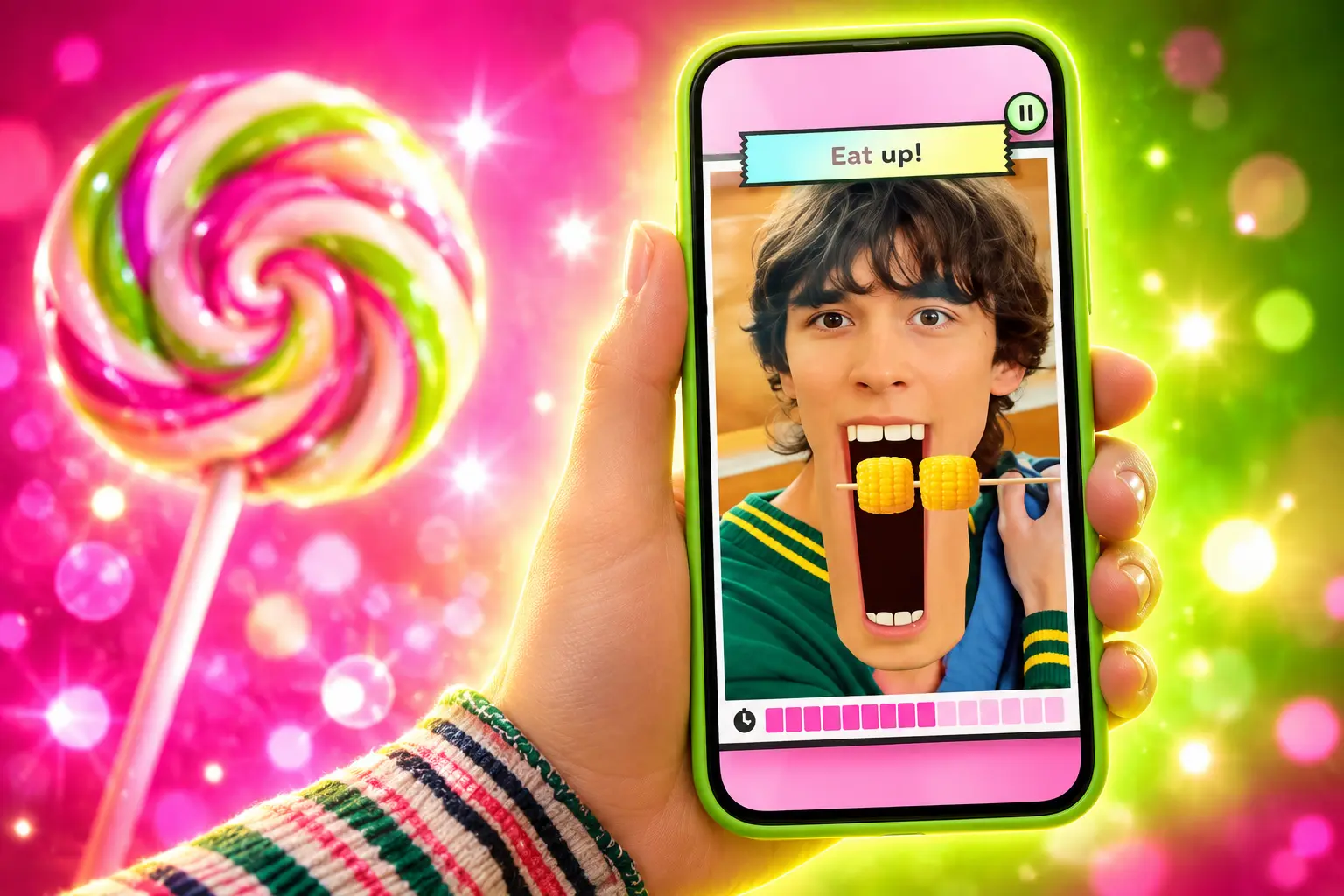
What the 10 Free Pictonico Games Do to a Photo
Nintendo listed the 10 titles in Japanese. Several match English names already used in the full 80-game set: Shush, Straws, Gardening, Jigsaw Puzzle, Nose Hair, Shampoo, Lollipop, and Chomp. Seiza and Kumitaisou stay on the Japan list as せいざ and くみたいそう.
The gag is the photo. The app pulls a face from the camera roll, or from a shot you take on the spot, and runs a few seconds of touch-screen business on it. Mouths get zipped. Jaws stretch toward a skewer. Hair takes shampoo. A plant has to catch falling water.
THE 10 GAMES IN THE FREE WINDOW
| Game | What the photo has to survive |
|---|---|
| Shush (おしずかに) | Zip a talking mouth shut |
| Straws (ストロー) | Get a cup and straw to the face |
| Gardening (ガーデニング) | Move a plant so it catches falling water |
| せいざ (Seiza) | Listed in Nintendo’s free set; keep the Japan title |
| くみたいそう (group exercise) | Listed in Nintendo’s free set; keep the Japan title |
| Jigsaw Puzzle (ジグソーパズル) | Drop the last pieces into the photo |
| Nose Hair (はなげ) | Pluck the hairs |
| Shampoo (シャンプー) | Rub shampoo into the hair |
| Lollipop (ペロペロキャンディ) | Move the candy to the face |
| Chomp (かむ) | Work the jaw to eat food on a skewer |
Nintendo Mobile posted a one-minute clip of that set the same week as the topics note. The trailer is the cleanest look at how a family snapshot becomes the punchline.
You can save the weird outcomes as images or videos and send them around. Nintendo’s U.S. launch note even pushes that share step. The free window is how a new player finally sees enough of those gags to decide whether the joke is worth 1,400 yen in packs.
Free Play Now Pays Coins Into Photo Lottery
The other change in the August 18 note is easy to skip if you only count games. Free mini-games now pay coins. You spend those coins on Photo Lottery, the fortune bit that uses a face from your library and a comic line about the day’s luck.
Photo Lottery was already in the app in May. What changed is the faucet. If coins used to sit behind paid packs, free play could stall after three microgames and a paywall. Paying coins on the free slice gives the app a reason to be opened again after the last Shush or Chomp, even if you never buy Vol. 1.
Nintendo’s Japan account posted the topics link the same day. The post is a headline and a URL, not a pitch about coins, which is why the lottery line in the article matters more than the tweet.
[トピックス]スマートフォン向けアプリ『Pictonico!』で無料で遊べるミニゲームが増量。https://t.co/Y89CYCsenKhttps://t.co/Y89CYCsenK
— 任天堂株式会社 (@Nintendo) August 18, 2026
The 10-game count is what expires at 9:59 a.m. on September 15, 2026. Nintendo did not say the coin rule expires with it. If the faucet stays, the lasting patch is a daily lottery habit on a three-game demo. If it goes, the August note was only fuel for this window.
A Camera-Roll Toy From the WarioWare Studio
Every Nintendo page on Pictonico carries the same credit: © Nintendo, co-developed by Intelligent Systems. That studio’s microgames are the closest cousin this app has. There is no Wario. Your boss, your kid, and a photo from a barbecue take the roles.
Nintendo’s U.S. launch copy is the plain version of the pitch. It tells you to pick gallery shots or take new ones, then run friends and family through zombie bits, costume gags, and carnival bits, and to keep the clips.
They’re your photos, so have some fun with them!
Nintendo, Pictonico U.S. launch note, May 28, 2026
On the Japan side, Nintendo walked through the photo pool in May. The app can scan all saved photos, a date range such as a trip, or a folder you make. It looks for faces that work, mostly fronts. You can also lock out photos you do not want in the gag reel, then shoot a new one when people are in the room.
Modes sit under that toy. Stages get harder as you go. Score Attack has a high-speed path and a one-miss “dangerous” path. Photo Lottery is the calm one. The 80-game catalog is the rest of the product, split 50 and 30 across the two packs, and you still unlock games by playing stages after you pay.
WarioWare fans keep treating Pictonico as a stopgap, which is fair and also a miss. This is the photo toy Intelligent Systems could only build on a phone, because the asset is the camera roll, not a cartoon roster. Three free games never proved that. Ten just might, if anyone still has the app installed.
Google Play Has a 3.6 After 1 Million Downloads
Google Play lists Pictonico at 1 million-plus Android downloads and a 3.6 rating. That storefront is Android only, so it is not a global install count. It is still the public score for the free-to-start pitch.
Metacritic’s iOS tally sits at 74 from 9 critic reviews, filed as mixed or average. The split in that small set is the same split you hear from people who actually tap through a round: the photo gags land, then the demo stops.
PICTONICO BY THE STOREFRONT
- Android score: 3.6 on Google Play, with 1 million+ downloads.
- Critic score: 74 on Metacritic, from 9 iOS reviews.
- Free at launch: 3 mini-games out of 80.
- Free in this window: 10 mini-games, through 9:59 a.m. on September 15, 2026.
On launch day, Google Play user Magnus Mulholland wrote the complaint the 3.6 still carries. He said he found three games, then two volumes, and that calling the download free felt off when a few minutes of play sat in front of a charge.
It feels so deceptive to mark this as a free download (even if it says in the description) when there is little hope of having more than 5 minutes of fun without paying money.
Magnus Mulholland, Google Play review, May 28, 2026
A later Play note from Jackson Burdick, posted August 20, 2026, called the demo fun in the WarioWare sense and said he still had not bought a pack. That is the player Nintendo is hunting with 10 games and a coin faucet: someone who already laughed, and still has not paid.
On-Device Photos and a Permission Warning
The scare around an app that reads your camera roll is obvious, and Nintendo put the counter in the legal lines, not in the jokes. The Japan topics pages repeat that the photos used in play are not sent to a server. The U.S. launch note says the same thing in English, and adds a consent line: only photograph people who said yes.
Nintendo also says you do not need to stay online. The phone has to talk to a network on first launch and when you buy a pack. After that, the gags run locally, which is why a paid volume can work on a train with no signal.
HOW PICTONICO HANDLES YOUR CAMERA ROLL
- On the device: Nintendo says photos are not sent to Nintendo.
- Permission: Only take photos of people who have provided permission.
- Pool controls: Use all photos, a date range, a folder, or a shot taken in the room.
- Network: First launch and pack purchases need a connection; the games do not stay online.
That local rule is the reason the app can be both nosy and contained. It has to see faces to distort them. It does not need to ship those faces out to do the gag. If you are handing a phone to a kid, the permission line is the one that still matters, because the humor is plucking a parent’s nose hair and zipping a sibling’s mouth.
Game Pack Vol. 1 Still Costs 800 Yen
The price list did not move with the free bump. Nintendo’s Japan pages still print Game Pack Vol. 1 at 800 yen (tax included) for 50 games and Game Pack Vol. 2 at 600 yen (tax included) for 30 games. Together that is 1,400 yen for the 80-game set. The download stays free.
WHAT YOU GET IF YOU PAY
| Slice | Games | Price (Japan) |
|---|---|---|
| Free demo at launch | 3 | 0 yen |
| Free demo in this window | 10 | 0 yen, through 9:59 a.m. on September 15, 2026 |
| Game Pack Vol. 1 | 50 | 800 yen, tax included |
| Game Pack Vol. 2 | 30 | 600 yen, tax included |
| Both packs | 80 | 1,400 yen, tax included |
U.S. store prices vary by shop and tax, which is why the yen figures from Nintendo’s own pages are the ones that hold. The pack math does not. Vol. 1 is the 50-game bundle. Vol. 2 is the 30-game add-on. You can download Pictonico on the App Store or from Google Play, try the 10, and still owe for the other 70 if you want the catalog.
After 9:59 a.m. on September 15, 2026, the free set is scheduled to shrink. The packs will still be 800 yen and 600 yen. The photos will still be the joke. The only open question Nintendo left on the table is whether free play keeps paying coins into Photo Lottery once the extra seven games go away.

Instagram Plus Tests a Read-Only Mode That Cuts Stories

Altman Asks the Public to Accept Some AI Harm

Google Freezes OSS VRP Product Reports After AI Flood

AI Agents Make Payment Rails the Scarce Prize

Turkey’s Crypto Boom Now Runs Through Three Banks

Fable 5 Came Back Under a Commerce On-Off Switch

Google’s SpaceX GPU Lease Has a Sept. 30 Deadline

Plasma One’s XPL Locks Face a 1.81 Billion Cliff

DGO’s Rs 549 World Cup Pass Cost Fans Sleep and Data

Moonshot AI’s $30 Billion Ask Became a $35 Billion Close
-
 AI4 months ago
Fable 5 Came Back Under a Commerce On-Off Switch
-
 AI5 months ago
Google’s SpaceX GPU Lease Has a Sept. 30 Deadline
-
 CRYPTO5 months ago
Plasma One’s XPL Locks Face a 1.81 Billion Cliff
-
 APPS5 months ago
DGO’s Rs 549 World Cup Pass Cost Fans Sleep and Data
-
 AI5 months ago
Moonshot AI’s $30 Billion Ask Became a $35 Billion Close
-
 NEWS5 months ago
ColorOS 17 Device List Spans Oppo, OnePlus and Realme
-

 GAMING4 months ago
The RTX 4050 Under Rs 70,000 Hides a Wattage Gap
-

 AI4 months ago
Boris Cherny’s Loops Still Demand a Higher Production Bar