
AI
Young Adults Sour on AI While Peers Land High-Pay Jobs
Young adults just crossed 55% more concerned than excited about AI, even as LinkedIn shows Gen Z taking the highest-paid builder jobs.

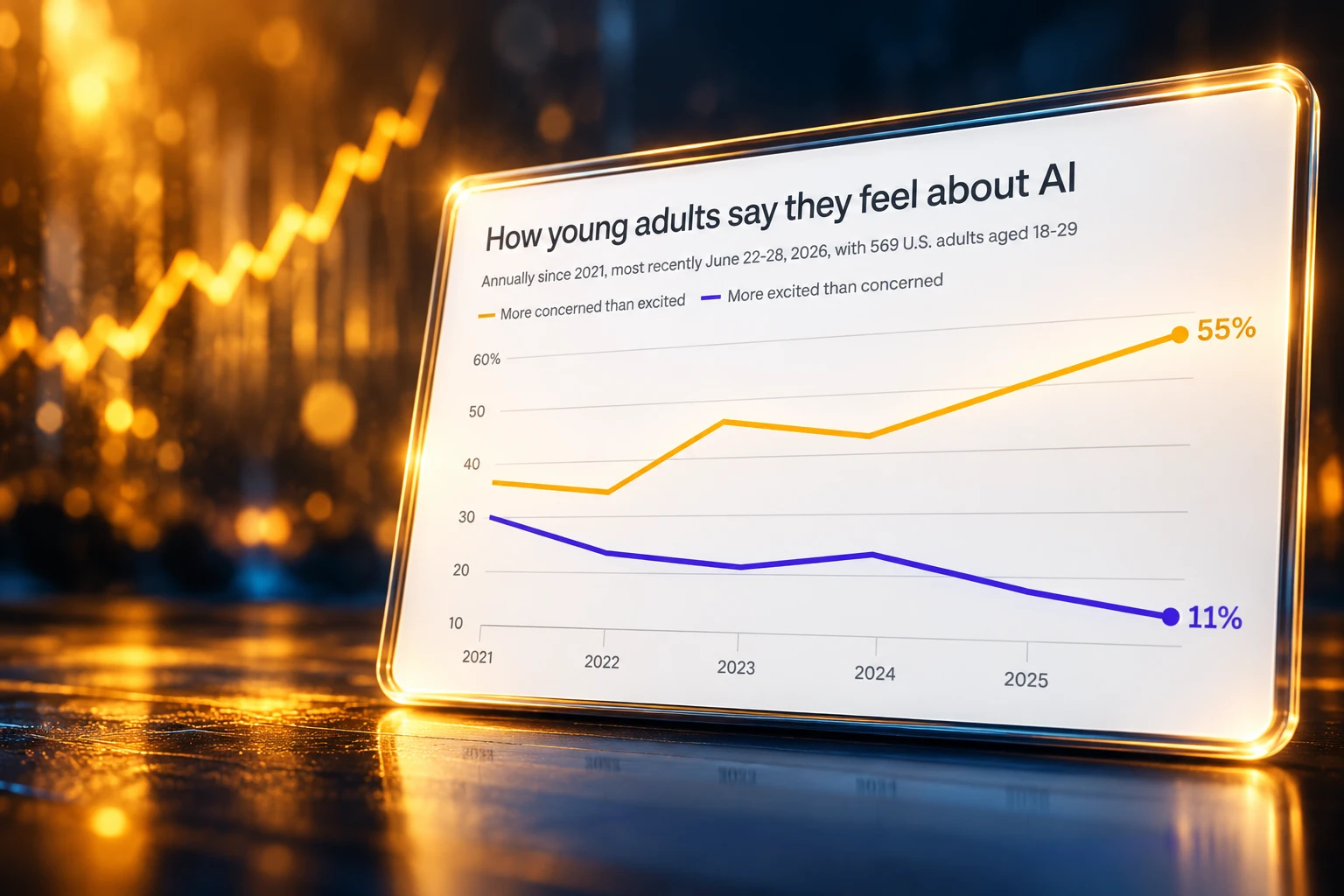
A majority of U.S. adults under 30 now say they are more concerned than excited about AI, Pew Research Center found. The June 2026 survey is the first time that age group has crossed the line since Pew began asking in 2021.
The same week, LinkedIn said millennials and Gen Z are taking the fastest-growing AI engineering jobs, work that pays a median of $177,000. Broader youth jobless rates still sit well above the national figure.
Under 30s Are Done Being the Optimistic Cohort
Pew surveyed 3,488 U.S. adults from June 22 to June 28, 2026, and published the results on August 18. Colleen McClain, a senior researcher, and Eugenie Park, a research analyst, wrote that a majority of adults under 30 now feel more concerned than excited about AI in daily life. That share is 55%, up from 31% in 2021 and 39% in 2024.
About 11% of adults 18 to 29 say they are more excited than concerned, down from 25% in 2021. Roughly a third feel both equally. Their concern now sits even with people in their 30s and 40s, and with adults 65 and older.
Across the whole sample, 52% of U.S. adults are more concerned than excited, up from 37% in 2021. Another 9% are more excited, and 37% say they feel both in equal measure. Adults 65 and older remain the most uneasy at 59%. The 50 to 64 band is the exception at 47% more concerned, the only age group Pew tracked that did not put a majority on that side in 2026.
CONCERN BY AGE, 2021 TO 2026
| Age group | More concerned, 2021 | More concerned, 2026 | Change |
|---|---|---|---|
| 18-29 | 31% | 55% | +24 pts |
| 30-49 | 34% | 51% | +17 pts |
| 50-64 | 41% | 47% | +6 pts |
| 65+ | 43% | 59% | +16 pts |
| All U.S. adults | 37% | 52% | +15 pts |
Pew posted the under-30 crossover the day after the report went out. Excitement has fallen in every age group since 2021. The climb in worry among people under 30 did not stall after 2023 the way it did for older adults.
For the first time, a majority of adults under 30 say they’re more concerned than excited about #AI.
Their concern is now on par with those in their 30s and 40s, and those 65 and up. pic.twitter.com/NQCFwnD09n
— Pew Research Center (@pewresearch) August 19, 2026
High Pay in a Thin Slice of AI Roles
On August 18, LinkedIn released a LinkedIn analysis of AI engineering roles that it defines as “AI engineering and technology-building roles.” It named 12 fast-growing jobs and then cut the hires by age, gender, and schooling. Kory Kantenga, Head of Economics, Americas, at LinkedIn, said the usual story that Gen Z cannot get hired is not wrong, and that seeing young workers take this slice of the market still surprised him.
Gen Z accounts for more than two thirds of hires in two individual-contributor jobs, forward deployed engineer and AI engineer, with median pay of $199,000 and $166,000. Millennials make up 60% of new hires for head of AI jobs, which list $236,000 in median pay. A typical AI role lists $177,000, more than double the $80,000 median for a non-AI role on the same platform.
That premium sits far above ordinary wages. The Federal Reserve Bank of St. Louis puts median pay for workers 25 to 34 at $60,320 in the second quarter of 2026, and at $74,672 for workers 35 to 44. AI job postings on LinkedIn rose 14% from 2023 to 2024, then 156% from 2024 to 2025. LinkedIn would not give raw posting counts.
WHAT THE AI BUILDER JOBS PAY
| Role or benchmark | Median pay | Who is getting hired |
|---|---|---|
| Forward deployed engineer | $199,000 | Gen Z more than two thirds of hires |
| AI engineer | $166,000 | Gen Z more than two thirds of hires |
| Head of AI | $236,000 | Millennials 60% of new hires |
| Typical AI role | $177,000 | 91% hold a bachelor’s degree or higher |
| Typical non-AI role | $80,000 | LinkedIn posting pay data |
| Data annotator | $51,000 | Lowest-paid AI job on the list |
| All jobs, ages 25-34 | $60,320 | Q2 2026, St. Louis Fed |
The wider market for young workers does not look like those medians. In June 2026, the unemployment rate was 7.2% for workers ages 22 to 27 and 4.1% for all workers, using Census Bureau and Bureau of Labor Statistics figures Kantenga cited. Unemployment among recent college graduates in that same 22 to 27 band was 5.7%.
How Pew Measured the Mood Shift
Pew asked a simple three-way question it has used since 2021: whether the increased use of AI in daily life makes you more excited than concerned, more concerned than excited, or equally concerned and excited. Everyone in the sample belongs to the Center’s American Trends Panel of U.S. adults. The 2026 wave, tagged Wave 195, has a margin of error of plus or minus 1.8 percentage points at 95% confidence.
The jobs question is separate and looks 20 years out. Pew asks whether AI will lead to more jobs, fewer jobs, or not much difference in the United States, and it offers “not sure.” It last asked that pair in August 2024, which is why the job figures move on a two-year clock while the mood question moves almost every year.
Overall concern first jumped in 2023, after ChatGPT had been public for a year, and then held near half of adults. The under-30 line is the one that kept rising in 2025 and 2026. Older groups flattened or, in the 50 to 64 band, eased off the peak.
WHEN OVERALL CONCERN CROSSED 50%
- November 1-7, 2021: 37% of U.S. adults say they are more concerned than excited, and 18% say they are more excited.
- December 12-18, 2022: Concern holds at 38%, with excitement at 15%.
- July 31-August 6, 2023: Concern jumps to 52%, the first majority, and excitement falls to 10%.
- August 12-18, 2024: Concern is 51%, and Pew records 64% expecting fewer jobs over 20 years.
- June 9-15, 2025: Concern is 50%.
- June 22-28, 2026: Concern is 52% overall and 55% among adults under 30, with 71% expecting fewer jobs.
McClain and Park note that job loss was already among the top reasons for worry in 2021. The new numbers show that belief spreading, including among the age group that will still be working at the end of Pew’s 20-year window.
73% of Young Adults Expect Fewer Jobs
73% of adults under 30 now say AI will lead to fewer U.S. jobs over the next 20 years, up from 61% in 2024. That 12-point jump closed the old gap with workers in the middle of their careers. Adults 30 to 49 sit at 74%, and adults 50 to 64 at 72%. Adults 65 and older are less likely to predict job loss, at 63%, still a majority.
For all adults, 71% expect fewer jobs, up from 64% in 2024. Only 5% expect more jobs, the same share as two years earlier. One in ten say AI will not make much difference, down from 14%, and 14% are not sure, down from 16%. The rise in “fewer jobs” came from people who had been on the fence, not from a collapse in the tiny “more jobs” camp.
A 20-year horizon is not a distant policy problem for people who will still be working in 2046. Job loss used to sound like a later chapter. For this age group it covers the whole career they have not started, or have just started. Using the tools and trusting the tools are not the same act. A 23-year-old can get very good at a chatbot and still wonder whether that extra output means the company needs fewer people.
Women Catch Little of the AI Pay Premium
Kantenga said companies have had to raise pay because so much money is flowing into AI. He also said the same boom can widen the pay gap if workers without the right degrees are shut out. LinkedIn found that 91% of people in these AI roles hold a bachelor’s degree or higher. Almost half of workers hired as head of AI have a graduate degree, and 20% have a doctoral degree.
Gender cuts through the same pipeline. Women were 26% of new hires in AI roles in 2025, against 50% in non-AI occupations. The only AI job on LinkedIn’s list where women are hired as often as men is data annotator, the lowest-paid title at $51,000.
WHO GETS HIRED INTO THE HIGH-PAY ROLES
- New AI hires: Women were 26% of new hires in AI roles in 2025, versus 50% in non-AI jobs.
- Head of AI: Women were one fifth of hires; millennials were 60% of new hires in the same title.
- Director of AI: Women were 26% of hires.
- Member of technical staff: Women were 18% of hires in one of the highest-paid titles.
- Schooling filter: 91% of people in AI roles have a bachelor’s degree or higher, and 20% of head of AI hires hold a doctorate.
A February 2025 study from leadership advisory firm Russell Reynolds found women hold 10% of CEO and top tech roles at AI organizations. Kantenga’s line on that pattern is blunt: women are less well represented at every rung of seniority in AI firms. The high-pay story is real. It is also narrow by degree and by gender, which is one reason a $177,000 median does not settle a 73% job-loss belief.
A Career Ladder With the Bottom Rungs Cut
Kantenga still tells recent graduates to treat computer science as a ticket into entry-level AI work, and to build side projects if they lack on-the-job data experience. He also said young workers are split in a way that matches Pew more than the salary tables do.
There is a big narrative in the labor market right now that it’s very difficult to get a job if you’re Gen Z.
Kory Kantenga, Head of Economics, Americas, LinkedIn
Some of them feel very positive and see a career opportunity, he said. Some of them are worried the tool will replace them. Teaching people to prompt a model does not answer what an entry-level job becomes once the research, drafting, and admin work that used to train juniors is automated. If firms cut those tasks without building a new way to learn judgment, they remove rungs and do not replace them.
That is the bind inside the optimism fade. The builder jobs are growing fast enough to mint six-figure pay for a small, credentialed group. They are not a labor market. Google, Amazon, Microsoft, Meta, Nvidia, Oracle, and others have put more than $1 trillion into AI projects and infrastructure since 2023, and they are still hiring the people who can stand up the stack. Pew’s under-30 majority is looking at the rest of the economy, where unemployment for 22- to 27-year-olds in June was 7.2% against 4.1% for everyone, and answering a 20-year jobs question with “fewer.”
Frequently Asked Questions
What Is the Margin of Error on Pew’s June 2026 AI Survey?
Pew reports a margin of error of plus or minus 1.8 percentage points at 95% confidence for the full sample of 3,488 U.S. adults. Subgroups such as adults under 30 have larger error bands than the headline sample, which is why Pew treats the 55% figure as a majority without claiming a precise gap against every other age band.
What Share of Americans Think AI Will Create More Jobs?
Only 5% of U.S. adults said AI will lead to more jobs over the next 20 years, the same share Pew recorded in August 2024. The climb in “fewer jobs,” from 64% to 71%, came from people who had said it would not make much difference or who had been unsure, not from a collapse in the more-jobs camp.
Was the 2026 Pew AI Survey Done Only Online?
No. The June 22-28, 2026, wave was conducted primarily online, with some interviews by live telephone. Earlier American Trends Panel surveys from October 2016 through June 2024 were fully online, with tablets and data plans given to adults who lacked home internet.
How Does Pew Phrase the AI Jobs Question?
The exact item, asked of everyone, is: “Thinking about the U.S. over the next 20 years, do you think that artificial intelligence (AI) will lead to more jobs, fewer jobs, will not make much difference,” or “not sure.” Response order for more jobs and fewer jobs is rotated, and the last two options stay last.
Did Concern Rise in Every Age Group Between 2023 and 2026?
No. Among adults 50 to 64, the share who were more concerned than excited fell from 59% in 2023 to 47% in 2026, even as their share expecting fewer jobs ticked up from 69% to 72%. Under-30 concern moved the other way, from 42% in 2023 to 55% in 2026.

Instagram Plus Tests a Read-Only Mode That Cuts Stories

Altman Asks the Public to Accept Some AI Harm

Google Freezes OSS VRP Product Reports After AI Flood

AI Agents Make Payment Rails the Scarce Prize

Turkey’s Crypto Boom Now Runs Through Three Banks

Fable 5 Came Back Under a Commerce On-Off Switch

Google’s SpaceX GPU Lease Has a Sept. 30 Deadline

Plasma One’s XPL Locks Face a 1.81 Billion Cliff

DGO’s Rs 549 World Cup Pass Cost Fans Sleep and Data

Moonshot AI’s $30 Billion Ask Became a $35 Billion Close
-
 AI4 months ago
Fable 5 Came Back Under a Commerce On-Off Switch
-
 AI5 months ago
Google’s SpaceX GPU Lease Has a Sept. 30 Deadline
-
 CRYPTO4 months ago
Plasma One’s XPL Locks Face a 1.81 Billion Cliff
-
 APPS5 months ago
DGO’s Rs 549 World Cup Pass Cost Fans Sleep and Data
-
 AI5 months ago
Moonshot AI’s $30 Billion Ask Became a $35 Billion Close
-

 NEWS5 months ago
ColorOS 17 Device List Spans Oppo, OnePlus and Realme
-

 GAMING4 months ago
The RTX 4050 Under Rs 70,000 Hides a Wattage Gap
-

 AI4 months ago
Boris Cherny’s Loops Still Demand a Higher Production Bar