
NEWS
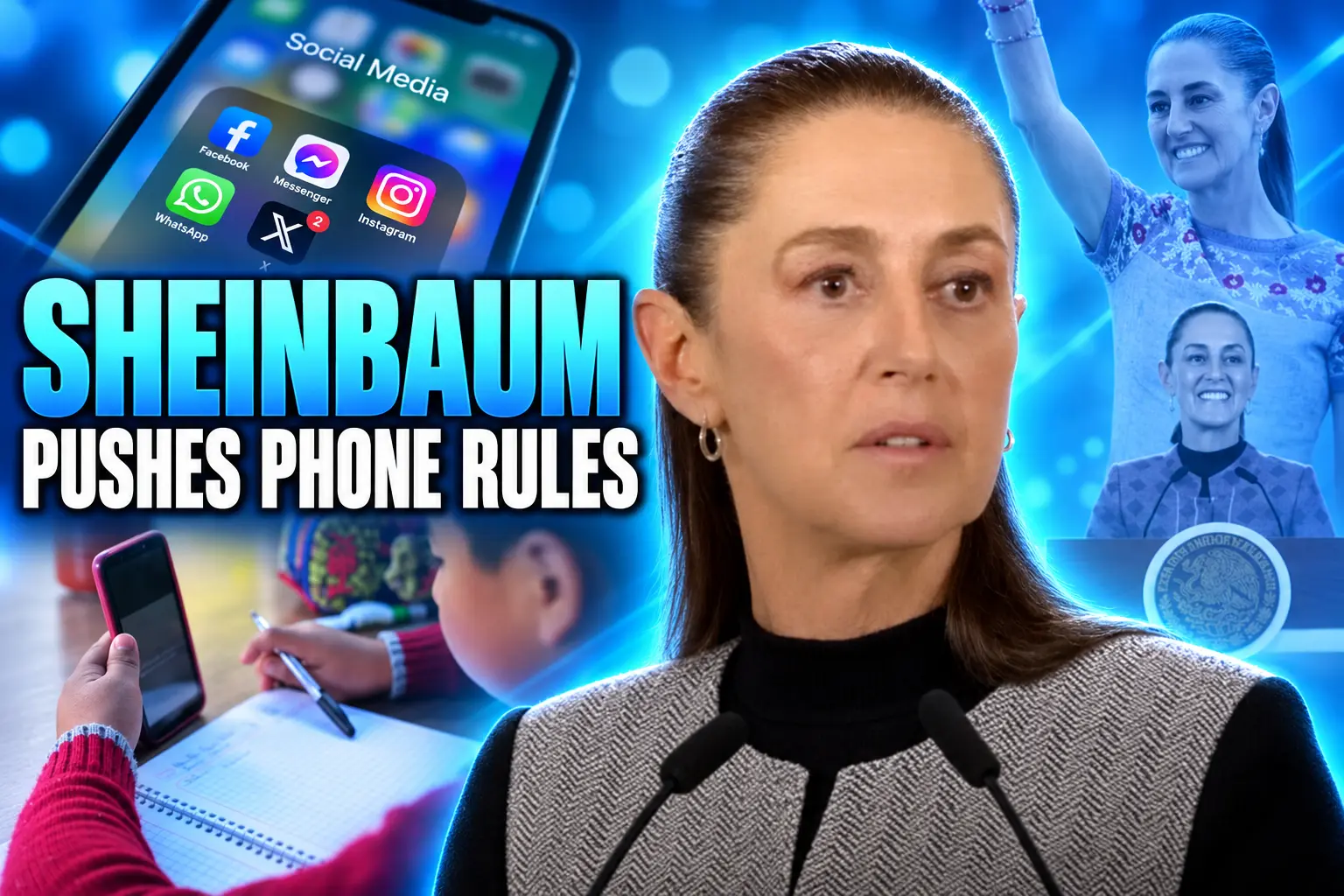
Sheinbaum Pushes Classroom Phone Rules, Not App Bans
Mexico will set national classroom phone rules on September 18 after teachers backed limits, while Sheinbaum rejects an under-age social media ban.

Mexico’s state education chiefs will meet on September 18 to set national rules on phones in schools, after 81 percent of teachers in a federal survey backed classroom limits. President Claudia Sheinbaum has already taken the other global option off her desk: a social media account ban for teenagers.
She called that idea very problematic, hard to police, and likely to make the apps more tempting. The bet is narrower. Lock the school day first, keep any law on feeds and algorithms in an open fight with parties and parents, and try not to look like the presidency is writing a speech code.
Haidt Asked for Two Rules and Mexico Is Building One
Jonathan Haidt, a New York University social psychologist and the author of The Anxious Generation, joined her morning briefing by video on August 3. He told the room that democracies were pulling smartphones out of the school day and raising to 16 the minimum age for a social media account, and he urged Mexico to implement both measures.
I encourage you, President Sheinbaum, to implement both measures in Mexico.
Jonathan Haidt, social psychologist, New York University, August 3 briefing
He framed both steps as a public health problem, not a content fight, and asked governments to stop treating a touchscreen as a digital pacifier for toddlers. Phone-free schools, he said, were the cheap, visible start: a norm change that begins in the building even if kids pick the devices back up at the gate.
Two weeks later Sheinbaum took the school half and declined the age gate. Education Secretary Mario Delgado Carrillo told the same August 17 briefing that more than a million teachers would weigh in on devices during the intensive technical-council sessions on August 24 and 25, across more than 200,000 basic-education schools.
That is the part of the Haidt script a federal government can run with buildings it already staffs. An account ban needs platforms, age checks, and a law that will be read as a muzzle the minute it leaves Palacio Nacional.
An 81 Percent Vote From Classroom Teachers
The 2026-27 year opened on August 31 for 28 million students and 1.6 million teachers. Delgado brought the survey to that first-day briefing: 565,396 teachers answered, a smaller group than the million-plus who were asked, and 81 percent backed guidelines for safe, teaching-related use of phones and other screens.
WHAT TEACHERS TOLD THE SEP
| Finding | Share of teachers |
|---|---|
| Back rules for phones and screens | 81 percent |
| Phones make it harder to keep attention | 40 percent |
| Devices interrupt schoolwork | 38 percent |
| Fights that start on social media enter the school | 38.7 percent |
| Kids leave shared play for the screen | 34 percent |
Sheinbaum translated the result into a simpler line. For now, she said, teachers agree phones should stay out of class and out of recess, so the school day is not another scroll. Sixteen of Mexico’s 32 states already limit phones in class. The September 18 meeting of the National Council of Education Authorities, known as CONAEDU, is where Delgado and the state secretaries are supposed to turn that patchwork into one national rule.
She has been careful with the verb. On September 11, speaking in Chiapas after a rough PISA round, she said the point was not to outlaw the device, and then described the school day she wants: no phone in the lesson, no phone in the yard, paper and pencil back on the desk. Kids, she said, had stopped reading because they lived in feeds whose design pushes addiction.
Why Sheinbaum Called an Age Ban Very Problematic
The sharper no came on August 17, in the same briefing that launched the teacher vote. Sheinbaum said the idea that young people cannot have social media is, in her view, very problematic. She asked how anyone would police who holds an account, and warned that a ban can make the product more interesting because it is forbidden.
That is a practical objection, and it is also a political one. She has said she does not want a social media rule to come from the presidency, and that she wants parties and society in the room so the government is not accused of trying to censor the feeds. Content rules, she said, are on the table, and if not the posts themselves then the way the algorithms are built, including infinite scroll. It will not become law tomorrow because the president thinks it should.
Mario Delgado had earlier floated age limits in the Australian style. Sheinbaum closed that door in public. The Monday expert circuit kept going anyway. Ravi Iyer, a University of Southern California researcher and a former Meta data-science lead, told the August 17 briefing that the choices that hold a user in a feed were made by people who wrote the ranking systems, so the companies share the blame. Arturo Béjar, a former Facebook security engineer, sat in the August 3 room on the same theme.
Platforms have their own teen timers, and those teen time limits that skip shared screens are one reason schoolhouses have become the easier lever. A rule that reaches the desk does not need an app store’s help.
Most Australian Teens Are Still on the Apps
Australia took the path she is not taking. Since December 10, 2025, major platforms have been barred from giving accounts to users under 16. The government says more than five million under-16 accounts have been blocked, deactivated, or restricted. Nine months in, the usage numbers are the part other capitals now read twice.
AUSTRALIA NINE MONTHS IN
- Accounts cut: More than five million under-16 accounts have been blocked since the ban took effect.
- Kids still on: More than 81 percent of children aged 10 to 15 were still using at least one restricted platform three months later, down only from nearly 86 percent before the law.
- Daily habit: About 58 percent reported daily use, against about 60 percent before the cutoff.
- The hole: 50.2 percent said the app had not asked them to confirm their age; 18.2 percent said the system guessed they were older.
Those two 81 percent figures are not the same poll. In Mexico, 81 percent is the share of teachers who want classroom rules. In Australia, more than 81 percent is the share of 10-to-15-year-olds who were still on restricted apps after the account ban.
eSafety, the Australian regulator, has been investigating Facebook, Instagram, Snapchat, TikTok, and YouTube. Prime Minister Anthony Albanese said the companies were not doing enough and that too many children were still on social media. Lawmakers doubled the maximum fine for systemic breaches from A$49.5 million to A$99 million (about US$68 million) and widened eSafety’s power to demand evidence; that bill received assent on September 11. Meta says it has removed access to more than 750,000 Australian accounts on Facebook and Instagram that its systems judged to belong to people under 16.
Sheinbaum’s August 17 question sits on top of that record. If a world-first ban still leaves most of the age group inside the apps, a Mexican copy would spend political capital on a gate kids already walk around.
France’s Court Struck Down a Blanket Ban
France tried a hard age wall and lost it in court before it could start. On August 14 the Constitutional Council struck down the under-15 access ban in decision 2026-911 DC, three days before Sheinbaum’s teacher-vote announcement. The law would have barred new accounts from September 1 and given platforms four months to close the ones already open.
The contested provisions, on the one hand, disproportionately infringe upon the freedom of expression and communication and, on the other, fail to provide the legal safeguards necessary to ensure the right to respect for private life.
French Constitutional Council, press release on decision 2026-911 DC, August 14
The judges accepted that protecting children can justify some limits. They refused a general shutdown that ignored the minor’s age and family situation, ignored the different risks of each service, and left parents no way to lift or narrow the bar. Because a under-15 lock forces every user, including adults, to prove a date of birth, they also held that the statute never set the conditions and limits for that proof.
President Emmanuel Macron told his prime minister to rewrite the text with those objections in mind, and said he still wanted a legally solid version by spring 2027. For Mexico, the ruling is a map of the traps Sheinbaum is trying not to step in: a ban so wide it covers tools that do not look like TikTok, an ID check that lands on every adult, and a free-speech fight the presidency cannot win on day one.
Brazil Tied Child Accounts to Parents
Brazil wrote a third model. Law 15,211/2025, the Digital Child and Adolescent Statute, took effect on March 17, 2026. Social media accounts for children under 16 must be linked to a parent or guardian. A decree that regulates Brazil’s Digital ECA, Decree 12,880/2026, puts age checks on high-risk services, tells app stores and operating systems to pass age signals without handing over a full birth date, and bars a simple self-declaration as proof. Fines can reach 50 million reais, or 10 percent of Brazil-sourced revenue, and repeat breaches can close a service.
That is not a clean eject of teenagers. It is a chain of custody: the child account hangs off an adult one, the store shares an age band, and the privacy regulator writes the tech rules. Mexico has not said it will copy that chain. It is the regional proof that a Latin American government can regulate platforms without a France-style blanket lockout, and without Australia’s all-or-nothing account purge.
HOW FOUR COUNTRIES DREW THE LINE
| Country | Main tool | Where it stands |
|---|---|---|
| Mexico | National classroom phone rules | CONAEDU to decide on September 18 |
| Australia | No accounts under 16 | In force since December 10, 2025; most surveyed kids still on the apps |
| France | No access under 15 | Struck down on August 14, 2026 |
| Brazil | Under-16 accounts linked to a parent | Digital ECA in force since March 17, 2026 |
The table is the bet in one view. Mexico is trying to take the column that lives inside a school, not the column that needs every phone in the country to prove a birthday.
PRI, Meta, and the Speech Fight She Wants to Avoid
Other people in Mexico are not waiting for CONAEDU. On September 9, PRI federal deputy Verónica Martínez García filed a bill to bar accounts under 14, require parental consent from 14 to 18, and force platforms to run age checks, safety defaults, and takedown rules. That is closer to Australia than to Sheinbaum’s school-first path, and it puts an age number on paper the president has refused to write.
The same week, a Meta spokeswoman told a Mexico City event that broad social media bans do not cut harm so much as move it, because teens leave apps that already have age tools and go to quieter ones. She pushed age checks at the app store and the operating system, the Brazil-and-U.S. model, and argued that parents should hold the switch. Sheinbaum has asked her legal counsel to study Meta’s U.S. youth agreement for pieces Mexico might reuse, while the U.S. kids addiction case against Meta supplies the addiction language her briefings already use.
THREE TRACKS IN MEXICO
- The school rule: CONAEDU is due to set national classroom phone limits on September 18, with 16 states already ahead of the federal line.
- The PRI bill: An opposition draft would block accounts under 14 and put 14-to-18 access under parental consent.
- The open debate: Algorithm design, infinite scroll, and content rules remain a multi-party talk with no bill from the presidency.
The objection that has followed this file since June is not about recess. A kids-safety law that is written too wide can become a speech law, and social media is already where young Mexicans needle the government. Sheinbaum keeps repeating that she does not want the text to come from her office for that reason. The teacher survey is her shield: a classroom rule blessed by 81 percent of the staff who answered, sold as reading and play, not as a feed clamp.
Thursday as a weekday is a mess in the official remarks, so the date is the fact that matters. On September 18, Delgado and the state secretaries can lock phones out of class and recess. They cannot, in that room, settle who gets an Instagram account, how an algorithm is built, or whether Mexico will ever ask every user to prove a birthday.

Instagram Plus Tests a Read-Only Mode That Cuts Stories

Altman Asks the Public to Accept Some AI Harm

Google Freezes OSS VRP Product Reports After AI Flood

AI Agents Make Payment Rails the Scarce Prize

Turkey’s Crypto Boom Now Runs Through Three Banks

Fable 5 Came Back Under a Commerce On-Off Switch

Google’s SpaceX GPU Lease Has a Sept. 30 Deadline

Plasma One’s XPL Locks Face a 1.81 Billion Cliff

DGO’s Rs 549 World Cup Pass Cost Fans Sleep and Data

Moonshot AI’s $30 Billion Ask Became a $35 Billion Close
-
 AI4 months ago
Fable 5 Came Back Under a Commerce On-Off Switch
-
 AI4 months ago
Google’s SpaceX GPU Lease Has a Sept. 30 Deadline
-
 CRYPTO4 months ago
Plasma One’s XPL Locks Face a 1.81 Billion Cliff
-
 APPS4 months ago
DGO’s Rs 549 World Cup Pass Cost Fans Sleep and Data
-
 AI4 months ago
Moonshot AI’s $30 Billion Ask Became a $35 Billion Close
-

 NEWS5 months ago
ColorOS 17 Device List Spans Oppo, OnePlus and Realme
-

 GAMING4 months ago
Xbox Cuts 3,200 Jobs After Five Years of Thin Returns
-

 GAMING4 months ago
The RTX 4050 Under Rs 70,000 Hides a Wattage Gap