
AI
Amazon Seeks a Grid Tie for Its Isolated Texas AI Campus
Amazon is exploring an ERCOT hookup for a 5,000 MW Pecos County AI plant that Texas permitted as an island that cannot trade utility power.

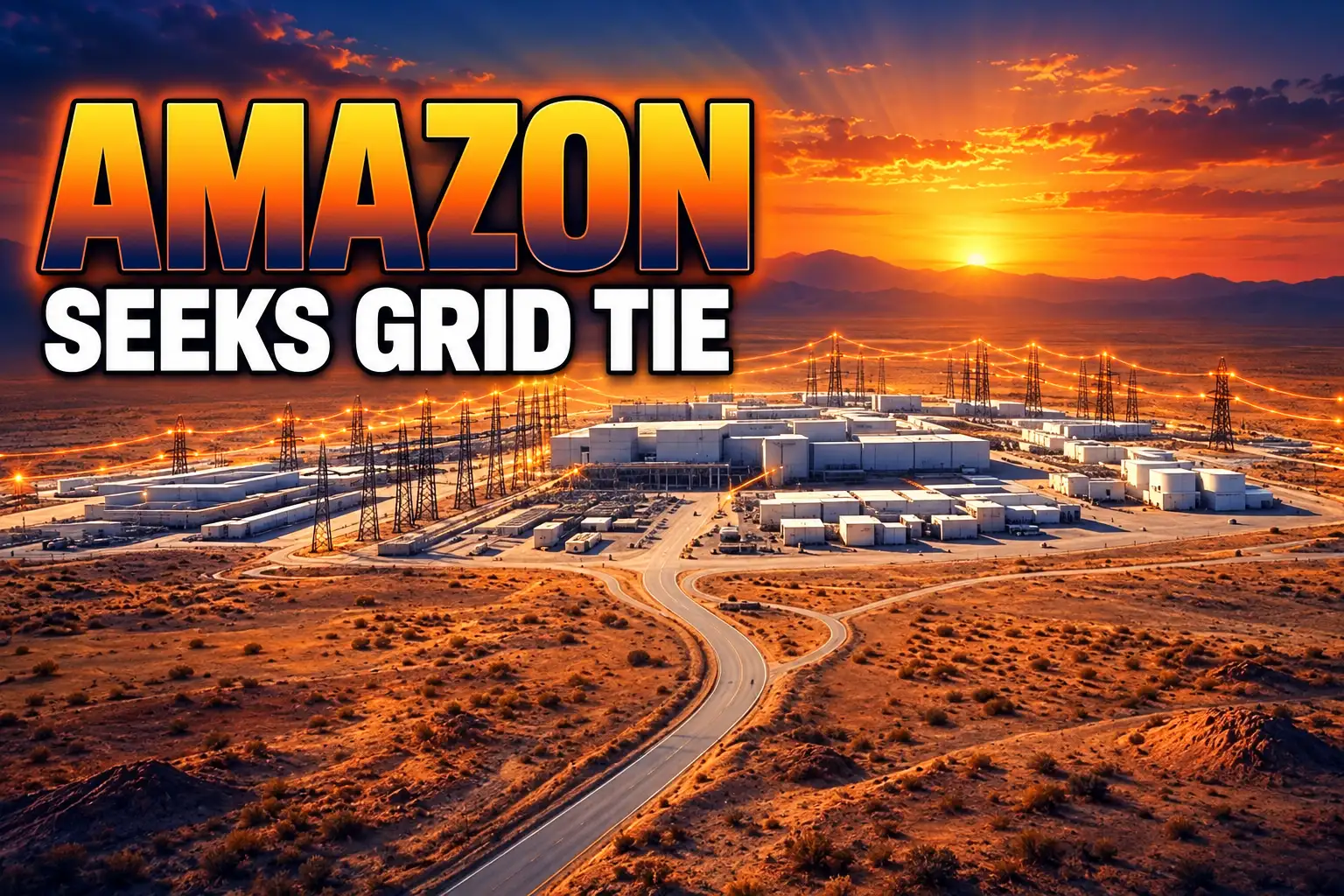
Amazon is exploring a grid hookup for a 5,000 MW private power plant that Texas permitted as an island for an 8,000-acre AI campus in Pecos County. The company says the site is designed to move onto the grid once interconnection timelines allow, and that the plant could later add supply for other customers.
Pacifico Energy is building the generation. Its project page still tells readers the campus will operate as a private grid that does not touch ERCOT.
Pacifico’s Own FAQ Still Says Stay Off the Grid
The Texas Commission on Environmental Quality’s preliminary determination for Pacifico GW LLC describes a greenfield simple-cycle plant at the GW Ranch Energy Center, on Highway 18 about 17 miles north of Fort Stockton. The plant, TCEQ wrote, will feed an on-site AI data center and will not be capable of selling power to, or taking power from, the local utility distribution system.
Pacifico’s public FAQ is even blunter. Asked whether the project will affect the electricity grid, the company answers no, saying GW Ranch generates and supplies power on site, does not draw from or add load to ERCOT, and needs no new utility transmission lines. The same page says the campus will operate independently from the electricity grid, a pitch aimed at speed and at shielding Texas households from higher bills.
Amazon has now confirmed it bought the ranch and plans to buy the plant’s output, and it is exploring how to connect that private system to the grid. The company has not said when a filing would come, whether the machines would become an ERCOT resource, or how many megawatts might be offered to anyone else. Pacifico has not updated the FAQ that still describes a sealed island.
The Permit Describes 5,000 MW, the Pitch Says 7.65 GW
TCEQ’s technical summary and Amazon’s own campus language both sit on a 5,000 MW private power system. Pacifico markets a larger GW Ranch buildout: up to 7.65 GW of gas generation, 1.8 GW of battery storage, and 750 MWac of solar on 8,000-plus acres. Those are not the same figure. One is the plant the air permit describes. The other is the campus the developer is selling.
The determination lists 35 simple-cycle turbines: 21 Siemens SGT-800 machines and 14 large-frame units whose maker is still open, with a short list that includes GE’s 7HA.03, Mitsubishi’s M501JAC, Siemens’s SGT6-9000HL, and Doosan Enerbility’s DGT6-300H S2. Nate Franklin, CEO of Pacifico Energy Group, called the air permit a path to the scale and speed large-load customers want. Constantyn Gieskes, vice president of project development, said site lines are complete, permits are in hand, and turbines are secured.
PERMITTED PLANT VERSUS CAMPUS PITCH
| Item | TCEQ plant description | Pacifico campus pitch |
|---|---|---|
| Gas output | 5,000 MW nominal | Up to 7.65 GW |
| Machines | 35 simple-cycle turbines | Mix of small and large gas turbines |
| Battery storage | Not listed in the determination | 1.8 GW |
| Solar | Not listed in the determination | 750 MWac |
| First power | Not dated in the air permit | Q1 2027, then 1 GW in 2028 and 5+ GW by 2031 |
Joshua Rhodes, a University of Texas researcher, has said behind-the-meter generation at this scale is unusual because the work is hard and turbines are scarce. Gieskes’s claim that the machines are already secured is the developer’s answer to that squeeze. Pacifico also says construction of the power plant and data-center campus could start in the first quarter of 2026, with first power in Q1 2027.
Amazon Already Wrote the Grid Into the Plan
Amazon’s Pecos County statement, posted August 10, 2026, is the cleanest record of what the company will say in public. It is also the sentence that collides with Pacifico’s FAQ.
Amazon believes in paying the full costs of powering our operations. Our new planned data center campus in Pecos County does just that: It’s powered by new on-site generation that won’t raise electricity costs for Texas families and is designed to transition to grid-connected service as interconnection timelines allow. We’re also exploring opportunities for solar energy and battery storage on site. To ensure we don’t put stress on the local watershed, we’ll use water that isn’t suitable for drinking or irrigation, custom cooling technology that minimizes water use wherever possible, and we’ll explore the beneficial use of produced water as an additional non-potable source. This new data center campus in Pecos County is a long-term commitment that we expect will create thousands of new jobs.
Amazon staff statement on the Pecos County campus, August 10, 2026
Separately, Amazon said it is structuring the behind-the-meter setup so the energy investment can later feed a more reliable and affordable grid, and that it is designed to transition to grid-connected service on a front-of-meter path that could add supply for other customers. It has not disclosed the campus’s planned IT load or the size of its check.
Margaret Callahan, an Amazon spokeswoman, said the world looks different now than when the company co-founded the Climate Pledge, and that the 2040 net-zero commitment has not changed. Amazon also said it has enabled 10 GW of carbon-free energy across 40 projects in Texas. The Pecos plant is gas first, with solar and batteries described as options under study, not as the initial fleet.
What a Grid Hookup Would Change in West Texas
A behind-the-meter plant lets a campus run while it waits on ERCOT. A later front-of-meter move would let unused generation, if any exists after the halls take their share, clear into the Texas market. Amazon has not said how much headroom it expects, or who would buy it.
That option sits on top of a queue Gov. Greg Abbott described, in an August 3, 2026 letter to Public Utility Commission of Texas Chairman Thomas Gleeson and ERCOT Chief Executive Pablo Vegas, as about 474 gigawatts of connection requests, about 90 percent of them data centers, more than five times the state’s record peak. Abbott directed a verification audit before more data centers advance, and wrote that any project that fails the review “must be denied” a Texas grid connection. ERCOT postponed its Batch Zero large-load study the same day.
An islanded campus does not need that study to energize halls on its own wire. A later request to sell power, or to take backup from the system, would. The dock Amazon is exploring is the step that puts GW Ranch back in front of the agencies Abbott just froze.
Texas is already the loudest corner of this build. Global Energy Monitor counts 122 GW of gas-fired capacity in Texas in development, a 51 percent rise in six months, with 77 GW of that pipeline aimed straight at data centers. Nationwide, GEM puts gas power in development at 378 GW, up 50 percent from its January release. Jenny Martos, who runs GEM’s oil and gas plant tracker, said the rush is hitting a tight equipment market, and that the projects that clear it are paying top dollar for turbines, locking in emissions, and pushing up electricity prices.
Cleanview, the energy-data firm that matched Amazon’s building permits to the ranch and to satellite photos of land clearing, has identified 59 data centers totaling about 90 GW that plan to build their own behind-the-meter power, more than a quarter of planned U.S. data-center capacity in its tracker, with 92 percent of those projects announced since the start of 2025. Michael Thomas, Cleanview’s founder, said Amazon confirmed it acquired GW Ranch and will buy power from Pacifico, and that land clearing had begun at the site described in the air permit. Imagery captured July 24, 2026, showed the scrape. Amazon also filed three construction permits for data-center buildings in early August.
The argument around those posts has been the carbon ceiling and the Climate Pledge, not the grid clause. People are still describing a sealed campus. Amazon’s own statement is already talking about a later hookup.
Texas Wrote a Hard Ceiling on Carbon
TCEQ issued permit 181033, Prevention of Significant Deterioration permit PSDTX1672, and greenhouse-gas PSD permit GHGPSDTX255 on January 21, 2026, with an expiration date of January 21, 2036. The letter, addressed to Gieskes in San Juan Capistrano, California, says the authorization is void if construction does not begin within 18 months of issuance, which lands on July 21, 2027, if work has not started.
The maximum allowable emission rates are a ceiling, not a forecast of how the plant will run. Plants rarely sit at the cap. The cap is still the legal box Texas drew around 35 simple-cycle machines that do not recover exhaust heat the way a combined-cycle plant would.
TCEQ ALLOWABLE ANNUAL RATES
- Carbon dioxide equivalent: 33,204,964 tons a year, the greenhouse-gas total in the determination.
- Carbon dioxide: 33,162,721 tons a year, before methane, nitrous oxide, and SF6 are added.
- Nitrogen oxides: 2,830.17 tons, with dry low-NOx burners and selective catalytic reduction to 2.5 ppmvd.
- Carbon monoxide: 5,955.13 tons, with an oxidation catalyst to 5.0 ppmvd; ammonia is listed at 1,924.87 tons and fine particles at 991.42 tons.
Pacifico says the site will use best available controls and a layout meant to limit noise, air, and visual effects, and that the design is CCS-ready. Amazon has not published an expected capacity factor, so the gap between the ceiling and actual tons is still an empty cell.
Gas Comes In Through Waha, Water Stays Off the Town Supply
The ranch sits in the Permian, which is the point. Pacifico’s January 26, 2026 announcement lists multiple gas laterals, including a 15-mile pipeline to the Waha hub sized at 1 billion cubic feet a day. Gieskes told a local business audience that Pacifico will own and operate the power campus whether or not the customer owns the halls, and that the first phase is a 1 GW block.
Amazon said the first phase of generation needs no water for cooling, and that later phases are meant to run mainly on brackish groundwater and possibly produced water, sources that do not compete with community drinking supplies. Pacifico’s page says the project needs no major outside water. The companies have not published a gallons-per-year figure.
SITE FACTS PACIFICO IS SELLING
- The land: 8,000-plus acres, described as flat, buildable, free of wetlands, and distant from sensitive ground, with room to grow.
- The uptime claim: Redundant design rated above 99.99 percent availability, with first power scheduled for Q1 2027.
- The jobs split: Pacifico lists 1,000-plus construction jobs and hundreds of permanent operations, maintenance, and security posts; Amazon says thousands of new jobs without a breakdown.
- The firm: Pacifico, founded in 2012 and based in San Juan Capistrano, says it has developed more than 1,750 MW, raised over $5 billion, and is advancing 8,000 MW of U.S. private-grid projects for AI and data-center load.
Pecos County leadership has endorsed the project, Gieskes said, and the company has been welcomed locally. Amazon has not named a dollar figure for the campus. Pacifico has not named Amazon as the customer on its own site, even as Amazon has confirmed the land purchase and the power offtake.
Abbott Closed the Front Door Amazon Wants to Use
The island was the workaround for a queue that had become a pile of paper. The dock is the piece that walks back into that pile, under a governor’s audit that now asks about on-site generation, water, tax breaks, and who actually owns the project.
THE PAPER TRAIL AT GW RANCH
- August 4, 2025: Pacifico GW LLC’s air applications are received by TCEQ for the GW Ranch Energy Center.
- January 21, 2026: TCEQ issues the construction permit, the PSD permit, and the greenhouse-gas PSD permit, and describes a plant that cannot trade power with the local utility.
- January 26, 2026: Pacifico announces the 7.65 GW air permit, the Waha lateral, and a first-half 2027 power date, with Gieskes saying turbines are secured.
- July 24, 2026: Satellite imagery reviewed by Cleanview shows land clearing at the permitted site.
- August 3, 2026: Abbott directs the PUCT and ERCOT to audit data centers in the interconnection process before more projects move forward.
- August 10, 2026: Amazon posts the Pecos statement that writes a later grid-connected service into the plan.
Behind-the-meter campuses can keep pouring slabs while Batch Zero sits. Connecting later is a different ask. It would require ERCOT to treat machines that were permitted as captive supply as something that can export, and it would put a 5,000 MW fleet, or the larger campus Pacifico is pitching, into a process Abbott has told the agencies to halt until the audit is done.
Amazon still has not said when it would file, how much power it would offer, or whether GW Ranch would sit inside ERCOT as a generator. Pacifico’s FAQ still answers the grid question with a flat no.

Instagram Plus Tests a Read-Only Mode That Cuts Stories

Altman Asks the Public to Accept Some AI Harm

Google Freezes OSS VRP Product Reports After AI Flood

AI Agents Make Payment Rails the Scarce Prize

Turkey’s Crypto Boom Now Runs Through Three Banks

Fable 5 Came Back Under a Commerce On-Off Switch

Google’s SpaceX GPU Lease Has a Sept. 30 Deadline

Plasma One’s XPL Locks Face a 1.81 Billion Cliff

DGO’s Rs 549 World Cup Pass Cost Fans Sleep and Data

Moonshot AI’s $30 Billion Ask Became a $35 Billion Close
-
 AI4 months ago
Fable 5 Came Back Under a Commerce On-Off Switch
-
 AI4 months ago
Google’s SpaceX GPU Lease Has a Sept. 30 Deadline
-
 CRYPTO4 months ago
Plasma One’s XPL Locks Face a 1.81 Billion Cliff
-
 APPS4 months ago
DGO’s Rs 549 World Cup Pass Cost Fans Sleep and Data
-
 AI4 months ago
Moonshot AI’s $30 Billion Ask Became a $35 Billion Close
-

 NEWS4 months ago
ColorOS 17 Device List Spans Oppo, OnePlus and Realme
-

 GAMING4 months ago
Xbox Cuts 3,200 Jobs After Five Years of Thin Returns
-

 GAMING4 months ago
The RTX 4050 Under Rs 70,000 Hides a Wattage Gap