
AI
Lunit Turns Routine H&E Slides Into a Lung Pre-Screen
Lunit’s WCLC 2026 posters read leftover H&E slides as a TP53 and EGFR immune pre-screen, with a 0.759 AUROC that still only triages sequencing.

Lunit will hang three posters in Seoul on AI that reads routine H&E lung-cancer slides for immune maps and gene clues. The Seoul firm (KRX: 328130) said on September 8 that the work will appear at the 2026 World Conference on Lung Cancer, which runs September 12 to 15.
The leftover hematoxylin and eosin slide, already cut for diagnosis, is being asked to do a second job: flag who should go on to sequencing and how EGFR subtypes sit in the tissue around the tumor. That is a filter, not a replacement test, and Lunit still labels the software as research use only.
Three Posters, One Leftover Slide
The meeting returns to Korea for the first time in 19 years, since 2007, and Lunit is on home ground. Headquarters sit at 374 Gangnam-daero, a short trip from the COEX Convention and Exhibition Center in Gangnam-gu, where the posters go up in Hall C on the third floor.
Two abstracts share a September 14 slot at 10:30 a.m. KST. One pairs SCOPE IO with spatial transcriptomics and high-plex proteomics in 32 patients treated with neoadjuvant chemo-immunotherapy. The other is an H&E genotype caller for TP53 in lung adenocarcinoma, checked on 462 independent cases. A third poster, on September 15 at 9:30 a.m. KST, runs SCOPE IO across 494 EGFR-mutant non-small cell lung cancer whole-slide images and splits the immune pattern by mutation subtype.
LUNIT AT WCLC IN SEOUL
- March 25, 2026: SITC names Paola Nisticò, M.D., of Rome’s Regina Elena National Cancer Institute, a recipient of the Lunit Research Program for SITC members.
- September 8, 2026: Lunit announces the three NSCLC posters and the SCOPE-based methods behind them.
- September 14, 2026, 10:30 a.m. KST: Posters P2.126 (neoadjuvant spatial study) and P2.134 (TP53 genotype predictor) hang in Hall C, 3F.
- September 15, 2026, 9:30 a.m. KST: Poster P3.156 reports tumor-microenvironment differences across EGFR subtypes in 494 cases.
Brandon Suh, Lunit’s CEO, tied the abstracts to biomarker discovery and patient stratification from images labs already store. Founded in 2013, the company sells FDA-cleared breast-imaging tools under the INSIGHT name and keeps the SCOPE pathology line in a different bucket, aimed at pharma and translational labs.
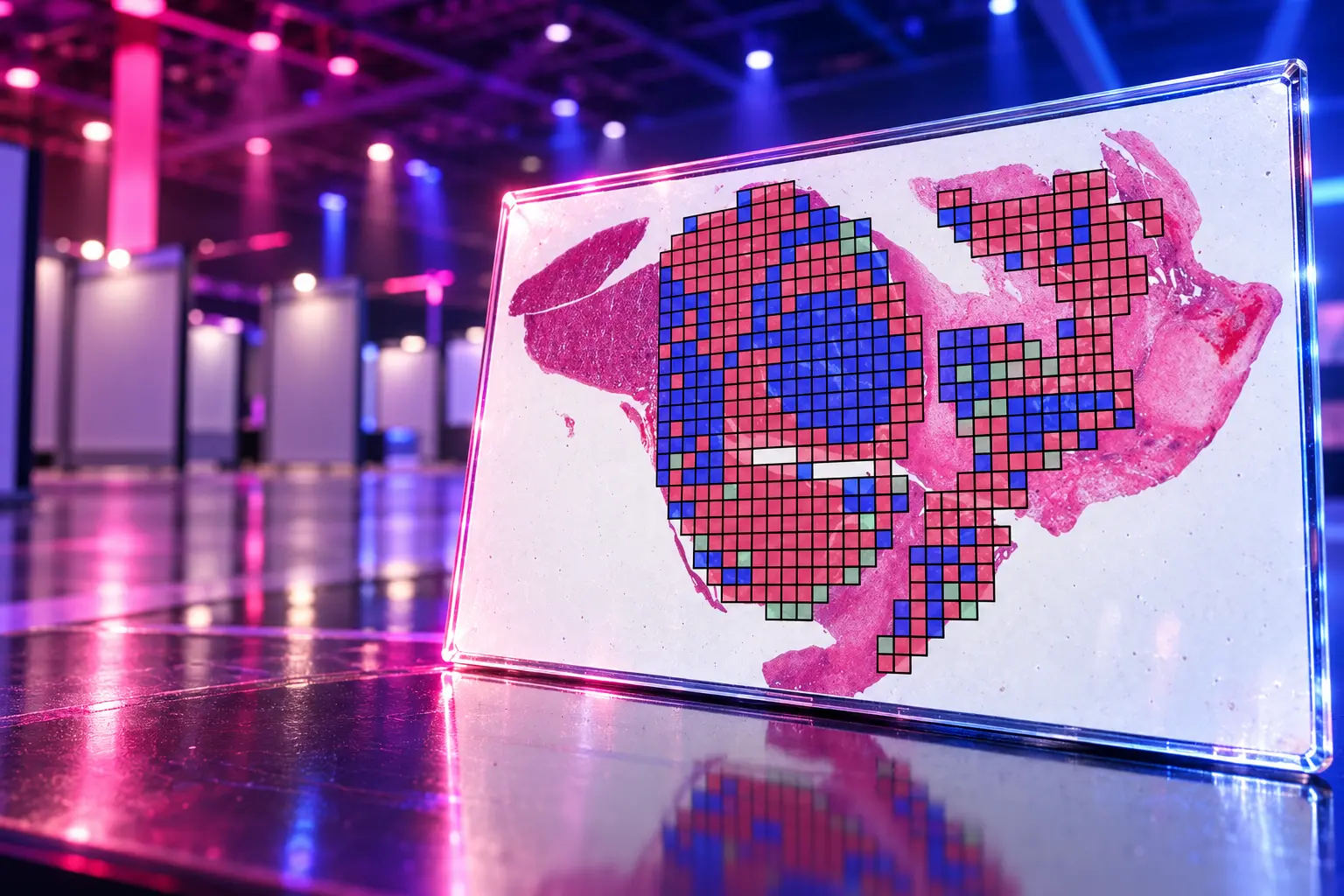
Lunit Already Sells This as a Pre-Screen
The WCLC TP53 model is a new caller. The business model around it is not. Lunit’s genotype product, SCOPE GP, is pitched as pre-screening from a single H&E slide, with a score meant to land before the molecular report and with a toggle between high-sensitivity and high-specificity rules.
A 2025 validation of that EGFR predictor, trained and tuned on more than 12,000 whole-slide images, reported an AUROC of 0.905 across 1,461 cases. A second set of 599 cases from 11 countries and five scanners came in at 0.860. Predictions matched in 90.4% of 2,261 multi-scanner cases among five of six common scanners. Surgical resections scored 0.912; biopsies scored 0.804.
Lunit also lists an AstraZeneca co-development that uses the same H&E-to-genotype idea on EGFR, ALK, ROS1, MET, KRAS, HER2, and other NSCLC drivers. The WCLC TP53 poster sits on that track, with a weaker score and a narrower job: enrich a cohort, then still sequence.
H&E GENOTYPE CALLS LUNIT HAS PUBLISHED
| Model | Call from H&E | Independent n | AUROC | Sensitivity / specificity |
|---|---|---|---|---|
| SCOPE GP (2025 set A) | EGFR mutant vs wild type | 1,461 | 0.905 | Not stated in the summary |
| SCOPE GP (2025 set B) | EGFR mutant vs wild type | 599 | 0.860 | Not stated in the summary |
| WCLC TP53 model | TP53 mutant vs wild type | 462 | 0.759 | 82% / 63% |
A 63% specificity screen will still push a large share of wild-type tumors into the sequencing queue. That is the design if the buyer is a trial team that would rather over-test than miss a mutant, and it is a poor design if anyone treats the slide score as a diagnosis.
494 EGFR Tumors Do Not Share One Immune Map
EGFR-mutant NSCLC is often discussed as one drug class. Pathologists and trialists already know exon 19 deletions, L858R, and exon 20 insertions do not behave the same on kinase inhibitors. The first poster asks whether the tissue around those tumors looks different too, using SCOPE IO on 494 H&E whole-slide images.
EGFR SUBTYPE PATTERNS ON SCOPE IO
| EGFR subtype | Immune and vessel pattern on H&E |
|---|---|
| Exon 19 deletion | Lower density of lymphocytes inside the tumor |
| L858R | Relative enrichment of lymphocytes and macrophages |
| Exon 20 insertion | Higher endothelial cell density |
Lunit’s authors say outcome gaps across those subtypes may involve the neighborhood, not only how the mutant kinase binds a drug. That claim will need survival tables the poster session may or may not show. If it holds, a lab that already knows the EGFR variant still has a reason to quantify lymphocytes, macrophages, and vessels on the same H&E used for diagnosis, because the variant name would not fully describe the immune setting a checkpoint drug would meet.
The practical customer for that map is a sponsor running EGFR-mutant immunotherapy combinations, not a community hospital trying to skip the PCR or NGS panel. Exon 20 insertions already need a different targeted-drug path than classic sensitizing mutations. A denser endothelial field would be extra context, not a substitute for naming the insertion.
A Rome Cohort of 32 Maps Complete Response
The neoadjuvant poster is smaller and denser. Nisticò’s group studied 32 patients with NSCLC who received chemo-immunotherapy before surgery, then layered SCOPE IO on top of spatial transcriptomics and high-plex spatial proteomics. The work ran through Lunit’s research program for SITC members, which loans SCOPE IO to immunotherapy labs.
Congratulations to Dr. Paola Nisticò, recipient of the SITC–@Lunit_AI Research Program. Her research will explore predictive factors in stage II–III NSCLC using Lunit SCOPE IO–derived immune features and multi-omic data to advance neoadjuvant chemo-immunotherapy. #NSCLC pic.twitter.com/UCPmKMSJ9V
— Society for Immunotherapy of Cancer (@sitcancer) March 25, 2026
SITC congratulated Nisticò on that award on March 25, 2026, months before the Seoul hanging. The sample size is the cost of the extra assays: 32 is enough to describe a pattern, not enough to lock a cutoff for the clinic.
WHAT THE POST-DRUG SLIDE SHOWED
- Complete response: A highly inflamed, spatially organized immune field with prominent tertiary lymphoid structures.
- No complete response: Immune exclusion, with stroma rich in activated fibroblasts.
- Method stack: H&E AI plus spatial transcriptomics plus high-plex proteomics on the same cases.
- Stated use: Further work on spatially resolved tissue markers of immunotherapy effect, not a locked clinical rule.
Tertiary lymphoid structures are organized immune follicles that pathologists can sometimes see by eye and that SCOPE IO is built to count among other features, including necrosis, mitoses, tumor-stroma ratio, and cell classes (tumor cells, lymphocytes, macrophages, fibroblasts, endothelial cells). If pCR cases keep showing that organized follicle pattern in larger series, a residual-tumor call after neoadjuvant therapy could carry a spatial immune score beside the usual percent-viable-tumor number.
What a 0.759 AUROC Can Still Do
TP53 is not a standard companion diagnostic in lung cancer. It is common, often co-mutated with EGFR or KRAS, and until recently it mostly sat in the prognostic column of an NGS report. That is changing for EGFR-positive disease, which is why a cheap morphology screen has a buyer even at this accuracy.
A randomized phase 3 trial at 17 sites in China enrolled 294 patients with untreated stage IV or recurrent nonsquamous NSCLC who carried both an EGFR-sensitizing mutation and TP53. Patients received osimertinib plus pemetrexed-carboplatin (146 people) or osimertinib alone (148). Median progression-free survival was 34.0 months versus 15.6 months, hazard ratio 0.44. Grade 3 or higher treatment-related events were more frequent with the combination. The authors argued that TP53 status can sort who should take on that extra burden in the first line.
If a trial or a high-risk EGFR clinic needs TP53 status early, waiting on a full panel can burn calendar time and leftover tissue. An H&E model with 82% sensitivity is built to catch most mutants and tolerate false positives. At 63% specificity, many wild-type cases still get sequenced, which is acceptable for enrichment and unacceptable as a stand-alone result. Lunit’s own poster language calls it a screening tool to enrich patients who may be eligible for trials aimed at specific TP53 variants, not a lab report a treating oncologist should file.
The same slides also showed a TME split: TP53-mutant tumors were more often immune-inflamed, while wild-type tumors showed immune exclusion and higher stromal fibroblast and endothelial densities. That finding rhymes with the EGFR-subtype poster. Genotype and immune geography are being read off one stain, then checked against the sequencer.
The Software Stays Research Use Only
This is not a cleared diagnostic. Lunit’s SCOPE IO page labels the product as research-use-only immune phenotyping software, “not for use in diagnostic procedures or decisions.” SCOPE GP carries the same line. The paying user in the copy is a biopharma team that wants to enrich an immunotherapy or targeted-drug trial without extra stains.
WHAT SCOPE IO IS BUILT TO COUNT
- Training pile: More than 50,000 whole-slide images and over 10 million cell annotations by pathologists.
- Published real-world set: More than 2,300 patient samples, with results in the Journal of Clinical Oncology and the Journal for ImmunoTherapy of Cancer.
- Phenotype labels: Inflamed, excluded, and desert, based on where lymphocytes sit relative to tumor and stroma.
- Company footprint: Lunit says its tools are trusted by over 10,000 sites in more than 65 countries; that tally includes imaging products, not a claim that SCOPE is in routine lung-cancer sign-out.
A 2024 JITC paper ran the immune-phenotype model on 1,806 patients treated with checkpoint inhibitors across more than 27 solid tumors and reported that the inflamed call tracked response and survival. That is the evidence base SCOPE IO brings into the EGFR and neoadjuvant posters. It is still a research instrument. Pathologists will not, on the strength of these abstracts, stop sending blocks for EGFR, ALK, ROS1, MET, KRAS, and the rest of the guideline panel.
These studies demonstrate the expanding potential of AI-based analysis to generate deeper insights into lung cancer biology, from genomic characteristics and the tumor microenvironment to features associated with treatment response.
Brandon Suh, CEO of Lunit
Suh’s second line in the release is the operational one: broaden what a routine pathology image can yield, then use that for biomarker discovery and stratification. Discovery and stratification are trial words. They are also the words on the SCOPE GP page next to “boost trial enrollment.”
Seoul Will Hear Posters, Not a Diagnostic Claim
The three abstracts will be visible for a few hours in a poster hall, then live or die in the full papers. Hall C will not settle whether a 0.759 TP53 score belongs in a hospital LIS, and it will not retire NGS. What it can show, if the figures match the press summary, is that mutation class and immune geography leave marks on a stain every pathology lab already makes.
WHAT WE KNOW
- The schedule: Three Lunit-linked NSCLC posters are listed for September 14 and 15 in Hall C at COEX.
- The regulatory label: SCOPE IO and SCOPE GP are listed as research use only.
- The TP53 metrics: Independent n of 462, AUROC 0.759, 82% sensitivity, 63% specificity, per Lunit’s September 8 release.
WHAT IS UNCONFIRMED
- Peer review: Full methods, confidence intervals, and external cohorts beyond the release have not been presented.
- Clinical cutoffs: No locked threshold for sending a slide score into a treatment algorithm.
- Subtype survival: The EGFR TME splits are not, in the release, tied to measured progression-free or overall survival.
If the Seoul figures hold, the next buyer is a trial that needs TP53-mutant or immune-inflamed EGFR cases faster than a sequencer can return, and that still confirms every call on tissue or plasma. The slide remains a leftover. The new work is in how much of the molecular report that leftover is allowed to preview.
Disclaimer: This article is news reporting on company-announced conference abstracts and product pages. It is informational only and is not medical advice, a diagnosis, or a recommendation to start, skip, or change cancer treatment or genomic testing. H&E-based AI scores described here are research tools and are not a substitute for guideline-recommended molecular testing or for a pathology diagnosis. Patients and clinicians should consult a board-certified oncologist and a pathologist before acting on any biomarker result. Numbers, poster times, and regulatory labels reflect the cited company statements and study summaries and may change after the posters are presented and after peer review.

Instagram Plus Tests a Read-Only Mode That Cuts Stories

Altman Asks the Public to Accept Some AI Harm

Google Freezes OSS VRP Product Reports After AI Flood

AI Agents Make Payment Rails the Scarce Prize

Turkey’s Crypto Boom Now Runs Through Three Banks

Fable 5 Came Back Under a Commerce On-Off Switch

Google’s SpaceX GPU Lease Has a Sept. 30 Deadline

Plasma One’s XPL Locks Face a 1.81 Billion Cliff

DGO’s Rs 549 World Cup Pass Cost Fans Sleep and Data

Moonshot AI’s $30 Billion Ask Became a $35 Billion Close
-
 AI4 months ago
Fable 5 Came Back Under a Commerce On-Off Switch
-
 AI5 months ago
Google’s SpaceX GPU Lease Has a Sept. 30 Deadline
-
 CRYPTO4 months ago
Plasma One’s XPL Locks Face a 1.81 Billion Cliff
-
 APPS4 months ago
DGO’s Rs 549 World Cup Pass Cost Fans Sleep and Data
-
 AI5 months ago
Moonshot AI’s $30 Billion Ask Became a $35 Billion Close
-

 NEWS5 months ago
ColorOS 17 Device List Spans Oppo, OnePlus and Realme
-

 GAMING4 months ago
The RTX 4050 Under Rs 70,000 Hides a Wattage Gap
-

 AI4 months ago
Boris Cherny’s Loops Still Demand a Higher Production Bar