
AI
Oracle Cut 21,000 Jobs to Fund Its AI Cloud
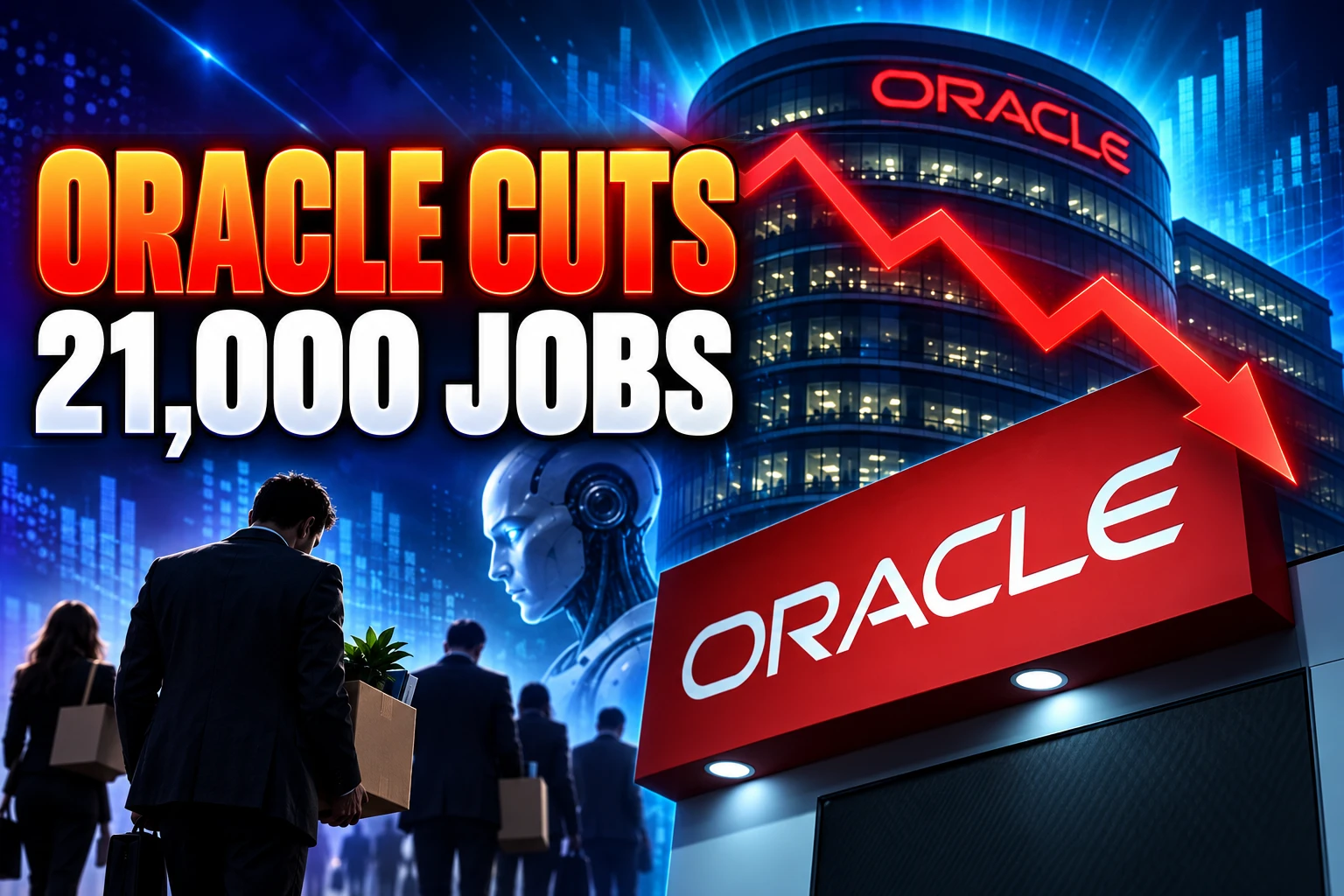
Oracle’s headcount fell by 21,000 in fiscal 2026 as its 10-K cited AI and $55.7 billion of cloud spending pushed cash flow negative.

Oracle closed the year ended May 31, 2026, with about 141,000 full-time employees, down about 21,000 from 162,000 a year earlier, a drop of about 13%. In the annual report filed June 22, the company said the adoption and deployment of AI technologies had already reduced its workforce and might do so again.
The same twelve months produced a $1.84 billion bill for severance and related exit costs and $55.7 billion of capital spending, mostly on data centers. Free cash flow went negative. Then, in September, a second round of 6 a.m. emails reached the cloud organization that is supposed to pay for that build.
What the Annual Report Put on Paper
The filing does not say software replaced every departing worker. It lists management and product changes, performance decisions, strategy shifts, and acquisitions alongside AI. Headcount is a net figure, so attrition sits inside the 21,000 as well as forced exits. About 49,000 of the remaining staff were in the United States and about 92,000 were abroad, with the U.S. down about 9,000 and the international count down about 12,000.
The adoption and deployment of AI technologies across our operations have resulted, and may continue to result, in reductions to our workforce.
Oracle Corporation, Form 10-K for the year ended May 31, 2026
That sentence is still unusual. Most large software firms wrap job cuts in softer words. Oracle put AI in the risk column and told investors the reductions might not be finished. The same 10-K describes Oracle Autonomous AI Database as engineered to lower labor costs and reduce human error by automating maintenance, tuning, patching, scaling, security, and backup. The product pitch and the headcount line now live in one document.
That pairing is why younger workers already fear AI job loss even when new AI titles keep appearing in the same industry. Oracle did not publish a map of which roles the models took. It did publish a cash statement that makes the labor cut look like a funding choice.
$1.84 Billion in Exit Pay Beside a $55.7 Billion Build
Exit costs of $1.84 billion in fiscal 2026 were nearly five times the $374 million recorded the year before. Capital spending rose from $21.2 billion to $55.7 billion. Operating cash flow still reached a record $32.0 billion, but the build was larger, and Oracle reported negative $23.7 billion of free cash flow for the year.
ORACLE’S YEAR ON PAPER
| Item | Fiscal 2025 | Fiscal 2026 |
|---|---|---|
| Full-time staff on May 31 | 162,000 | 141,000 |
| Restructuring and exit costs | $374 million | $1.84 billion |
| Capital expenditure | $21.2 billion | $55.7 billion |
| Free cash flow | Not stated in the June 10 release | -$23.7 billion |
Revenue for the year was $67.4 billion, up 17%. Cloud revenue was $34.0 billion, up 39%, including $18.1 billion of infrastructure, up 77%, and $15.9 billion of applications, up 11%. The company was not shrinking because the top line had stalled. It was shrinking because the new business consumes cash before it returns it.
To fund the plants, Oracle raised $43 billion of debt and $5 billion of equity in fiscal 2026 and said it expected to raise about $40 billion more in fiscal 2027, including a $20 billion at-the-market stock program. Remaining performance obligations, contracted revenue not yet booked, ended May 31 at $638 billion, up 363% from a year earlier and up $85 billion from the prior quarter. Oracle said $75 billion of the large AI contracts was prepaid capacity or customer-supplied hardware, which lowers how much cash it must put up itself.
Alphabet, Microsoft, Amazon, and Meta together pointed to 2026 capex guidance of $720 billion to $745 billion as of their July reports, on Yield Theory’s compilation of those four companies’ own ranges. Oracle’s $55.7 billion sits beside that pile, not on top of it, and much of the spend is going into chips that wear out on a short cycle rather than assets that last for decades.
A 6 a.m. Email and a 26-Week Cap
The first large 2026 wave hit on March 31. Workers in the United States, India, Canada, and Mexico opened a message that their role was gone and that the day was their last. U.S. terms described in later packets were four weeks of base pay for the first year of service plus one week for each year after that, capped at 26 weeks. Unvested stock awards were treated as forfeited.
TD Cowen, the research shop that had earlier sketched a reduction of 20,000 to 30,000 jobs, estimated that Oracle Health, the former Cerner records business bought in 2022, took 8,000 to 10,000 of the cuts. That range is an analyst estimate, not an Oracle total. Legacy software and revenue teams were also described as heavily hit. Cloud infrastructure and AI product groups were widely described as spared in that first wave, which is why the September roster landed as a reversal.
FROM THE MARCH WAVE TO THE NOVEMBER EXITS
- March 31, 2026: Sends same-day termination mail in several countries, with DocuSign severance to follow.
- May 31, 2026: Closes the fiscal year at about 141,000 full-time employees.
- June 10, 2026: Posts fiscal 2026 results, including $638 billion of remaining performance obligations and negative $23.7 billion of free cash flow.
- June 22, 2026: Files the 10-K that names AI as a workforce factor and says further reductions may follow.
- September 10, 2026: Reports fiscal first-quarter results, with infrastructure revenue more than doubling and remaining obligations at $664 billion.
- September 14, 2026: Starts a second round of early-morning termination mail.
- November 13, 2026: WARN notices in Washington and California list about 800 U.S. jobs as ending that day.
Co-CEOs Clayton Magouyrk and Michael Sicilia signed the June 22 report with Chief Financial Officer Hilary Maxson. Lawrence Ellison remains executive chair and chief technology officer. On September 12, two days before the second mail wave, Oracle said Ellison had cancelled a planned stock-sale program and had sold no shares under it.
September Cuts Reached the Cloud Unit
The September notice used the same core lines as March. Oracle Leadership told people their role was eliminated as part of a broader organizational change and that the day was their last working day, then pointed them to a personal email address for DocuSign paperwork as system access shut off.
After careful consideration of Oracle’s current business needs, we have made the decision to eliminate your role as part of a broader organizational change. As a result, today is your last working day.
Oracle Leadership, termination email, September 14, 2026
Oracle has not published a global headcount for that round. State WARN filings dated September 14 list about 800 jobs ending November 13: 359 in Washington, including Seattle sites and remote staff, and 441 in California, including 279 in Redwood City, 99 in Santa Clara, and 63 in Pleasanton. Those notices are not a world total.
An internal America Cloud Infrastructure roster that later circulated listed 546 people for severance, about 7.6% of 7,185 names on that list. Software developers were about 17% of the listed cuts, with Software Developer III the single largest title at 57 people. Titles containing “manager” accounted for 128 of the 546. Data-center support services, the group that maintains the plants, accounted for 41 names, including senior leaders of that unit.
WHERE THE SEPTEMBER CUTS SHOWED UP
- Official silence: Oracle has not given a worldwide number for the September round.
- WARN floor: About 800 California and Washington jobs are dated to end November 13.
- Cloud roster: 546 people on an America Cloud Infrastructure list, about 7.6% of 7,185 names.
- Roles: Developers, program managers, principal infrastructure engineers, and data-center support, not only leftover software sales.
The hiring board in the same period did not freeze. Open roles clustered around data-center construction, power, network reliability, mechanical engineering, AI delivery, and operations, including people moving over from Amazon Web Services and Microsoft. The company is not simply running with fewer people. It is trading one kind of payroll for another.
OpenAI’s Compute Bill Starts in 2027
On February 1, 2026, Oracle said it was raising money to add capacity for contracted Oracle Cloud Infrastructure customers, and it named AMD, Meta, NVIDIA, OpenAI, TikTok, and xAI. Around the 2025 backlog jump, the OpenAI purchase was described as about $300 billion of computing over about five years, starting in 2027, on the order of 4.5 gigawatts. Oracle has not put that dollar figure in the 2026 earnings releases, and it remains a contract description rather than recognized revenue.
The first-quarter release on September 10 showed why the company keeps spending anyway. Total revenue was $19.3 billion, up 30%. Cloud revenue was $11.6 billion, up 62%. Cloud infrastructure revenue of $7.4 billion was up 121%. Remaining performance obligations rose to $664 billion after more than $30 billion of additional AI cloud contracts, and Oracle said those new deals did not change its capital-raising plan. It delivered 850 megawatts of added data-center capacity in the quarter and more than 300,000 GPUs, almost triple the prior quarter’s GPU deliveries.
THE BUILD THE PAYROLL IS FUNDING
- Backlog: Remaining obligations moved from $638 billion on May 31 to $664 billion after the August quarter.
- Run rate: Infrastructure revenue hit $7.4 billion in one quarter, up 121%.
- Kit: More than 300,000 GPUs went to AI cloud customers in that quarter, plus 850 megawatts of added capacity.
- Cash: First-quarter operating cash flow was $23 billion, and free cash flow was still negative $5 billion.
Oracle also completed the $20 billion common-stock sale it had flagged in June. Fiscal 2027 revenue is now guided to at least $90 billion. Demand, the company said, still grows faster than supply. The people who left in March and September will not be on the books when the 2027 OpenAI capacity is supposed to start billing in full.
A Software Firm That Now Buys Megawatts
The leftover company is 141,000 people, fewer than before the Cerner deal, supporting a backlog that is several times annual sales. Applications still bring in billions, but the growth line is rented compute. Sales and marketing expense in the August quarter fell 12%, research and development fell 4%, and interest expense rose 55% to $1.43 billion, the cost of the debt that paid for the plants.
AI-washing is the easy charge, and the 10-K gives it room, because reorganizations and performance cuts sit in the same paragraph as the models. The harder read is the one the cash flow statement already made. Oracle spent more on exit pay in one year than many software firms spend on their entire research budget, and it still spent thirty times that amount on buildings and chips. Then it cut developers and data-center support inside the unit whose revenue just doubled.
The filing’s warning that reductions may continue is the part that still has work to do. The 21,000-person drop is a closed fiscal-year number. The September round is not. Between them sits a company that now budgets like a utility, hires like a contractor, and still sends the same 6 a.m. mail when the model, or the bond market, wants a smaller payroll.

Instagram Plus Tests a Read-Only Mode That Cuts Stories

Altman Asks the Public to Accept Some AI Harm

Google Freezes OSS VRP Product Reports After AI Flood

AI Agents Make Payment Rails the Scarce Prize

Turkey’s Crypto Boom Now Runs Through Three Banks

Fable 5 Came Back Under a Commerce On-Off Switch

Google’s SpaceX GPU Lease Has a Sept. 30 Deadline

Plasma One’s XPL Locks Face a 1.81 Billion Cliff

DGO’s Rs 549 World Cup Pass Cost Fans Sleep and Data

Moonshot AI’s $30 Billion Ask Became a $35 Billion Close
-
 AI4 months ago
Fable 5 Came Back Under a Commerce On-Off Switch
-
 AI4 months ago
Google’s SpaceX GPU Lease Has a Sept. 30 Deadline
-
 CRYPTO4 months ago
Plasma One’s XPL Locks Face a 1.81 Billion Cliff
-
 APPS4 months ago
DGO’s Rs 549 World Cup Pass Cost Fans Sleep and Data
-
 AI4 months ago
Moonshot AI’s $30 Billion Ask Became a $35 Billion Close
-

 NEWS4 months ago
ColorOS 17 Device List Spans Oppo, OnePlus and Realme
-

 GAMING4 months ago
Xbox Cuts 3,200 Jobs After Five Years of Thin Returns
-

 GAMING4 months ago
The RTX 4050 Under Rs 70,000 Hides a Wattage Gap