
AI
Tendata AI Cracks LLM Brand Bias in Trade Lead Hunt
Tendata AI joins verified customs data with LLMs to surface SME buyers generic models miss, delivering contactable lists and tracked outreach for exporters.

Tendata AI now pairs a specialized large language model with more than 10 billion verified customs records so international sales teams can pull contactable mid-tier buyers instead of the same household brands every general chatbot returns. The Shanghai-based firm made the case on July 31 that pure internet-trained models systematically hide the small and mid-sized suppliers who need new customers most.
The release lands inside a crowded 2026 push by vertical AI tools to fix the blind spots of ChatGPT-class systems in B2B work.
The Brand Bias Generic Models Cannot Escape
Trade professionals who feed prompts into ChatGPT or Gemini keep hitting the same wall. The models surface the industry’s most visible companies, the ones with dense web footprints, established supplier lists and polished English sites. Smaller manufacturers and specialized importers stay invisible.
The reason is mechanical. Large language models train on public internet text. Stronger brand presence equals higher ranking in the model’s internal associations. Official government customs portals publish useful macro statistics, yet they almost never release company-level contact details. Sales teams therefore get either glossy names they cannot easily reach or dry aggregates that never turn into a phone call.
Crowd conversation among exporters mirrors the complaint: lists skew heavily toward Fortune-tier names, product-fit guesses appear invented, and verified decision-maker emails stay missing. Conversion rates collapse once the first polite reply never arrives.
The bias compounds with every new prompt. A team that asks for glove importers, then valve buyers, then packaging partners still receives the same handful of globally known distributors because those names dominate the training corpus. Fresh mid-tier demand never enters the association graph.
- 10B+ import-export trade records claimed as the grounding layer
- 228+ countries and regions covered with bill-of-lading and declaration data
- 850M+ business contacts and 900M+ company profiles available for matching
- 100,000+ customers already using the broader Tendata suite
Those numbers come straight from the company’s current public materials and set the scale of the data moat it is trying to defend.
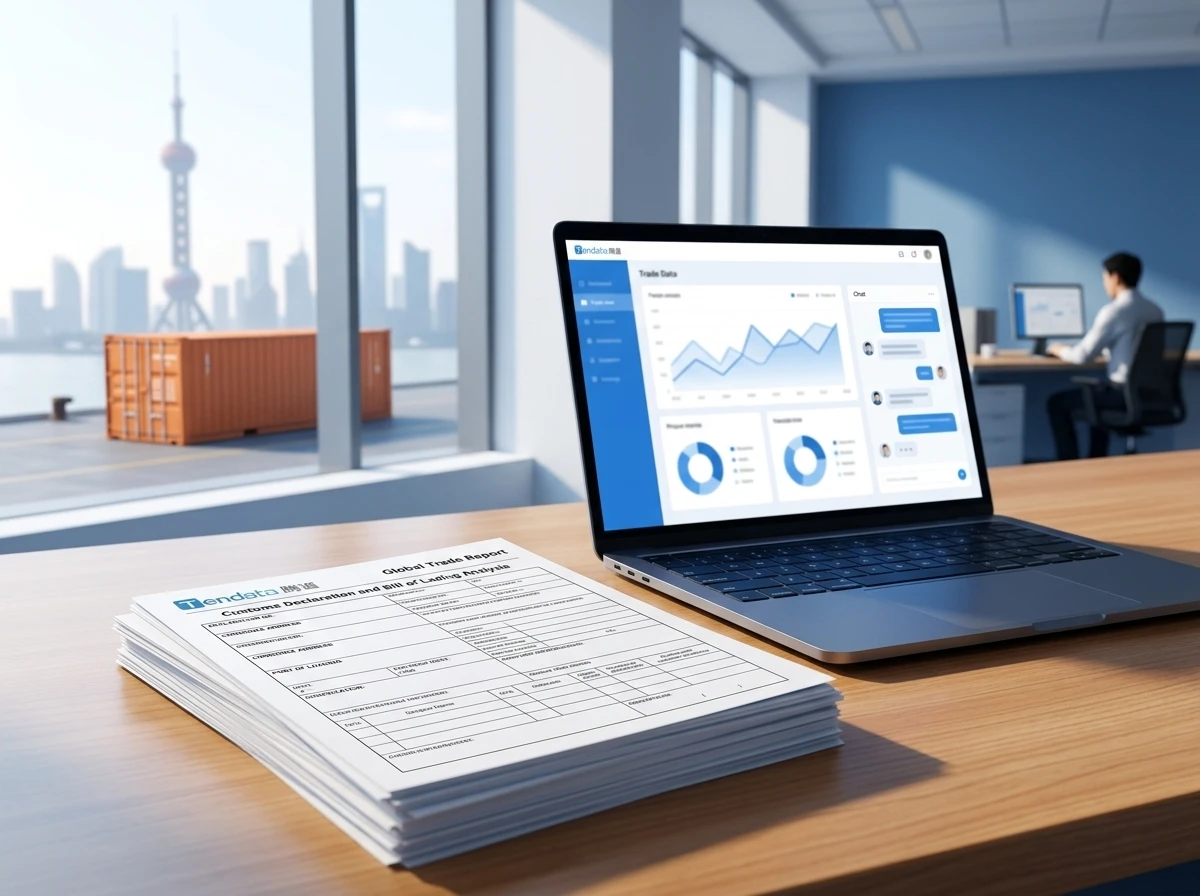
Three Data Layers Tendata Joins
Tendata AI does not treat the LLM as a standalone oracle. It routes every query through three fused sources: transactional trade records, commercial and company registries, and selective internet signals. The Tendata global trade intelligence platform already holds the customs backbone; the AI layer simply makes it conversational and executable.
Users enter their own company profile plus the desired customer scale. The system returns ranked prospect lists matched to product focus rather than brand fame. Live trade activity then appears for each name: exact products imported or exported, volumes, frequencies and counterparties. Related-product logic surfaces upstream or downstream firms that generic web scrapes never catch, including buyers of byproducts or adjacent SKUs that never appear on a corporate homepage.
Each layer corrects a different failure mode. Transaction records prove what moved. Commercial registries supply the reachable entity. Selective internet signals fill gaps only when the filings leave a detail blank. The model never has to invent a flow that the customs data already documents.
| Capability | General-purpose LLMs | Tendata AI | Pure customs portals |
|---|---|---|---|
| Prospect source | Public web popularity | Verified trade + commercial + web | Macro statistics only |
| SME visibility | Low (brand bias) | High (transaction match) | None (no contacts) |
| Product-fit proof | Inferred from sites | Live import/export history | Aggregate volumes |
| Decision-maker emails | Unreliable or absent | Supplied and verified | Not provided |
| Outreach execution | Draft only | Generate, send, track, iterate | None |
The table makes the division of labor clear. Generic models excel at fluent text. Pure data portals excel at volume counts. The hybrid claims the middle ground sales teams actually need.
What the System Returns in Practice
Seventeen ready-to-use prompts cover the common jobs: buyer discovery, market sizing, competitor monitoring and marketing copy. Expert mode turns the same engine into longer strategy notes. A sample prompt on the Korea site asks for U.S. importers of nitrile gloves under HS 401511 ranked by recent volume; the reply lists concrete firms with TEU figures and offers to draft the cold email on the spot.
Product-level analysis shows exactly what a prospect buys and sells today. That verified history lets a sales rep decide fit in minutes instead of weeks of LinkedIn archaeology. When a firm has no website or keeps product details offline, the model no longer has to invent plausible flows. It simply reads the customs filings.
- Buyer lists filtered by HS code, volume band and geography
- Related-product expansion to catch adjacent demand
- Competitor shipment alerts when a rival gains a new customer
- One-click market reports that cite the underlying records
- Personalized email drafts grounded in the prospect’s actual trade pattern
Those outputs sit inside the same interface that already powers Tendata iTrader, T-Insight and T-Discovery, so teams do not jump between tools.
The practical effect is a shorter path from question to action. A rep who once juggled three browser tabs and a spreadsheet now stays inside one ranked list that already carries volume proof and a draft message.
SMEs Finally Enter the Frame
The PR states the quiet part aloud: small and mid-sized enterprises are the ones most starved for new customers yet least visible to internet-trained AI. Tendata’s pitch is that transaction data levels that field. A specialized valve maker in Jiangsu or a glove exporter in Malaysia can surface as a high-fit prospect because the model sees their shipments, not their Google ranking.
Company materials repeatedly call out SME suitability. Automation replaces the large research teams that only big exporters can afford. Response rates on emails that reference real purchase history reportedly rise because the message feels informed rather than mass-blasted. For Chinese manufacturers still expanding after years of tariff noise and supply-chain reshuffles, that speed difference compounds.
The same logic works in reverse for importers hunting reliable mid-tier suppliers who never appear on Alibaba’s paid ads.
Visibility without contact data still leaves the deal unfinished. The platform’s contact layer turns the newly visible SME into someone a sales team can actually reach, which is the step generic models skip.
How the Approach Differs from Classic Trade Platforms
Panjiva, now under S&P Global, remains the enterprise benchmark for supply-chain visibility and risk. Its enterprise supply chain transparency tools emphasize relationship graphs and multi-year shipment histories aimed at large corporations. ImportGenius leans into U.S. bill-of-lading depth. Volza and others compete on country breadth or price.
Tendata positions itself further down the stack toward sales execution. Coverage claims of import export data from 228 countries plus hundreds of millions of contacts let it sell “find and email” rather than “analyze and report.” The AI layer simply compresses the last mile that pure data platforms still leave to the user. Similar vertical moves appear elsewhere; agentic AI systems tackling opaque markets show the same pattern of domain data plus autonomous action.
- Panjiva: relationship graphs and multi-year histories for large corporations
- ImportGenius: deep U.S. bill-of-lading focus
- Volza and peers: country breadth or lower price points
- Tendata AI: ranked prospects plus verified outreach in one loop
None of the competitors vanish. Large multinationals will keep buying enterprise-grade risk tools. The disruption claim targets the middle market that previously had to choose between expensive research staff and hallucination-prone general AI.
The Outreach Loop That Closes
Once a prospect list exists, Tendata AI drafts personalized messages that cite the buyer’s recent trade behavior. It supplies the decision-maker email, sends the message, tracks opens and replies, then iterates follow-ups. The entire sequence is described as one-click. Claude or Gemini can polish prose from public scraps; they cannot deliver into verified inboxes or close the feedback loop with real open rates.
- Draft a message that cites the buyer’s recent trade behavior
- Supply the verified decision-maker email
- Send and track opens and replies
- Iterate follow-ups from the tracking data
That last mile is where conversion lives. A fluent email that never reaches the right person is just content. A shorter note that references last quarter’s glove shipments and lands in the procurement inbox is a sales motion. Tendata’s materials treat the tracking data as fuel for the next iteration rather than a vanity metric.
Exporters who already pay for customs data still waste hours stitching contacts and copy together. The AI wrapper claims to collapse that work into minutes while keeping every claim tethered to a filing.
Shipment Proof Cuts Research Cycles Short
Desk research once meant weeks of cross-checking public sites against incomplete directories. The hybrid approach collapses that cycle because the same query that returns a ranked list also returns the shipment evidence behind each name. Fit stops being a guess built from homepage copy.
Related-product logic widens the net without diluting relevance. A buyer of byproducts or adjacent SKUs appears even when those items never surface on a corporate site. The sales team sees demand that web-trained models simply never encode.
Market-entry questions follow the same path. A one-click report cites the underlying records instead of summarizing blog posts, so the numbers a team presents internally already carry a filing trail.
The 2026 Vertical Push Gains a Clear Pattern
The July 31 release sits inside a wider move by vertical AI tools to repair the blind spots general models show in B2B work. Domain data plus autonomous action is the recurring recipe. Tendata’s version applies that recipe to customs records and contact matching.
Two decades of database work give the firm an asset that a pure language-model startup cannot recreate overnight. The recent headquarters move into Shanghai’s Lujiazui Software Park and the local digital-trade awards signal that the company is packaging a long-held store of filings rather than starting from scraped web text.
Whether rivals follow with similar hybrids will turn on how quickly they can fuse verified transactions with reachable contacts. The middle market now has a reference point for what that fusion should deliver.
Trade Teams Gain a New Default Starting Point
The practical shift is simple. Instead of asking a general model “who buys nitrile gloves in the U.S.?” and receiving the same three global distributors everyone already knows, a team asks Tendata AI and receives ranked mid-tier importers with volume proof and emails attached. Market-entry questions that once required weeks of desk research now return cited reports in a single session.
Tendata itself has spent more than two decades building the underlying database and recently moved headquarters inside Shanghai’s Lujiazui Software Park while collecting local digital-trade awards. The AI product is the latest packaging of that asset. Whether the hybrid becomes table stakes across the category will depend on data freshness, contact accuracy and price, none of which the July 31 release quantified in public dollars. What it does show is a clear product thesis: ground the language model in the shipments that actually happened, and the brand bias that has frustrated exporters for two years finally has a structural counter.
For sales teams that live or die by new logos, that counter is already usable today.


Workers Still Trust Judgment Over the AI Tools They Use

DigitalOcean’s $894 Million Backlog Rewrites the Old Cloud

Companies Froze Job Design and Called AI a People Problem

AI Capex Looks Unique Because the Chips Wear Out

Samsung Medison’s HERA Z10 Aims at the Sonographer Shortage

GPT-6 Astra Ships as OpenAI’s First Critical Cyber Model

Palms Sells Clean Air Without Ending Casino Smoking

OnlyFans Promo Bots on X Now Pass the Humanity Tests

Datamaran Drops the ESG Label After Winning the Argument

Xiaomi’s Own Chip Lands While Apple Argues Over Color

Oracle Cuts 21,000 Jobs in a Year, Cites AI in 10-K Filing

Fable 5 and Mythos 5 Return as US Lifts Anthropic Export Controls

SpaceX’s Google Deal Turns a Rocket Company Into a Cloud Landlord

CD Projekt Red Co-CEO: Redemption Arc Isn’t Done, Witcher 4 in 2027

XPL Rallies 30% Ahead of Plasma One Card Tier Launch

Google Search Profiles Build a Follow Graph Inside Discover

DGO App Brings Rs 549 Mobile Pass for FIFA World Cup 2026 in Nepal

Moonshot AI Targets $30 Billion in China’s Fastest AI Funding Sprint

Oppo’s ColorOS 17 Eligibility List Leaves A-Series Buyers Behind

Microsoft Xbox Layoffs Start in July as Sharma Slams 3% Margin
-
 AI3 months ago
Oracle Cuts 21,000 Jobs in a Year, Cites AI in 10-K Filing
-
 AI2 months ago
Fable 5 and Mythos 5 Return as US Lifts Anthropic Export Controls
-
 AI3 months ago
SpaceX’s Google Deal Turns a Rocket Company Into a Cloud Landlord
-
 GAMING3 months ago
CD Projekt Red Co-CEO: Redemption Arc Isn’t Done, Witcher 4 in 2027
-
 CRYPTO3 months ago
XPL Rallies 30% Ahead of Plasma One Card Tier Launch
-
 NEWS3 months ago
Google Search Profiles Build a Follow Graph Inside Discover
-
 APPS3 months ago
DGO App Brings Rs 549 Mobile Pass for FIFA World Cup 2026 in Nepal
-
 AI3 months ago
Moonshot AI Targets $30 Billion in China’s Fastest AI Funding Sprint