
CRYPTO
Aviva’s Tokenized Liquidity Fund Quietly Rewires XRPL Cash Rails
Aviva Investors launched a regulated tokenized share class of its USD Liquidity Fund on XRPL with Ripple, proving digital twins can keep full investor protections.

Aviva Investors launched a tokenised share class of its US Dollar Liquidity Fund on the XRP Ledger on July 29, five months after teaming with Ripple. The Ireland-domiciled product keeps the same objective, risk profile, daily liquidity and regulatory protections as the conventional shares while opening access through approved digital wallets.
BNY Mellon still holds the underlying high-grade short-term dollar debt. The blockchain records ownership. That split is the point that travels beyond one fund announcement.
The launch converts a partnership letter into a regulated, wallet-accessible share class without rewriting the fund’s legal shell. Custody, prospectus and investor protections remain where European managers already know how to operate them. Only the record of who owns which units moves onto a public ledger built for institutional settlement speed.
The Share Class That Went Live
The traditional Aviva Investors USD Liquidity Fund dates to 2020. It seeks low-risk returns and daily liquidity via short-term, high-grade US dollar debt. The new share class is Aviva’s first tokenization of any fund structure.
The Central Bank of Ireland approved the class. Eligible investors receive identical economic terms and protections. Aviva Investors manages roughly £253 billion to £260 billion in assets group-wide, according to recent company figures. The manager has not disclosed the initial size of the tokenized slice.
Ripple called the February deal its first with a European investment manager. Both sides said they would work through 2026 and beyond. The July launch turns that letter of intent into a live product.
The sequence from conventional fund to tokenized share class is short enough to matter for desks still modelling multi-year build programmes:
- 2020 – conventional Ireland-domiciled USD Liquidity Fund launches with a short-term, high-grade dollar debt mandate.
- February 2026 – Aviva Investors and Ripple announce a partnership aimed at XRPL fund structures, Ripple’s first with a European manager.
- July 29, 2026 – the tokenized share class goes live on XRPL under Central Bank of Ireland approval.
- Through 2026 and beyond – both sides commit to further work on tokenized structures.
Five months from announced intent to production share class compresses the operational path many European managers still treat as open-ended. The fund itself did not need reinvention. The share class did.
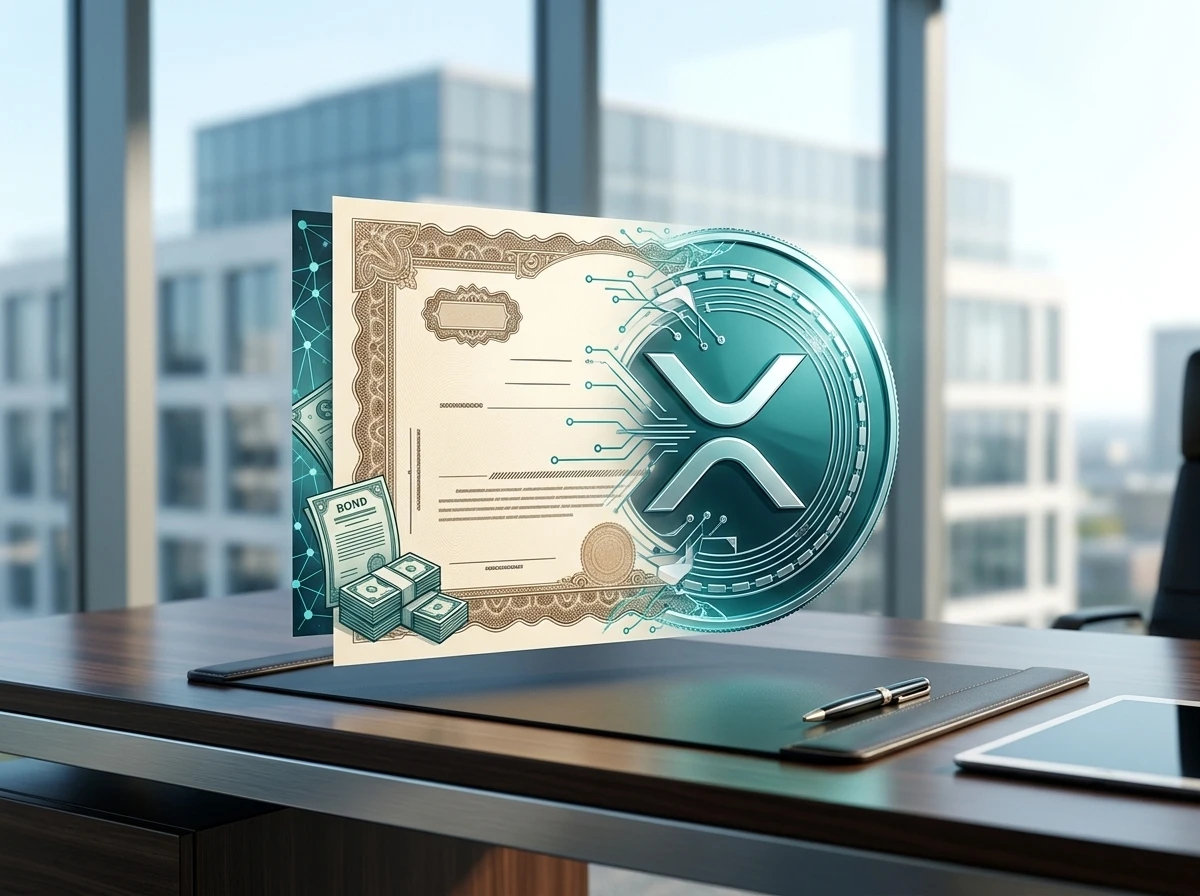
How the Digital Twin Keeps Traditional Protections
Aviva describes a structure that sits inside existing legal frameworks. The off-chain fund continues. Tokens on XRPL represent the share class. Investors still get the fund’s objective, risk limits and liquidity terms.
- Underlying assets stay with BNY Mellon as fund custodian.
- Tokenized units issue and settle on XRPL for eligible wallet holders.
- Komainu supplies regulated institutional custody support for the digital side.
- Licuido provides the tokenization infrastructure.
- Central Bank of Ireland approval keeps the product inside the UCITS perimeter.
The design lets Aviva issue and administer digital shares without moving the securities themselves onto the ledger. Settlement speed and cost improve. Investor protections do not change. Aviva already advertises tokenised access to its liquidity range as a streamlined digital-first route that leaves the investment process untouched.
That separation is deliberate. The money-market portfolio continues to hold short-term, high-grade US dollar debt under the same risk limits and daily liquidity rules. Token holders receive economic exposure to that portfolio. They do not receive a claim that requires the debt securities to live on-chain. Regulators can therefore treat the share class as an extension of an already approved UCITS vehicle rather than a new asset class.
For eligible investors the practical difference is settlement and transfer, not return profile. Approved digital wallets become the channel. The investment process that selects and rolls the underlying paper stays with Aviva’s existing liquidity desk.
The Partners Who Made the Rails Work
| Party | Role |
|---|---|
| Aviva Investors | Asset manager and fund issuer; first tokenized fund structure |
| Ripple | XRPL support for issue and administration of digital shares |
| BNY Mellon | Custody of underlying short-term USD debt assets |
| Komainu | Regulated institutional custody support for tokens |
| Licuido | Tokenization infrastructure |
| Central Bank of Ireland | Regulatory approval of the new share class |
Mark Versey, CEO of Aviva Investors, said Ripple’s role was significant and that the firm would examine other tokenized fund structures. He framed the move as efficiency that should improve client outcomes over time.
It is our view that this trend will increase efficiency and ultimately lead to improved client outcomes.
Versey made the comment in connection with the launch. Nigel Khakoo of Ripple said the product shows a regulated investment product can work on live blockchain architecture.
The roster splits cleanly along traditional and digital lines. BNY Mellon anchors the securities side that UCITS investors and supervisors already recognise. Komainu and Licuido handle the token layer that XRPL records. Ripple supplies the ledger support for issue and administration. No single party is asked to become both custodian of paper and operator of a public chain. That division of labour is what made Central Bank of Ireland approval tractable inside an existing fund perimeter.
XRPL’s RWA Book Before Aviva Arrived
The fund lands on a ledger already carrying real-world asset activity. As of July 30, RWA.xyz showed XRPL with $313.30 million in distributed assets and $4.06 billion in represented assets. RWA holders stood at 182, up 17.42 percent over 30 days. The network listed 373 RWA items.
Stablecoins added another $952.25 million and roughly 60,160 holders. RLUSD accounts for the bulk of that stablecoin figure. Combined distributed and represented RWA plus stablecoins push the tracked stack past $5 billion when categories are summed, though RWA.xyz reports them separately.
Stats snapshot from the ledger:
- $4.06B represented asset value (slight 30-day dip)
- $313.30M distributed asset value
- 182 RWA holders, +17.42% month-on-month
- $952.25M stablecoin market cap on XRPL
XRPL has processed more than four billion transactions since 2012. Ripple notes more than eight million active wallets and 130 or more independent validators. Speed and low cost remain the network’s pitch to regulated institutions.
Holder growth running ahead of distributed value tells its own story. More addresses are touching RWA items even while the dollar total of distributed assets eased slightly over the prior month. That pattern fits a market still adding participants faster than it adds large new issuances. Aviva’s share class arrives into that environment rather than into an empty ledger.
RLUSD’s weight inside the stablecoin total also matters for the product’s neighbours. Institutions that want a tokenized money-market position often want a regulated cash leg on the same rail. The ledger already carries that cash leg at scale.
What the Production Label Changes for European Managers
Most tokenization headlines still describe pilots or private chains. This product is live, wallet-accessible for eligible investors, and approved by a European regulator for a UCITS money-market fund. That combination matters more than the single-fund AUM, which remains undisclosed.
The February partnership focused on XRPL funds set a multi-year path. Delivery inside the same calendar year signals that the operational and legal path is shorter than many desks assumed. Other European managers watching UCITS distribution costs now have a concrete template: keep the fund, custody and prospectus, put the share class on a public ledger that already settles institutional flows.
The same pattern appears in broader UK policy interest. Recent coverage of UK interest in Ripple’s tokenization model sits beside this launch as another signal that regulated rails, not pure crypto experimentation, are the target.
On the ledger itself, RLUSD growth on the same ledger supplies the cash leg many institutions will want next to a tokenized money-market position. The pieces are beginning to sit together.
For distribution teams the comparison is no longer abstract pilot versus legacy share register. It is a live UCITS money-market share class with identical terms, offered through approved wallets, against the slower settlement path of the conventional class. Cost and speed advantages accrue on the digital side without a change in risk limits or liquidity promise. That is the template other managers can now cost against their own UCITS ranges.
Custody Stays Off Chain While Ownership Moves
The architecture’s central choice is what never touches the ledger. High-grade short-term dollar debt remains with BNY Mellon. Tokens represent the share class only. That choice keeps the product inside familiar custody, audit and supervisory routines while still delivering on-chain issue, transfer and settlement for eligible holders.
Traditional and tokenized routes therefore share the same economic core and diverge only on the ownership record:
| Feature | Conventional shares | Tokenized share class |
|---|---|---|
| Fund objective and risk profile | Low-risk, short-term USD debt | Identical |
| Daily liquidity terms | Yes | Yes |
| Underlying custody | BNY Mellon | BNY Mellon |
| Ownership record | Traditional register | XRPL tokens |
| Access channel | Conventional subscription | Approved digital wallets |
| Regulatory perimeter | UCITS / Central Bank of Ireland | Same, via approved share class |
Komainu’s role on the digital side closes the institutional gap that pure self-custody would leave open. Licuido’s infrastructure handles the tokenization mechanics so Aviva does not have to build that stack in-house. Ripple’s XRPL support covers issue and administration. Each partner stays inside a defined lane.
The result is a digital twin that supervisors can map back to an existing prospectus. Investor protections travel with the fund structure, not with the token format. Settlement improvements travel with the token format, not with a change in what the fund owns.
Crowd Read and the Limits That Remain
Reaction on X treated the news as infrastructure, not a price catalyst. One widely shared update from @BankXRP put it flatly: “Not a pilot. A regulated, institutional-grade product actually in production.” That post and its quotes circulated with tens of thousands of views within hours. The consistent line across replies was that five months from partnership announcement to live share class is the pace that counts.
Limits stay clear. Access is for eligible investors only. Local securities rules still govern distribution. No US retail path or SEC approval was claimed. Initial tokenized AUM was not released. Distributed RWA value on XRPL actually dipped slightly over the prior 30 days even as holder counts rose. One fund does not rewrite market structure overnight.
- Eligible investors only; no open retail on-ramp claimed
- Local securities rules still gate distribution by jurisdiction
- No US retail path or SEC approval asserted
- Initial size of the tokenized slice undisclosed
- Distributed RWA value on XRPL eased slightly even as holders rose
Still, the architecture works in production. A major European asset manager can now offer a regulated liquidity product through digital wallets while BNY continues to hold the paper. That is a different sentence from “we are exploring tokenization.”
Aviva has already said it will look at further tokenized structures. Ripple continues to layer issuance, custody partnerships and stablecoin tooling around XRPL. The second-order effect is simple: once one UCITS liquidity fund runs this way, the cost of not offering a digital share class starts to look like a distribution disadvantage rather than a technology risk.
Market reaction that treats the launch as infrastructure rather than a trading catalyst matches the product’s design. The story is operational proof under a European regulator, not a promise of immediate scale. Scale, if it comes, will show up in later AUM disclosures and in whether peer managers copy the keep-the-fund, tokenize-the-share-class pattern.
Where the Multi Year Path Points Next
Both sides framed the July launch as the start of work through 2026 and beyond, not as a one-off experiment. Versey said Aviva would examine other tokenized fund structures. Ripple continues to add issuance support, custody partnerships and stablecoin tooling around the same ledger. The live money-market share class becomes a reference point for those next steps.
The practical implication for peer managers is narrow and concrete. A UCITS liquidity fund can keep its custodian, its risk limits and its regulatory home while offering a wallet-accessible share class on a public ledger that already clears institutional volume. The February-to-July clock shows the legal and operational work can fit inside a single calendar year once the partnership and the rails are in place.
What remains unstated is size and follow-on product mix. Aviva has not released the tokenized slice’s opening AUM. Further structures are a stated intent, not a dated pipeline. Those gaps do not erase the production fact. They simply mark where the next disclosures will matter.
For institutions already holding or considering RLUSD on XRPL, the new share class sits on the same rail as a potential cash leg. For European distribution teams, the template now exists in live form rather than in pilot decks. The pressure that creates is commercial: match the digital access path or explain why clients should accept slower settlement on an otherwise identical money-market exposure.
Frequently Asked Questions
What is the Aviva Investors USD Liquidity Fund?
It is an Ireland-domiciled UCITS money-market fund launched in conventional form in 2020 that invests in high-grade, short-term US dollar debt to seek low-risk returns and daily liquidity; the new tokenized share class sits on top of that same portfolio.
Who holds the underlying assets of the tokenized share class?
BNY Mellon remains the custodian of the fund’s short-term debt securities; the tokens on XRPL represent ownership of the share class rather than moving the securities themselves onto the blockchain.
What did the Central Bank of Ireland approve?
The regulator approved the new tokenized share class so it can operate inside the existing regulated fund structure, giving eligible investors the same protections and terms as holders of the conventional shares.
How does wallet access differ from buying traditional shares?
Eligible investors with approved digital wallets can hold and transfer the tokenized units on XRPL for faster, lower-cost settlement, while the investment objective, risk profile and liquidity terms stay identical to the off-chain class.
How large is XRPL’s real-world asset footprint?
As of late July 2026, RWA.xyz tracked roughly $313 million distributed and $4.06 billion represented assets on XRPL, plus about $952 million in stablecoins, with 182 RWA holders showing double-digit monthly growth.
Disclaimer: This article is for informational purposes only and does not constitute investment advice. Cryptocurrency and tokenized fund products carry risk; verify all details with primary sources and qualified advisers before acting.


South Korea Retail Investors Face Reckoning After KOSPI AI Rally Collapses

Surrey AI Maps Three Heart Attack Paths and Their Molecular Roots

Germany Locks Neutral Apple ATT Prompts Across Most of Europe

Apple’s 5% EU Fee Quietly Rewrites Alternative App Store Math

Apple’s EU Fee Truce Cuts Complexity but Leaves Rivals Fuming

Pixel 11 Pro Fold Trades Thinness for Durability and Seven-Year Stay

Mayo AI Flags HCM Obstruction From Everyday Ultrasound Videos

Indian Brands Quietly Scale Landmark Screens and Home Tech

Navin Vatsa Turns Grief Into a Lifetime of Quiet Seeing

Google Bets Pixel 11 Agentic AI Will Redefine Phones

Oracle Cuts 21,000 Jobs in a Year, Cites AI in 10-K Filing

Fable 5 and Mythos 5 Return as US Lifts Anthropic Export Controls

SpaceX’s Google Deal Turns a Rocket Company Into a Cloud Landlord

CD Projekt Red Co-CEO: Redemption Arc Isn’t Done, Witcher 4 in 2027

XPL Rallies 30% Ahead of Plasma One Card Tier Launch

Google Search Profiles Build a Follow Graph Inside Discover

DGO App Brings Rs 549 Mobile Pass for FIFA World Cup 2026 in Nepal

Moonshot AI Targets $30 Billion in China’s Fastest AI Funding Sprint

Oppo’s ColorOS 17 Eligibility List Leaves A-Series Buyers Behind

Microsoft Xbox Layoffs Start in July as Sharma Slams 3% Margin
-
 AI2 months ago
Oracle Cuts 21,000 Jobs in a Year, Cites AI in 10-K Filing
-
 AI2 months ago
Fable 5 and Mythos 5 Return as US Lifts Anthropic Export Controls
-
 AI2 months ago
SpaceX’s Google Deal Turns a Rocket Company Into a Cloud Landlord
-
 GAMING2 months ago
CD Projekt Red Co-CEO: Redemption Arc Isn’t Done, Witcher 4 in 2027
-
 CRYPTO2 months ago
XPL Rallies 30% Ahead of Plasma One Card Tier Launch
-
 NEWS2 months ago
Google Search Profiles Build a Follow Graph Inside Discover
-
 APPS2 months ago
DGO App Brings Rs 549 Mobile Pass for FIFA World Cup 2026 in Nepal
-
 AI2 months ago
Moonshot AI Targets $30 Billion in China’s Fastest AI Funding Sprint