
GADGETS
Apple Holds Camera AirPods for a 2027 Debut
Apple skipped camera AirPods on September 9, shipping AirPods 5 instead, and left 2026’s wearable-camera market to Meta until a 2027 sensor design is ready.

Apple skipped camera-equipped AirPods at its September 9 event and still aims to ship them in 2027, after a leaked demo had suggested a sooner debut. The pair on stage was AirPods 5 starting at $129, with stronger noise cancellation and hands-free Siri AI, and no lenses in the stems.
That choice leaves Meta with another holiday season as the company actually selling wearable cameras, while Apple waits on sensors meant to feed Siri rather than fill a camera roll.
What Apple Put on Stage Instead of Cameras
The September 9 “Surprise and Shine” event was the first fall launch under CEO John Ternus, who took the job on September 1. Cupertino used the morning for the foldable iPhone Duo, iPhone 18 Pro, new Apple Watch models, and a cheaper open-ear AirPods refresh. Camera AirPods were not in the rundown.
People familiar with Apple’s plans had said the camera pair was supposed to show up at that event. By mid-August those plans were already off the 2026 list. September 9 closed the argument in public: the new earbuds were AirPods 5.
Apple priced the base pair at $129 and the Wireless Charging Case model at $149. Both include Active Noise Cancellation, which Apple says removes up to 50 percent more external noise than AirPods 4 with ANC. The $149 model is rated for up to five hours of listening with ANC on, and up to 22 hours with the case. Pre-orders opened September 9. Stores get them on Friday, September 18.
Dave Pakula, Apple’s vice president of Hardware Engineering, said the company was thrilled to bring Active Noise Cancellation to its most affordable AirPods. The same buds pick up Siri AI, which rolls out as a beta in iOS 27 on Monday, September 14, and Live Translation across the AirPods lineup. They are a volume product. They are not eyes for Siri.
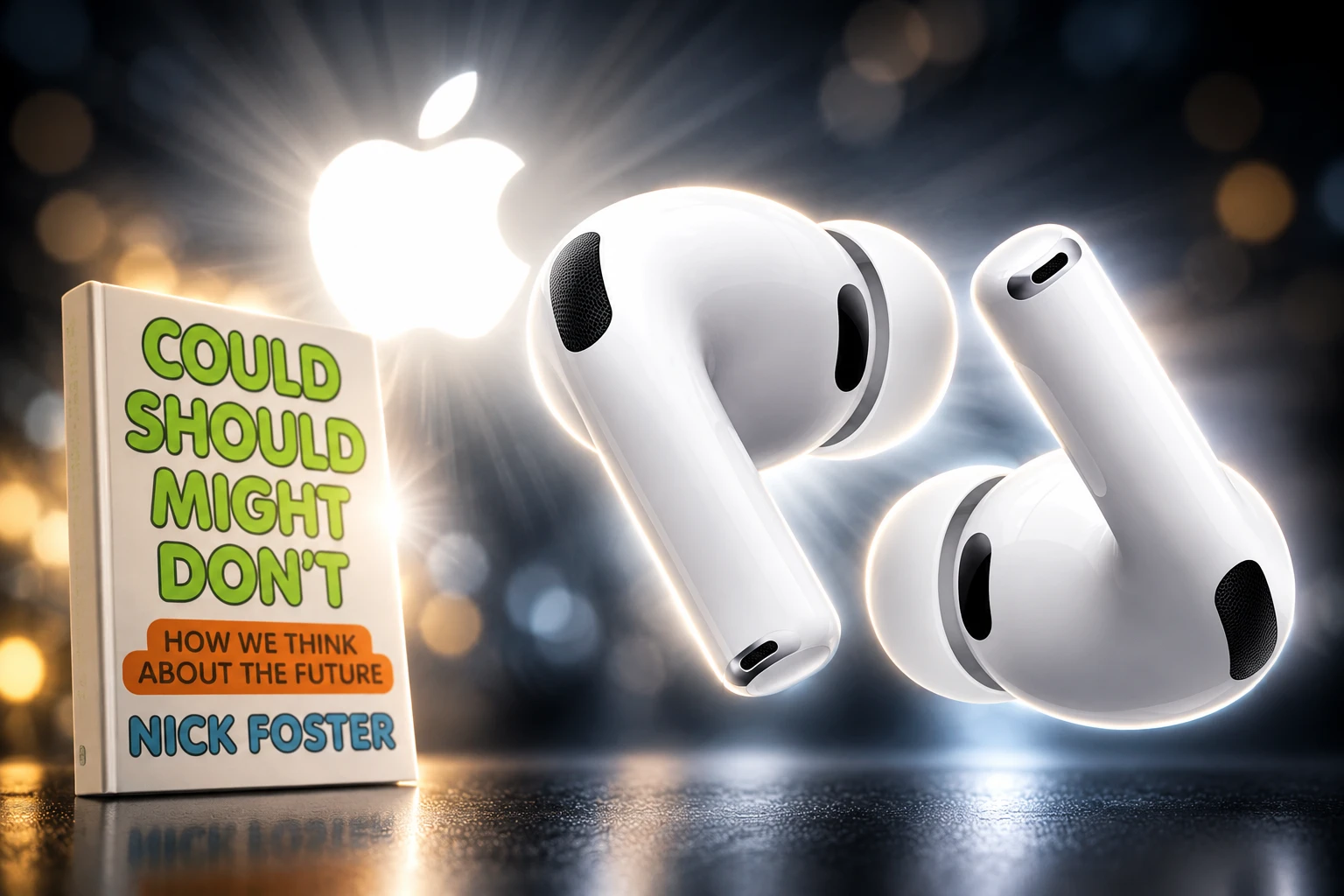
A Book, a Stem, and a 13-Second Leak
The reason so many people expected cameras on September 9 sat in a developer build. On August 17, Aaron Perris, an analyst who posts leaked Apple files, pulled a 13-second clip out of the macOS Tahoe 26.7 release candidate and put it on X. A man in earbuds that look like a thicker AirPods Pro holds up a book. A Siri voiceover sells the trick.
With Visual Intelligence, your world becomes savable. See something you like? Just ask me to save it for later.
Siri voiceover, macOS 26.7 demo video
The cameras themselves never appear on the stems in that clip. Code in the same build refers to the hardware as B790 and to an image stream from each bud, including a failure string for the left side. Setup copy warns that hair over the buds will wreck the read: the system tells you to keep AirPods uncovered if you want accurate information about things around you.
That leftover demo is why the leak felt like a launch file, not a lab sketch. It also explains the whiplash. A finished-looking tutorial in shipping software is usually how Apple briefs a product it is about to put on a keynote slide. Three weeks later the keynote sold noise cancellation instead.
Why the Lenses Will Not Take Photos
Apple’s pitch, repeated after the leak, is that these are not tiny cameras for a photo library. They are low-resolution sensors in the stems, meant to scan a room and hand context to Siri and Visual Intelligence. Mark Gurman, who has tracked both code names, wrote that the cannot take pictures or record video plan had not changed.
Visual Intelligence in the Camera app already lets an iPhone look up what is in front of it, split a bill, read a dish, or file a card to Apple Wallet. Camera AirPods would move that loop off the phone and onto the head, so you are not raising a handset every time Siri needs a look. The same stack is the one Apple rebuilt in the iOS 27 Siri AI overhaul, which is why a hardware delay keeps tracking a software one.
HOW THE STEM CAMERAS ARE SUPPOSED TO WORK
- The capture: Code in macOS 26.7 describes an active capture that starts at 640×640 and returns a processed 1024×1024 image, far below a phone camera.
- The pair: Each bud has a sensor, tracked as a left and right unit that work together rather than as two independent cameras.
- The light: A privacy indicator on the stem is supposed to turn on when images are being captured or when data is sent to the cloud.
- The limit: The sensors are not meant to save photos or video; they feed Siri for object IDs, saved items, contextual reminders, and walking directions.
- The snag: Hair, hoods, and jewelry can cover the stems, and Apple’s own setup copy treats that as a live failure mode.
That last point is not a forum nitpick. If the cameras only work with a clear view, a lot of the people who actually wear AirPods all day will own a pair of expensive microphones again. Holding a book up to your ear for a demo is the clean case. A commute in a hood is the real one.
Meta Gets Another Year of Camera Glasses
While Apple argues about stem geometry, Meta is already selling glasses that take photos and video. IDC said display-less smart glasses shipped 2.25 million units in the first quarter of 2026, up 167 percent from a year earlier, and put Meta’s share of that slice at 69.2 percent. The same tracker has projected 13.6 million display-less units for the full year. Those are different counts, one quarter versus a year-long forecast, and both still describe a market Apple is not in.
Meta’s own line now starts at $299, under the Ray-Ban-branded models. The glasses are built to capture. They also spend engineering time on a problem Apple is trying not to inherit.
WHAT YOU CAN BUY VERSUS WHAT APPLE IS HOLDING
| Product | Cameras | When it is for sale | What the camera is for |
|---|---|---|---|
| AirPods 5 | None | Stores September 18, 2026, from $129 | No visual sensor; Siri AI by voice |
| Camera AirPods (unreleased) | Low-res stem sensors | Aimed at 2027 | Scan a scene for Siri; no photo or video library |
| Meta AI glasses | Photo and video capture | On sale now, from $299 | Gallery shots plus Meta AI, with a recording light |
Meta’s privacy page describes a Capture LED that blinks while recording and a rule that covering or breaking that light kills the camera. It has still had to chase people who start a recording and then hide the lamp. Apple wants out of that fight before it starts, which is why the AirPods story keeps stressing that nothing lands in a roll of pictures. The cost of that caution is a full year in which Meta is the default camera on someone’s face.
The 2026 Pair Apple Quietly Scrapped
Apple did not delay one project. It ran two, then dropped the near-term one.
THE SLIP FROM SPRING TESTING TO A 2027 SLOT
- Spring 2026: Camera AirPods go into advanced testing with Apple employees, on a path that still pointed at a 2026 introduction.
- June 2026: Supply-chain and software problems, including visual models that were harder to train than planned, push the product into 2027, alongside a 20th-anniversary iPhone.
- Early August 2026: A second, further-along variant, B790, sits on an internal map that still allowed a 2026 debut, separate from the newer B798 design.
- August 17-19, 2026: The B790 demo leaks in macOS 26.7. Apple then pulls that variant off the 2026 roadmap. People familiar with the work say the company no longer plans to release B790.
- September 9, 2026: The fall event ships AirPods 5. Camera AirPods stay off the 2026 schedule.
B790 was a modified AirPods Pro 3 with sensors and AI bolted on, and it is the hardware in the book video. B798 is a new AirPods Pro generation that also includes the cameras. If anything ships in 2027, people briefed on the work say it is that newer pair, not the leftover Pro 3 conversion. Killing B790 is how Apple avoided a 2026 SKU that looked ready in a clip and was not ready in a factory.
The Nickname That Explains the Wait
The leak did not produce a rush of shopping lists. It produced a nickname, “pervertpods,” and a pile of jokes about filming people who never agreed to be in frame. One of the first replies to the demo video asked Siri to record a waitress. That is crude, and it is also the product problem in one line.
Glasses at least look like they might have a camera. AirPods already sit on millions of heads in gyms, offices, trains, and bathrooms, and nobody checks a stem for a lens. A recording light helps only if bystanders know to look for it, and if the device is actually recording. Apple’s answer is to say the sensors never keep a photo. Plenty of people will still assume any camera is a camera, especially on a gadget you cannot see from across a table.
Meta is learning that lesson in public, patching LED loopholes months after glasses became common. Apple has spent years selling privacy as a reason to buy its phones. Shipping a head-worn camera that the internet already treats as a peeping tool would punch a hole in that pitch during Ternus’s first holiday as CEO. Holding the product is the quieter way to keep the pitch intact. It also means Apple sells no wearable camera this Christmas.
Glasses, a Pendant, and the 2027 Pile
Camera AirPods are not waiting alone. Apple has been building a neck- or shirt-worn pendant with a camera, and smart glasses that have already slipped toward a 2027 debut. The same year is supposed to bring a 20th-anniversary iPhone and a second foldable. Ternus oversaw much of that hardware before he became CEO, including the camera AirPods work that did not make September 9.
Even without the buds, his first holiday slate is heavy: the Duo, Pro iPhones, Watch updates, a smart home display tied to the new Siri, and AirPods 5. Other items still in the pipeline include a touch-screen MacBook, a home security camera, a robotic-arm display, a new TV box, and a faster HomePod mini. The 2027 bet is that Visual Intelligence, Siri AI, and a cluster of cameras that do not behave like phone cameras arrive together, instead of as a one-off earbud with a messy software story.
Until then, the wearable camera you can actually buy still has a Meta logo on it. Apple’s next earbuds, the ones in stores on September 18, will cancel more noise than AirPods 4 and answer Siri with your voice. They will not glance at a book and save the title for later.

Instagram Plus Tests a Read-Only Mode That Cuts Stories

Altman Asks the Public to Accept Some AI Harm

Google Freezes OSS VRP Product Reports After AI Flood

AI Agents Make Payment Rails the Scarce Prize

Turkey’s Crypto Boom Now Runs Through Three Banks

Fable 5 Came Back Under a Commerce On-Off Switch

Google’s SpaceX GPU Lease Has a Sept. 30 Deadline

Plasma One’s XPL Locks Face a 1.81 Billion Cliff

DGO’s Rs 549 World Cup Pass Cost Fans Sleep and Data

Moonshot AI’s $30 Billion Ask Became a $35 Billion Close
-
 AI4 months ago
Fable 5 Came Back Under a Commerce On-Off Switch
-
 AI5 months ago
Google’s SpaceX GPU Lease Has a Sept. 30 Deadline
-
 CRYPTO4 months ago
Plasma One’s XPL Locks Face a 1.81 Billion Cliff
-
 APPS4 months ago
DGO’s Rs 549 World Cup Pass Cost Fans Sleep and Data
-
 AI5 months ago
Moonshot AI’s $30 Billion Ask Became a $35 Billion Close
-
 NEWS5 months ago
ColorOS 17 Device List Spans Oppo, OnePlus and Realme
-

 GAMING4 months ago
The RTX 4050 Under Rs 70,000 Hides a Wattage Gap
-

 AI4 months ago
Boris Cherny’s Loops Still Demand a Higher Production Bar