
GAMING
That’s No Moon Puts Smilegate’s $100 Million Bet on Tape
That’s No Moon’s first Crafting Crossfire tape sells Adaptive Cover as the device that can make Smilegate’s $100 million Western story bet pay.

That’s No Moon released Crafting Crossfire Part 1 on August 19, 2026, arguing Adaptive Cover can make Smilegate’s $100 million Western bet pay. Filmmaker Danny O’Dwyer and Secret Tape made the episode with the Los Angeles studio, which still has not set a launch date for its first game.
The tape arrived 13 days after former staff said 14 people had been cut. It is a vision pitch, not a ship date, and it asks players to trust a cover system on a franchise that already failed once in the West.
The First Crafting Crossfire Tape Arrives
The episode is titled High Stakes and Bold Vision. That’s No Moon billed it as the first in a series on how the studio was founded, how story and systems are supposed to lock together, and why Adaptive Cover exists. Chief creative officer Taylor Kurosaki wrote in the June 5, 2026 reveal note that the story should shape the gameplay, and that every player action should deepen the story.
On August 22 the studio posted the same YouTube link and thanked O’Dwyer for documenting the work. The official account called Adaptive Cover the thing that forced the team to rebuild how it makes games. Replies to that post were thin. One asked for Turkish subtitles. Nobody in that thread treated the tape as a crisis, and nobody treated it as a finished game either.
The diary walks through the founding pitch and the cover tech. It also shows the physical grind behind the marketing line, including a developer filming himself taking cover so the animation team had a real body to copy. That clip is the most honest frame in the tape. The system is not a menu of snap points. It is a person trying not to get shot.
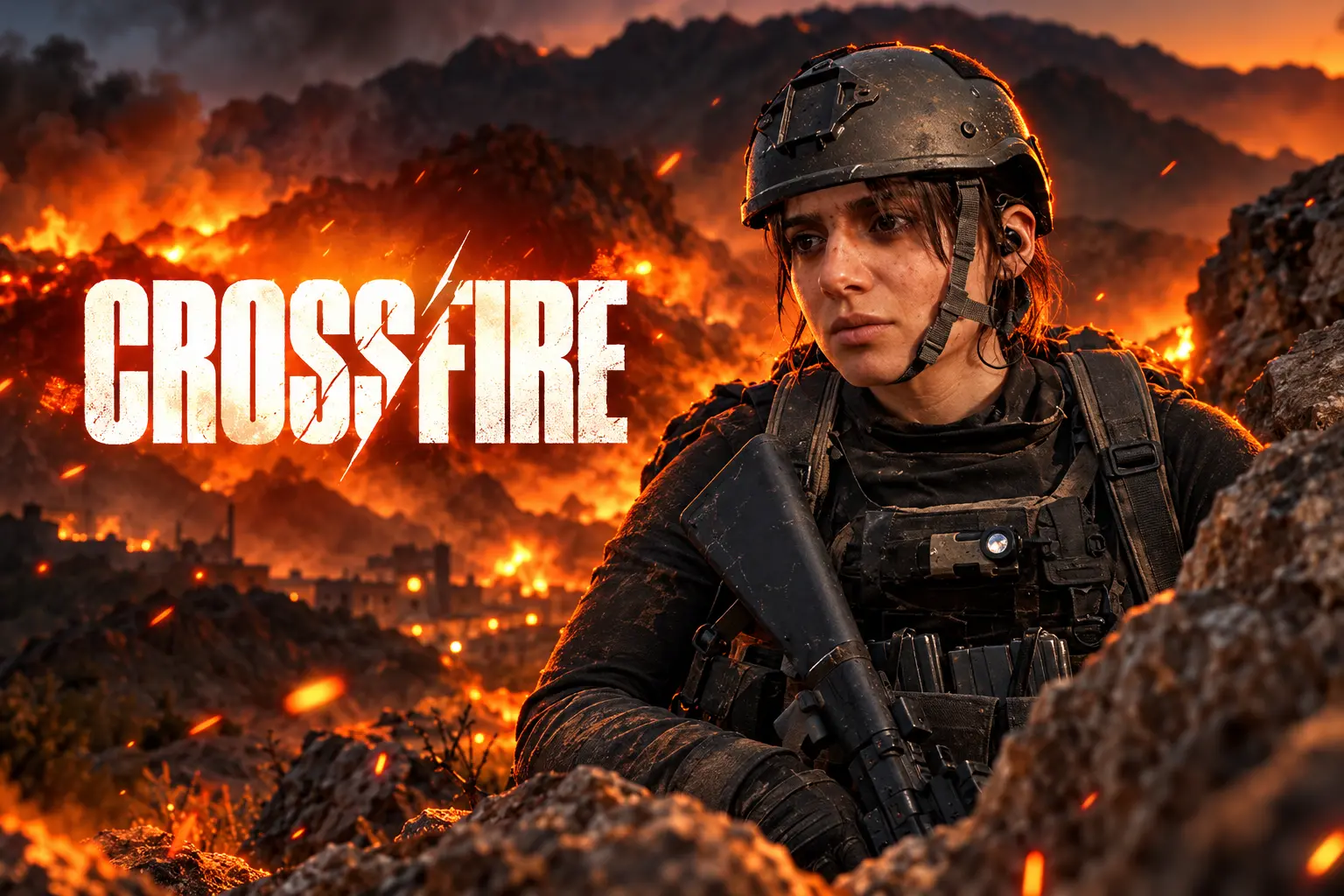
Adaptive Cover Turns Every Rock Into a Stance
Game director Jacob Minkoff has been clear about what the studio is throwing out. Classic third-person shooters teach you to slam into a marked wall, pop out, and blind-fire. Crossfire wants the opposite. Cover is whatever breaks line of sight: a slope, a boulder, a fold in the Atlas Mountains. Layla Qassem, the player character, is supposed to change stance on her own as the ground and the enemies change around her.
With Adaptive Cover, the player character, Layla, dynamically responds to the complex terrain around her and enemy positions to adjust her stance to maintain cover. This creates a greater sense of immersion and becomes an active skill to refine and master.
Jacob Minkoff, game director, That’s No Moon, Xbox Wire
Minkoff has also called the game mil-sim-light. Stance changes that a hardcore sim would hang on a scroll wheel are meant to happen automatically, and inventory busywork is supposed to stay out of the way. The bet inside the bet is accessibility. The studio wants Tarkov tension without Tarkov homework, and it wants that tension to serve a story about two people who do not trust each other.
WHAT ADAPTIVE COVER ACTUALLY CHANGES
- The snap point: There is no painted waist-high box. Players have to read the terrain and hide in it.
- The stance: Crouch, prone, and peek are meant to fire from the height of the object and the angle of the threat, not from a cover button.
- The ally: Delroy Cross fights beside Layla, so the same ground has to protect two bodies that do not like each other.
- The engine: Unreal Engine 5 Nanite and Lumen draw messy geometry; motion matching is supposed to let the body follow it.
Minkoff told a studio visitor he had watched motion-matching research about 12 years earlier and then saw Unreal Engine 5 render the kind of organic ground that research needed. Those two pieces, he said, generated Adaptive Cover. That is also how Adaptive Cover cracks old shooter formulas: the mountain is the cover, so the mountain has to be built like a combat tool, not like a postcard.
Organic cover is expensive. If the rocks are simple, the system looks like a crouched walk. If the rocks are good, environment artists become as load-bearing as gun designers. That is the part of the pitch the August cuts make harder to watch.
Smilegate Paid $100 Million for a Western Story
Adaptive Cover is the mechanic on the poster. The money trail is older. In 2021 Smilegate Entertainment made a $100 million strategic investment in That’s No Moon, a new Los Angeles studio staffed with people from Naughty Dog, Infinity Ward, Bungie, and Sony Santa Monica. DLA Piper, which advised Smilegate on the deal, said CrossFire already had more than 670 million registered users and over 8 million concurrent players.
Harold Kim, then Smilegate’s vice president of business development, said the company had done well in competitive games and still lacked the storytelling piece. Expanding in the West, he said, meant buying that skill, and Los Angeles had Hollywood next door. Former CEO Michael Mumbauer called the check the impossible deal: a huge sum for a studio that had not shipped anything.
Smilegate’s goal is to become a global player in the industry. We have been doing well in the competitive gaming space but what we lack is the storytelling element.
Harold Kim, vice president of business development, Smilegate
Kurosaki now describes the publisher relationship as close to Sony and Naughty Dog: trust in the vision, with story and combat glued together. Crossfire is a single-player third-person game, not a free multiplayer sequel. Smilegate is publishing on consoles. Team K1, a Tencent unit, is publishing on PC. The platforms named so far are PlayStation 5, Xbox Series X/S, and PC, including Steam and the Epic Games Store.
That split tells you who this Crossfire is for. The original CrossFire is a free first-person shooter that prints money in Asia. This one is a paid story about two operators in the Atlas Mountains, sold with Hollywood faces and a cover lecture. Smilegate is not iterating a playlist. It is trying to buy a prestige sentence in a market where CrossFire still reads as a blank.
CrossfireX Lasted One Year and Three Months
This is Smilegate’s second serious try at a Western CrossFire. CrossfireX launched on Xbox on February 10, 2022, with free multiplayer and paid single-player missions from Remedy Entertainment, Operation Catalyst and Operation Spectre. Smilegate halted sales on February 3, 2023, and closed the servers on May 18, 2023, one year and three months after launch. The Remedy missions died with the servers.
Smilegate said the game was ultimately not where it needed to be. That is the fuse this new tape is trying to outrun. Remedy already gave CrossFire a cinematic campaign. The West did not keep it. That’s No Moon’s answer is to throw out the free-to-play wrapper, switch to third person, and hang the whole game on Adaptive Cover and a two-hander story.
CROSSFIRE AGAINST CROSSFIREX
| Piece | New Crossfire | CrossfireX |
|---|---|---|
| Studio | That’s No Moon | Smilegate, with Remedy on the paid campaign |
| Shape | Single-player third-person story | Xbox multiplayer shooter plus two paid missions |
| Platforms | PS5, Xbox Series X/S, PC | Xbox One and Xbox Series |
| Launch | None set | February 10, 2022 |
| End state | In development | Servers closed May 18, 2023 |
Kurosaki said the new game uses a single connected world map, so you can look back down a mountain at the ground you already fought over. That is a different production problem than a multiplayer map pack. It is also a different failure mode. If Adaptive Cover feels stiff, there is no playlist to hide in.
Fourteen Staff Left After Summer Game Fest
Crossfire was revealed at Summer Game Fest on June 5, 2026. On August 6, two months later, former staff began posting on LinkedIn that they had been laid off. A senior environment concept artist said they were one of the 14 people affected. A producer used the same number. An associate environment artist said it was their first job in games. A procedural technical artist called the cuts unexpected. That’s No Moon has not issued a public count of its own.
Environment and technical art are not random departments for this pitch. Adaptive Cover needs irregular ground, and irregular ground is what those jobs make. Cutting there after a reveal that sold organic terrain is the tell the documentary does not mention. The tape talks about starting from the ground up. The staff posts say some of the ground crew is already gone.
The studio’s earlier mess sits under that. A January 2026 complaint filed in California by co-founders Tina Kowalewski, Taylor Kurosaki, and Nick Kononelos accuses former CEO Michael Mumbauer of taking the company domain offline after he was fired in 2022. The complaint says the firing followed leaks of confidential information. The studio had to rebuild its public front before it ever showed a trailer.
FROM THE $100 MILLION CHECK TO THE TAPE
- 2021: Smilegate puts $100 million into That’s No Moon, a new Los Angeles studio that has not shipped a game.
- February 10, 2022: CrossfireX launches on Xbox, with Remedy on the paid single-player missions.
- 2022: The complaint says That’s No Moon fires CEO Michael Mumbauer.
- May 18, 2023: CrossfireX servers close, one year and three months after launch.
- January 2026: Three co-founders sue Mumbauer over the domain.
- June 5, 2026: Crossfire is revealed at Summer Game Fest with Adaptive Cover as the hook.
- August 6, 2026: Former staff begin posting that 14 people were cut, including environment artists.
- August 19, 2026: Crafting Crossfire Part 1 goes up, selling high stakes and a bold vision.
None of that proves the game is doomed. Studios cut people after a reveal for dull reasons, including budget shape and a shift from concept art into production. It does prove the diary is a controlled image. High stakes is a title card. Fourteen résumés are the footnote.
Who Are Layla Qassem and Delroy Cross?
Layla Qassem is the gun for hire you control. Claudia Doumit plays her. Doumit is known for Victoria Neuman in The Boys and for Farah Karim in the recent Modern Warfare games, which Minkoff and Kurosaki also worked on. Delroy Cross is the opposing operator, played by Ricky Whittle, and he is an AI partner, not a second player. The setup is a recon job in the Atlas Mountains that collapses, then a forced alliance against a threat that corrupts both sides.
Kurosaki has said this is not a story about two enemies finding common ground. Layla pushes change. Cross defends the status quo. Survival is the only reason they share a ridgeline. Adaptive Cover is supposed to make that tension playable: you move with someone you were trained to kill, and the mountain is the only thing that will hide you both.
The studio built its own performance capture stage for that work and is using Unreal Engine 5 to keep the faces and the firefights in the same register. More behind-the-scenes tapes are planned before launch. What is not planned, at least in public, is a day on the calendar.
WHAT WE KNOW
- The tape: Crafting Crossfire Part 1 went live on August 19, 2026, made with Danny O’Dwyer and Secret Tape.
- The platforms: PS5, Xbox Series X/S, and PC, with Smilegate on consoles and Team K1 on PC.
- The money: Smilegate’s 2021 check was $100 million, aimed at Western storytelling, not at another free playlist.
WHAT IS UNCONFIRMED
- The launch: No year, season, or window has been set.
- The cuts: 14 is the figure named by former staff. The studio has not confirmed it.
- The build: Press saw an early slice in June. How much of the mountain is actually playable is still private.
On September 9, 2026, That’s No Moon was still posting combat prompts, asking whether to patch a wound and risk the opening or push on and risk bleeding out. That is the tone the studio wants: slow, lethal, and short on hero armor. The cover lecture is doing the same job the $100 million check was meant to do in 2021. It is trying to make CrossFire mean a story in the West. CrossfireX already spent a year and three months on that problem and then vanished. This tape is the next chip, and it still has no date on it.

Instagram Plus Tests a Read-Only Mode That Cuts Stories

Altman Asks the Public to Accept Some AI Harm

Google Freezes OSS VRP Product Reports After AI Flood

AI Agents Make Payment Rails the Scarce Prize

Turkey’s Crypto Boom Now Runs Through Three Banks

Fable 5 Came Back Under a Commerce On-Off Switch

Google’s SpaceX GPU Lease Has a Sept. 30 Deadline

Plasma One’s XPL Locks Face a 1.81 Billion Cliff

DGO’s Rs 549 World Cup Pass Cost Fans Sleep and Data

Moonshot AI’s $30 Billion Ask Became a $35 Billion Close
-
 AI4 months ago
Fable 5 Came Back Under a Commerce On-Off Switch
-
 AI5 months ago
Google’s SpaceX GPU Lease Has a Sept. 30 Deadline
-
 CRYPTO4 months ago
Plasma One’s XPL Locks Face a 1.81 Billion Cliff
-
 APPS5 months ago
DGO’s Rs 549 World Cup Pass Cost Fans Sleep and Data
-
 AI5 months ago
Moonshot AI’s $30 Billion Ask Became a $35 Billion Close
-

 NEWS5 months ago
ColorOS 17 Device List Spans Oppo, OnePlus and Realme
-

 GAMING4 months ago
The RTX 4050 Under Rs 70,000 Hides a Wattage Gap
-
 AI4 months ago
Boris Cherny’s Loops Still Demand a Higher Production Bar