
AI
Microsoft’s Cash Engine and Super App Leave Rivals Behind
Microsoft posts $331.8 billion revenue, Azure tops $100 billion and 30 million Copilot seats as Nadella teases a unified AI super app and model independence.

Microsoft closed fiscal 2026 with $331.8 billion in revenue, up 18 percent, as Azure crossed $100 billion for the first time and Microsoft 365 Copilot paid seats topped 30 million. CEO Satya Nadella used the earnings call to confirm the company is stitching Copilot chat, code, Cowork and Autopilot into one AI super app this year.
The numbers arrived alongside free cash flow of $19.6 billion in the fourth quarter and a commercial backlog that hit $678 billion. Microsoft is turning heavy AI infrastructure spend into locked multi-year contracts while some peers face sharper cash pressure.
A Record Year Built on Cloud and AI
Full-year revenue reached $331.8 billion. Microsoft Cloud hit $214.4 billion, up 27 percent. Azure and other cloud services grew 41 percent for the year and 43 percent in the June quarter.
Q4 company revenue was $90.0 billion, up 18 percent. Operating income reached $40.6 billion. Net income was $35.8 billion on a GAAP basis. Diluted EPS came in at $4.81 GAAP.
| Metric | Q4 FY26 | Full Year FY26 |
|---|---|---|
| Revenue | $90.0B (+18%) | $331.8B (+18%) |
| Microsoft Cloud | $59.3B (+27%) | $214.4B (+27%) |
| Azure and other cloud | +43% | +41% (>$100B) |
| Commercial RPO | $678B (+84%) | $678B |
| M365 Copilot paid seats | >30 million | >30 million |
| Free cash flow | $19.6B | N/A |
Amy Hood, executive vice president and chief financial officer, called out Microsoft Cloud revenue of $59.3 billion as the quarter’s highlight. Commercial remaining performance obligation jumped 84 percent to $678 billion. The entire sequential increase of roughly $50 billion came from commitments by companies outside the leading U.S. AI model makers.
Microsoft returned $10.2 billion to shareholders in the quarter through dividends and buybacks, more than $43 billion for the full year.
Copilot Moves Toward One Super App
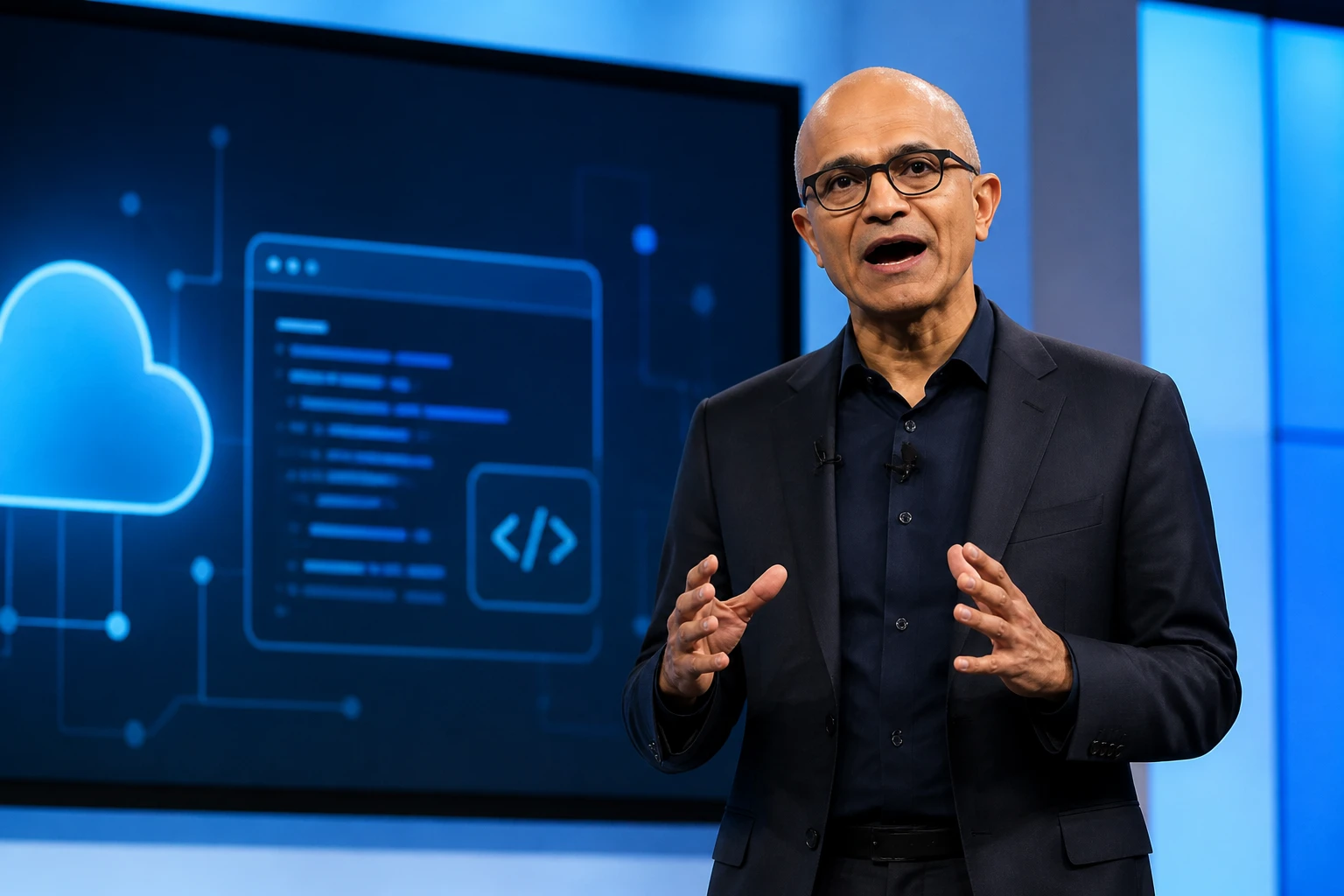
Nadella described the product shift in plain terms on the call. “This quarter we will bring these Copilot experiences together, including Code, in one ‘super app’ spanning both consumer and commercial experiences. This is a major step forward, and I look forward to sharing more soon.”
The package is expected to combine the Copilot chatbot, GitHub Copilot coding tools, Cowork multi-step task agents and Autopilot long-running agents. It sits closer to OpenAI’s ChatGPT Work direction than a pure chatbot.
Paid Microsoft 365 Copilot seats passed 30 million, up from 20 million the prior quarter. Net seat adds more than doubled quarter-over-quarter. Customers with more than 50,000 seats rose over 7X year-over-year. Conversations per user nearly doubled. Average weekly engagement now matches Outlook and Teams levels for many users.
- NHS England is rolling out Copilot to 505,000 clinicians and staff after a trial that saved an average 43 minutes per day.
- KPMG is expanding across more than 276,000 professionals.
- HSBC committed to 200,000 seats.
- Large wins of 60,000-plus seats include AstraZeneca, Boeing, Infosys, Procter & Gamble, Wells Fargo and others.
- The new E7 suite, which bundles Copilot with security and Agent 365, already saw hundreds of enterprise customers and an EY deployment of 400,000 seats.
User satisfaction scores doubled over three quarters and hit an all-time high. Latency fell 25 percent in the latest quarter alone. Time from deployment to high usage (above 80 percent monthly active) dropped from months to days.
Nadella later posted a concrete demo. He described the ROIC Intelligence App he built from a Morgan Stanley PDF using Copilot code tools that will ship in the super app, plus autopilot and testing skills, all inside the enterprise boundary with Fabric data and Agent 365 controls.
Cash Still Flows After Heavy Capex
Fourth-quarter capital expenditures hit $41 billion. Roughly two-thirds went to short-lived assets, mainly GPUs and CPUs. Cash paid for property and equipment was $35.8 billion. Operating cash flow reached $55.4 billion, up 30 percent. Free cash flow landed at $19.6 billion.
That figure sits well above many peer trajectories under AI buildout pressure. Public reporting has shown Google turning cash-flow negative in recent periods for the first time in decades and Meta seeing steep drops in cash reserves as both push aggressive data-center spend. Microsoft remains free-cash-flow positive and expects to stay that way in fiscal 2027.
For the first quarter of fiscal 2027, Microsoft guided capital expenditures above $50 billion, including effects from a useful-life change. Calendar 2026 reported CapEx expectations moved to approximately $175 billion after the company extended estimated useful lives of data centers and office buildings from 15 to 25 years. That shift moves more future leases from finance to operating classification. Actual investment plans are unchanged; only the accounting presentation softens the reported CapEx number from the prior $190 billion outlook.
Gross margin percentage was 67 percent in the quarter, down year-over-year on Azure mix and AI infrastructure. Operating margin held near 45 percent. The company still expects double-digit revenue and operating-income growth in fiscal 2027 with operating margins down less than a point.
Models and Silicon Microsoft Controls Itself
Nadella stressed architecture independence. Customers want model choice by quality, latency, cost and compliance. Microsoft now offers more than 11,000 models, including OpenAI, Anthropic, Mistral, xAI and its own MAI family. Customers building with models from multiple providers rose 5X since the start of the year.
Own-model progress is concrete. MAI-Code-1-Flash on GitHub Copilot delivered higher acceptance rates and 10 percent lower median token usage for millions of developers. In Excel it matches GPT-class quality on common tasks at lower cost. MAI-Cyber-1-Flash beat a larger rival model at half the cost inside a multi-agent security harness. GPU cost reductions reached 89 percent in Dynamics 365 with one voice model and 84 percent in PowerPoint with an image model.
Maia 200 custom silicon delivers 30 percent better performance per dollar than the latest-generation hardware already in the fleet and now runs both OpenAI and MAI models. Cobalt CPU VMs power first-party and customer workloads; Cobalt 200 racks are heading into more than 25 data centers. The company will deploy next-generation rack-scale systems based on AMD Helios and NVIDIA Vera Rubin among the first cloud providers.
This is the enterprise design Microsoft says it is evangelizing and already using internally. The earlier heavy reliance on OpenAI models for Copilot is giving way to a substitutable, multi-provider stack. That reduces single-vendor risk for customers and for Microsoft itself. The company’s larger Frontier Company AI engineering push fits the same full-stack pattern.
We are advancing the frontier on the cost-to-outcome curve, ensuring every customer can turn tokens into business results.
Nadella said that in the official release, tying the philosophy directly to Azure crossing $100 billion and Copilot seats topping 30 million.
Who Gains and Who Feels the Pressure
Enterprise customers that already live inside Microsoft 365, Azure, GitHub and security tools gain the clearest path. They get agents grounded in Work IQ, Fabric data and Agent 365 governance without outsourcing core IP. Large seat deals and the E7 bundle show CIOs are willing to pay for that containment and compliance wrapper.
Microsoft itself is the structural winner on cash conversion. Positive free cash flow after $41 billion of quarterly CapEx, plus a backlog swollen by non-frontier customers, gives it room to keep building while still returning capital. Azure scale now sits far ahead of Google Cloud even as both grow fast; the India Today framing of Microsoft beating Google in cloud tracks the absolute revenue gap.
Pure-play model labs face a more mixed outcome. OpenAI remains a major partner and equity stake, yet Microsoft is deliberately making models interchangeable and shipping its own MAI family into production workloads. Anthropic models appear in the catalog and delivered Microsoft a $3.2 billion investment gain in the quarter. The super app puts Microsoft’s interface and distribution against ChatGPT Work and similar offerings from Anthropic-focused stacks.
Rivals spending at similar or higher CapEx intensity without Microsoft’s diversified software cash engine face tighter free-cash-flow math. That gap is already visible in public comparisons across the hyperscalers.
Nadella has previously flagged downside risks. His earlier warning on AI hollowing industries still hangs over the broader economy even as Microsoft’s own numbers accelerate.
The Backlog That Is Not Just Frontier Labs
Commercial RPO of $678 billion carries a weighted average duration of 2.3 years. Roughly 30 percent is expected to convert in the next 12 months, up 37 percent year-over-year. The portion beyond 12 months jumped 112 percent. Critically, sequential growth came entirely from outside the big U.S. model companies.
That breadth matters. Demand is not confined to a handful of AI labs chasing training capacity. Banks, manufacturers, health systems, professional services firms and governments are signing multi-year deals for the full stack: compute, data, models, agents and governance.
Foundry now has 100,000 customers and revenue that more than doubled. Agent 365 already shows nearly 40 million agents registered across tens of thousands of companies just two months in. PostgreSQL and Fabric usage tied to AI workloads continues to accelerate.
Capacity keeps coming online. Microsoft added 31 new data centers across five continents in the quarter, 88 for the year. Dock-to-live times for new GPUs in largest regions fell nearly 50 percent. Another gigawatt of capacity arrived in the quarter; the company remains on track to roughly double overall capacity in two years. Throughput for Copilot workloads rose 4X since the start of the year.
The lease accounting change and the $175 billion calendar-2026 CapEx figure lower the headline spend number without cutting actual build plans. Investors get a cleaner view of depreciation timing while the physical build continues.
Microsoft is converting AI infrastructure dollars into recurring software and cloud revenue faster than the cash drain shows at several peers. The super app is the next distribution layer. The multi-model, multi-silicon stack is the insurance policy. The $678 billion backlog is the proof that enterprises outside the hype cycle are already buying in for years ahead.


South Korea Retail Investors Face Reckoning After KOSPI AI Rally Collapses

Surrey AI Maps Three Heart Attack Paths and Their Molecular Roots

Germany Locks Neutral Apple ATT Prompts Across Most of Europe

Apple’s 5% EU Fee Quietly Rewrites Alternative App Store Math

Apple’s EU Fee Truce Cuts Complexity but Leaves Rivals Fuming

Pixel 11 Pro Fold Trades Thinness for Durability and Seven-Year Stay

Mayo AI Flags HCM Obstruction From Everyday Ultrasound Videos

Indian Brands Quietly Scale Landmark Screens and Home Tech

Navin Vatsa Turns Grief Into a Lifetime of Quiet Seeing

Google Bets Pixel 11 Agentic AI Will Redefine Phones

Oracle Cuts 21,000 Jobs in a Year, Cites AI in 10-K Filing

Fable 5 and Mythos 5 Return as US Lifts Anthropic Export Controls

SpaceX’s Google Deal Turns a Rocket Company Into a Cloud Landlord

CD Projekt Red Co-CEO: Redemption Arc Isn’t Done, Witcher 4 in 2027

XPL Rallies 30% Ahead of Plasma One Card Tier Launch

Google Search Profiles Build a Follow Graph Inside Discover

DGO App Brings Rs 549 Mobile Pass for FIFA World Cup 2026 in Nepal

Moonshot AI Targets $30 Billion in China’s Fastest AI Funding Sprint

Oppo’s ColorOS 17 Eligibility List Leaves A-Series Buyers Behind

Microsoft Xbox Layoffs Start in July as Sharma Slams 3% Margin
-
 AI2 months ago
Oracle Cuts 21,000 Jobs in a Year, Cites AI in 10-K Filing
-
 AI2 months ago
Fable 5 and Mythos 5 Return as US Lifts Anthropic Export Controls
-
 AI3 months ago
SpaceX’s Google Deal Turns a Rocket Company Into a Cloud Landlord
-
 GAMING2 months ago
CD Projekt Red Co-CEO: Redemption Arc Isn’t Done, Witcher 4 in 2027
-
 CRYPTO2 months ago
XPL Rallies 30% Ahead of Plasma One Card Tier Launch
-
 NEWS3 months ago
Google Search Profiles Build a Follow Graph Inside Discover
-
 APPS2 months ago
DGO App Brings Rs 549 Mobile Pass for FIFA World Cup 2026 in Nepal
-
 AI3 months ago
Moonshot AI Targets $30 Billion in China’s Fastest AI Funding Sprint