
GADGETS
Sony’s Free App Update Gives Away a Premium Exposure Tool
Sony’s Monitor & Control app now runs EL Zone, the Hollywood exposure tool monitor makers charge thousands for, free on Alpha and Cinema Line cameras.

Sony just gave away, for free, an exposure tool that cinematographers used to need a several-thousand-dollar monitor to access. The company’s Monitor & Control app added EL Zone this week. Cinematographer Ed Lachman built the stop-based exposure system for films like Carol and Erin Brockovich.
Version 3.0 also adds support for the new Alpha 7R VI and FX5 cameras. It brings a vectorscope too, along with an image overlay tool for matching shots between setups. Monitor makers built businesses charging for this exact feature. Sony just made it free.
Sony Slips a Hollywood Exposure Tool Into Its Free App
Newsshooter, a cinematography trade publication, first detailed the update on July 23. The site listed a run of new capabilities packed into version 3.0 of the Monitor & Control app, the companion tool Sony ships for its Alpha and Cinema Line cameras.
- EL Zone support – visualizes exposure using stops instead of IRE percentages
- Compatibility added for the Alpha 7R VI and FX5
- The FX5 now accepts simultaneous connections from multiple devices
- Multi-Camera Monitoring adds vertical-position shooting
- Multi-Camera Monitoring adds wired USB connections
- A new image overlay tool superimposes stored reference images onto the live feed
- A vectorscope for checking hue and saturation across cameras
- Snapshots now save automatically
The app itself costs nothing to download and already worked with a long roster of Sony bodies before this update, including the BURANO, FX6, FX3, FX30 and several Alpha models. What changed is what the app can now show on screen once it is paired with a camera.
Stops, Not Percentages
Ed Lachman, the cinematographer behind Carol and Erin Brockovich, built EL Zone by adapting a decades-old idea. He based the system on the Zone System that photographer Ansel Adams formulated for analog still photography, translating it into a tool for digital motion picture stops.
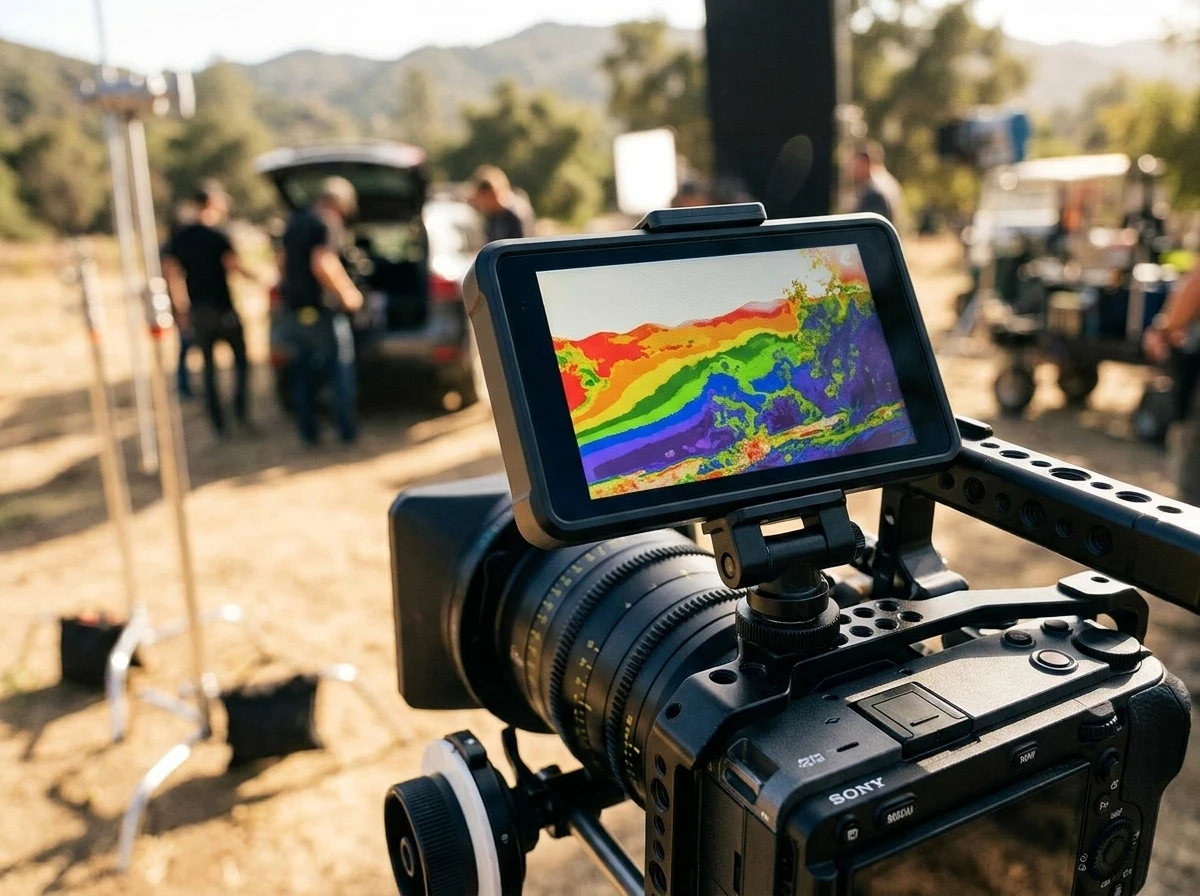
Traditional false color tools measure exposure in IRE, a percentage-based unit for video signal strength that the Institute of Radio Engineers standardized in the 1950s. EL Zone throws that out. It maps each stop of light above and below 18% gray to its own color, so a shooter reads exposure the way a light meter would, not as an abstract percentage.
The system renders roughly fifteen stops in fifteen colors, running through a rainbow scale. White marks anything overexposed by six stops or more. Black marks anything six stops under. Middle gray sits neutral in between.
We have again a vocabulary to communicate exposure with each other
Lachman said that after EL Zone helped a mostly English-speaking crew communicate exposure decisions with an all-Chilean crew on the 2024 film El Conde, according to Cinematography World’s account of the shoot.
Why Give Away What Monitor Makers Charge For?
Sony’s decision costs monitor makers a selling point they built entire product lines around. SmallHD and Atomos have offered EL Zone as a headline feature on dedicated hardware priced from roughly $1,200 to $3,000. Sony’s app runs a version of the same idea on a phone or tablet a shooter likely already owns, at no extra cost.
| Manufacturer | Product | How EL Zone Arrived | Price Point |
|---|---|---|---|
| SmallHD | Cine 7, Ultra 7 monitors | Built into PageOS 5 firmware | $2,199 to $2,999, monitor purchase required |
| Atomos | On-camera monitors | Built into monitor firmware | Monitor purchase required |
| Panasonic | VariCam LT, VariCam 35 | Native camera firmware | Included with cinema camera |
| Sigma | fp, fp L | Native camera firmware | Included with camera |
| Sony | Venice 2 | Added natively, summer 2025 | Included with flagship cinema camera |
| Sony | Alpha 7R VI, FX5 (Monitor & Control app) | Free app update, July 2026 | Free download |
Dedicated monitors still do things a phone screen cannot. They run brighter in direct sunlight, take SDI and HDMI inputs, and survive drops on a set that a glass slab in a phone clamp won’t. But for a solo shooter or a small crew who just wants an accurate read on exposure, the reason to spend $2,000 on a monitor got noticeably thinner this week.
From VariCam Sets to Sony’s Own Flagship Cinema Camera
EL Zone’s path to Sony’s app took years. Panasonic built it into the VariCam LT and VariCam 35. Sigma added it to the fp and fp L mirrorless bodies. SmallHD folded it into PageOS 5, the operating system running across its monitor lineup, and Atomos added it to its own on-camera displays.
Sony’s own flagship cinema camera, the Venice 2, gained native EL Zone support in summer 2025, according to the EL Zone System’s own media page. That rollout stayed inside Sony’s rarefied cinema-camera tier, the kind of body that rents for a day rate rather than sells to a hobbyist. This week’s app update is the first time the tool has reached Sony hardware built for a mass audience.
EL Zone’s Biggest Stage Yet
The Alpha 7R VI matters here more than its spec sheet suggests. Sony announced the camera on May 13, priced at $4,499, built around a 66.8-megapixel stacked sensor with 8K video and ProRes RAW output. It is sold first as a high-resolution stills camera for sports, wildlife and portrait work, not a cinema tool.
That is precisely why EL Zone reaching it matters. Venice 2 sells to production companies and rental houses. The Alpha 7R VI sells to working photographers who shoot video on the side, wedding shooters, and content creators who never set foot on a union film set. Folding EL Zone into a $4,499 hybrid camera, through a free app, puts a tool designed for feature films in front of an audience many multiples larger than Venice 2 ever reached.
The FX5, Sony’s compact full-frame cinema camera, picked up its own upgrade in the same release: support for simultaneous connections from multiple monitoring devices, useful on multi-camera shoots where more than one operator needs a live feed.
What a Free Update Means for Monitor Sales
SmallHD’s and Atomos’s pitch for years has rested partly on exclusivity: buy this screen, get this exposure tool. Sony just showed that a camera maker can hand the same capability to its own customers for nothing, using hardware they already carry in their pocket.
That does not erase the monitor makers’ business. Bigger productions still need daylight-viewable screens, ruggedized housings and native camera-control ports that a phone app cannot replicate. But the specific argument that EL Zone alone justifies a four-figure monitor purchase gets harder to make once a competing camera maker ships the same math for free.
Sony has not said whether EL Zone will reach older Alpha bodies through a future firmware update.
Frequently Asked Questions
Is EL Zone the Same as False Color?
No. Standard false color tools are generic and based on IRE percentages that don’t always match a specific camera’s middle gray value. On the Alexa 35, for instance, middle gray sits around 28 IRE, an outlier that most generic false-color scales are not built to represent accurately. EL Zone is calibrated per camera and reads in stops instead.
Is Sony’s Monitor & Control App Really Free?
The core app is free to download and use. No Film School reported that an earlier update, version 2.6.0, added a feature for saving monitored video directly to a device’s internal storage, but that specific recording function sits behind a paid plan. The exposure and monitoring tools covered in this update, including EL Zone, are not behind that paywall.
Does EL Zone Work the Same Way on Every Sony Camera?
Not exactly. Venice 2 has EL Zone built directly into the camera’s own firmware as a native tool. On the Alpha 7R VI and FX5, EL Zone runs through the separate Monitor & Control app on a connected phone or tablet rather than the camera’s own screen, so the experience depends on the paired device.
Which Camera Makers Might Adopt EL Zone Next?
Beyond Panasonic, Sigma and Sony, Filmmakers Academy reported in 2024 that EL Zone’s creators were in talks with ARRI, RED, Blackmagic, Canon and Fuji. None of those conversations had produced a shipping product as of this update, and camera makers routinely hold such talks without adopting a third-party tool.


Sony’s 10 Percent Disc Drop Leaves the 2028 Cutoff Intact

Chip Allocation Sidelines the Base iPhone 18 This Fall

Miami-Dade Fights the Vice City Brand It Already Wears

IFA 2026 Awards Put Tecno Ahead of Flagship Phones

USB-C Gadgets Made the Junk Drawer Rechargeable

Pixel 11 Pro Asks $1,099 for a Light Google Locked

The iPhone Ultra Sells Two Retired Minis as One Foldable

Google Opens Gmail to Voice and Gates Docs Live

Lenovo Prices the IdeaPad Vibe Against Apple’s $699 Neo

Xbox Caps Game Pass Cloud Gaming at 15 Hours

Oracle Cuts 21,000 Jobs in a Year, Cites AI in 10-K Filing

Fable 5 and Mythos 5 Return as US Lifts Anthropic Export Controls

SpaceX’s Google Deal Turns a Rocket Company Into a Cloud Landlord

CD Projekt Red Co-CEO: Redemption Arc Isn’t Done, Witcher 4 in 2027

XPL Rallies 30% Ahead of Plasma One Card Tier Launch

Google Search Profiles Build a Follow Graph Inside Discover

DGO App Brings Rs 549 Mobile Pass for FIFA World Cup 2026 in Nepal

Moonshot AI Targets $30 Billion in China’s Fastest AI Funding Sprint

Oppo’s ColorOS 17 Eligibility List Leaves A-Series Buyers Behind

Microsoft Xbox Layoffs Start in July as Sharma Slams 3% Margin
-
 AI2 months ago
Oracle Cuts 21,000 Jobs in a Year, Cites AI in 10-K Filing
-
 AI2 months ago
Fable 5 and Mythos 5 Return as US Lifts Anthropic Export Controls
-
 AI3 months ago
SpaceX’s Google Deal Turns a Rocket Company Into a Cloud Landlord
-
 GAMING3 months ago
CD Projekt Red Co-CEO: Redemption Arc Isn’t Done, Witcher 4 in 2027
-
 CRYPTO3 months ago
XPL Rallies 30% Ahead of Plasma One Card Tier Launch
-
 NEWS3 months ago
Google Search Profiles Build a Follow Graph Inside Discover
-
 APPS3 months ago
DGO App Brings Rs 549 Mobile Pass for FIFA World Cup 2026 in Nepal
-
 AI3 months ago
Moonshot AI Targets $30 Billion in China’s Fastest AI Funding Sprint