
GAMING
Epic Store Hits Brazilian iPhones Amid Apple’s Familiar Friction Play
Epic opens its iOS store in Brazil with Fortnite and 20% rewards, yet a nine-step install and 5% fee echo the EU and Japan pattern regulators already faced.

Brazilian iPhone owners can download the Epic Games Store straight from the web as of 29 July, unlocking Fortnite and Rocket League Sideswipe plus 20% Epic Rewards cash back. Epic says Apple built a nine-step install gauntlet of warnings and a 5% Core Technology Commission that deliberately blunts the very competition Brazil’s regulator ordered open.
The pattern is familiar. The same studio documented identical friction in the EU and Japan after those markets forced Apple to allow alternative marketplaces. Each opening has followed the same arc: a regulator mandate, a technical pathway that arrives with heavy warnings and fees, then a public dispute over whether the pathway meets the spirit of the order.
Brazil now becomes the latest test of that sequence. The store is live, the first games are playable, and the commercial incentive is clear. The install path and the fee stack remain the contested ground.
Fortnite and a 20% Rebate Arrive First
Players in Brazil now reach the store by visiting Epic’s site on a supported iPhone running iOS 26.5 or later. The catalogue opens with two first-party titles. Third-party games are promised later once Epic finishes implementing Apple’s reporting and technical requirements.
- Fortnite with full progression and purchases
- Rocket League Sideswipe
- 20% back in Epic Rewards on Fortnite spends made through the standalone store (unavailable on the native App Store version)
- No iPad support in Brazil at launch
Tim Sweeney, Epic’s CEO, put the commercial pitch plainly on X: “Epic Games Store is now live on iOS in Brazil, featuring Fortnite and Rocket League Sideswipe. Third-party games coming later. Benefit: Get 20% cash back with Epic Rewards, compared to the iOS App Store.” The post drew tens of thousands of views within hours.
The rebate is the clearest consumer-facing difference at launch. Fortnite purchases made through the standalone store return value that the native App Store version does not match. For players willing to complete the install flow, the offer lowers the effective cost of cosmetics and other digital goods.
Epic’s official Brazil launch statement frames the opening as both a win for local gamers and fresh evidence that Apple still designs the path to keep alternatives marginal. The limited roster and the missing iPad path underscore that this is a first tranche, not a finished marketplace.
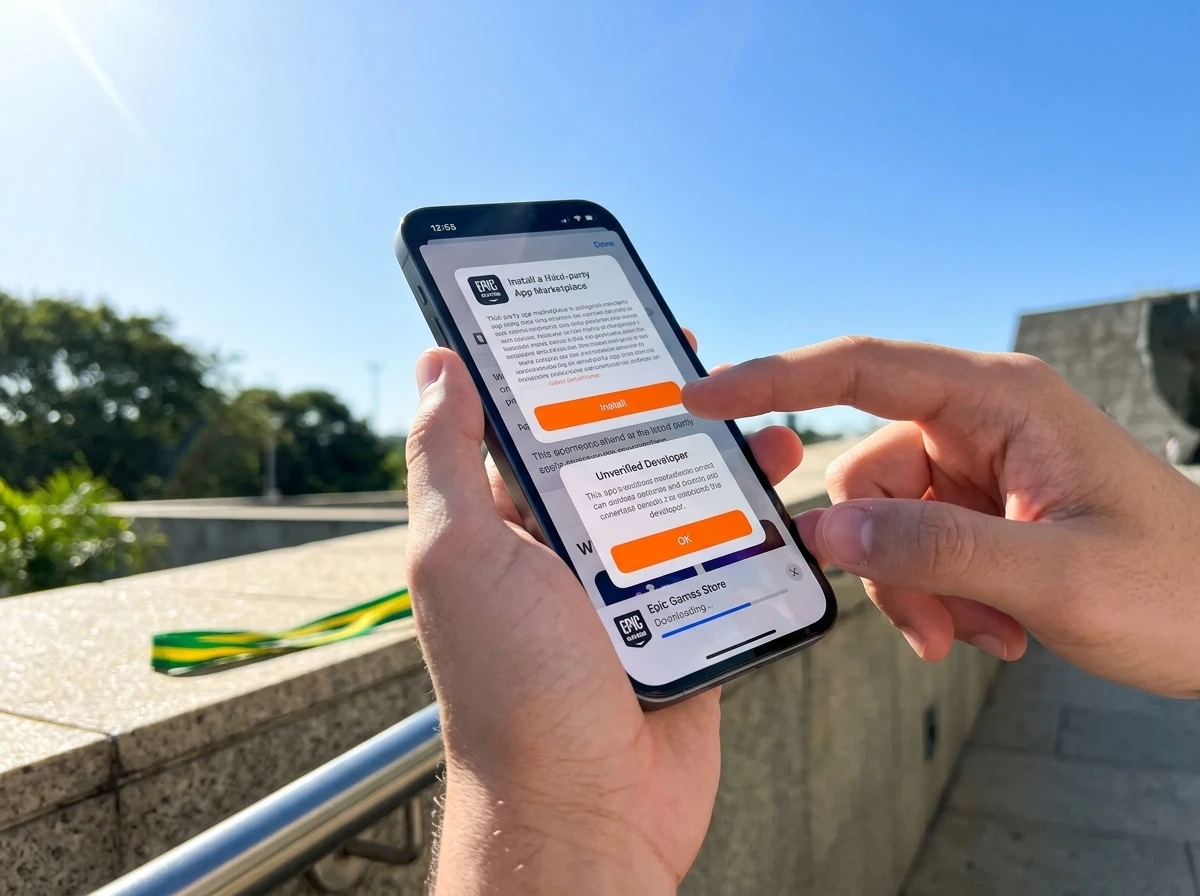
Nine Screens Separate the User From the Store
Epic counts nine distinct screens and scary-sounding warnings before an alternative marketplace finishes installing. The studio calls them “scare screens” built to deter downloads. Screenshots in its announcement show repeated system alerts about trust, unknown developers, and the risks of leaving the App Store.
Apple requires notarization for every app distributed outside its store, plus authorization for the marketplace itself. Those steps generate the extra taps and consent sheets. Epic argues the volume is intentional: after European pressure cut the EU flow from 15 steps to six, Brazil’s process climbed again.
The warnings cluster around a few themes that users must clear in sequence:
- Trust and unknown-developer alerts
- Risks of leaving the App Store
- Marketplace authorization and notarization confirmations
- Repeated system consent sheets before the install completes
The official Epic Newsroom account summarized the charge: “Apple is intentionally making it hard for alternative stores to compete with a 9-step install flow, anticompetitive fees and tracking. This is just like the evasive tactics we’ve seen in Japan and the EU.”
Each extra screen is a decision point. In the EU, trimming those points produced a sharp rise in completed installs. Epic’s Brazil complaint is that the nine-step path rebuilds the friction that regulators elsewhere already forced Apple to reduce.
Apple Still Collects Its Cut Outside the Store
Distribution outside the App Store does not escape Apple’s economics. Developers pay a Core Technology Commission on digital goods and services sold through alternative channels.
| Channel / Fee | Rate | Applies to |
|---|---|---|
| Core Technology Commission | 5% | Paid apps and digital goods/services via alternative marketplaces |
| App Store commission (standard) | 21% | Most digital sales on App Store |
| App Store commission (reduced) | 10% | Small Business Program, first-year subscription anniversary, certain partners |
| Apple payment processing | 5% | In-App Purchase transactions |
| Store services (web link) | 10-15% | Sales within 7 days of an out-of-app link |
Epic is launching with only its own titles while it builds the transaction reporting and technical hooks Apple demands. The studio has long called these terms “anticompetitive fees” and “junk fees” that force developers to share sensitive data and still pay Apple even when the store never touches the payment. Full details sit in Apple’s full Brazil business terms and CTC rates.
On paper the 5% Core Technology Commission undercuts the standard 21% App Store rate and even the 10% reduced tier. In practice the commission arrives with reporting duties and technical integration work that Epic is still finishing. That overhead helps explain why the catalogue opens narrow.
Apple’s June framing is security-first. Alternative marketplaces open “new avenues for malware, fraud, scams, and privacy and security risks.” Notarization and marketplace authorization are presented as the necessary guardrails agreed with CADE.
The fee table and the security language travel together. Apple keeps a revenue claim on alternative sales and keeps control of the gate that every sideloaded app must pass. Epic treats both as tools that blunt the competitive opening CADE ordered.
Europe Already Showed What Fewer Steps Deliver
In the EU last year Apple cut the install flow from 15 steps to six under Digital Markets Act pressure. It removed the most alarming scare screen and fixed a dead-end that stranded users in Settings. Epic measured the result immediately.
- Pre-change drop-off: around 65% of users abandoned the Epic Games Store install
- Post-change drop-off: around 25%
- Measured improvement: 60% decrease in player drop-off
- Outcome: iOS install success rates began approaching Windows and Mac levels
That data comes from 60% drop in EU player drop-off after six steps, published by Epic in October 2025. The studio now argues Apple deliberately lengthened the Brazil sequence “to thwart competition.”
| Market | Install steps (as cited by Epic) | Noted effect |
|---|---|---|
| EU (pre-iOS 18.6) | 15 | 65% drop-off |
| EU (post-pressure) | 6 | 25% drop-off, 60% improvement |
| Brazil (current) | 9 | Epic claims designed to deter |
Japan drew the same “evasive tactics” label when Epic launched there. The recurring sequence is clear: regulator forces an opening, Apple adds layers of warnings and fees, install conversion suffers until further pressure lands.
The EU numbers give the argument its force. Cutting nine steps from the path more than halved abandonment and pushed iOS install success toward desktop norms. Brazil’s nine-step flow sits between the old EU extreme and the reformed six-step path, which is exactly why Epic is waving the October 2025 figures at CADE now.
CADE Opened the Door in June
Brazil’s competition authority, Conselho Administrativo de Defesa Econômica (CADE), accepted a cease-and-desist agreement that required Apple to allow alternative app marketplaces, alternative payments, and external links. Apple published the resulting policy changes on 18 June 2026 for iOS 26.5.
- December 2025, CADE Tribunal approves the TCC with Apple, suspending the main proceeding pending compliance
- 18 June 2026, Apple announces new distribution and payment options plus notarization and marketplace authorization rules
- Early July 2026, Developers required to accept updated license terms
- 29-30 July 2026, Epic Games Store goes live on Brazilian iPhones; studio briefs CADE on the remaining friction
Apple’s June CADE agreement announcement stresses that the App Store remains “the best place” for discovery and safety while offering the new options under strict conditions. Epic’s response is that the conditions recreate the obstacles regulators sought to remove.
The timeline compresses the dispute into roughly seven months from tribunal approval to a live alternative store. That speed shows CADE’s order had teeth. The content of the July briefing shows Epic already treating the implementation as incomplete.
Notarization, marketplace authorization, the Core Technology Commission, and the nine-step flow all arrived inside the compliance package. Apple presents them as agreed guardrails. Epic presents them as the next layer of resistance. CADE now holds both the original TCC and Epic’s fresh complaint about how that TCC was built out.
Only Epic Titles Ship Today
Because the Core Technology Commission and reporting rules add engineering and compliance cost, Epic restricted the initial catalogue to its own games. Other developers have been slower to appear on alternative iOS stores in every market where the same fee structure exists. Epic has repeatedly noted that none of the top-grossing mobile game makers rushed to its store while those terms remain.
Brazilian players therefore get Fortnite and Sideswipe with a clear price advantage via the 20% rewards, yet the broader competitive marketplace CADE envisioned is still mostly empty. Crowd conversation on X quickly flagged missing titles such as Fall Guys and treated the limited roster as proof the opening is incomplete.
Apple’s child-safety rules add another layer: parental gates for under-18 users on alternative payments, no web links for Kids-category apps, and age ratings required on every distribution path. Those rules are permanent facts of the new regime.
The empty third-party shelf is not a launch quirk unique to Brazil. It is the same outcome Epic has described in every market that pairs alternative distribution with the Core Technology Commission and heavy reporting. Until that calculus changes, the store’s depth will lag its headline availability.
The Rebate Rewards Users Who Finish the Flow
The 20% Epic Rewards cash back on Fortnite spends is the main reason a player might push through nine screens. That rebate is unavailable on the native App Store version of the game, so the standalone store carries a direct price advantage once installation succeeds.
The offer applies to Fortnite purchases made through the Epic Games Store path. Rocket League Sideswipe ships alongside it, but the stated cash-back benefit is tied to Fortnite spends. For heavy spenders the arithmetic is simple: clear the warnings once, then keep more of every later purchase.
That incentive structure also explains Epic’s launch order. First-party titles let the studio control both the catalogue and the rewards program while it finishes Apple’s transaction reporting hooks. Third-party games arrive only after those hooks work, which keeps early support costs inside Epic’s own walls.
Players who bounce off the scare screens never see the rebate. Players who finish the flow gain a lasting discount relative to App Store billing. The commercial hook and the install friction are therefore locked together: one exists to offset the other.
How the Fee Stack Shapes Developer Choices
The fee table makes the developer decision look attractive at first glance. A 5% Core Technology Commission is far below the standard 21% App Store commission and undercuts the 10% reduced tier as well. Yet Epic still opened with only its own games, and top-grossing mobile makers have stayed away in every market that uses the same terms.
The gap between the headline rate and actual participation sits in the surrounding obligations. Developers must build reporting and technical integrations Apple demands, share data Epic has called sensitive, and accept that Apple still collects a cut when its store never handles the payment. Those costs land before any revenue arrives.
Web-link store services fees of 10-15% on sales within seven days of an out-of-app link add another variable. Apple payment processing at 5% continues to apply on In-App Purchase transactions inside the old model. The alternative path therefore competes with a familiar stack rather than replacing it cleanly.
Epic’s choice to ship Fortnite and Sideswipe first is a direct response to that stack. First-party titles absorb the compliance work internally. Outside studios wait for clearer economics, which is why Brazilian users still see a short list and why Fall Guys and other missing titles became an immediate talking point.
The Same Playbook Draws Fresh Regulatory Eyes
We’ve seen this playbook in other markets: Apple is required to open up iOS to competition but deliberately evades compliance. Brazil and governments around the globe must recognize these malicious tactics and take strong action to open up the mobile app ecosystem for developers and consumers.
That is Epic’s direct appeal, published alongside the Brazil launch and already shared with CADE. The studio’s earlier EU data gives Brazilian authorities a ready metric: step count correlates tightly with abandonment.
For now the practical outcome is mixed. Brazilian Fortnite players who push through the nine screens can keep more of their spending and play outside Apple’s billing system. Apple retains notarization control, a 5% cut on alternative sales, and the friction that historically suppresses volume. Developers outside Epic’s walls still face the same calculus that kept them away in Europe. Whether CADE treats the nine-step flow and reporting demands as compliant implementation or as the next chapter of evasion will decide how wide the door actually swings.


Workers Still Trust Judgment Over the AI Tools They Use

DigitalOcean’s $894 Million Backlog Rewrites the Old Cloud

Companies Froze Job Design and Called AI a People Problem

AI Capex Looks Unique Because the Chips Wear Out

Samsung Medison’s HERA Z10 Aims at the Sonographer Shortage

GPT-6 Astra Ships as OpenAI’s First Critical Cyber Model

Palms Sells Clean Air Without Ending Casino Smoking

OnlyFans Promo Bots on X Now Pass the Humanity Tests

Datamaran Drops the ESG Label After Winning the Argument

Xiaomi’s Own Chip Lands While Apple Argues Over Color

Oracle Cuts 21,000 Jobs in a Year, Cites AI in 10-K Filing

Fable 5 and Mythos 5 Return as US Lifts Anthropic Export Controls

SpaceX’s Google Deal Turns a Rocket Company Into a Cloud Landlord

CD Projekt Red Co-CEO: Redemption Arc Isn’t Done, Witcher 4 in 2027

XPL Rallies 30% Ahead of Plasma One Card Tier Launch

Google Search Profiles Build a Follow Graph Inside Discover

DGO App Brings Rs 549 Mobile Pass for FIFA World Cup 2026 in Nepal

Moonshot AI Targets $30 Billion in China’s Fastest AI Funding Sprint

Oppo’s ColorOS 17 Eligibility List Leaves A-Series Buyers Behind

Microsoft Xbox Layoffs Start in July as Sharma Slams 3% Margin
-
 AI3 months ago
Oracle Cuts 21,000 Jobs in a Year, Cites AI in 10-K Filing
-
 AI2 months ago
Fable 5 and Mythos 5 Return as US Lifts Anthropic Export Controls
-
 AI3 months ago
SpaceX’s Google Deal Turns a Rocket Company Into a Cloud Landlord
-
 GAMING3 months ago
CD Projekt Red Co-CEO: Redemption Arc Isn’t Done, Witcher 4 in 2027
-
 CRYPTO3 months ago
XPL Rallies 30% Ahead of Plasma One Card Tier Launch
-
 NEWS3 months ago
Google Search Profiles Build a Follow Graph Inside Discover
-
 APPS3 months ago
DGO App Brings Rs 549 Mobile Pass for FIFA World Cup 2026 in Nepal
-
 AI3 months ago
Moonshot AI Targets $30 Billion in China’s Fastest AI Funding Sprint