
COMPUTERS
Modders Coax a Desktop RTX 4060 Onto Windows on Arm
Modders extracted NVIDIA’s unreleased RTX Spark driver to run a desktop RTX 4060 and RTX 2080 Ti on Windows 11 Arm, exposing a gap NVIDIA never intended to open.

A desktop GeForce RTX 4060 booted into Windows 11 on an Arm processor this week and rendered actual games, something NVIDIA has never sanctioned on hardware like this. Two separate modders pulled it off using a driver NVIDIA built for a product that has not even shipped yet.
The frame rates are rough enough to ignore. The driver underneath them is not. It turns out to carry no hardware lock tying it to the one machine NVIDIA designed it for, and that gap between what the code can do and what NVIDIA actually sells is the part worth sitting with.
A Borrowed Driver Wakes Up a Desktop GPU
A Chinese hardware tinkerer who goes by VoidTech pulled the Arm64 GeForce driver out of NVIDIA’s RTX Spark Developer Preview software and installed it on a Huawei Qingyun W510 workstation, according to VideoCardz and Tom’s Hardware, both of which reviewed VoidTech’s footage posted to Bilibili. The workstation runs a 24-core Kunpeng 920 chip built on the Armv8.2 architecture, paired with 32GB of DDR4-2933 memory and an 8GB GeForce RTX 4060 wired in through a PCIe 4.0 x8 slot.
Getting Windows 11 to even boot took an open-source ACPI table patch, since Huawei does not officially support Windows on this hardware. Once it did, the operating system detected the RTX 4060, switched on DirectX 12, Vulkan and CUDA, and reported the driver as WHQL certified, Windows Latest wrote in a post on X.
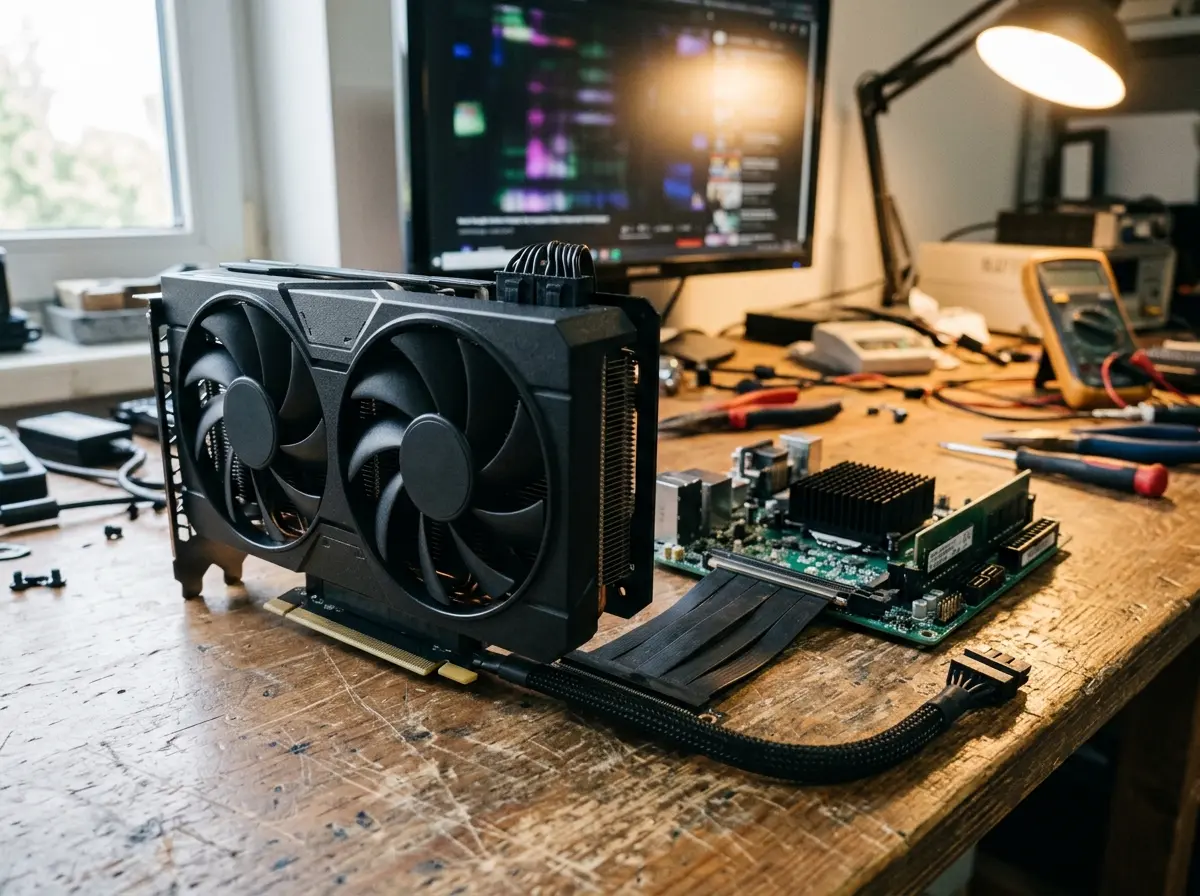
A second modder using the handle RPG-Lover ran the same trick on different hardware entirely: a Radxa Orion O6 board fitted with a full desktop GeForce RTX 2080 Ti. Two unrelated testers, two different Arm chips, one borrowed driver.
Two Rigs, One Leaked Arm64 Driver
Line the two setups up side by side and the improvisation shows. Neither rig was designed by NVIDIA, Huawei or Radxa to do what it just did.
| Detail | Huawei Qingyun W510 Rig | Radxa Orion O6 Rig |
|---|---|---|
| Tester | VoidTech | RPG-Lover |
| Arm processor | Kunpeng 920, 24-core, Armv8.2 | CIX P1 (CD8180), 12-core, Armv9 |
| Graphics card | GeForce RTX 4060 8GB, PCIe 4.0 x8 | GeForce RTX 2080 Ti |
| System memory | 32GB DDR4-2933 | Up to 64GB LPDDR5 (board spec) |
| Notable hurdle | Needed a community ACPI patch just to boot Windows | One of the few Arm boards with a full PCIe x16 slot |
The Kunpeng 920 is not a new chip. HiSilicon, Huawei’s chip design arm, designed it in-house under Huawei’s own Arm license, and it debuted back in 2019 as a data-center part built for Linux, not Windows. That history is exactly why VoidTech needed a patch just to get a desktop operating system running at all before a graphics card entered the picture.
Genshin Impact Struggles to Hold 20 Frames
Nobody is buying this setup for the performance. The Kunpeng 920’s processing cores and Windows’ x64-to-Arm translation layer strangled almost everything that ran.
- Around 20 FPS: Genshin Impact at 1080p, with frequent stuttering according to Tom’s Hardware’s review of the footage.
- 21 FPS average, 3 to 33 FPS range: the Black Myth: Wukong benchmark.
- 23 to 25 FPS: NVIDIA’s own Star Wars Reflections ray tracing tech demo.
- 43,530 / 32,370 / 2,252: native Arm64 3DMark scores in Night Raid, Solar Bay and Speed Way.
Time Spy still had to run through x64 translation rather than natively, and its graphics score came back at 6,369, well under the 10,393 the same RTX 4060 normally hits on x86 Windows. Blender rendered through CUDA with GPU usage reaching about 89 percent, proof the card itself was doing real work even while everything around it struggled.
Not everything launched. Arknights: Endfield refused to start, likely because its Anti-Cheat Expert package cannot tolerate the Prism translation layer needed to run x86 Windows games on Arm, Tom’s Hardware reported. The outlet also noted a stranger wrinkle: VoidTech could never coax a direct video signal out of the RTX 4060 itself, even though the card was clearly doing the rendering underneath.
Why Has Windows on Arm Never Had This Before?
Windows on Arm gaming has belonged to Qualcomm alone for years, because neither NVIDIA nor AMD ever shipped a public Arm64 driver for a standard desktop card, and Arm chips lack the x86 SIMD instructions many PC games expect. RTX Spark is the first crack in that wall.
Windows on ARM has basically been tied to Qualcomm, and Nvidia never released public ARM64 GeForce drivers for normal desktop GPUs. But with RTX Spark, Nvidia now has ARM64 driver work in the wild.
Windows Latest wrote that in the same post covering VoidTech’s test. It is a fair summary of just how closed this platform has been. Qualcomm itself only modernized its side of the equation recently: in November 2025 the company rebranded its beta Adreno tool into the Snapdragon Control Panel and shifted to its own downloadable Arm64 graphics driver, decoupling updates from Microsoft’s OS cycle and finally mirroring how NVIDIA and AMD handle drivers on x86.
The Chip NVIDIA Actually Built This Driver For
None of this driver work exists because NVIDIA wanted hobbyists plugging old GeForce cards into hobbyist motherboards. It exists because of RTX Spark, the system-on-chip NVIDIA announced at Computex 2026 for launch this fall, pairing a 6,144-core Blackwell GPU alongside 20 Grace CPU cores with up to 128GB of unified memory.
ASUS, Dell, HP, Lenovo and MSI all plan laptops and mini PCs built around it. Dell’s entry stands out for including a compact RTX Spark mini PC with a built-in SD card slot, a feature several rival machines skip. NVIDIA’s first Developer Preview driver, version 616.00 alongside a CUDA 13.4 Toolkit preview, targets Microsoft’s fanless Surface RTX Dev Box specifically, so software teams can start porting Arm64 code months before real RTX Spark hardware ships.
NVIDIA’s own release notes call CUDA 13.4 pre-release software not intended for production deployment or benchmarking. Modders ran Genshin Impact on it anyway.
A Driver With No Hardware Leash
Here is what the hack actually proves: NVIDIA’s Arm64 driver recognizes GeForce silicon on its own terms, not because a specific board told it to. Once that code exists, keeping it away from ordinary desktop GPUs becomes a policy decision, not a technical wall.
NVIDIA has little reason to make that decision in the community’s favor. RTX Spark is built and sold as a sealed system-on-chip through OEM partners, not a motherboard platform meant to accept someone else’s graphics card, so there is no product line NVIDIA loses by leaving the workaround alone, and none it clearly gains by blessing it either.
What We Know
- Windows 11 Arm loaded the RTX 4060 driver, flagged it as WHQL certified, and ran DirectX 12, Vulkan and CUDA workloads on it.
- Two independent modders, on two unrelated Arm chips, reproduced enough of the trick to benchmark real games.
- NVIDIA’s public preview still lists only RTX Spark hardware as a supported target.
What’s Unconfirmed
- Whether the RTX 30- and RTX 50-series cards VoidTech hopes to test next behave the same way.
- Whether anti-cheat vendors will ever patch around the Prism translation layer this setup depends on.
- Whether a future NVIDIA driver revision adds hardware checks that quietly close this door.
NVIDIA’s public RTX Spark preview still lists only its own hardware as a supported target, due this fall. Everything running today, on a Huawei workstation or a $200 hobbyist board, is running on code the company never signed off on.
Frequently Asked Questions
Can I put any NVIDIA graphics card in an Arm PC and expect it to work?
Not with anything sold today. Most Windows-on-Arm devices, including nearly every Snapdragon X-based Copilot+ PC laptop, have no PCIe slot for a discrete card at all. This trick only worked because the Huawei workstation and the Radxa board happen to expose a real PCIe connection, something the vast majority of Arm PCs simply do not have.
What exactly is NVIDIA RTX Spark built to do?
Beyond gaming, NVIDIA has said the platform is designed to run AI models with up to 120 billion parameters locally, including agent workloads with context windows as large as 1 million tokens, using its combined Grace CPU and Blackwell GPU design.
Does the same trick work with AMD Radeon cards?
No. Every confirmed case so far uses NVIDIA’s own Arm64 driver on GeForce hardware. AMD has not released any equivalent Arm64 Radeon driver, official or leaked, so there is currently no AMD version of this workaround.
Did NVIDIA authorize any of this testing?
No. NVIDIA’s own documentation lists known issues built for its intended developer audience, including a display that can stay blank for roughly two minutes during installation and possible instability during PyTorch build workflows, none of which were written with Genshin Impact benchmarks in mind.
Will this workaround keep working?
Nobody can say for certain. VoidTech believes the same unified driver could support RTX 20, 30, 40 and 50-series cards beyond the RTX 4060 and RTX 2080 Ti already tested, but because NVIDIA labels the software pre-release, a future update could add checks that block non-Spark hardware entirely.


Workers Still Trust Judgment Over the AI Tools They Use

DigitalOcean’s $894 Million Backlog Rewrites the Old Cloud

Companies Froze Job Design and Called AI a People Problem

AI Capex Looks Unique Because the Chips Wear Out

Samsung Medison’s HERA Z10 Aims at the Sonographer Shortage

GPT-6 Astra Ships as OpenAI’s First Critical Cyber Model

Palms Sells Clean Air Without Ending Casino Smoking

OnlyFans Promo Bots on X Now Pass the Humanity Tests

Datamaran Drops the ESG Label After Winning the Argument

Xiaomi’s Own Chip Lands While Apple Argues Over Color

Oracle Cuts 21,000 Jobs in a Year, Cites AI in 10-K Filing

Fable 5 and Mythos 5 Return as US Lifts Anthropic Export Controls

SpaceX’s Google Deal Turns a Rocket Company Into a Cloud Landlord

CD Projekt Red Co-CEO: Redemption Arc Isn’t Done, Witcher 4 in 2027

XPL Rallies 30% Ahead of Plasma One Card Tier Launch

Google Search Profiles Build a Follow Graph Inside Discover

DGO App Brings Rs 549 Mobile Pass for FIFA World Cup 2026 in Nepal

Moonshot AI Targets $30 Billion in China’s Fastest AI Funding Sprint

Oppo’s ColorOS 17 Eligibility List Leaves A-Series Buyers Behind

Microsoft Xbox Layoffs Start in July as Sharma Slams 3% Margin
-
 AI3 months ago
Oracle Cuts 21,000 Jobs in a Year, Cites AI in 10-K Filing
-
 AI2 months ago
Fable 5 and Mythos 5 Return as US Lifts Anthropic Export Controls
-
 AI3 months ago
SpaceX’s Google Deal Turns a Rocket Company Into a Cloud Landlord
-
 GAMING3 months ago
CD Projekt Red Co-CEO: Redemption Arc Isn’t Done, Witcher 4 in 2027
-
 CRYPTO3 months ago
XPL Rallies 30% Ahead of Plasma One Card Tier Launch
-
 NEWS3 months ago
Google Search Profiles Build a Follow Graph Inside Discover
-
 APPS3 months ago
DGO App Brings Rs 549 Mobile Pass for FIFA World Cup 2026 in Nepal
-
 AI3 months ago
Moonshot AI Targets $30 Billion in China’s Fastest AI Funding Sprint