
AI
Alphabet’s Cloud Soars 82% but Its Own Scientists Wait for Chips
Alphabet’s cloud unit grew 82% and beat every estimate, but the same call revealed Google’s own researchers now queue behind Anthropic and Meta for TPU chips.

Alphabet booked $119.8 billion in revenue and 82% cloud growth for the second quarter, blowing past every Wall Street estimate, and its stock still dropped about 3% in extended trading Wednesday. The reason sat two lines further down the earnings call: a new plan to spend as much as $205 billion on AI infrastructure this year, plus the company’s first quarter of negative free cash flow in its history as a public company.
Buried further into the call was a smaller, stranger admission. Google’s own AI scientists are now waiting behind paying customers, Anthropic and Meta among them, for access to the same chips the company spent a decade building strictly for itself.
Cloud’s Record Quarter Meets a Bigger Bill
Alphabet, Google’s parent company, reported total revenue of $119.8 billion for the April to June quarter, ahead of Wall Street’s $116.9 billion estimate. Advertising revenue, still Google’s largest business, reached $81.6 billion against a forecast of $81.1 billion. Adjusted earnings came in at $2.85 a share, just under the $2.89 analysts wanted.
Google Cloud revenue jumped 82% year over year to $24.8 billion, far past the roughly 64% growth analysts had modeled. That is a sharp acceleration from the 63% growth the division posted just one quarter earlier, off a $20 billion base. The result keeps Google in third place among cloud providers, behind Amazon Web Services and Microsoft Azure, though the gap is closing fast. Some of that momentum is showing up in unexpected places, including a search redesign that has cemented Google’s AI lead even as it squeezes traffic to outside publishers.
| Metric | Q2 2026 Actual | Wall Street Estimate |
|---|---|---|
| Total revenue | $119.8 billion | $116.9 billion |
| Advertising revenue | $81.6 billion | $81.1 billion |
| Google Cloud growth | 82% year over year | About 64% year over year |
| Adjusted EPS | $2.85 | $2.89 |
Shares fell anyway. That extends a rough stretch. Alphabet’s stock had already dropped for three straight months heading into Wednesday’s report as investors weighed AI infrastructure costs against AI infrastructure returns.
Google Starts Selling the Chips It Used to Hoard
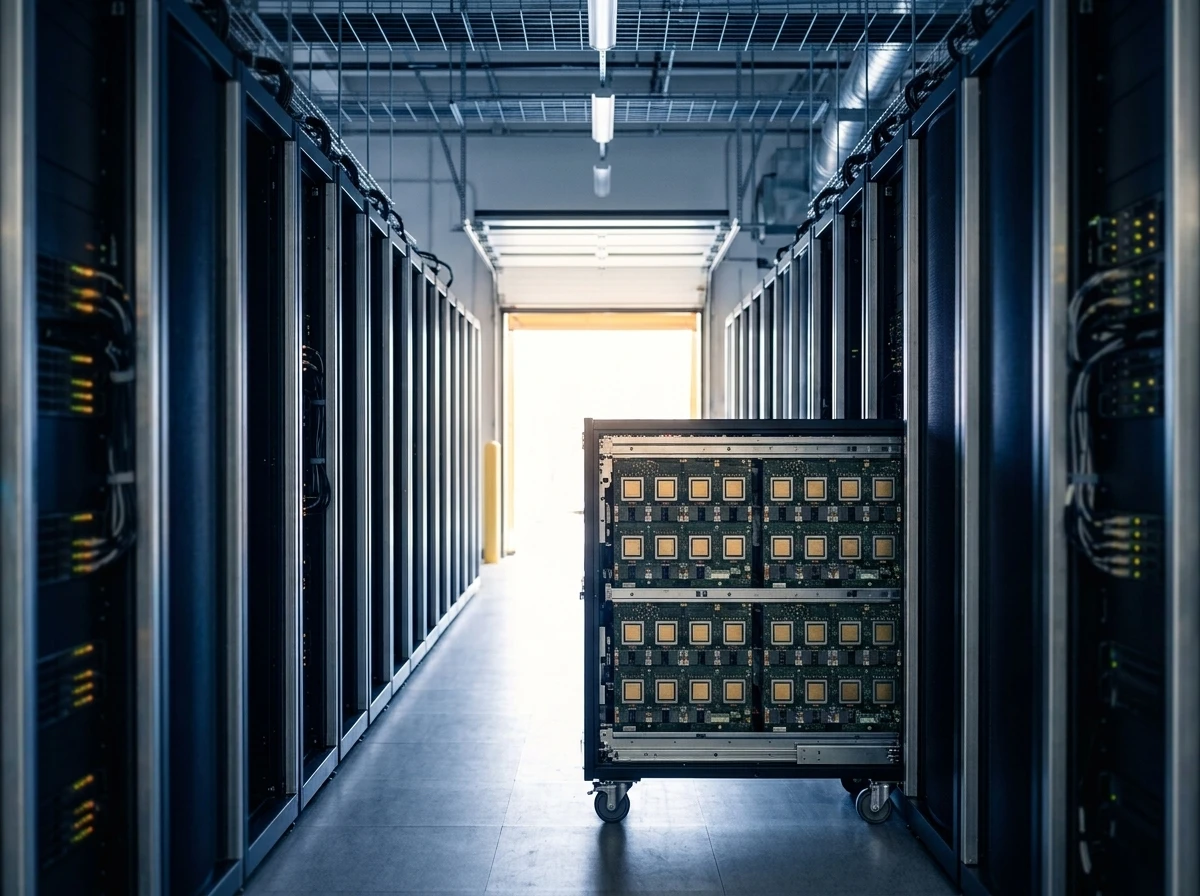
Alphabet recognized revenue from direct sales of Tensor Processing Units, its in-house AI chips, for the first time this quarter. Chief Financial Officer Anat Ashkenazi told analysts most of that revenue is still ahead, landing mostly in 2027 rather than this year.
Google built TPUs for a decade strictly to run its own workloads. That changed on the company’s first-quarter call in April, when CEO Sundar Pichai said Google would begin shipping the chips into select customers’ own data centers, a direct challenge to Nvidia’s grip on AI accelerators. Demand for the hardware is already colliding with Google’s own needs. Pichai told investors in June that enterprise and consumer demand for Google’s AI products is running meaningfully exceeding our available supply.
The customer list moved quickly once Google opened the door.
- Anthropic, the AI lab behind Claude, committed to as many as one million TPUs and multiple gigawatts of capacity, in a deal reported to be worth tens of billions of dollars, with a further expansion agreed in April for capacity arriving in 2027.
- Meta signed its own multibillion-dollar TPU agreement earlier this year, moving a chunk of its AI buildout away from Nvidia hardware.
- OpenAI, Safe Superintelligence and xAI are reportedly in discussions for TPU capacity too, though none of those deals has been confirmed publicly.
Analysts including those at Morgan Stanley estimate TPU hardware sales alone could approach $13 billion in revenue for Google by 2027. That business is also feeding a dependency the market has already noticed elsewhere: a growing list of software makers, including an AI launchpad running through Google’s cloud infrastructure, are building products on top of Google’s compute rather than owning their own.
Waiting Behind Anthropic and Meta
Every one of those outside commitments draws from the same finite pool of chips, wafers and power that Google’s own product teams also need. Bloomberg reported in May that Google’s own AI researchers, including teams inside Google DeepMind, are competing with Anthropic and Meta for access to the TPUs their employer now sells them. Google did not dispute the internal-allocation account on the record, framing the squeeze as an industry-wide condition rather than one unique to the company.
DeepMind chief executive Demis Hassabis has described the bottleneck in two parts. Some of it is hardware, tied to what he called “a few suppliers of a few key components,” with high-bandwidth memory from Samsung, Micron and SK Hynix among the tightest chokepoints. Some of it is scientific: researchers, in his words, “need a lot of chips to be able to experiment on new ideas at a big enough scale.”
Anthropic’s contracts alone lock up more than a gigawatt of TPU capacity this year, expanding into several additional gigawatts starting in 2027. Every chip inside those commitments is one Google’s own model teams cannot use without queuing for what is left.
Is Google Falling Behind on Frontier AI?
Not by Sundar Pichai’s own account, though he conceded ground on one front. Google’s flagship model, Gemini 3.5 Pro, was supposed to strengthen the company’s position in AI coding and autonomous agents. Instead, its launch slipped, and analysts pressed Pichai repeatedly on the call about whether Google can still compete with OpenAI, Anthropic and fast-moving Chinese AI labs.
Pichai did not brush the concern aside. “We’ve had clearly frontier models. There are many attributes on which we are still at the frontier. There are areas where we’ve acknowledged we need to improve; coding and agentic coding is an example of that,” he said.
He added that Google is still testing Gemini 3.5 Pro internally while training on Gemini 4 has already begun, with significant computing resources directed at the next generation. “We are both very committed and very confident of being at the frontier for the next generation,” Pichai said. Google has given no release date for either model.
Neither executive linked the delay to the TPU squeeze on the call. Still, Google’s internal compute is tighter than at any point since the TPU program began selling externally, in the same quarter its flagship coding model missed its expected window.
Capex Climbs to $205 Billion as Cash Flow Turns Negative
Ashkenazi told analysts Wednesday that Alphabet now expects 2026 capital expenditure of between $195 billion and $205 billion, up from the $180 billion to $190 billion range the company had guided just months earlier. She said capacity additions are running ahead of schedule, and demand is still outrunning supply. “We have increased our capacity quite significantly over the past three years. The demand still outpaces that investment,” she said. Ashkenazi also reaffirmed that 2027 capital spending will rise again, significantly.
- 2024: Alphabet spent $52.5 billion on capital expenditures for the full year.
- February 2025: The company guided to about $75 billion in 2025 capex, above Wall Street’s $58 billion estimate.
- July 2025: Alphabet raised that guidance to $85 billion on its second-quarter call, and shares fell despite beating revenue and earnings estimates.
- October 2025: Full-year 2025 guidance moved again, to as much as $93 billion.
- April 2026: Alphabet set initial 2026 guidance at $180 billion to $190 billion.
- July 2026: The company raised 2026 guidance a second time, to $195 billion to $205 billion, and shares fell again.
Alphabet’s own regulatory filings show the buildup in real spending, not just guidance: capital expenditures climbed from $38.3 billion to $63.6 billion over the first nine months of 2024 versus the same span in 2025. That trajectory is what pushed free cash flow negative for the first time, a $5.9 billion shortfall this quarter driven by capital spending rather than a drop in underlying profitability. Adjusted earnings per share stayed positive at $2.85. The company also raised its 2026 capex outlook to $205 billion on the same call where it disclosed the cash burn.
As long as revenue keeps accelerating, investors will tolerate it. But capital has a real cost again, and the room for error is shrinking every quarter.
Thomas Monteiro, senior analyst at Investing.com, said that in reaction to the results.
The Same Selloff, One Year Apart
Wednesday’s report landed almost exactly one year after Alphabet’s last capex surprise. CNBC reported the company’s move to $85 billion in 2025 capital spending on July 23 of last year, the same date this year’s report published, and shares fell both times despite beating revenue and earnings expectations.
The dynamic underneath has not changed. Big Tech firms are expected to spend more than $700 billion on AI infrastructure this year, and Morgan Stanley projects that figure could exceed $1 trillion in 2027. Some of that money is already reshaping adjacent markets, including a wave of energy IPOs chasing AI power demand to feed the same data centers Google and its rivals keep expanding. Google’s cloud business remains the clearest evidence yet that the spending buys something real. Investors priced that trade calmly last July. This year, with cash flow negative for the first time, they priced it with a sharper edge.
Frequently Asked Questions
Why Did Alphabet’s Stock Fall After a Record Quarter?
Alphabet shares had already fallen for three straight months heading into the report as investors grew wary of AI spending. The combination of a bigger capex plan, worth up to $205 billion, and the company’s first negative free cash flow quarter added to that pressure even though revenue and cloud growth beat forecasts.
How Large Is Google Cloud’s Order Backlog?
Google Cloud entered the quarter carrying roughly $462 billion in contracted, not yet recognized revenue, more than five years of the division’s current quarterly run rate, according to Alphabet’s own disclosures. Ashkenazi has said just over half of that backlog should convert into recognized revenue within 24 months, with TPU hardware agreements included in the total.
What Are TPUs, and How Do They Compete With Nvidia?
Tensor Processing Units are custom AI chips Google designed in house, originally built to run its own search, ads and Gemini workloads instead of Nvidia GPUs. Google began selling TPU hardware directly into outside customers’ data centers in 2026, turning a decade of internal infrastructure into a second product line competing head on with Nvidia for large AI labs’ business.
Is Alphabet Still Profitable With Free Cash Flow Negative?
Yes. Negative free cash flow means Alphabet spent more cash on capital projects and operations than it brought in during the quarter, not that the company posted a loss. Adjusted earnings per share were a positive $2.85, and the shortfall traces to the scale of the AI infrastructure buildout rather than weaker underlying profitability.


Workers Still Trust Judgment Over the AI Tools They Use

DigitalOcean’s $894 Million Backlog Rewrites the Old Cloud

Companies Froze Job Design and Called AI a People Problem

AI Capex Looks Unique Because the Chips Wear Out

Samsung Medison’s HERA Z10 Aims at the Sonographer Shortage

GPT-6 Astra Ships as OpenAI’s First Critical Cyber Model

Palms Sells Clean Air Without Ending Casino Smoking

OnlyFans Promo Bots on X Now Pass the Humanity Tests

Datamaran Drops the ESG Label After Winning the Argument

Xiaomi’s Own Chip Lands While Apple Argues Over Color

Oracle Cuts 21,000 Jobs in a Year, Cites AI in 10-K Filing

Fable 5 and Mythos 5 Return as US Lifts Anthropic Export Controls

SpaceX’s Google Deal Turns a Rocket Company Into a Cloud Landlord

CD Projekt Red Co-CEO: Redemption Arc Isn’t Done, Witcher 4 in 2027

XPL Rallies 30% Ahead of Plasma One Card Tier Launch

Google Search Profiles Build a Follow Graph Inside Discover

DGO App Brings Rs 549 Mobile Pass for FIFA World Cup 2026 in Nepal

Moonshot AI Targets $30 Billion in China’s Fastest AI Funding Sprint

Oppo’s ColorOS 17 Eligibility List Leaves A-Series Buyers Behind

Microsoft Xbox Layoffs Start in July as Sharma Slams 3% Margin
-
 AI3 months ago
Oracle Cuts 21,000 Jobs in a Year, Cites AI in 10-K Filing
-
 AI2 months ago
Fable 5 and Mythos 5 Return as US Lifts Anthropic Export Controls
-
 AI3 months ago
SpaceX’s Google Deal Turns a Rocket Company Into a Cloud Landlord
-
 GAMING3 months ago
CD Projekt Red Co-CEO: Redemption Arc Isn’t Done, Witcher 4 in 2027
-
 CRYPTO3 months ago
XPL Rallies 30% Ahead of Plasma One Card Tier Launch
-
 NEWS3 months ago
Google Search Profiles Build a Follow Graph Inside Discover
-
 APPS3 months ago
DGO App Brings Rs 549 Mobile Pass for FIFA World Cup 2026 in Nepal
-
 AI3 months ago
Moonshot AI Targets $30 Billion in China’s Fastest AI Funding Sprint