
NEWS
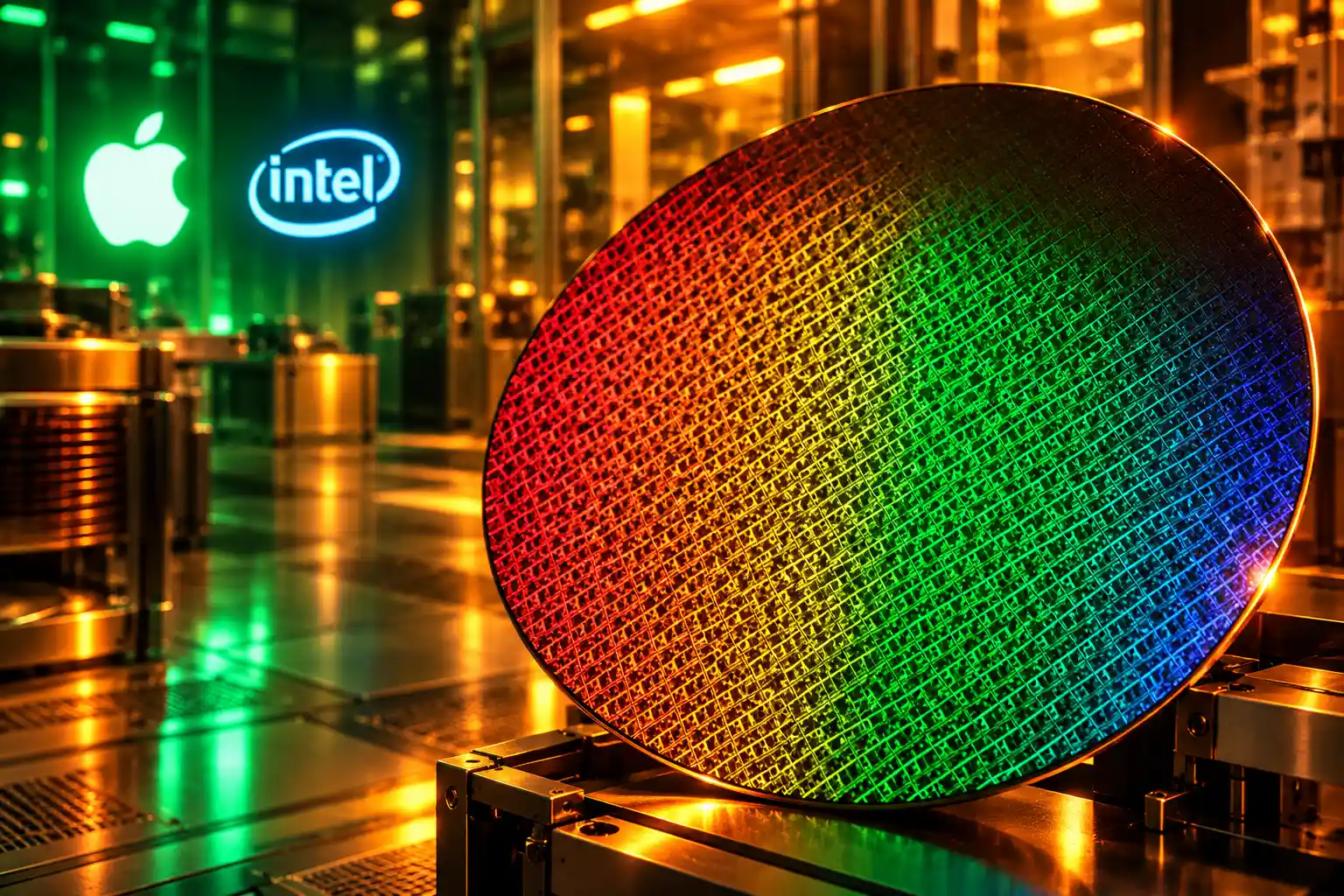
Apple’s Intel Chip Talks Serve Washington More Than iPhone
A preliminary Apple-Intel foundry pact would put Washington’s 9.9 percent Intel stake in the room, while TSMC still makes the new iPhone’s 2nm chips.

Apple and Intel reached a preliminary deal in May for Intel to make some Apple-designed chips, and neither company has confirmed it. Commerce Secretary Howard Lutnick had spent a year pushing Apple toward those factories. The new iPhone 18 Pro, iPhone 18 Pro Max, and iPhone Duo still ship with A20 Pro chips built on TSMC’s 2nm process.
The talks do not put Intel processors back in the iPhone. They test whether a U.S. foundry the government already owns can take overflow work TSMC no longer prices as its tightest capacity.
Intel Would Fab Chips Apple Designed
People familiar with the talks said the two companies spent more than a year on the file and hammered out a formal pact in the months before May 8, 2026. Apple and Intel both declined to comment. The people said Intel would make some of the chips that power Apple devices, and they did not name the products. Apple ships more than 200 million iPhones a year, plus iPads and Macs, so even a thin slice of that mix would be a landmark external order for Intel Foundry.
Intel shares jumped 15 percent on the report. That move priced a customer logo, not a shipping chip. The work, if it holds, is a foundry contract: Apple would still design the silicon, and Intel would run the wafers. That is the inverse of the old Mac relationship, when Intel designed the processors and Apple bought them as finished parts.
WHAT WE KNOW
- The pact: People familiar with the talks described a preliminary deal in May for Intel to make some chips that power Apple devices.
- The silence: Apple and Intel both declined to comment, and no volumes, fabs, or product names were disclosed.
- The politics: People familiar with the talks said Lutnick met repeatedly with Tim Cook, Elon Musk, and Jensen Huang to push Intel foundry work.
WHAT IS UNCONFIRMED
- The SKUs: Which iPhone, iPad, or Mac chips would run at Intel, and whether any flagship A-series part ever would.
- The start date: When qualified volume would leave an Intel line, as opposed to test wafers.
- The bind: Whether the May pact is a paid production contract or a process that can still stall on yields.
Supply-chain analyst Ming-Chi Kuo later said Apple had started low-end and legacy iPhone, iPad, and Mac processors at Intel on the 18A-P series with Foveros packaging, with an order mix of roughly 80 percent iPhone. Other analysts described a much slower clock. Futurum Group chief executive Daniel Newman put volume production of Apple-designed chips in late 2027 or early 2028, with early work aimed at less critical MacBook Air or iPad Pro parts. Malcolm Penn, chief executive of Future Horizons, said the best case was still two to three years before the first chips flowed at volume, because a system-on-chip of this class takes about two years to design and another four months to ramp.
Washington’s 9.9% Stake Sat in the Room
The hidden party in the May talks already sits on Intel’s register. In August 2025 the United States turned unpaid industrial grants into equity and became Intel’s largest holder, a 9.9 percent stake, with no board seat and a pledge to vote with the board. People familiar with the talks said that stake, and Lutnick’s meetings, helped bring Apple to the table.
WHO WROTE CHECKS INTO INTEL IN 2025
| Buyer | Amount | Terms |
|---|---|---|
| United States | $8.9 billion | 9.9 percent stake, converted grants, passive holder |
| Nvidia | $5 billion | Equity stake in September |
| SoftBank | $2 billion | Common stock at $23 a share in August |
Intel’s own winter note described the U.S. piece as an $8.9 billion investment in Intel common stock, funded by $5.7 billion in unpaid CHIPS and Science Act grants and $3.2 billion from the Secure Enclave program. Add the $2.2 billion in CHIPS grants Intel had already received and the federal total is $11.1 billion. Nvidia’s $5 billion and SoftBank’s $2 billion arrived in the same season. Those are separate commercial bets, not foundry purchase orders, and they still changed who had an interest in seeing Intel’s factories fill.
Chief executive Lip-Bu Tan has refused to name foundry customers, a habit he dates to his years running Cadence. At Computex in Taipei on June 2 he told analysts to watch capital spending instead. When Intel starts equipping fabs and lifting capex, he said, customers are locked in. That is a useful tell in a year when he also said he expects several foundry commitments in the second half of 2026, a window that is still open.
Record August Sales, and the iPhones Inside Them
Four months after the Intel headlines, TSMC is still the factory that shows up in Apple’s new phones. On September 10 the foundry posted August revenue of NT$514.81 billion, up 10.1 percent from July and 53.3 percent from August 2025. Sales for January through August reached NT$3,386.87 billion, up 39.3 percent from the same stretch a year earlier. TrendForce, which tracks wafer foundry share, put TSMC at 72.5 percent of the pure-play market in the second quarter, up from 72.3 percent in the first, with Samsung at 5.9 percent and SMIC at 5.4 percent. It also tied part of the August run to the first revenue from 2nm and to inventory build for new iPhones.
Those iPhones are not a footnote. TSMC’s 2025 figures showed Nvidia at 19 percent of its revenue and Apple at 17 percent, the year Nvidia passed Apple as the largest customer. Creative Strategies analyst Ben Bajarin has separately estimated Apple and Nvidia together could account for about 40 percent of TSMC revenue in 2026. AI servers now set TSMC’s mix and its prices. Phone chips still fill a lot of wafers, and they no longer sit at the front of the line.
WHERE APPLE SILICON IS MADE NOW
| Chip / product | Foundry | Status |
|---|---|---|
| A20 Pro in iPhone 18 Pro, Pro Max, and iPhone Duo | TSMC | 2nm, on sale |
| In-house C-series 5G modem, including 2nm orders | TSMC | Kept at TSMC amid the Intel talks |
| Low-end and legacy A- and M-series parts, per Kuo | Intel Foundry | 18A-P tests in 2026, ramp described for 2027 |
| Intel-designed Mac CPUs | None | Apple silicon replaced them; last Intel Macs left the lineup in 2023 |
Cook said on Apple’s most recent earnings call before the May report that iPhone sales had been held back by supply limits at a contract manufacturer. That complaint is about wafers and packaging, not about Intel’s old x86 cores. It is also the opening Intel needed: a customer that still wants TSMC’s leading node, and that now wants a spare line for the chips it can afford to qualify more slowly.
Why Apple Would Give Intel Any Wafers
Apple did not reopen Intel because the 18A node already matches TSMC’s 2nm on the parts that sell the iPhone. Chip analyst Ben Bajarin said Apple is likely to wait for 18A-P, the tuned follow-on, before it commits manufacturing. The case for giving Intel any wafers is uglier than a spec sheet, and it has three parts that stack.
WHY A SECOND FOUNDRY GETS A LOOK
- Capacity, not clocks: Nvidia, AMD, and the cloud builders have absorbed TSMC’s advanced lines, so Apple is bidding against AI silicon for the same tools.
- A U.S. spare: Almost all of Apple’s leading-edge making still sits in Taiwan, and the administration that owns 9.9 percent of Intel spent a year asking U.S. chip buyers to feed those Arizona and Oregon plants.
- A bargain chip: Older iPhone and Mac parts do not need the newest TSMC node, and a second foundry is a lever on price even if it never wins a Pro chip.
Industry operators in Taiwan have been blunt about the same split. The chips that can move are the low-volume, low-end, non-core parts, a way to show an American factory without betting a flagship launch on a new yield curve. TSMC can live with that. Losing overflow work eases political heat and antitrust talk while it keeps the dies that actually set iPhone cameras, battery life, and launch-day supply. Liu Pei-chen, who directs the industry and economy database at the Taiwan Institute of Economic Research, has said TSMC’s packaging, yields, and delivery record still make it Apple’s first choice for core chips, and that Intel and Samsung look more like a strategic reserve than a replacement.
18A-P Is the Process Apple Is Waiting On
Intel put a date on that reserve on June 16, 2026. At the VLSI Symposium it said 18A-P has entered risk production, on the timeline it had given customers a year earlier. Risk production is the early run that has to prove a node can meet a customer’s spec before anyone books volume. Base 18A already went into production in 2025. Panther Lake, the first consumer chip on that node, showed up at CES 2026, and Intel has been making 18A at volume in Arizona since December.
Our updates and presentations at VLSI signal to Intel Foundry customers and partners that we are fully committed to leading edge process innovation over the long term. This is a journey, and while we have more work ahead, we appreciate the opportunity to share the progress we are making with Intel 18A-P and our longer-range R&D.
Naga Chandrasekaran, executive vice president and general manager of Intel Foundry, June 16, 2026
The node Intel is selling into those talks is a refinement, not a clean sheet. Intel says 18A-P delivers 9 percent higher performance at the same power as 18A, or 18 percent lower power at the same performance, with thermal resistance improved 20 to 40 percent and via resistance cut 10 to 30 percent. It is fully design-rule compatible with 18A, so a customer can reuse IP and design flows. For Apple, that compatibility is the whole pitch: a second factory that does not force a full redesign of an M-series or A-series die just to qualify a spare line.
One hard limit sits underneath the slides. Intel’s high-volume muscle is still x86. Apple’s custom chips, like Google’s and Amazon’s, run on Arm. A foundry can print Arm if the process, the libraries, and the yields are there. It cannot bluff those things with a CPU brand. Tan’s own rule, that customers stay unnamed until the tools are ordered, is an admission that the May logo rally ran ahead of that proof.
Apple Spent Years Walking Away From Intel CPUs
The foundry file is a reunion only if you ignore what Apple spent the last decade doing to Intel’s other businesses. In 2019 Apple bought Intel’s smartphone modem unit for $1 billion and took on about 2,200 engineers. The first fruit of that deal, the C1 modem, shipped in the iPhone 16e in 2025, and Apple has kept the follow-on 2nm modem orders at TSMC even while it talks to Intel about other silicon. In 2020 it began moving the Mac from Intel processors to its own Arm chips. The last Intel iMac arrived in August 2020. The last Intel Macs left the lineup in 2023.
On September 3, 2026, Apple told Mac App Store developers they can now ship Apple-silicon-only builds for apps that need macOS 13 or later. macOS 27 is set as the last system release that still carries Intel Macs, and Rosetta 2 is scheduled to go away after that. The same company that is qualifying Intel as a factory is telling software partners the Intel Mac is done.
THE APPLE-INTEL CLOCK
- June 2005: Apple announces the Mac will move from PowerPC to Intel processors.
- 2019: Apple buys Intel’s smartphone modem business for $1 billion and hires about 2,200 engineers.
- June 2020: Apple announces Apple silicon for the Mac and begins the exit from Intel-designed CPUs.
- 2023: The last Intel Macs leave Apple’s lineup.
- August 2025: The United States takes a 9.9 percent passive stake in Intel by converting unpaid grants.
- May 8, 2026: People familiar with the talks describe a preliminary pact for Intel to make some Apple-designed chips.
- June 16, 2026: Intel says 18A-P is in risk production.
- September 2026: iPhone 18 Pro, Pro Max, and iPhone Duo ship with TSMC 2nm A20 Pro chips, and Apple lets developers drop Intel Mac support.
That sequence is why a headline about Apple “buying Intel chips” misses the mechanism. Apple already tried Intel as a modem vendor and as a CPU vendor. It kept the engineers and dumped the products. What it might buy now is wafer starts in Arizona, on a process Intel is still qualifying, for chips Apple already knows how to design at TSMC.
Low-End Wafers First If They Come at All
Kuo’s wafer plan, if it is right, is a process-node lifecycle rather than a takeover. He described small-scale testing in 2026, a ramp in 2027, further growth in 2028, and a decline in 2029 as 18A-P ages out, with Apple also looking at Intel’s later nodes. That path only works if yields hold once the lots get larger. Intel has missed that test before, which is why Apple’s flagship phones can sit on TSMC 2nm in September while the Intel file is still a test plan.
Tan has called the foundry a national treasure and said outside customers have started asking him to open 18A after watching Panther Lake ship. Microsoft and Amazon have already been named around 18A work in industry briefings, and Tesla has been tied to the later 14A node. An Apple logo would still be the one that tells every other fabless shop the process is safe for a consumer launch. It would not, on the evidence of this iPhone cycle, take the dies that actually make the device.
The next public signal is not a teardown of an iPhone 18. It is whether Intel’s capital budget rises in the second half of 2026, the tell Tan offered when he would not name names. Until those tools are ordered, Washington has a paper second source, TSMC has the phones, and Apple has an option it has not yet had to exercise.

Instagram Plus Tests a Read-Only Mode That Cuts Stories

Altman Asks the Public to Accept Some AI Harm

Google Freezes OSS VRP Product Reports After AI Flood

AI Agents Make Payment Rails the Scarce Prize

Turkey’s Crypto Boom Now Runs Through Three Banks

Fable 5 Came Back Under a Commerce On-Off Switch

Google’s SpaceX GPU Lease Has a Sept. 30 Deadline

Plasma One’s XPL Locks Face a 1.81 Billion Cliff

DGO’s Rs 549 World Cup Pass Cost Fans Sleep and Data

Moonshot AI’s $30 Billion Ask Became a $35 Billion Close
-
 AI4 months ago
Fable 5 Came Back Under a Commerce On-Off Switch
-
 AI5 months ago
Google’s SpaceX GPU Lease Has a Sept. 30 Deadline
-
 CRYPTO4 months ago
Plasma One’s XPL Locks Face a 1.81 Billion Cliff
-
 APPS4 months ago
DGO’s Rs 549 World Cup Pass Cost Fans Sleep and Data
-
 AI5 months ago
Moonshot AI’s $30 Billion Ask Became a $35 Billion Close
-
 NEWS5 months ago
ColorOS 17 Device List Spans Oppo, OnePlus and Realme
-

 GAMING4 months ago
Xbox Cuts 3,200 Jobs After Five Years of Thin Returns
-
 GAMING4 months ago
The RTX 4050 Under Rs 70,000 Hides a Wattage Gap