
NEWS
Apple’s A20 Pro Ships at $1,199 After the 18% Leak
The 18% A20 Pro leak tracked a TSMC node slide. Apple shipped a 40% faster GPU at $1,199 and ate a 38% BOM jump driven by DRAM.

Apple priced the iPhone 18 Pro at $1,199 with an A20 Pro chip it rates 40% faster in graphics than the A19 Pro. A pre-event leak had put the same chip at about 18% faster and the phone at $1,399.
On September 9, 2026, Apple put that 2-nanometer part on stage at its Surprise and Shine event. Pre-orders opened September 12. Phones arrive in stores September 18.
The 18% Figure Was a Foundry Slide
Weibo tipster Fixed Focus Digital had said the A20 Pro would land around 18% faster than the A19 Pro and use up to 30% less power, on TSMC’s new gate-all-around process. Those two numbers travel together on foundry slides. They do not travel together on a finished iPhone chip.
TSMC’s own N2 card, issued when the node was still a 2025 target, offered a 10-15% speed improvement at the same power, or 25-30% less power at the same speed, plus nanosheet transistors. You pick speed or you pick power. You do not get both tops of the range as a product spec.
The leak treated the trade as a stack: 18% more performance and 30% less power, then a fatter bill of materials. Apple never published a chip-level 18% or a chip-level 30%. It published a 7-core GPU, a second Neural Engine, 50% more memory bandwidth, and a vapor chamber with three times the area of the iPhone 17 Pro’s.
GAA still matters. N2 is TSMC’s first nanosheet node, the shift off FinFET. That is the process under the A20 Pro. It is not the scoreboard Apple read out on September 9.
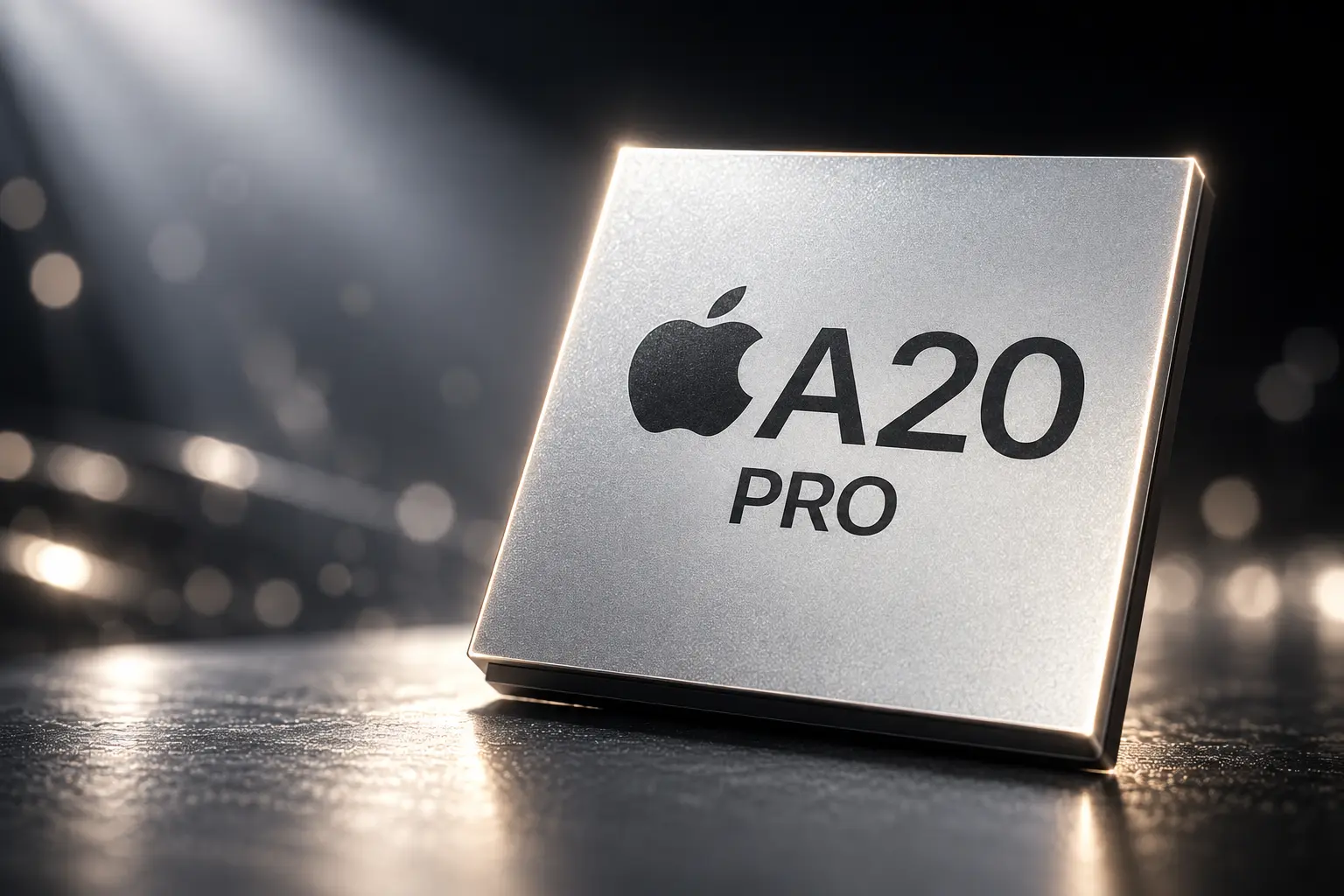
What Apple Claimed for the A20 Pro
Apple’s newsroom copy is the working spec. The A20 Pro is a 2-nanometer, 6-core CPU with two super cores and four efficiency cores, a 7-core GPU, and a Dual 16-core Neural Engine (32 cores, double the A19 Pro). Apple said the GPU is up to 40% faster than the A19 Pro and that the chip has 50 percent more memory bandwidth. On stage, Apple also said the two super cores are up to 20% faster and called them desktop class.
Sribalan Santhanam, vice president of Apple’s silicon engineering group, walked the 40% graphics claim during the event. Greg Joswiak, Apple’s senior vice president of Worldwide Marketing, tied the chip to camera, battery, and on-device intelligence rather than to a single CPU percentage.
THE LEAK VERSUS THE CHIP APPLE SHIPPED
| Metric | Pre-event leak | TSMC N2 node | Apple A20 Pro |
|---|---|---|---|
| Peak speed | About 18% higher | 10-15% at the same power | Super cores up to 20% faster; GPU up to 40% faster |
| Power | Up to 30% less | 25-30% less at the same speed | No chip-level %; 36 hours of video on the Pro |
| AI block | Not stated | Not a node claim | Dual 16-core Neural Engine, 2x AI compute |
| Memory bandwidth | Not stated | Not a node claim | 50% more than A19 Pro |
| Phone start price | $1,399 | Not a node claim | $1,199 for 256GB |
The extra GPU core is the cleanest product change. The A19 Pro used six GPU cores. The A20 Pro uses seven, with new neural accelerators Apple says double FP8 throughput for on-device models. The Neural Engine is no longer a single 16-core block. It is two 16-core engines sharing the same 32-core total.
Apple’s first 2nm silicon was the M6, announced in August for a Mac mini later in September. The A20 Pro is the first of those transistors in an iPhone. Apple also put the chip in the iPhone 18 Pro Max and the iPhone Duo.
Super Cores Near 5 GHz in Early Geekbench
A Geekbench 6 listing that circulated on September 10 posted a 4,719 single-core Geekbench 6 result and 12,677 multi-core for an iPhone 18 Pro. A paired iPhone 18 Pro Max listing landed at 4,725 single-core and 12,575 multi-core. The smaller phone won the multi-core run by a hair.
Against a 3,905 single-core score logged for the iPhone 17 Pro Max’s A19 Pro, that 4,719 listing sits about 21% higher. That is in the same band as Apple’s 20% super-core claim, and it is not the 18% the leak advertised. The same listing shows a 4.93 GHz peak, about 16% above the A19 Pro’s 4.26 GHz.
These are one-run listings on units that are not yet in reviewers’ labs. Geekbench 6 is a burst test, so it does not speak to the 40% sustained figure Apple attached to the new vapor chamber. Independent reviews start after September 18.
Spec sheets list 12GB of memory on every iPhone 18 Pro storage tier. Apple did not print a RAM figure in the newsroom note. It printed the 50% bandwidth claim and called the interface the widest it has shipped in an iPhone.
The Vapor Chamber Does the Other 40%
Apple split the 40% language on purpose. Graphics are “up to 40 percent faster than A19 Pro.” Sustained performance is a separate “up to a 40 percent gain,” and it is a packaging story. The A20 Pro sits beside its memory instead of under it, in a layout Apple said is inspired by M-series chips, so the die can sit on the vapor chamber. That chamber has three times the surface area of the iPhone 17 Pro’s.
The 7-core GPU with Neural Accelerators only holds a 40% graphics claim if the phone can dump heat. Apple’s own comparison runs the other way too: 40% more sustained performance versus the A19 Pro in the iPhone 17 Pro, and twice the sustained performance versus the A18 Pro in the iPhone 16 Pro.
Battery is the public test of that efficiency. eSIM-only iPhone 18 Pro models are rated for up to 36 hours of video playback, and the Pro Max for 45 hours. Apple’s typical-use figures are 24 hours on the Pro and 30 hours on the Pro Max. Wired charging is rated to 50% in around 15 minutes on the Pro.
A20’s 2nm efficiency plus improved vapor chamber means biggest battery claims for iPhone yet: 18 Pro should be same as 17 Pro Max. And 18 Pro Max should be ‘30 hours of usage’ and charges faster: 50% in 15 minutes. Not ground breaking, but definitely welcome
Marques Brownlee, YouTube reviewer, on X
Apple’s own page puts the 15-minute 50% charge on iPhone 18 Pro, not as a Pro Max exclusive. The 30-hour typical-use figure is the Pro Max number. Side-by-side photos of the iPhone 17 Pro and iPhone 18 Pro have been circulating as a camera and body argument, which is why the silicon case has to be made with the GPU, the second Neural Engine, and those battery hours, not with an 18% CPU leak.
The Pro also picks up Apple’s C2 modem, which Apple said uses 15% less energy than C1X, with faster uploads and mmWave in the United States. An N1 chip handles Wi-Fi 7, Bluetooth 6, and Thread.
DRAM, Not 2nm, Took Over the Build Cost
The leak was right that the phone got more expensive to build. It pointed at the wrong line item. TrendForce, in an August 10 note, put an about 38% higher BOM cost on the 256GB iPhone 18 Pro versus the 256GB iPhone 17 Pro. Memory, not the application processor, did that.
WHAT MEMORY DID TO THE 256GB BILL
- Year-ago share: Memory was around 10% of the 256GB Pro bill of materials.
- 3Q26 share: TrendForce puts memory at about 34% of the iPhone 18 Pro’s BOM.
- 1H27 share: The same note says that share is expected to exceed 40%.
- Year-on-year build cost: The 256GB model is estimated about 38% more expensive to build than last year’s Pro.
- Apple’s lever: TrendForce said Apple may cut gross margin to keep the sticker from jumping in line with that 38%.
A year ago the processor and the display were the expensive parts. In this cycle they are not. TrendForce said Android brands, with thinner margins, will have to pass more of the memory spike through to retail, or kill models that slip into negative gross margin. Global smartphone production, in that view, stays under pressure from the second half of 2026 into 2027.
That is the cost story the 2nm rumor was used to tell, and it is mostly a DRAM story. The A20 Pro is still a dear piece of silicon. It is not 34% of the phone.
Why the iPhone 18 Pro Starts at $1,199
Apple listed the iPhone 18 Pro 256GB at a $1,199 purchase price, $100 above the iPhone 17 Pro’s $1,099 start. The iPhone 18 Pro Max starts at $1,299. The $1,399 figure that floated all summer is the 512GB Pro’s listed price, not the entry ticket.
IPHONE 18 PRO US PRICES
| Configuration | Listed price |
|---|---|
| iPhone 18 Pro 256GB | $1,199 |
| iPhone 18 Pro 512GB | $1,399 |
| iPhone 18 Pro 1TB | $1,799 |
| iPhone 18 Pro 2TB | $2,399 |
| iPhone 18 Pro Max 256GB | $1,299 |
That $1,199 start is $200 under the $1,399 rumor. It is also $100 above the Pixel 11 Pro’s $1,099 starting price. Apple kept the round $100 step and, if TrendForce is right, ate the rest of a 38% build-cost jump in margin. Storage still runs through 2TB on both Pro models. Finishes are black, silver, glacier, and burgundy. The 6.3-inch Pro panel is a 2622-by-1206 OLED, and the phone weighs 211 grams.
The 18% leak had priced the node. Apple priced the product.
iPhone Duo Runs the Same 2nm Chip
The A20 Pro is not a Pro-only tax in the way a 2nm shortage story would have implied. Apple put the same chip in the iPhone Duo, the foldable it announced on the same day. The Pro and Pro Max Geekbench listings already sit on top of each other. The foldable gets the same 6-core CPU, 7-core GPU, and dual Neural Engine, which is the capacity tell: TSMC’s N2 allocation for Apple is large enough to cover a new form factor, not only the two glass slabs.
The 2026 flagship comparison with Pixel 11 will be fought on camera and on that $100 gap, because peak CPU is no longer the argument that sells an iPhone. On-device models, a 40% GPU claim, and 36 hours of video are. Independent tests of those claims start when units ship September 18.
Pre-orders have been open since September 12. The A20 Pro is no longer a Weibo percentage. It is a $1,199 phone with a 7-core GPU, a second Neural Engine, and a vapor chamber that Apple says is the reason the other 40% holds.

Instagram Plus Tests a Read-Only Mode That Cuts Stories

Altman Asks the Public to Accept Some AI Harm

Google Freezes OSS VRP Product Reports After AI Flood

AI Agents Make Payment Rails the Scarce Prize

Turkey’s Crypto Boom Now Runs Through Three Banks

Fable 5 Came Back Under a Commerce On-Off Switch

Google’s SpaceX GPU Lease Has a Sept. 30 Deadline

Plasma One’s XPL Locks Face a 1.81 Billion Cliff

DGO’s Rs 549 World Cup Pass Cost Fans Sleep and Data

Moonshot AI’s $30 Billion Ask Became a $35 Billion Close
-
 AI4 months ago
Fable 5 Came Back Under a Commerce On-Off Switch
-
 AI5 months ago
Google’s SpaceX GPU Lease Has a Sept. 30 Deadline
-
 CRYPTO4 months ago
Plasma One’s XPL Locks Face a 1.81 Billion Cliff
-
 APPS4 months ago
DGO’s Rs 549 World Cup Pass Cost Fans Sleep and Data
-
 AI5 months ago
Moonshot AI’s $30 Billion Ask Became a $35 Billion Close
-

 NEWS5 months ago
ColorOS 17 Device List Spans Oppo, OnePlus and Realme
-

 GAMING4 months ago
Xbox Cuts 3,200 Jobs After Five Years of Thin Returns
-
 GAMING4 months ago
The RTX 4050 Under Rs 70,000 Hides a Wattage Gap