
PHONES
Pixel 11 vs iPhone 18 Pro: How to Choose the Right Phone
Pixel 11 vs iPhone 18 Pro splits into two buys: $899 for the base Pixel, $1,099 for the Pro that matches the camera class, and $1,199 for the 2nm iPhone.

You are comparing Google’s more affordable Pixel with Apple’s Pro iPhone, and the two names in that search are not the same class of phone. One is the base model in its family. The other is the high-end model. This guide sorts launch price, the chip, the screen, the battery, the cameras, and software support so you can pick the handset that fits how you already take photos and how long you keep a phone.
Match the tier before you match the brand. The Pixel 11 is the phone to price when you want Google for less. The Pixel 11 Pro is the Google phone that sits nearest the iPhone 18 Pro on camera and screen. The sections below show what you give up, and what you keep, at each step.
What Do the Pixel 11 and iPhone 18 Pro Cost?
Launch stickers, not this week’s sale price, are the fair place to start. Those starting prices come from Google’s Pixel 11 series announcement on August 12, 2026, and from Apple’s pricing on September 9, 2026. Google put the phones on shelves on August 20. Apple opened pre-orders on September 12 and store sales on September 18. Every price below is the US starting price for 256 GB, before tax and before a trade-in.
| Launch detail | Pixel 11 | Pixel 11 Pro | iPhone 18 Pro |
|---|---|---|---|
| US start price | $899 | $1,099 | $1,199 |
| Storage at that price | 256 GB | 256 GB | 256 GB |
| RAM at that price | 12 GB | 12 GB | Not published by Apple |
| Top storage | 512 GB, still 12 GB RAM | 1 TB with 16 GB RAM | 2 TB |
| On sale | August 20, 2026 | August 20, 2026 | September 18, 2026 |
The sticker gap between the base Pixel and the iPhone 18 Pro is $300. On the Pixel 11 Pro, 16 GB of RAM shows up only when you buy 512 GB or 1 TB. The 256 GB Pro stays at 12 GB. Apple does not print a RAM capacity for the iPhone 18 Pro, so storage is the split you can actually shop: 512 GB on the base Pixel, 1 TB on the Pixel 11 Pro, and 2 TB on the iPhone.
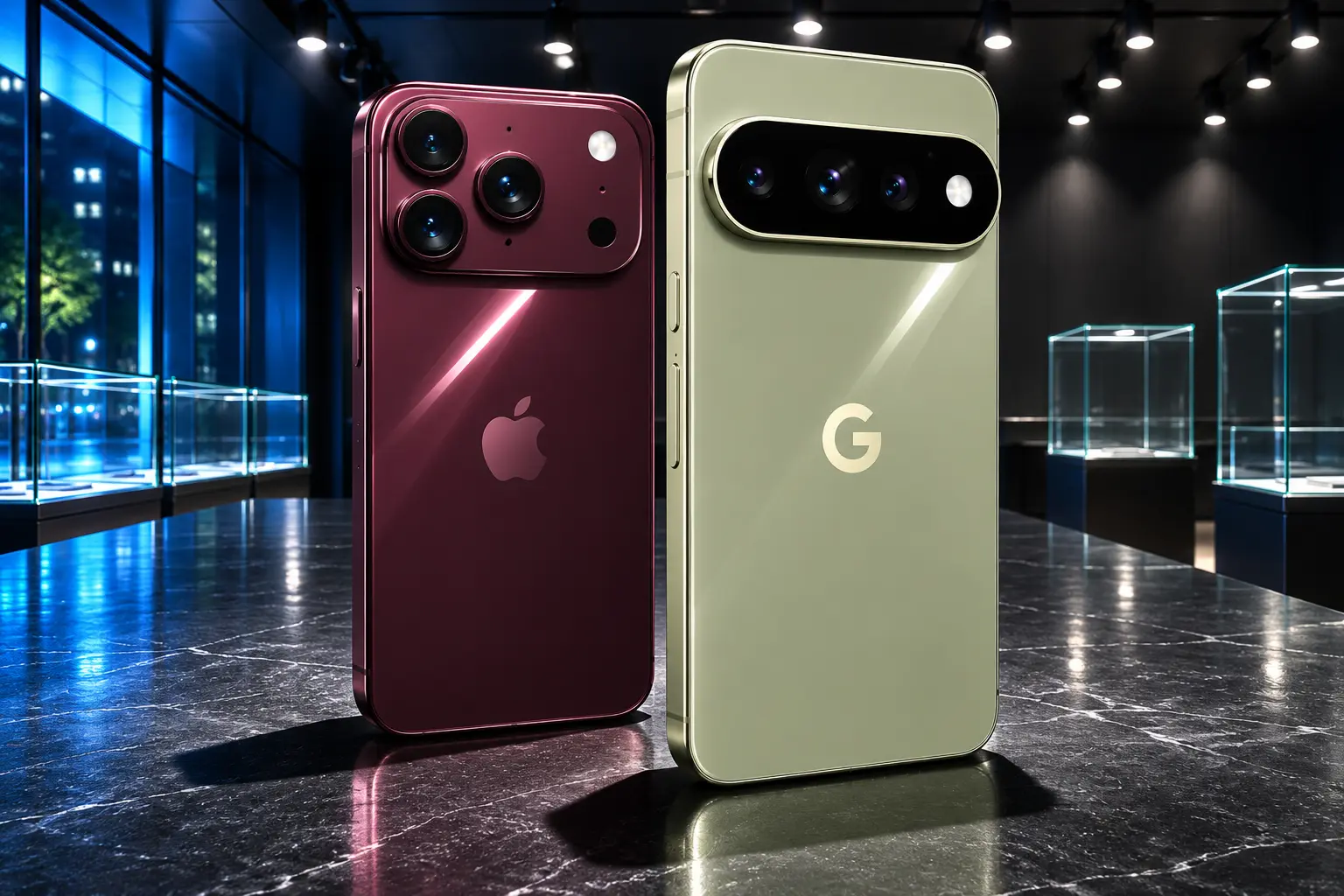
Which Pixel Lines Up With the iPhone 18 Pro?
Put the $899 Pixel 11 beside the iPhone 18 Pro when your question is what you can buy for less. Put the Pixel 11 Pro beside it when your question is which Google phone matches the Pro camera and the brighter screen. Both Pro-class phones use a 6.3 inch display. The Pixel 11 Pro adds a larger main sensor, a 48 MP telephoto, and HiLight, the lights around the flash that signal a call or a Gemini prompt while the phone lies face down.
Read the $1,099 Pixel 11 Pro as its own purchase, $100 under the iPhone at launch, before you treat the base Pixel as the whole Google side of this matchup. The larger Pixel 11 Pro XL starts at $1,299, the same sticker as the iPhone 18 Pro Max, so the big-phone pair is a tie on price and a different size conversation.
WHO EACH STICKER PRICE FITS
- The $899 phone: You want a new Pixel with a 5x telephoto and you can live with a 1080p screen.
- The $1,099 phone: You want Google’s Pro camera, the brighter panel, and a price $100 under the iPhone.
- The $1,199 phone: You want iOS, storage past 1 TB, and the variable-aperture camera.
Once the sticker matches the tier you actually meant, the next difference is the chip you never see printed on the glass.
How Do the Tensor G6 and A20 Pro Differ?
Both companies design the chip and have TSMC build it, and that is where the shared story ends. The A20 Pro is a 2nm chip in Apple’s announcement of the A20 Pro. TSMC’s 2nm N2 process page says that node, the foundry’s first nanosheet process, entered volume production in the fourth quarter of 2025. Google’s spec sheet does not name a node for Tensor G6. Peng Yu-chun, a Google vice president of hardware, has said the chip uses TSMC’s N3P, a 3nm process, the same broad generation as the previous Tensor rather than Apple’s jump.
You feel that gap in long sessions and in on-device AI, not in a logo on the back. Each maker’s speed claims are also aimed at its own last chip, so they cannot be stacked into one score.
| Chip claim | Tensor G6 | A20 Pro |
|---|---|---|
| Process | Not on the spec sheet; described by Google’s hardware VP as TSMC N3P (3nm) | 2nm |
| Versus the previous chip | 25% faster browsing, 15% quicker app launches, 50% more TPU compute, on-device AI up to 3.5 times faster and up to 3.5 times less energy, all versus Tensor G5 | 50% more memory bandwidth, 7-core GPU up to 40% faster, 32-core Neural Engine with double the AI processing, all versus A19 Pro |
| CPU | Not listed as a core count on the spec sheet | 6 cores: 2 super cores and 4 efficiency cores |
| Cooling | Not described as a vapor chamber on the spec sheet | Vapor chamber with 3 times the surface area of the iPhone 17 Pro, rated up to 40% higher sustained performance |
Packaging sits under that sustained figure. Apple places the A20 Pro die beside the memory so the chip can touch the vapor chamber directly, instead of leaving memory stacked on the hot part of the silicon. Long games and video exports are where that shows up, after a short benchmark has already finished.
How Do Size, Screen, and Battery Compare?
All three are compact flagships, and the gram count is what you notice in a pocket. Google says the Pixel 11 camera bar is 40 percent thinner than on earlier base Pixels, so a cased phone sits flatter on a table. Glass and metal differ too: Gorilla Glass Victus 2 on the Pixel 11, the same glass plus an anti-scratch shield on the Pro, and Ceramic Shield 2 on the iPhone’s front with Ceramic Shield on an aluminum unibody back.
| Body and power | Pixel 11 | Pixel 11 Pro | iPhone 18 Pro |
|---|---|---|---|
| Size | 152.8 by 72 by 8.6 mm | 152.7 by 71.9 by 8.4 mm | 150 by 71.9 by 8.75 mm |
| Weight | 197 g | 204 g | 211 g |
| Screen | 6.3 in, 1080 by 2424, 422 ppi, 60 to 120 Hz | 6.3 in, 1280 by 2856, 495 ppi, 1 to 120 Hz | 6.3 in, 2622 by 1206, 460 ppi, up to 120 Hz |
| Brightness | 2,000 nits HDR, 3,000 nits peak | 2,400 nits HDR, 3,600 nits peak | 1,000 nits typical, 1,600 HDR, 3,000 outdoor, 1 nit minimum |
| Battery | 4,985 mAh typical, 30+ hours | 4,850 mAh typical, 30+ hours | Up to 24 hours typical use, up to 36 hours video |
| Wired charge | 55% in about 30 minutes at 30W or higher | 55% in about 30 minutes at 30W or higher | 50% in about 15 minutes with a 60W or higher AVS adapter |
| Wireless | 25W Qi2.2 Pixelsnap | 25W Qi2.2 Pixelsnap | 25W MagSafe or Qi2 |
Google’s Pixel 11 spec sheet is the source for the 4,985 mAh cell, the 197 gram weight, and an IP68 rating with no depth printed. The iPhone 18 Pro technical specifications list 211 grams, IP68 to 6 meters for 30 minutes, and those video-playback hours. Hour ratings come from each maker’s own test, so a 30 hour Pixel claim and a 24 hour iPhone claim are not one shared stopwatch. The cheaper Pixel also carries the larger Google cell.
Brightness needs the same caution. Google’s peak figures and Apple’s outdoor figure are different lab setups, and the Pro peak is measured on a small slice of the panel. The iPhone is the phone with a published 1 nit floor. The wired-charge times also assume different bricks: 30 watts on the Pixel, and a separate 60 watt or higher adapter with Adjustable Voltage Supply on the iPhone.
What Changes in the Camera on Each Phone?
Zoom labels travel further than the sensors behind them. A 5x mark on the base Pixel and a 4x mark on the iPhone are not the same lens, and the Pixel 11 Pro is the Google camera that belongs in that argument.
The Pixel 11 Triple Camera
The main camera is 48 MP at f/1.70 on a 1/1.56 inch sensor, and Google says it gathers 56 percent more light than the Pixel 10. The 5x telephoto is a 10.8 MP, f/3.1 camera on a 1/3.2 inch sensor. The ultrawide is 13 MP at f/2.2 on a 1/3.1 inch sensor with a 120 degree view. Super Zoom runs to 30x, with optical-quality steps at 0.6x, 1x, 2x, 5x, and 10x.
- Front camera: 10.5 MP at f/2.2 with a 95 degree view and autofocus.
- Video: 4K at 24, 30, or 60 fps, 10-bit HDR, and slo-mo up to 240 fps.
- Low light: Night Sight on Tensor G6 is rated up to 4.5 times faster than on the Pixel 10, Pixel 9, and Pixel 8 series, at the quality Google already claims.
Macro sits on the main camera, which is useful for close objects and a compromise if you wanted a dedicated ultrawide macro like the Pro. For travel snapshots and a real 5x reach without Pro money, this trio is the point of the cheaper phone.
The Pixel 11 Pro Sensor Upgrade
The Pro does not just stretch the same zoom. The sensors get larger, the ultrawide gains autofocus, and portrait mode works at 5x. Pro Zoom reaches 120x, and Google lists optical-quality framing at 0.5x, 1x, 2x, 5x, and 10x. The telephoto is the clearest step up: Google says it is 30 percent more sensitive to light than the telephoto on the Pixel 10, Pixel 9, and Pixel 8 series.
THE PRO SENSOR STEP
- Main camera: 50 MP at f/1.68 on a 1/1.3 inch sensor with an 82 degree view.
- Ultrawide: 48 MP at f/1.7, autofocus, 123 degrees, on a 1/2.51 inch sensor.
- Telephoto: 48 MP at f/2.8, 5x, on a 1/1.95 inch sensor.
If zoom and low light are why you typed the iPhone into the same search, compare this Pro, not the base Pixel. The base phone’s 5x lens is real, and it is a much smaller piece of glass.
How Does Variable Aperture Change iPhone Photos?
The iPhone 18 Pro uses a 48 MP camera at each rear position, and the new mechanism is on the main lens only. Six laser-cut blades move across four apertures. You can leave the camera on automatic or set aperture, shutter speed, and white balance yourself. The default look Apple describes for many shots is f/1.8.
- f/1.48: The widest opening, for low light.
- f/1.8: The balance Apple describes for portraits.
- f/2.8: The middle stop on the same blades.
- f/4.0: A narrower opening so more of a group stays sharp.
The telephoto is 48 MP at 100 mm, a 4x lens at f/2.8, and it also makes an 8x optical-quality crop at 200 mm. Digital zoom runs to 40x. The ultrawide is 48 MP at 13 mm, f/2.2, with a 120 degree view. The front camera is 18 MP at f/1.9. Main-camera video reaches 4K Dolby Vision at 120 fps, with ProRes RAW and Apple Log 2 available for heavier edits. The base Pixel stops at 4K60. If you record for work, that frame rate and the aperture control are the iPhone’s case, ahead of the megapixel count.
How Long Do Software Updates and On-Device AI Last?
Google puts seven years of OS, security, and Pixel Drop updates in writing on the Pixel 11, which launched on Android 17. Apple ships the iPhone 18 Pro on iOS 27 and does not publish a fixed year count for this model. If you are also weighing how long Pixel software updates last against a Galaxy, that check sits beside this iPhone comparison rather than inside it.
The assistants are not swap-in features. Tensor G6 runs Gemini Nano on the phone, which is the speed Google ties to those on-device gains versus Tensor G5. The iPhone runs Apple Intelligence, with heavier requests able to use Private Cloud Compute. Pro Pixels include a Google AI Pro bundle at purchase. The base Pixel 11 does not get that bundle in the launch offer. Unlocking also splits here in daily use: the Pixel 11 lists a fingerprint reader and face unlock, and the iPhone 18 Pro uses Face ID only.
Which Phone Should You Buy?
Start with the devices you already own, then the camera, then the cash you can spend before tax. On a $1,000 budget, the Pixel 11 at $899 leaves $101. The Pixel 11 Pro at $1,099 sits $99 over that line. The iPhone 18 Pro at $1,199 sits $199 over it.
MATCH THE PHONE TO THE BUYER
- Already on Apple: A Watch, a Mac, and daily iMessage habits cost more to replace than the gap on the sticker, so the iPhone 18 Pro is the phone that fits the rest of the bag.
- Price first: The Pixel 11 gives you the 5x telephoto, both unlock methods, and the larger 6.3 inch Google battery.
- Camera peer: The Pixel 11 Pro is the Google phone to set next to the iPhone when the sensor size and the 3,600 nit panel matter.
- Video or big storage: The iPhone 18 Pro is the one with 4K at 120 fps, Log and ProRes, variable aperture, and a 2 TB option.
- Waiting on a cheaper iPhone: A standard iPhone 18 was not in the September 9 release, so that wait is its own decision.
Color is the last filter, not a performance one. The Pixel 11 comes in Frost, Pistachio, Hibiscus, and Obsidian. The Pixel 11 Pro comes in Canyon, Olive, Fog, and matte Obsidian. The iPhone 18 Pro comes in black, silver, glacier, and burgundy. A few delivery-day questions still sit outside that pick.
Frequently Asked Questions
Does the US iPhone 18 Pro Have a SIM Tray?
No. Models sold in the United States are eSIM only, as are models sold in Bahrain, Canada, Guam, Japan, Kuwait, Mexico, Oman, Qatar, Saudi Arabia, the UAE, and the US Virgin Islands. Phones for other countries can include a nano-SIM tray. Apple says the eSIM only versions use a larger battery and add two hours of video playback.
Do These Phones Come With a Wall Charger?
The Pixel 11 box includes the phone, a USB-C cable, and a SIM tool. It does not include a wall charger. The fast wired charge and the MagSafe top-up on the iPhone 18 Pro also depend on adapters Apple sells separately.
Is a Standard iPhone 18 on Sale?
No. Apple’s September 9, 2026 announcement covered the iPhone 18 Pro and the iPhone 18 Pro Max, and a standard iPhone 18 was not part of that release. As of November 2026 that cheaper model is still not on sale, and reports have pointed to spring 2027. Waiting for it is a separate choice from buying either phone on this page.
Does the iPhone 18 Pro Offer Satellite Emergency Features?
Yes. Apple lists Emergency SOS, Roadside Assistance, Messages, and Find My via satellite on the iPhone 18 Pro. The Pixel 11 spec sheet lists Emergency SOS, Safety Check, crisis alerts, and earthquake alerts, and that page does not describe those tools as satellite features.
Is Siri AI Still in Beta on the iPhone 18 Pro?
It is still in beta. Apple says Siri AI rolls out in beta with iOS 27, drawing on personal context in your apps and on what is on your screen. That is a different product from Gemini on the Pixel, which is the assistant the phone ships with rather than a beta label on day one.
If the money you can spend before tax stops around $1,000, the phone in this matchup that fits is the Pixel 11. The iPhone 18 Pro is a separate purchase built around a 2nm chip, a variable aperture, and iOS, and the Pixel 11 Pro is the Google phone to price against it when the camera matters as much as the brand.

OpenAI’s 372 Math Results Force Departments to Rethink Hiring

Instagram Plus Tests a Read-Only Mode That Cuts Stories

Altman Asks the Public to Accept Some AI Harm

Google Freezes OSS VRP Product Reports After AI Flood

AI Agents Make Payment Rails the Scarce Prize

Fable 5 Came Back Under a Commerce On-Off Switch

Google’s SpaceX GPU Lease Has a Sept. 30 Deadline

Plasma One’s XPL Locks Face a 1.81 Billion Cliff

DGO’s Rs 549 World Cup Pass Cost Fans Sleep and Data

Moonshot AI’s $30 Billion Ask Became a $35 Billion Close
-
 AI5 months ago
Fable 5 Came Back Under a Commerce On-Off Switch
-
 AI5 months ago
Google’s SpaceX GPU Lease Has a Sept. 30 Deadline
-
 CRYPTO5 months ago
Plasma One’s XPL Locks Face a 1.81 Billion Cliff
-
 APPS5 months ago
DGO’s Rs 549 World Cup Pass Cost Fans Sleep and Data
-
 AI5 months ago
Moonshot AI’s $30 Billion Ask Became a $35 Billion Close
-
 NEWS6 months ago
ColorOS 17 Device List Spans Oppo, OnePlus and Realme
-
 GAMING5 months ago
The RTX 4050 Under Rs 70,000 Hides a Wattage Gap
-

 AI5 months ago
Boris Cherny’s Loops Still Demand a Higher Production Bar