
GAMING
Bit Reactor bets studio future on Star Wars Zero Company
XCOM veterans at Bit Reactor wager their new studio on a Clone Wars tactics game with softened permadeath and 150 planets, days before the August 27 release.

Star Wars Zero Company arrives August 27 on PlayStation 5, Xbox Series X|S and PC as Bit Reactor’s debut, a single-player turn-based tactics game set in the twilight of the Clone Wars. The studio, founded by XCOM veteran Greg Foertsch, is wagering its future on the title at a moment when the wider games industry has already shed tens of thousands of jobs.
Early previews of the first ten hours have been warm. The bet still carries real weight: a new independent studio, a licensed IP with exacting canon gatekeepers, and a genre many players associate with brutal permadeath.
How a phone call from Vince Zampella changed the pitch
Foertsch started Bit Reactor in 2021 after years as art director on the modern XCOM games at Firaxis. He wanted the first project to ride an existing franchise rather than invent a new IP on top of a new company. “Making a new IP on top of making a new studio seems reckless, right?” he told GadgetGuy.
The team built a tactical prototype and shopped for a publisher. Then came the late Vince Zampella of Respawn Entertainment. After talking through other franchises, Zampella asked whether they could turn the prototype into Star Wars. Foertsch said yes. Zampella told him to pitch and hung up. Bit Reactor won the licence for its first game.
“The version of me that was four that saw the original trilogy in the theatre was like, ‘woo-hoo!’, and the 40-plus version of me was like, ‘oh God, don’t mess this up’,” Foertsch said. Lucasfilm Games and Respawn stayed involved; creative control largely stayed with Bit Reactor. The studio is now roughly 90 people strong.
That path from prototype to licence reads as a short chain of decisive turns rather than a long development slog with no anchor.
- 2021: Foertsch founds Bit Reactor after his Firaxis years and sets a franchise-first rule for the debut.
- Prototype stage: the team builds a tactical demo and shops it to publishers.
- Zampella call: other franchises give way to a Star Wars question, a yes, and an immediate pitch order.
- Licence win: Bit Reactor lands the IP; Lucasfilm Games and Respawn remain involved while creative control stays largely in-house.
- August 27 launch: the finished game ships on PlayStation 5, Xbox Series X|S and PC with a roster near 90 people.
The four-year-old fan and the veteran art director still share the same project. One supplies the thrill. The other supplies the caution that keeps a licensed debut from overreaching.
What Zero Company actually plays like
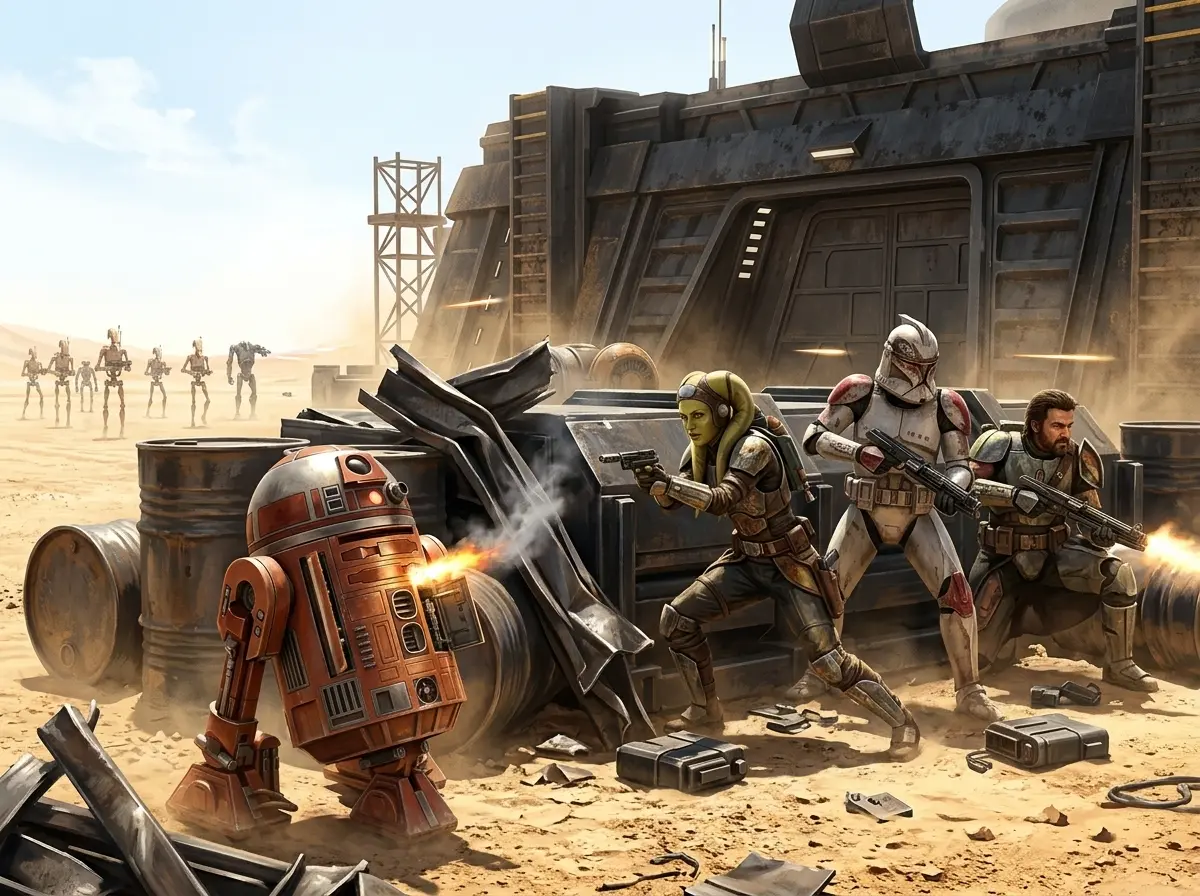
Players step into the role of Hawks, a former Republic officer now leading Zero Company, an unconventional squad of professionals for hire. The job is stopping Kundri Fathom and the Separatist-aligned Infinite Coil cult before a shadow plague spreads. Between missions the base called The Den lets players recruit, upgrade facilities, buy gear and pick the next target from a holotable. The galaxy map covers more than 150 planets; choices alter the path.
Combat sits between classic XCOM risk and the more deterministic style of Marvel’s Midnight Suns. Lead designer James Brawley, who worked on both XCOM 2 and Midnight Suns, described the difference plainly.
- Plans carry real failure chance: a 95 percent shot can still miss, forcing on-the-fly adaptation.
- Melee range often guarantees a directional push, letting players bowl battle droids into scrap.
- Action points limit each operator per turn; astromechs can hand extra points to teammates or deploy gadgets.
- Short third-person exploration segments between some story missions give breathing room and world detail after the tactical grid.
Bonds form between authored characters and custom operators, unlocking support abilities and cross-training. The result is meant to feel cinematic without losing the tension of imperfect information.
The Den and the holotable give that combat loop a home. Recruitment, facility upgrades and gear buys happen off the grid, so a failed shot or a costly push still feeds back into base decisions. The 150-planet map then turns those decisions into route choices. A squad that leans on bonds and cross-training can chase a different path than a squad that stockpiles gadgets and astromech support. The campaign length reported in previews gives that loop room to escalate rather than reset every mission.
The injury system that keeps teeth without instant wipeouts
Zero Company uses permadeath, but not the classic XCOM version. Characters who hit zero hit points take an injury. Three uncleared injuries remove them for good. Brawley watched players bounce off XCOM 2 and War of the Chosen when losses came too fast and too early.
The more you have to walk into a combat scenario with characters who you know are approaching the verge of death, the more that tension develops its teeth. But it still gives some margin of error to the type of player who’s not quite all leaned into the impossible Ironman XCOM gameplay experience.
Brawley said the system also protects lower-difficulty players from gradually losing control after early mistakes. Higher difficulties can tighten the screws. The design keeps stakes high while giving the team more room to tune.
The three-injury ladder changes how attachment works. An operator who drops once becomes a resource problem, not a save-file funeral. Bonds and cross-training still matter because a twice-injured specialist is a risk you can see coming. Lower difficulties keep the campaign readable after early errors. Higher difficulties shrink that margin so the same rules still satisfy players who want Ironman pressure. The studio gains tuning headroom either way, which matters for a debut that must serve both XCOM veterans and licensed-IP newcomers.
Operators, species and a brand-new astromech
Hawks and recruited operators draw from eight species: Devaronian, Human, Neimoidian, Ovissian, Togruta, Twi’lek, Weequay and Zabrak. Voices, outfits, specializations and talents are customizable. Authored squadmates include a Clone Trooper, a Mandalorian of Clan Verminoth and a Jedi Padawan among others.
Foertsch called creating the all-new BR-1 astromech a bucket-list moment with Lucasfilm. “They’re very much trying to figure out ways to say yes to questions,” he said of the collaboration. BR-1s cannot hold blasters like R2-D2, yet Brawley treats them as Swiss Army knives: grenades, flamethrowers and other gadgets emerge from ports. Multiple astromechs can form a grenade legion if players want the chaos. Pre-order buyers get the Crystalline Astromech Cosmetic Pack that includes the BR-1 plus translucent heads for R4 and R5 variants.
Pricing and editions are straightforward on the official store.
| Edition | PC SRP | Console SRP | Key extras |
|---|---|---|---|
| Standard | $49.99 | $59.99 | Base game |
| Deluxe | $59.99 | $69.99 | Two cosmetic packs, five painted weapon themes |
| Pre-order bonus (all) | – | – | Crystalline Astromech pack including BR-1 |
The soundtrack by GRAMMY winner Gordy Haab lands the same day via Walt Disney Records. Full details live on the Standard and Deluxe edition pricing page and the EA announcement of the August 27 launch across PC and consoles.
Species choice and authored roles pull in opposite useful directions. Custom operators supply the fantasy of building a hire-gun roster from eight species with full control over voice, outfit, specialization and talent. Authored squadmates supply fixed personalities a Clone Trooper, a Clan Verminoth Mandalorian, a Jedi Padawan that the bond system can hook into without waiting for the player to invent backstory. The BR-1 sits in the middle of that design: a new canon-friendly gadget platform whose ports replace blaster nostalgia with grenades, flamethrowers and shared action-point support.
Studio survival sits above any single IP
Foertsch keeps returning to the long game. He has watched teams scatter after big projects and wants Bit Reactor to keep the institutional knowledge that only years of shared work produce. “If you fail at the studio level, the game won’t be good,” he said. The hope is a durable company that happens to make a great Star Wars game, not a studio defined by one licence.
That stance lands against a harsh backdrop. Trackers put cumulative industry layoffs since 2022 well above 45,000 jobs, with fresh waves continuing through 2026 at major publishers and studios. Bit Reactor’s bet is that careful hiring, existing IP and a team-first culture can outlast the volatility. Respawn’s support and Lucasfilm’s willingness to green-light new elements such as the BR-1 gave the young studio cover that pure independents rarely get.
The wager breaks into a few plain pillars the studio can still control.
- Hire carefully and keep shared craft inside the building after ship.
- Build on existing IP instead of launching a new studio and a new universe together.
- Lean on Respawn support and Lucasfilm collaboration when a debut needs cover.
- Treat the BR-1 and similar yes answers as proof the licence relationship can flex.
Star Wars itself remains busy across media. Tabletop fans have watched D&D’s own Star Wars tabletop push and the recent Monopoly Star Wars board game release, proof the brand still opens doors in multiple formats.
Previews land positive nine days out
Hands-on coverage from IGN, Game Informer and others after ten-plus hours describes an approachable tactics game that still rewards depth. Character writing, bonding systems and escalating mission design draw consistent praise; a few technical edges and the balance between narrative and pure strategic layer draw the usual pre-launch notes. On X, reaction mixes hype for full clone customization, the reported 40-hour campaign length and the absence of microtransactions with quieter fretting that trailers leaned harder on story and operators than on the strategic layer some XCOM veterans crave.
Preview themes cluster in a way that maps cleanly onto the systems already shown.
| Theme | What previews stress | Linked systems |
|---|---|---|
| Praise | Character writing, bonds, escalating missions | Authored squadmates, bond unlocks, holotable pathing |
| Hype | Clone customization, 40-hour campaign, no microtransactions | Species and loadout tools, galaxy map, premium pricing model |
| Notes | Technical edges, narrative versus pure strategy balance | Exploration segments, Den management, tactical grid tension |
The official Star Wars Zero Company features page frames the fantasy cleanly: lead cunning operatives, choose your path, forge bonds, personalize the fight. Final trailers and community Q&As have kept the information flow steady into the last week.
The Den Turns Downtime Into Campaign Pressure
Between missions, The Den is where Zero Company’s systems meet. Players recruit, upgrade facilities, buy gear and choose the next target from the holotable. Those verbs sound like menu work. They function as the campaign’s second combat layer.
A squad carrying injuries still needs bodies on the field. Recruitment fills gaps without erasing the cost of the three-injury rule. Facility upgrades and gear buys decide whether the next holotable pick is a safe contract or a swing at Kundri Fathom’s wider plan. The galaxy map’s span across more than 150 planets means a choice deferred is a path altered, not a mission simply replayed later.
Bonds deepen in that same downtime. Support abilities and cross-training unlock between authored characters and custom operators, so the roster that leaves The Den is not the same roster that returned. Astromechs extend the pattern: extra action points and port-built gadgets are loadout decisions made before the grid appears. The shadow plague clock and the Infinite Coil’s Separatist alignment give those decisions a narrative edge. Idle upgrades still serve a story about stopping a spread, not only about min-maxing hit chance.
Previews that praise escalating mission design are praising this loop as much as any single firefight. The Den keeps failure expensive and recovery possible. That balance matches the injury system’s stated goal: tension with teeth, and enough margin that early mistakes do not end the run for every player.
Licensed Cover Still Leaves the Debut Exposed
Bit Reactor’s cover is real and limited. Respawn’s involvement and Lucasfilm’s yes on the BR-1 are advantages pure independents rarely see. Creative control largely stayed with the studio, which is the other half of the same deal: the credit and the blame both route home.
The wider market does not pause for a careful debut. Layoffs since 2022 sit well above 45,000 jobs, with waves still moving through 2026. Foertsch’s answer is institutional memory keep the team, keep the craft, refuse to treat one licence as the whole company. Zero Company is the proof of concept for that answer, not the final definition of Bit Reactor.
Pricing keeps the first impression simple. Standard and Deluxe tiers, a shared pre-order cosmetic pack, and a same-day Gordy Haab soundtrack draw a clean line around what players buy on day one. The reported absence of microtransactions in preview chatter fits that line. So does the single-player, turn-based brief. The game asks for attention and a premium purchase. It does not ask players to fund the studio through a live service spiral.
Star Wars remaining busy in tabletop and board games helps the launch window without carrying the tactical genre’s load. A D&D push and a Monopoly release show the brand still opens doors. They do not teach anyone how a 95 percent shot feels when it misses, or how a three-injury clock changes attachment. That work still belongs to Bit Reactor on August 27.
The last stretch before Zero Company deploys
Bit Reactor, Respawn and Lucasfilm Games now wait for players to take the controls. Foertsch’s four-year-old self would be thrilled. The adult version still carries the healthy fear. The injury system, the BR-1, the 150-planet map and the insistence on keeping the team together are the concrete pieces of the wager. On August 27 the market gets its turn to answer.


DigitalOcean’s $894 Million Backlog Rewrites the Old Cloud

Companies Froze Job Design and Called AI a People Problem

AI Capex Looks Unique Because the Chips Wear Out

Samsung Medison’s HERA Z10 Aims at the Sonographer Shortage

GPT-6 Astra Ships as OpenAI’s First Critical Cyber Model

Palms Sells Clean Air Without Ending Casino Smoking

OnlyFans Promo Bots on X Now Pass the Humanity Tests

Datamaran Drops the ESG Label After Winning the Argument

Xiaomi’s Own Chip Lands While Apple Argues Over Color

Pixel 11 Trails Galaxy Phones That Last as Long

Oracle Cuts 21,000 Jobs in a Year, Cites AI in 10-K Filing

Fable 5 and Mythos 5 Return as US Lifts Anthropic Export Controls

SpaceX’s Google Deal Turns a Rocket Company Into a Cloud Landlord

CD Projekt Red Co-CEO: Redemption Arc Isn’t Done, Witcher 4 in 2027

XPL Rallies 30% Ahead of Plasma One Card Tier Launch

Google Search Profiles Build a Follow Graph Inside Discover

DGO App Brings Rs 549 Mobile Pass for FIFA World Cup 2026 in Nepal

Moonshot AI Targets $30 Billion in China’s Fastest AI Funding Sprint

Oppo’s ColorOS 17 Eligibility List Leaves A-Series Buyers Behind

Microsoft Xbox Layoffs Start in July as Sharma Slams 3% Margin
-
 AI3 months ago
Oracle Cuts 21,000 Jobs in a Year, Cites AI in 10-K Filing
-
 AI2 months ago
Fable 5 and Mythos 5 Return as US Lifts Anthropic Export Controls
-
 AI3 months ago
SpaceX’s Google Deal Turns a Rocket Company Into a Cloud Landlord
-
 GAMING3 months ago
CD Projekt Red Co-CEO: Redemption Arc Isn’t Done, Witcher 4 in 2027
-
 CRYPTO3 months ago
XPL Rallies 30% Ahead of Plasma One Card Tier Launch
-
 NEWS3 months ago
Google Search Profiles Build a Follow Graph Inside Discover
-
 APPS3 months ago
DGO App Brings Rs 549 Mobile Pass for FIFA World Cup 2026 in Nepal
-
 AI3 months ago
Moonshot AI Targets $30 Billion in China’s Fastest AI Funding Sprint