
COMPUTERS
Quantinuum’s Flat IPO Leaves Honeywell With Voting Control
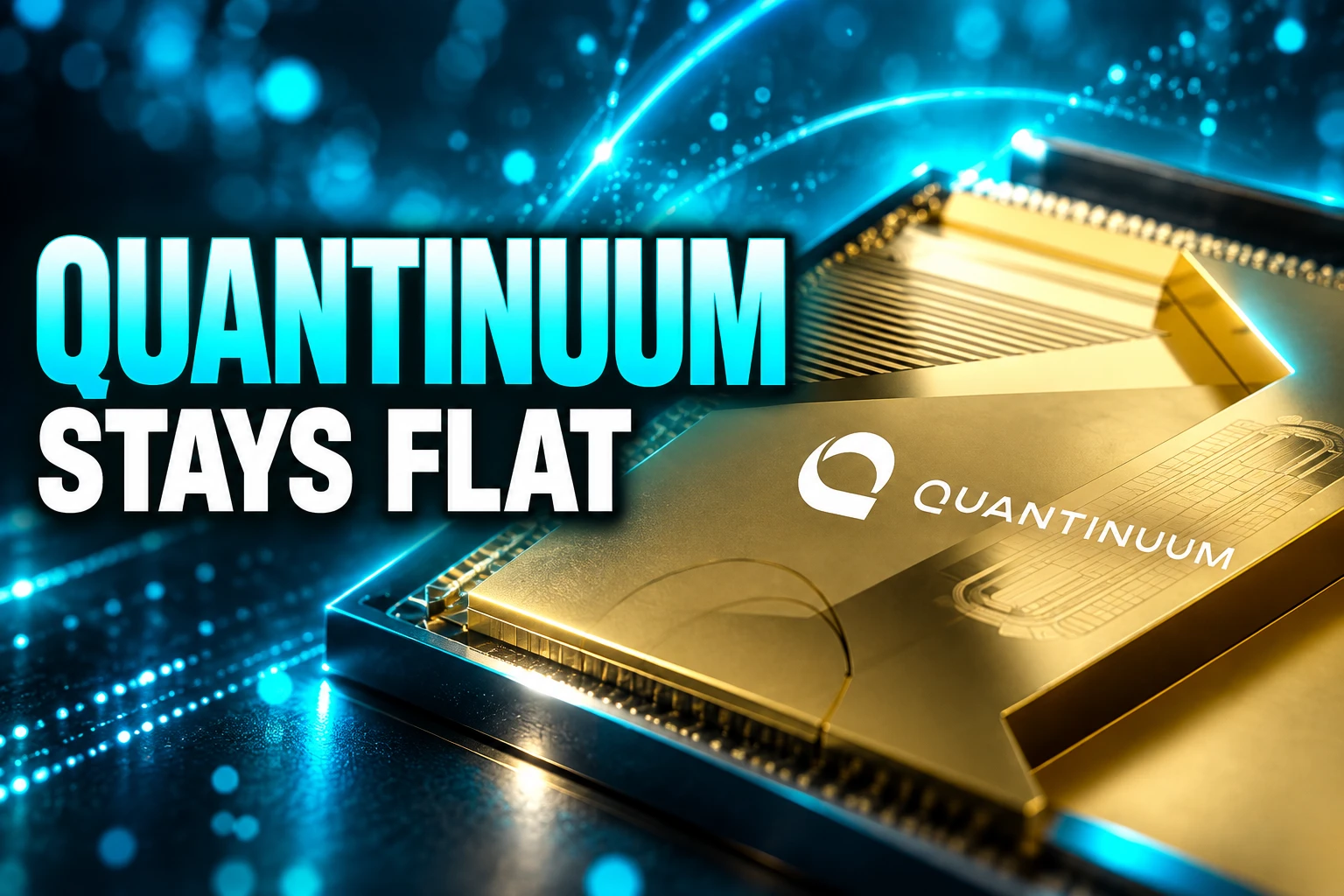
Quantinuum’s Nasdaq debut faded to $60.38 as Honeywell kept 47.8% of the votes and public holders received 12.6% of the company.

Quantinuum shares closed at $60.38 on June 4, a 0.6% gain from the $60 IPO price after a $68 open. The Honeywell-backed company, trading as QNT on the Nasdaq Global Market, had just raised $1.68 billion and a fully diluted value of $15.7 billion. By the bell, the pop was gone, and the people who still ran the vote had not sold a share.
Alex Taub, a principal at QED Investors, called a quiet tape a kind of stamp of approval for a young field. QED had joined the last private round and did not sell in the offering. The quieter fact sat in the prospectus. Public holders were invited in as a minority.
A $68 Open That Died at $60.38
The registration statement was declared effective on June 3. Quantinuum priced 28 million Class A shares at $60.00, above a marketed range of $53 to $55 that had already been lifted from $45 to $50. Underwriting fees ran $2.85 a share, or $79.8 million, leaving $1.6002 billion in proceeds before other expenses. The company closed its upsized offering of 28 million shares on June 5. All of those shares came from the company. Honeywell holders did not receive a separate QNT certificate in the mail.
Demand, by several desks that worked the book, ran more than 20 times the shares on offer, with the allocation tilted toward long-only institutions. J.P. Morgan and Morgan Stanley ran the books. The first print was $68, up 13%. The session high was $71.35. The low was $59.89. Volume hit 29.6 million shares, and the close was $60.38.
THE JUNE 4 TAPE AGAINST CEREBRAS
| Metric | Quantinuum (June 4) | Cerebras (May 14) |
|---|---|---|
| IPO price | $60.00 | $185.00 |
| Open | $68.00 | $350.00 |
| Close | $60.38 | $311.07 |
| First-day change | +0.6% | +68% |
| Gross proceeds | $1.68 billion | $5.5 billion |
Cerebras, the AI chipmaker that listed three weeks earlier, had given 2026 its template for a hot debut. Quantinuum opened with a similar rush and then gave it back. The next session, June 5, closed at $56.26. The listing still funded the lab. It did not mint a first-day fortune for anyone who bought the open.
Honeywell Still Casts Almost Half the Votes
Quantinuum was formed in 2021 when Honeywell merged its trapped-ion hardware group with Cambridge Quantum, the UK software shop. The IPO used an Up-C holding-company structure. Quantinuum Inc. is the Nasdaq registrant. The operating business sits in Quantinuum Holdings, LLC. After the deal, the public company owned 12.6% of those LLC units. Continuing unitholders kept 87.4%.
Class A and Class B each carry one vote and vote together. Class B has no claim on dividends or on a liquidation beyond par. Those B shares sit with the pre-IPO unitholders, one for one with their LLC units. The Honeywell Entities, named in the prospectus as the principal stockholders, beneficially own 47.8% of the combined voting power, or 47.0% if the 4.2 million-share greenshoe had been exercised in full. A stockholder agreement lets Honeywell designate two directors while it holds at least 40% of its IPO-night stake, and one director down to 20%.
That is control with a public price tag, not a founder exit. Helios, the current machine, is still marketed as “Powered by Honeywell.” Vimal Kapur’s industrial group remains both a parent and a partner. The vote did not go out the door with the 28 million new shares.
What Public Shareholders Bought
On completion, 32,862,895 Class A shares were outstanding. If every LLC unit were exchanged, the Class A count would be 260,970,737. At $60, that fully diluted stack is the $15.7 billion value. The people who bought the IPO, assuming full exchange, hold 12.6% of the combined voting power and the same slice of the economics, or 14.0% with the greenshoe. Up to 5% of the offering was reserved for directors, officers, employees, and business associates.
THE SLICE THAT WENT PUBLIC
- Public vote: 12.6% of Class A and Class B together, before any greenshoe.
- Honeywell vote: 47.8% after the offering, with two board seats while the stake stays large.
- LLC split: Quantinuum Inc. owns 12.6% of Holdings; continuing unitholders own 87.4%.
- Cash after the deal: $2.1 billion in cash, cash equivalents, and short-term investments as of June 30.
The income statement the new holders inherited was thin and lumpy. Revenue was $30.9 million in 2025 against a $192.6 million net loss, up from $23.0 million of revenue and a $144.1 million loss in 2024. Bookings for 2025 were $79.3 million, a wider top-of-funnel figure than the revenue line. First-quarter 2026 revenue was $5.2 million, down from $19.1 million a year earlier, with a $136.6 million net loss. Cash before the IPO was $677.0 million on March 31.
Second-quarter results, the first as a public company, showed $8 million of revenue, up 279% from $2 million a year earlier, and a GAAP net loss of $597 million that dwarfed the $57 million loss in the prior-year quarter. Adjusted EBITDA loss widened to $68 million from $43 million. GAAP loss per Class A share was $1.93. Hardware leases booked in 2025 made the year-on-year revenue path jumpy. The $2.1 billion cash pile is the number that changed.
QED’s Taub described the firm’s holding as a five-to-10-year bet on quantum inside large financial institutions, and said QED did not sell in the IPO. He declined to say what it will do when the six-month lockup he described runs out, which, from the June 5 closing, points to early December. NVentures, Nvidia’s venture arm, Serendipity Capital, and Quanta Computer had joined the September 2025 round that raised $600 million at a $10 billion pre-money value, alongside Honeywell, JPMorgan Chase, Mitsui, and Amgen.
A $100 Million Check With a Government Stake
On May 21, two weeks before pricing, the Commerce Department signed nine letters of intent for $2.013 billion in federal incentives under the CHIPS and Science Act. Quantinuum’s envelope was $100 million, aimed at low-loss integrated photonics and optical parts at trapped-ion wavelengths. IBM was in line for $1 billion and GlobalFoundries for $375 million as foundry plays. Atom Computing, D-Wave, Infleqtion, and PsiQuantum were listed at $100 million each, Rigetti at up to $100 million, and Diraq at up to $38 million. Commerce said it would take a minority, non-controlling equity stake in each recipient.
That letter became a signed award on September 8. Quantinuum said it was the only trapped-ion shop in the CHIPS R&D set, and that it would work with GlobalFoundries on 300 mm wafers for next-generation ion traps and control chips, and with Monarch Quantum on lasers and optics. Shares across the quantum group firmed on the news. The move was a one-percent tape, not a rerating, and the louder session belonged to names with smaller floats. The grant buys a domestic line. It also puts the United States on the cap table beside Honeywell.
This award is a validation of Quantinuum’s leadership in trapped-ion quantum computing. Together with our domestic partners, we are building the technology and supply-chain foundation needed to scale fault-tolerant systems and strengthen America’s leadership in this strategically important field.
Dr. Rajeeb Hazra, President and CEO, Quantinuum, September 8, 2026
WHAT THE $100 MILLION IS FOR
- Ion traps: GlobalFoundries will fabricate next-generation traps and electronics on 300 mm wafers.
- Light path: Monarch Quantum will build lasers and optical parts, shifting the design toward integrated photonics.
- Architecture: Quantinuum was the only trapped-ion company in the CHIPS R&D awards.
- The state’s cut: Commerce takes a minority, non-controlling equity stake as a condition of the funds.
Secretary of Commerce Howard Lutnick said the package would create thousands of high-paying jobs and advance American quantum work. Tim Breen, CEO of GlobalFoundries, said manufacturing will decide whether the hardware can scale. Dr. Timothy Day, CEO of Monarch Quantum, said large trapped-ion machines depend on leaving sprawling optical tables behind. The equity terms, including how many QNT shares the government receives and at what discount, have not been laid out the way D-Wave later detailed its own issuance.
50 Logical Qubits, Under 40 kW
Investors who bought the IPO were not buying a 2025 earnings stream. They were buying a trapped-ion stack that Quantinuum says leads commercial machines on two-qubit gate fidelity. Helios, launched commercially in November 2025, is listed with 98 fully-connected qubits and 50 logical qubits, 99.9975% single-qubit fidelity, and 99.921% two-qubit fidelity. The base unit is rated at less than 40 kW, not counting support gear. An NVIDIA Grace Hopper box sits in the control system. The software stack includes Guppy, a high-level language, and is built to run beside classical accelerators rather than instead of them.
The prospectus cites that 99.921% two-qubit figure, as of December 31, 2025, as the highest among commercially available gate-based systems in the studies it names. Headquarters are in Broomfield, Colorado, with sites in the United States, the United Kingdom, Germany, Japan, Qatar, and Singapore. The September staff count is about 800. Named Helios users and research partners on the product page include JPMorgan Chase, BMW, SoftBank, and Amgen. Will Zeng, a partner at Quantonation, a quantum-focused VC firm, put the listing inside the same spending wave as AI data centers: capital wants the next compute layer, and quantum is a way to buy it early.
That is the product the float is attached to. It is also a product whose parent still votes 47.8% and whose largest new outside check, as of September 8, is a government grant with equity attached.
Cerebras Held a 68% First-Day Premium
Cerebras priced at $185 on May 13, opened at $350 the next day, and closed at $311.07, a 68% first-day gain, after raising about $5.5 billion. It already had 2025 revenue of $510.0 million. Quantinuum’s $30.9 million of 2025 revenue sat under a $15.7 billion IPO value. The comparison that made the round on June 4 was always going to be cruel on a percentage basis.
The rest of the public quantum set had come in through SPACs. Infleqtion, IQM, and Pasqal all used that route over the prior year. Infleqtion’s neutral-atom system in Japan is already running as a national machine, which is a different proof point from a Nasdaq open. IonQ, Rigetti, and D-Wave had been the liquid proxies. Quantinuum’s traditional IPO was the first large primary listing in the dedicated quantum group, and it gave those names a comps set that was not a blank-check leftover. It also showed that a 20-times book and a Honeywell logo do not force a Cerebras close.
Taub’s line about one day being a thin sample still holds. The structure around that day is not a one-session story. Public holders own a sliver. Honeywell keeps the vote. The lockup still sits in front of any overhang from the September 2025 round.
300 mm Wafers for the Next Ion Traps
If the June tape was a pricing event, the September award is a factory event. Trapped-ion systems have lived on custom optics and low-volume traps. The CHIPS work is an attempt to put those parts on a semiconductor line. GlobalFoundries already had its own $375 million foundry letter in the May package. Quantinuum is now a named user of that 300 mm path.
Quanta Computer, the Taiwan manufacturer that came into the $10 billion round, had already signed a development deal in August to put quantum hardware on an industrial footing. That sits beside Quanta’s factory-scale quantum manufacturing pact as the commercial echo of the same idea: the bottleneck is no longer a single extra qubit on a slide. It is whether ion traps and lasers can be made the way chips are made. Nvidia’s NVentures cheque, and the Grace Hopper box inside Helios, tie the same stack to the GPU buildout Zeng described.
Management is due at a Piper Sandler conference in Nashville from September 14 to 16. The cash account is $2.1 billion. Honeywell still holds 47.8% of the votes. Helios is on the floor in Broomfield with 50 logical qubits behind a 40 kW rating. The float that changed hands on June 4 was never the whole company. It was the part the prospectus allowed out.
Disclaimer: This article is news reporting and analysis of Quantinuum’s public listing, ownership, and related funding. It is for information only and is not investment advice, a recommendation to buy or sell QNT or any other security, or a forecast of returns. Readers should consult a licensed financial adviser or broker who can review their own holdings, time horizon, and risk limits before making any trade. Share prices, voting percentages, cash balances, and federal-award terms are taken from the filings and company statements cited here and can change with later disclosures, lockup expirations, and market trading.

Instagram Plus Tests a Read-Only Mode That Cuts Stories

Altman Asks the Public to Accept Some AI Harm

Google Freezes OSS VRP Product Reports After AI Flood

AI Agents Make Payment Rails the Scarce Prize

Turkey’s Crypto Boom Now Runs Through Three Banks

Fable 5 Came Back Under a Commerce On-Off Switch

Google’s SpaceX GPU Lease Has a Sept. 30 Deadline

Plasma One’s XPL Locks Face a 1.81 Billion Cliff

DGO’s Rs 549 World Cup Pass Cost Fans Sleep and Data

Moonshot AI’s $30 Billion Ask Became a $35 Billion Close
-
 AI4 months ago
Fable 5 Came Back Under a Commerce On-Off Switch
-
 AI4 months ago
Google’s SpaceX GPU Lease Has a Sept. 30 Deadline
-
 CRYPTO4 months ago
Plasma One’s XPL Locks Face a 1.81 Billion Cliff
-
 APPS4 months ago
DGO’s Rs 549 World Cup Pass Cost Fans Sleep and Data
-
 AI4 months ago
Moonshot AI’s $30 Billion Ask Became a $35 Billion Close
-

 NEWS4 months ago
ColorOS 17 Device List Spans Oppo, OnePlus and Realme
-

 GAMING4 months ago
Xbox Cuts 3,200 Jobs After Five Years of Thin Returns
-
 GAMING4 months ago
The RTX 4050 Under Rs 70,000 Hides a Wattage Gap