
COMPUTERS
Fujitsu and Daiichi Life Bet One Basis Point on Quantum
Fujitsu and Daiichi Life are spending a year testing quantum asset allocation on a ¥30 trillion insurance book, chasing 1 basis point on simulators.

Fujitsu and Daiichi Life Group are spending a year testing quantum code on a ¥30 trillion insurance book for a 1 basis point gain. They price that tick at ¥3 billion, and they are running the work on a 40-qubit simulator plus quantum computers through March 2027.
The wager is dated and narrow. It is not a claim that a life insurer can now rebalance a full book on a quantum chip. It is a year of algorithm work against live constraints, parked on machines that still cannot hold the real problem, so the code is ready if larger systems arrive.
A One-Basis-Point Prize on a 30 Trillion Yen Book
On June 4, 2026, Fujitsu Limited and Daiichi Life Group, Inc. said they had already started joint research from April 2026 to March 2027 on quantum tools for insurance asset management. The study uses Daiichi Life Insurance Co., Ltd., which they describe as a leading Japanese institutional investor managing approximately ¥30 trillion (about $188 billion at the group’s March 31, 2026 rate of ¥159.88 per dollar).
The prize sits in one line of that release. If portfolio returns rose by even 1 basis point (1/10,000) through optimization, they wrote, the book would throw off an extra ¥3 billion (about $19 million). That arithmetic is clean: ¥30 trillion times 0.0001 equals ¥3 billion. It is also a thought experiment, not a result.
THE STATED STAKE
- The book: About ¥30 trillion of Daiichi Life Insurance assets named in the June 4, 2026 release.
- The tick: A 1 basis point rise in portfolio return, defined as 1/10,000.
- The yen: ¥3 billion of extra return on that stated book.
- The clock: Work from April 2026 through the end of March 2027, with papers promised after.
Fujitsu Research posted the same outline the day of the release, tagging Daiichi Life Group and repeating the ¥30 trillion figure without adding a new metric.
Fujitsu and Daiichi Life Group (@DaiichiLife_Grp). launch joint research to advance asset management operations through the application of quantum technology in the insurance sector. Based on the operations of Daiichi Life Insurance, which manages approximately 30 trillion yen,…
— Fujitsu Research (@fujitsulabs) June 4, 2026
Both companies will jointly design quantum algorithms to set weights across stocks, bonds, and alternative assets while folding in risk-return balance and liability characteristics. They will then test those algorithms on quantum simulators and on quantum computers, varying constraints and economic scenarios as they go.
Daiichi Life Already Banks the Spread Without Qubits
The ¥30 trillion line is a rounded working figure. Daiichi Life’s own FY2025 results, published May 15, 2026, put the general account’s average daily balance at ¥31,430.2 billion, with interest and dividends of ¥811.7 billion and a general account yield of 2.58% on that average.
That income yield is one number. The investment yield used for fundamental profit is another, at 2.43%. The average assumed rate of return on the liabilities is a third, at 1.77%. The gap between what the assets earn and what the policies were sold to pay is the positive spread, which Daiichi Life said rose 35% year on year to ¥169.4 billion.
Most of the book is not a stock-picking puzzle. Yen fixed income was 69.7% of the general account at the end of March 2026. Domestic bonds alone carried an average daily balance of ¥18,129.7 billion and yielded 1.71%, while the 10-year Japanese government bond yield was about 2.4% and the 30-year about 3.6% that month. The dollar-duration matching ratio sat at 87%.
FY2025 GENERAL ACCOUNT INCOME YIELDS
| Asset class | Avg daily balance (¥ bn) | Interest and dividends (¥ bn) | Yield |
|---|---|---|---|
| General account total | 31,430.2 | 811.7 | 2.58% |
| Domestic bonds | 18,129.7 | 309.2 | 1.71% |
| Domestic equities | 1,011.0 | 79.4 | 7.86% |
| Foreign bonds | 2,961.4 | 92.3 | 3.12% |
| Foreign equities | 1,382.8 | 110.3 | 7.97% |
Those yields already moved the old way. Daiichi Life said large-scale rebalancing of yen-denominated fixed-income assets, done as domestic rates rose, is worth ¥30.0 billion a year of extra positive spread, with ¥21.0 billion of that due to land in FY2026. The 1 basis point quantum prize of ¥3 billion is one-tenth of that single classical program.
Fundamental profit at Daiichi Life still rose 3% to ¥372.7 billion, because the fatter spread offset weaker insurance margins. The group is not hunting basis points because the book is idle. It is hunting them because a book this large turns a rounding error into real money, and because the easy rate-driven pickup will not last forever.
What the Year of Joint Research Covers
The release is blunt about the mess an insurer actually has to solve. Asset allocation is not a clean mean-variance slide. It has to hold several ugly facts in the air at once, then do it again under many economic paths.
WHAT THE ALGORITHMS MUST HOLD TOGETHER
- Risk and return: Weights across stocks, bonds, and alternatives, not a single asset sleeve.
- Liabilities: Duration, cash-flow shape, and the assumed rates already sold to policyholders.
- Rules: Regulatory capital and investment limits that differ by asset class.
- Constraints: Position limits, liquidity, and the other on-the-ground bounds Daiichi Life’s desk actually uses.
- Scenarios: The same allocation tested across a wide set of economic paths, not one base case.
Fujitsu’s job is the quantum algorithms and the machines, including the large simulator built from 1,024 nodes and the quantum computers on its hybrid platform. Daiichi Life Group designs the research themes, sets the scoreboard, and feeds in asset-management data, workflows, and the problems that show up in daily operations at Daiichi Life Insurance.
That split is the bet’s real collateral. Fujitsu gets a live insurance book with liability hooks that a public equity tape does not have. Daiichi Life gets a year of algorithm work and a seat on the hardware queue, without having to pretend the current chips can swallow 31,430.2 billion yen of general-account average balances in one shot.
They also said they will look past asset management into other insurance uses, and that they will publish what they learn in academic papers. Until those papers exist, the public record is the June 4, 2026 outline. Fujitsu’s own quantum news list after that date is conference talks, a diamond-spin prototype, and atom-machine software tests, not a Daiichi Life scorecard.
The 40-Qubit Simulator Does the Heavy Lifting
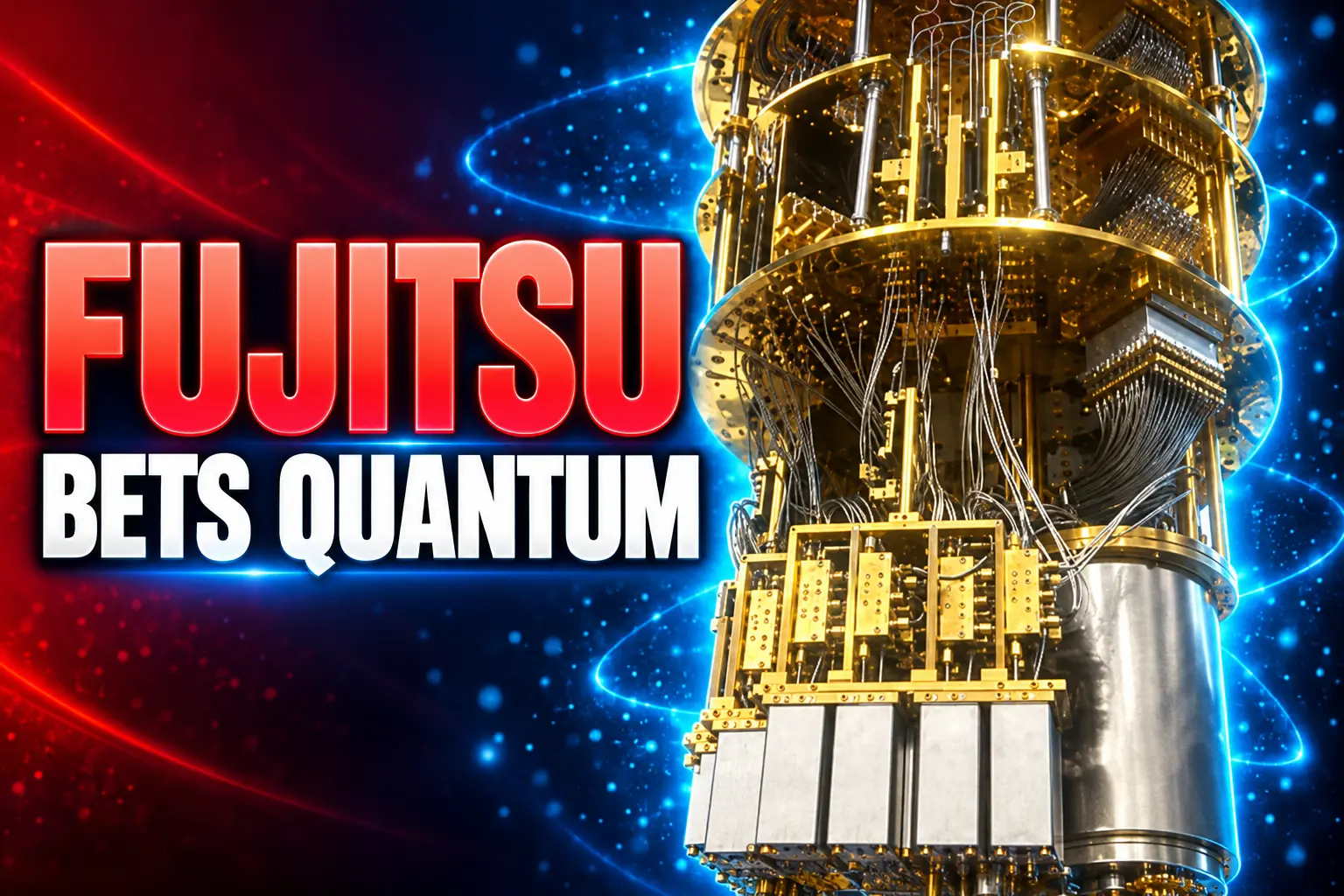
The fine print on the hardware is easy to miss under the word “quantum.” The simulator named in the note is a 40-qubit state-vector machine made of 1,024 PRIMEHPC FX700 systems with A64FX processors, the same Arm CPU family used in the Fugaku supercomputer. It is a classical cluster pretending, very well, to be a small quantum computer.
Forty qubits is a hard ceiling for a full state-vector. Each extra qubit doubles the memory. A 40-qubit wavefunction is already a supercomputer-scale object, which is why Fujitsu built the box out of 1,024 nodes. It is also why a life-insurance allocation with hundreds of instruments, integer lots, and scenario trees will not fit on that register as a single unreduced circuit.
The physical machine Fujitsu can actually point at is larger and noisier. With RIKEN it put a 256-qubit superconducting quantum computer on the hybrid platform on April 22, 2025, scaling the 64-qubit chip from October 2023 by stacking the same 4-qubit unit cells in a 3D package and quadrupling density inside the same dilution refrigerator. That system opened to companies and labs in the first quarter of fiscal 2025.
FUJITSU’S QUANTUM HARDWARE PATH
- March 30, 2022: Fujitsu says it has the world’s fastest 36-qubit quantum simulator on an FX700 cluster, and aims at a 40-qubit box by September 2022.
- October 2023: Fujitsu and RIKEN launch a 64-qubit superconducting machine at the RIKEN RQC-FUJITSU Collaboration Center, with MEXT support.
- April 22, 2025: The same partners put a 256-qubit superconducting machine on the hybrid platform and schedule a 1,000-qubit installation at Fujitsu Technology Park in 2026.
- April 2026: The Daiichi Life study starts, using the 40-qubit simulator and quantum computers.
- June 4, 2026: The two companies announce the work in Kawasaki and Tokyo.
The April 2025 plan still called for a 1,000-qubit machine at Fujitsu Technology Park in 2026. That date is a schedule, not a completion notice. Even 256 noisy physical qubits are not 256 clean logical qubits, and they are not a 1,000-asset allocator. The Daiichi Life release itself says the point of the year is to test what asset allocation would look like “when utilizing future large-scale, high-performance quantum computers.”
While the insurance study runs, Fujitsu has kept spreading software across other hardware. In August 2026 it moved STAR, its early fault-tolerant architecture, onto a physical neutral-atom machine with Yaqumo. That sits alongside Japan’s first neutral-atom quantum computer, a separate domestic track that does not change the 40-qubit simulator doing the Daiichi Life grinding.
Why Plain Portfolio Math Is a Tough Quantum Case
Vanilla portfolio math is a bad place to hunt a quantum win, and the literature now says so in public. In a July 2026 benchmark, Eric Stopfer and Friedrich Wagner at the Fraunhofer Institute for Integrated Circuits built 250 portfolio instances up to 1,000 assets from real stock data and compared quantum annealing and QAOA with mixed-integer programming, simulated annealing, tabu search, and a problem-specific heuristic.
We conclude that there is only very limited room for a potential quantum advantage for the considered variant of portfolio optimization.
Eric Stopfer and Friedrich Wagner, Fraunhofer Institute for Integrated Circuits, arXiv:2509.17876v2
Quantum methods in that study could be tested on at most 30 assets, a hardware limit, not a modelling choice. Mixed-integer programming solved every instance to proven optimality in the order of seconds. The tailored classical heuristic also beat the quantum runs on solution quality for a fixed runtime. Stopfer and Wagner used a volatility-minimizing form they had already shown is harder for classical solvers than return-max or blended versions, and the classical side still won.
That finding does not kill the Daiichi Life study. It kills the slide that treats “portfolio optimization” as an automatic quantum use case. Convex Markowitz with continuous weights is a polynomial-time quadratic program. The NP-hard version appears when you add cardinality limits, lot sizes, and integer decisions. Those extras are exactly the constraints insurers already live with, and they are also the extras that blow up qubit counts when the problem is packed into a QUBO.
WHERE THE TWO SIDES DISAGREE
- The Fraunhofer reading: On standard portfolio instances, even the harder volatility form, classical MIP and tailored heuristics still set the bar, and current quantum hardware cannot pass 30 assets.
- The Fujitsu-Daiichi reading: The live task is not a stock-only weight vector. It is allocation under liabilities, capital rules, per-asset limits, and many economic scenarios, which they say classical machines handle poorly at full fidelity.
- The hardware reading: A 40-qubit simulator and a 256-qubit noisy chip can host reduced models and circuit tests. They cannot host the unreduced Daiichi Life book as one quantum program.
If the year produces a reduced ALM encoding that still respects duration matching, capital, and scenario trees, that is a software result worth publishing. If it produces a small QAOA demo on a dozen risk assets, it will look like every other quantum-finance pilot. The papers after March 2027 are what decide which of those two things happened.
Fujitsu Sold Quantum-Inspired Portfolio Tools First
Fujitsu did not arrive at Daiichi Life as a first-time finance vendor. For years it sold Digital Annealer, a classical digital circuit built to mimic quantum annealing, into portfolio and allocation work. That product could be installed without waiting for a dilution refrigerator. It also meant Fujitsu has been telling banks and insurers that combinatorial allocation is the job, long before it had a 256-qubit chip to rent.
In January 2026 it went further and, with SC Ventures, set out a joint venture named Qubitra Technologies for quantum applications in financial services. Fraud detection, derivatives, and trading sat on that roadmap. The Daiichi Life study is a different shape: a named insurer, a named book, a named 1 basis point, and a 12-month clock tied to asset-liability work rather than a trading desk.
That is why the simulator does so much of the labour. Fujitsu’s public line is that it wants the algorithms in hand “once large-scale quantum computers become a reality,” and that early practical tests are how you deploy fast later. Daiichi Life Group, for its part, said it wants cutting-edge tools as it tries to become a “global top-tier insurance group.” The year of work is how both of those sentences get a file attached to them.
The Study Ends in March 2027 With Papers
The clock is the cleanest fact in the release. The study is planned through the end of March 2027. After that, the two companies said they will put the findings into academic papers and look for other insurance uses. They did not publish an interim score, a target excess return, or a go-live date for a production allocator.
A useful paper would show the reduced model, the qubit count, the constraint set, and a head-to-head against the classical ALM stack Daiichi Life already runs, including the bond-rebalancing program that is already booked at ¥30.0 billion a year. A paper that only shows a small circuit beating a weak baseline will not move a 69.7% yen-fixed-income book.
Until then the bet stays open on both sides. Fujitsu is spending simulator time and algorithm work against a real liability-matched book. Daiichi Life is spending data and desk time on a 1 basis point option that pays ¥3 billion only if the future machine, and the encoding, both work. The ¥30 trillion is already there. The qubits that can hold it are not.
Disclaimer: This article is news reporting and analysis of a joint research announcement and of published financial and technical figures. It is informational only and is not investment advice, an offer to buy or sell any security, or a recommendation of any asset-allocation strategy. Readers who may act on insurance, portfolio, or capital-markets questions should consult a licensed financial adviser, actuary, or other qualified professional who can review their own facts. Asset values, yields, solvency ratios, hardware roadmaps, and the status of the Fujitsu-Daiichi Life study can change after the dates of the sources cited here.

Instagram Plus Tests a Read-Only Mode That Cuts Stories

Altman Asks the Public to Accept Some AI Harm

Google Freezes OSS VRP Product Reports After AI Flood

AI Agents Make Payment Rails the Scarce Prize

Turkey’s Crypto Boom Now Runs Through Three Banks

Fable 5 Came Back Under a Commerce On-Off Switch

Google’s SpaceX GPU Lease Has a Sept. 30 Deadline

Plasma One’s XPL Locks Face a 1.81 Billion Cliff

DGO’s Rs 549 World Cup Pass Cost Fans Sleep and Data

Moonshot AI’s $30 Billion Ask Became a $35 Billion Close
-
 AI4 months ago
Fable 5 Came Back Under a Commerce On-Off Switch
-
 AI4 months ago
Google’s SpaceX GPU Lease Has a Sept. 30 Deadline
-
 CRYPTO4 months ago
Plasma One’s XPL Locks Face a 1.81 Billion Cliff
-
 APPS4 months ago
DGO’s Rs 549 World Cup Pass Cost Fans Sleep and Data
-
 AI4 months ago
Moonshot AI’s $30 Billion Ask Became a $35 Billion Close
-

 NEWS4 months ago
ColorOS 17 Device List Spans Oppo, OnePlus and Realme
-

 GAMING4 months ago
Xbox Cuts 3,200 Jobs After Five Years of Thin Returns
-

 GAMING4 months ago
The RTX 4050 Under Rs 70,000 Hides a Wattage Gap