
AI
Alphabet Raises AI Spending to $205 Billion as SpaceX Cashes In
Alphabet’s Q2 beat estimates, but a $205 billion capex forecast, negative free cash flow and a monthly SpaceX compute deal defined investor reaction.

Alphabet raised its 2026 AI spending forecast to as much as $205 billion on Wednesday, and Wall Street punished the stock anyway. Shares fell roughly 5% after hours even though revenue climbed 24% to $119.8 billion and Google Cloud grew 82%. The capex line jumped from the $180 billion to $190 billion range Alphabet had set just three months earlier, and investors zeroed in on that number instead of the beat.
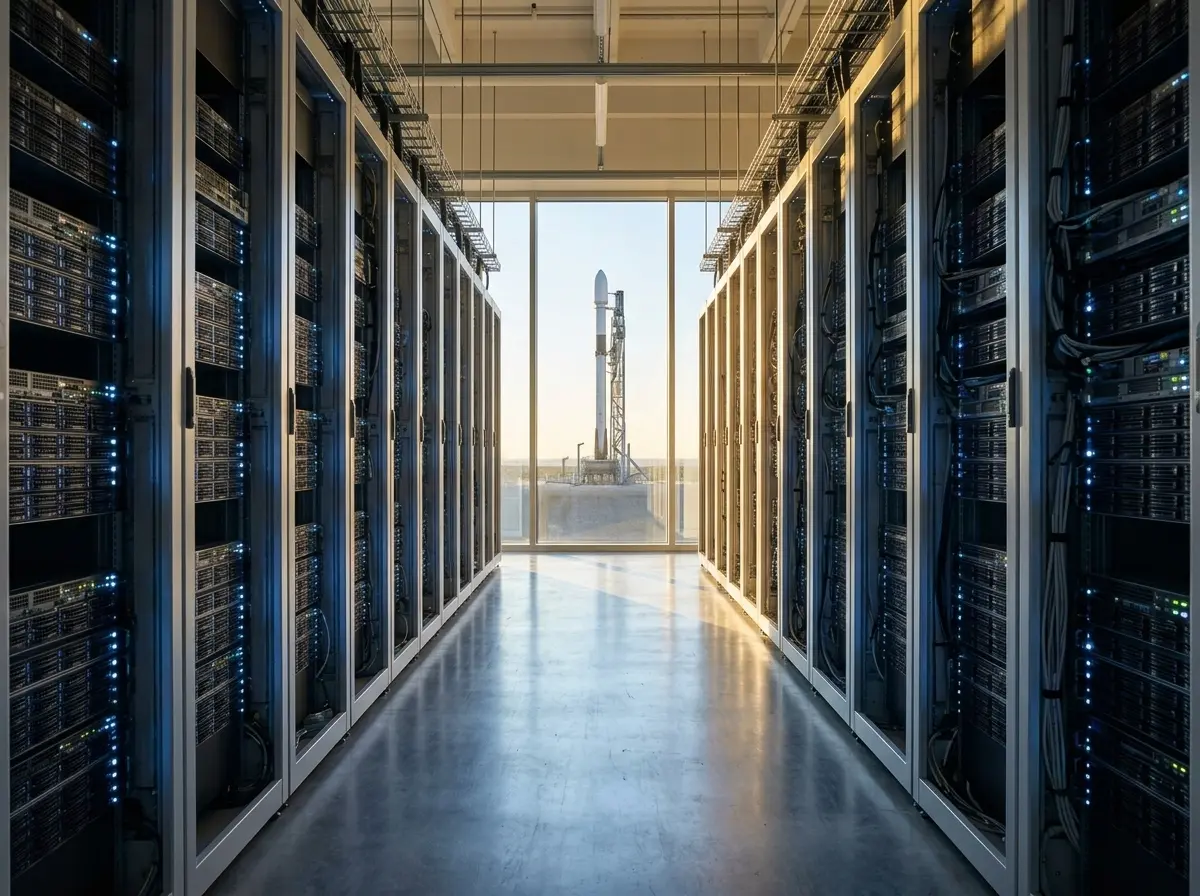
Buried deeper in the earnings call is a smaller, stranger figure: $920 million. That is what Google now pays Elon Musk’s SpaceX every month for computing capacity it cannot build fast enough on its own, turning a company Alphabet helped fund in 2015 into one of its own AI-era suppliers.
Cloud’s 82% Quarter Cushions a Bigger Bill
Google Cloud generated $24.8 billion in revenue for the quarter, up 82% year over year and well ahead of the roughly 63% growth Wall Street had modeled, according to earnings figures reported by Investing.com. Cloud’s operating margin jumped to 35.6% from 20.7% a year earlier. The unit’s backlog, contracted work still to be delivered, reached $514 billion, up $50 billion in just three months.
- Revenue: $119.8 billion, up 24% from a year earlier
- Google Cloud: $24.8 billion, up 82%, with a $514 billion backlog
- YouTube ads: $11.06 billion, up 12.6%, ahead of the $10.8 billion Wall Street expected
- Net income: $112.1 billion, or $9.11 a share, lifted by $99 billion in gains on Alphabet’s equity investments
That backlog growth is also why Warren Buffett’s Berkshire Hathaway built a stake tied directly to Google’s cloud contract pipeline. Alphabet’s $29.5 billion acquisition of cloud security firm Wiz earlier this year is adding to Cloud’s growth too, though analysts flagged the integration as a near-term drag on margins going forward.
Free Cash Flow Turns Negative for the First Time
The cost of that growth showed up on the cash flow statement. Alphabet spent $44.9 billion on capital expenditure in the quarter, roughly double what it spent a year earlier. That outran the $39.1 billion in operating cash the business generated, pushing free cash flow to negative $5.9 billion, its first quarterly free cash outflow in nearly two decades. Alphabet has already spent $78.6 billion through June, meaning the back half of the year will need to average $58 billion to $63 billion a quarter to land inside the new range.
Alphabet financed the gap like a capital-intensive utility this quarter, not the ad-driven cash machine it has been for most of its history.
- Completed a $49.6 billion equity raise in June
- Issued $20.3 billion in new senior notes, roughly doubling long-term debt to about $98 billion
- Repurchased zero shares during the quarter
- Kept about $242 billion in cash and marketable securities on hand, with room for $40 billion more in stock sales
CFO Anat Ashkenazi told analysts free cash flow “will continue to be pressured by technical infrastructure investments.” Thomas Monteiro, a senior analyst at Investing.com, put the tension more bluntly.
After a negative free cash flow quarter, Alphabet raising capex again makes the market uneasy. The most reliable cash generator in the market is now spending more than it earns.
Monteiro also noted that Cloud’s backlog growth is the clearest sign the spending is turning into contracted revenue, the argument Alphabet’s own executives lean on whenever the capex line draws pushback.
Servers Take Six of Every Ten New Dollars
About 60% of this year’s spending is going toward servers, mostly Nvidia GPUs and Google’s own TPU chips, with the remaining 40% funding data centers and networking equipment, company executives said on the call. Most revenue from TPU system sales is not expected until 2027.
“We’re still in a supply-constrained environment,” Ashkenazi told analysts, explaining why Alphabet keeps raising guidance instead of holding the line. Management also warned that third-party capacity use in the third quarter could create modest margin pressure, a category that turns out to have a very specific, very famous name attached to it.
Musk’s SpaceX Now Sends Google a Monthly Invoice
In June, Google signed a deal to pay SpaceX $920 million a month for access to about 110,000 Nvidia GPUs, plus CPUs, memory and other hardware, according to a regulatory filing SpaceX disclosed and reporting from CNBC and TechCrunch. The equipment sits in data centers SpaceX built in Memphis for its xAI unit’s Colossus project.
The contract runs from October 2026 through June 2029, with capacity ramping up through September at a reduced rate. Google described the arrangement as “a short-term, timely agreement to ensure we have bridge capacity to meet surging customer demand for our agent platform, Gemini Enterprise.” Either side can walk away with 90 days’ notice once the year turns, and Google can cancel outright if SpaceX fails to deliver the promised chips by the end of September, terms that read more like a hedge than a lasting partnership.
A 2015 Google Bet Becomes a 2026 Supplier Contract
Alphabet’s relationship with SpaceX goes back further than this contract. Google invested in Musk’s rocket company in 2015, when SpaceX was valued at about $12 billion. Eleven years later, SpaceX has folded in Musk’s xAI, and the combined entity was valued at $1.25 trillion after that merger earlier this year, with SpaceX targeting a public offering above $1.75 trillion. Alphabet remains a shareholder from that 2015 round even as it now pays the company monthly for computing capacity of its own.
Google is not the only AI company renting SpaceX’s spare capacity. Anthropic signed a similar deal in May for roughly 325,000 Nvidia GPUs, more than double Google’s allocation, at $1.25 billion a month. Together, the two contracts could bring SpaceX about $26 billion a year, more than the company’s total revenue last year.
| Customer | Monthly Fee | Compute Access | Contract Window | Estimated Annual Value |
|---|---|---|---|---|
| $920 million | About 110,000 Nvidia GPUs plus CPUs and memory | October 2026 to June 2029 | About $11 billion | |
| Anthropic | $1.25 billion | About 325,000 Nvidia GPUs, full Colossus 1 capacity | Signed May 2026, through 2029 | About $15 billion |
Bulls have made the case for Alphabet as a decade-long AI holding for years now, and the SpaceX contract fits that argument either way it is read: as proof Google will pay almost anything to keep growth on schedule, or as proof its own early venture bets are starting to pay it back in unexpected forms.
Will Amazon Break Its Own Pattern on July 30?
Three months ago, the pattern ran the other way. When Alphabet reported first-quarter results in April, its stock jumped nearly 10% even as it raised 2026 capex guidance, while Meta fell 6% and Microsoft slipped 2.5% on their own higher spending plans. Amazon held its capex forecast steady at $200 billion that quarter, the only one of the four hyperscalers not to raise it.
This time Alphabet joined the group getting punished instead of standing apart from it. That leaves Amazon’s July 30 earnings as the next test of investor patience, and the company has not touched its 2026 capex number since April.
Combined, the four hyperscalers are on pace to spend about $725 billion on capex this year, up from roughly $410 billion last year. Some analysts think the market’s patience has further to run out regardless of who reports next. Oliver Rodzianko, writing on Seeking Alpha, argues Alphabet faces potential multiple compression as capex digests in 2028, rating the stock a hold rather than a buy at current levels. Amazon’s earnings call is scheduled for July 30, the fourth data point in a pattern that started with Meta and Microsoft back in April.
Frequently Asked Questions
What is Gemini Enterprise?
Gemini Enterprise is Google’s AI agent platform for businesses. Alphabet cited surging demand for the product, which the company said has grown faster than expected, as the reason it signed the bridge-capacity deal with SpaceX rather than waiting for its own data centers to catch up.
Could SpaceX’s compute business become as big as its rockets?
Possibly. Industry analysts have suggested SpaceX’s data center leasing revenue could eventually rival what it earns from Starlink internet service and rocket launches combined, based on the pace of the Google and Anthropic deals signed in 2026.
When does Amazon report second-quarter 2026 earnings, and could it raise AI spending guidance?
Amazon is scheduled to report on July 30, 2026. CEO Andy Jassy has defended the company’s roughly $200 billion capex plan by pointing to customer commitments, including a cloud deal with OpenAI worth more than $100 billion, as evidence the spending is already contracted rather than speculative.
How much is Big Tech’s AI spending expected to grow beyond this year?
Goldman Sachs analysts project combined capital spending across Alphabet, Amazon, Microsoft and Meta could reach $5.3 trillion between 2025 and 2030, more than double the $4.5 trillion estimate analysts were using just one quarter earlier.


Pixel 11 Trails Galaxy Phones That Last as Long

OpenAI’s Research Intern Arrives With a Warning Attached

Robinhood Prices XRP Into a Two-Cent 9 a.m. Bet

Sony’s 10 Percent Disc Drop Leaves the 2028 Cutoff Intact

Chip Allocation Sidelines the Base iPhone 18 This Fall

Miami-Dade Fights the Vice City Brand It Already Wears

IFA 2026 Awards Put Tecno Ahead of Flagship Phones

USB-C Gadgets Made the Junk Drawer Rechargeable

Pixel 11 Pro Asks $1,099 for a Light Google Locked

The iPhone Ultra Sells Two Retired Minis as One Foldable

Oracle Cuts 21,000 Jobs in a Year, Cites AI in 10-K Filing

Fable 5 and Mythos 5 Return as US Lifts Anthropic Export Controls

SpaceX’s Google Deal Turns a Rocket Company Into a Cloud Landlord

CD Projekt Red Co-CEO: Redemption Arc Isn’t Done, Witcher 4 in 2027

XPL Rallies 30% Ahead of Plasma One Card Tier Launch

Google Search Profiles Build a Follow Graph Inside Discover

DGO App Brings Rs 549 Mobile Pass for FIFA World Cup 2026 in Nepal

Moonshot AI Targets $30 Billion in China’s Fastest AI Funding Sprint

Oppo’s ColorOS 17 Eligibility List Leaves A-Series Buyers Behind

Microsoft Xbox Layoffs Start in July as Sharma Slams 3% Margin
-
 AI3 months ago
Oracle Cuts 21,000 Jobs in a Year, Cites AI in 10-K Filing
-
 AI2 months ago
Fable 5 and Mythos 5 Return as US Lifts Anthropic Export Controls
-
 AI3 months ago
SpaceX’s Google Deal Turns a Rocket Company Into a Cloud Landlord
-
 GAMING3 months ago
CD Projekt Red Co-CEO: Redemption Arc Isn’t Done, Witcher 4 in 2027
-
 CRYPTO3 months ago
XPL Rallies 30% Ahead of Plasma One Card Tier Launch
-
 NEWS3 months ago
Google Search Profiles Build a Follow Graph Inside Discover
-
 APPS3 months ago
DGO App Brings Rs 549 Mobile Pass for FIFA World Cup 2026 in Nepal
-
 AI3 months ago
Moonshot AI Targets $30 Billion in China’s Fastest AI Funding Sprint