
COMPUTERS
HP’s OmniBook Ultra 14 Review Puts Intel’s Comeback Bet to the Test
HP’s OmniBook Ultra 14 runs Intel’s Panther Lake chip on the 18A process, real evidence the chipmaker’s costly manufacturing bet is starting to pay off.

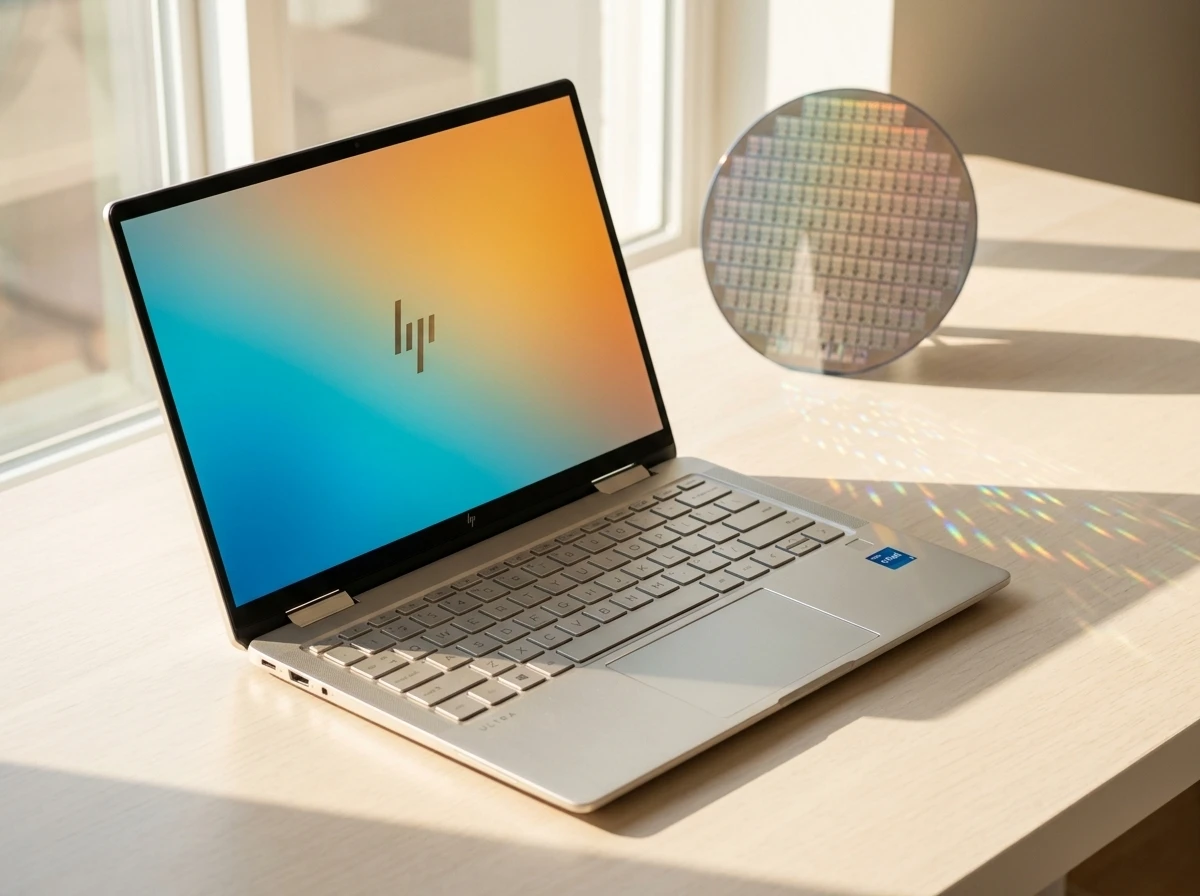
HP’s OmniBook Ultra 14 starts at Rs 1,89,999, or roughly $2,150, and a new review says it earns that price. Moneycontrol tested the laptop for weeks and came away impressed by its OLED screen, metal chassis and everyday performance. The bigger fact sits under the keyboard deck.
Its Core Ultra 7 356H chip is one of the first Panther Lake processors built on Intel’s 18A manufacturing node, the process behind the company’s biggest comeback bet in decades. A laptop chip rarely carries that kind of weight. This one does, and the early evidence is starting to show it.
A Comeback Chip Rides Inside a Rs 1,89,999 Laptop
Panther Lake is Intel’s internal name for its Core Ultra Series 3 processors, and the OmniBook Ultra 14’s Core Ultra 7 356H is a member of that family. The chip launched publicly at CES 2026, and it matters for a reason that has nothing to do with typing or battery life: it is the first client processor built on Intel 18A, a manufacturing node the company has spent years and tens of billions of dollars trying to bring to market on schedule.
Intel calls Fab 52 in Chandler, Arizona the home of that effort. In its own announcement unveiling the Panther Lake architecture, Intel describes 18A as the most advanced semiconductor node developed and manufactured in the United States, with Fab 52 built to carry it into high volume production. More than 200 laptop designs from partner brands, HP included, now use some version of this chip family.
We are entering an exciting new era of computing, made possible by great leaps forward in semiconductor technology that will shape the future for decades to come.
Intel chief executive Lip-Bu Tan said that while holding a wafer of Panther Lake compute tiles outside the company’s Chandler campus. Tan took over Intel in 2025 from Pat Gelsinger, whose original five nodes in four years plan set the roadmap that 18A now completes. Every laptop shipping with this chip, including the one reviewed in India, is effectively a field test of whether that multiyear plan actually delivers usable silicon at scale.
A Forged Aluminum Shell Built to Take a Hit
Set the chip story aside for a moment and the OmniBook Ultra 14 is, on its own terms, a well built machine. HP uses a forge stamped aluminum chassis with a wedge profile, and the company’s own listing says the design has cleared 20 test items under the MIL-STD 810H military durability standard, covering drop, vibration, humidity and extreme temperature scenarios.
HP’s official OmniBook Ultra product page lists the laptop at 10.7mm thin and under 1.3kg, though that figure only measures the rear taper and skips the rubber feet. A separate US review of the same laptop measured the closed profile at closer to 16.5mm on a desk, a reminder that marketing spec sheets and lived-in measurements do not always match. HP also builds in access panels for the SSD and battery, so repairs do not require a full teardown. RAM is soldered to the board on every configuration, a tradeoff buyers should know about before they open their wallets.
A 3K OLED Screen Carries the Rest of the Laptop
The display is where this laptop separates itself. HP fits a 14 inch 3K OLED touchscreen running at up to 120Hz, with 100 percent DCI-P3 colour coverage, Gorilla Glass 3 on top, and brightness that reaches 500 nits for standard content and 1,100 nits in HDR. Moneycontrol’s testers found the panel held up whether they were editing photos, watching video or gaming casually, with viewing angles and black levels that did not fade.
A separate US review of the panel found it carries VESA Display HDR True Black 600 and Calman Verified certification, two marks that back up the colour accuracy claims independently rather than just taking HP’s word for it.
Typing, Touch and Sound
Typing on the OmniBook Ultra 14 has long key travel and a tactile bounce that reviewers keep comparing to HP’s older Pavilion keyboards. The tradeoff is legibility. Light colored keycaps paired with backlighting make individual letters harder to read under certain lighting setups, a small but real annoyance for a laptop at this price. The haptic touchpad drew no such complaints and was one of the more consistently praised parts of daily use. A quad speaker setup stays clear at most volumes, distorting only near the very top of the range, and the 5MP webcam pairs with Windows Hello Enhanced Sign-in Security and HP’s bundled Poly Studio software for calls.
Battery Life and the Ports HP Left Out
Battery life landed around 8 hours of regular use on the 70Wh cell, and the bundled 65W GaN charger pushes the battery to roughly 50 percent in about 48 minutes. Connectivity covers Wi-Fi 7 and Bluetooth 6, with three Thunderbolt 4 or USB4 Type-C ports split across both sides of the chassis. There is no USB-A port anywhere on the laptop, which will matter to anyone still carrying older peripherals or dongles.
How Does the Core Ultra 7 356H Stack Up Against Rivals?
The Core Ultra 7 356H held up comfortably across productivity tasks and heavier development work in Moneycontrol’s testing, with no noticeable slowdown, and its integrated graphics came close to entry level dedicated GPUs in several scenarios. Against Panther Lake’s direct rivals, the picture is more mixed: Intel wins on integrated graphics and matches or beats ARM rivals on battery life, but early multi-core CPU benchmarks still favor Qualcomm’s newest chip.
HP’s own specification listing for the Core Ultra 7 356H confirms 16 cores, 16 threads, up to 4.7GHz and a 50 TOPS neural processing unit, the same NPU rating carried across the Panther Lake family. A separate US test of the flagship Core Ultra X9 388H found graphics performance in the neighborhood of an entry Nvidia RTX 4050 laptop GPU, and noted that Intel did not allow reviewers to run CPU-specific benchmarks on that chip, likely because its 16 cores trail the 18 cores inside Qualcomm’s rival Snapdragon X2 Elite Extreme.
| Chip | Cores / Threads | Architecture | Standout Trait |
|---|---|---|---|
| Core Ultra 7 356H (this laptop) | 16 / 16 | x86, Intel 18A | Steady output across dev workloads with no slowdown |
| Core Ultra X9 388H (Panther Lake flagship) | 16 / 16 | x86, Intel 18A | Arc B390 graphics near RTX 4050 laptop-class levels |
| Snapdragon X2 Elite Extreme | 18 / 18 | Arm | Widest CPU multi-core lead in early Geekbench runs |
| Ryzen AI 9 HX 370 | 12 / 24 | x86 | Strongest DaVinci Resolve rendering throughput |
Worth noting: the review unit here runs the mid-tier 356H, not the flagship X9 388H that most head-to-head lab benchmarks actually test. Real buyers of the base configuration should expect somewhat less headroom than the numbers chip forums argue about.
Intel’s Foundry Numbers Tell a Two-Sided Story
A good laptop chip is one proof point. The bigger question is whether 18A can turn into a real business, and that story is still unfolding in Intel’s own financial disclosures.
Intel’s combined AI-related businesses now account for 60 percent of total revenue, and the company beat its own first quarter 2026 guidance by $1.4 billion. CFO David Zinsner credited part of that beat to yields on 18A coming in better than expected. Separately, Intel has confirmed Microsoft and AWS as anchor customers for custom AI silicon built on the 18A node, an early sign that outside companies are willing to trust Intel’s factories again.
- What we know: Intel’s foundry segment brought in $5.4 billion last quarter, but just $174 million of that came from outside customers rather than Intel’s own product divisions.
- What we know: Microsoft and AWS are confirmed anchor customers for custom silicon on Intel 18A, and Apple has reportedly received an early 18A-P design kit for evaluation.
- What’s unconfirmed: Intel does not publish exact 18A yield figures. Outside estimates put Panther Lake compute tile yields in the 50 to 60 percent range as of this month, up from an estimated 10 to 15 percent last November.
- What’s unconfirmed: Whether Apple, Google or any other evaluator actually commits production volume to Intel’s factories, rather than just testing a design kit, remains an open question.
Yields are the number that decides whether any of this becomes profitable. A chip that works in a review unit is not the same as a chip Intel can manufacture cheaply enough at scale to win business away from TSMC.
The Price Tag Comes With Two Real Compromises
Back to the laptop itself, because that is what most buyers are actually deciding on. Rs 1,89,999 buys the entry Core Ultra 7 356H configuration in India. In the US, PCWorld’s review of the same laptop put an equivalent entry configuration at $1,699.99, while a version with the flagship Core Ultra X9 388H, 64GB of memory and a 2TB drive rang up at over $3,000. Pricing on configurator sites moves with promotions, so exact figures shift week to week, but the gap between markets is real.
Moneycontrol’s verdict called the drawbacks real but not dealbreakers for most buyers, and the list below reflects what testers actually ran into rather than theoretical nitpicks.
- No fingerprint reader – Windows Hello relies on the IR camera alone, an odd gap on a laptop at this price
- Soldered, non-upgradeable RAM – memory is fixed at purchase even though the SSD and battery are user-serviceable
- Inconsistent sleep and wake behavior – a platform quirk testers flagged during the review period
- Limited stock of higher-end configurations – the bigger memory and storage models are harder to find at launch
None of these change the laptop’s core case for existing: a genuinely good screen, dependable CPU performance and battery life that gets most people through a working day. Intel reports its second quarter 2026 results on July 23, three days from now, and gross margin on 18A is the line every foundry customer weighing a bet on Intel will be watching most closely.
Frequently Asked Questions
Does the HP OmniBook Ultra 14 come only with Intel chips?
No. HP also sells OmniBook Ultra 14 configurations built around a Qualcomm Snapdragon X2 chip, and retail listings show versions with an AMD Ryzen AI 9 365 processor as well, so the Intel Core Ultra 7 356H that Moneycontrol tested is one of at least three platform choices sold under the same model name.
What makes Intel’s 18A process different from its older manufacturing nodes?
Intel 18A introduces RibbonFET, a gate-all-around transistor design, alongside PowerVia backside power delivery, which moves power routing to the underside of the chip. Together they cut voltage loss and let chips run more efficiently than the FinFET designs Intel relied on for more than a decade.
What RAM and storage configurations does the OmniBook Ultra 14 lineup offer?
Global configurations span from 16GB of memory with a 512GB SSD on entry Core Ultra 7 models up to 64GB of memory with a 2TB SSD on the range topping Core Ultra X9 388H model, which has listed for more than $3,000 in the United States.
What does Copilot+ PC certification require?
Microsoft’s Copilot+ PC standard requires a neural processing unit rated at 40 trillion operations per second or higher, plus minimum memory and storage thresholds. The OmniBook Ultra 14’s 50 TOPS NPU clears that bar with room to spare.
How does the OmniBook Ultra 14 compare with Dell’s XPS 14?
Gizmodo’s side-by-side testing found the OmniBook Ultra 14’s keyboard easier to live with day to day than the XPS 14’s flush, seamless keyboard deck, even though Dell’s all-aluminum build proved comparably rigid and premium in hand.
Is Intel trying to attract outside companies to manufacture their chips too?
Yes. Intel’s own annual report filing describes 18A as its first node aimed at government and enterprise foundry customers, with the newer 14A node designed from inception to serve external clients rather than Intel’s own products first.


Sony’s 10 Percent Disc Drop Leaves the 2028 Cutoff Intact

Chip Allocation Sidelines the Base iPhone 18 This Fall

Miami-Dade Fights the Vice City Brand It Already Wears

IFA 2026 Awards Put Tecno Ahead of Flagship Phones

USB-C Gadgets Made the Junk Drawer Rechargeable

Pixel 11 Pro Asks $1,099 for a Light Google Locked

The iPhone Ultra Sells Two Retired Minis as One Foldable

Google Opens Gmail to Voice and Gates Docs Live

Lenovo Prices the IdeaPad Vibe Against Apple’s $699 Neo

Xbox Caps Game Pass Cloud Gaming at 15 Hours

Oracle Cuts 21,000 Jobs in a Year, Cites AI in 10-K Filing

Fable 5 and Mythos 5 Return as US Lifts Anthropic Export Controls

SpaceX’s Google Deal Turns a Rocket Company Into a Cloud Landlord

CD Projekt Red Co-CEO: Redemption Arc Isn’t Done, Witcher 4 in 2027

XPL Rallies 30% Ahead of Plasma One Card Tier Launch

Google Search Profiles Build a Follow Graph Inside Discover

DGO App Brings Rs 549 Mobile Pass for FIFA World Cup 2026 in Nepal

Moonshot AI Targets $30 Billion in China’s Fastest AI Funding Sprint

Oppo’s ColorOS 17 Eligibility List Leaves A-Series Buyers Behind

Microsoft Xbox Layoffs Start in July as Sharma Slams 3% Margin
-
 AI2 months ago
Oracle Cuts 21,000 Jobs in a Year, Cites AI in 10-K Filing
-
 AI2 months ago
Fable 5 and Mythos 5 Return as US Lifts Anthropic Export Controls
-
 AI3 months ago
SpaceX’s Google Deal Turns a Rocket Company Into a Cloud Landlord
-
 GAMING3 months ago
CD Projekt Red Co-CEO: Redemption Arc Isn’t Done, Witcher 4 in 2027
-
 CRYPTO3 months ago
XPL Rallies 30% Ahead of Plasma One Card Tier Launch
-
 NEWS3 months ago
Google Search Profiles Build a Follow Graph Inside Discover
-
 APPS3 months ago
DGO App Brings Rs 549 Mobile Pass for FIFA World Cup 2026 in Nepal
-
 AI3 months ago
Moonshot AI Targets $30 Billion in China’s Fastest AI Funding Sprint