
AI
Samsung’s PCIe 6.0 AI SSD Arrives Five Months Behind Micron
Samsung began mass-producing its PM1763 PCIe 6.0 SSD for AI servers, but Micron shipped the format’s first drive five months earlier.

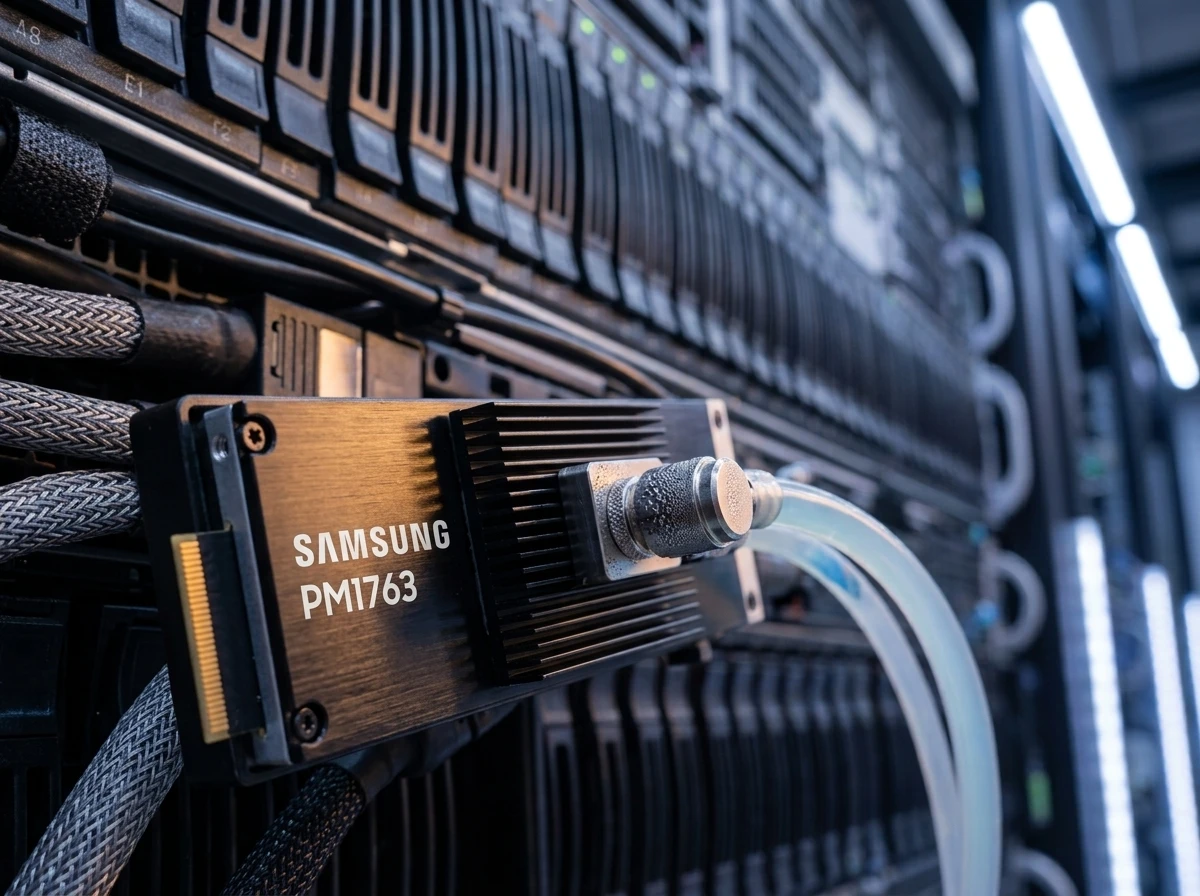
Samsung Electronics has started mass-producing an enterprise solid state drive (SSD) fast enough to move a 40-gigabyte AI model in about 1.4 seconds, the company said this month. The PM1763 is Samsung’s first drive built for the PCIe 6.0 standard, aimed at the data centers training and running today’s largest AI models.
Samsung’s own announcement calls the drive’s performance industry-leading. It says nothing about Micron, which has been shipping a PCIe 6.0 enterprise SSD since February, five months before Samsung’s mass-production news. It also leaves out SK Hynix and Kioxia, both already testing Nvidia-linked storage chips designed to make this whole generation of drives look slow.
Samsung’s Answer to an AI Storage Squeeze
Samsung Electronics Co., Ltd. announced on July 8 that its PM1763 enterprise SSD had entered mass production. The drive pairs Samsung’s ninth-generation V-NAND with a new 4-nanometer controller, a combination the company says drives most of the performance jump.
The flagship 16-terabyte version delivers sequential read speeds of up to 28,400 megabytes per second and 21,900 MB/s on writes, more than double its predecessor, the PM1753. At that speed, the PM1763 can pull a 40-gigabyte large language model (LLM) off the drive in about 1.4 seconds, cutting the wait between storage and the processors and accelerators that need the data.
The drive is built for liquid-cooled racks, using direct-to-chip (D2C) cooling channels that carry heat away without fans. Samsung says that design holds peak performance during long, heavy workloads and improves power efficiency by more than 1.8 times over the PM1753, which should trim data center electricity bills. The PM1763 also adds post-quantum cryptography (PQC) to resist future quantum decryption, plus a security protocol called TDISP that locks down data pathways inside virtualized servers.
Built on industry-leading performance, PM1763 has successfully completed validation for next-generation AI platforms and is well positioned to support evolving AI infrastructure requirements.
Jangseok Choi, vice president and head of memory product planning at Samsung Electronics, said that in the announcement. He added that as AI models keep growing, the drive will help customers scale storage without slowing their systems down.
The Industry’s First Belongs to Micron
Samsung calls the PM1763 its first PCIe 6.0 drive. That claim is accurate, and it is also narrower than the coverage around it suggests.
Micron’s 9650 reached a new shipping milestone in February, roughly five months before Samsung’s mass-production announcement. Micron ran 18 months of interoperability testing across switches and retimers before that launch, and the 9650 is now being qualified by OEMs and AI data center customers for training and retrieval-augmented generation workloads. SK Hynix, meanwhile, has confirmed it will join the PCIe 6.0 supply chain only by the end of this year.
Here is how the drives stack up on paper.
| Maker | Drive / Project | Interface | Key Performance Metric | Status |
|---|---|---|---|---|
| Micron | 9650 | PCIe 6.0 | About 28 GB/s sequential read | Shipping since February 2026 |
| Samsung | PM1763 | PCIe 6.0 | 28,400 MB/s sequential read | Mass production since July 8, 2026 |
| SK Hynix | AI-N P (Storage Next) | PCIe 6.0, next-gen | Targeting 100 million IOPS by 2027 | Proof-of-concept testing with Nvidia |
| Kioxia | Nvidia-linked GPU SSD | GPU-direct | Nikkei estimate: nearly 100x current drives | Targeted for 2027 |
Samsung’s raw numbers edge out Micron’s. The five-month gap is the part missing from most of this week’s coverage, and it matters because it is a smaller repeat of a fight Samsung has already lost once this cycle.
Why AI Data Centers Are Racing for Milliseconds
This fight has nothing to do with laptops. Consumer PCs still run on PCIe 4.0 or 5.0, and even next-generation desktops will not carry PCIe 6.0 support. The contest is entirely inside hyperscale data centers, where storage has become the newest bottleneck in AI training and inference.
GPUs and accelerators can now chew through model weights faster than most storage can feed them. High bandwidth memory and general-purpose memory cannot hold an entire AI model’s parameters on their own, so engineers are pushing SSDs to act as a lower, cheaper memory tier that keeps pace with the chips above it. Every second an accelerator waits on a checkpoint or a model reload is a second of idle, expensive compute.
That is also why liquid cooling keeps showing up in these announcements. Direct-to-chip coolant channels replace fans because AI racks now pack in more high-power components than air alone can manage, and a drive that throttles under heat gives back the speed gains it was built to deliver.
SK Hynix and Kioxia Are Building the Next Leap
While Samsung and Micron trade blows over PCIe 6.0 generation speed bumps, two rivals are working on something bigger.
- SK Hynix’s AI-N P: an ultra-high-performance SSD architecture built with Nvidia, already in proof-of-concept testing. It targets 25 million IOPS (input/output operations per second) for first samples next year, scaling to 100 million IOPS in a 2027 production version, according to a ZDNet report. Current high-end enterprise SSDs manage roughly 2 to 3 million IOPS.
- SK Hynix’s AI-N B, or HBF: a High Bandwidth Flash design built with SanDisk, with an alpha spec expected in early 2026 and evaluation units by 2027.
- Kioxia’s Nvidia-linked SSD: a GPU-connected drive that Nikkei reports could run nearly 100 times faster than today’s models, aimed at generative AI servers and targeted for a 2027 launch.
If any of these hit their targets, the entire PCIe 6.0 generation, PM1763 included, becomes a stopgap.
Samsung Has Been Here Before, in HBM
This is not the first time Samsung has arrived second in an AI memory race. In high bandwidth memory, the stacked chips that sit next to AI accelerators, Samsung slipped to third place behind SK Hynix and Micron at one point in 2025, holding just 17% of the market in the second quarter while SK Hynix held 62%, according to a Chosun Biz report cited by Astute Group.
SK Hynix has kept that lead into the next generation. The company disclosed a 63.2% share of the global HBM market for 2025 in a securities filing citing IDC data. Analysts at UBS expect the company to hold roughly 70% of HBM4 supply for Nvidia’s next-generation Rubin platform, according to the company’s own market outlook.
Samsung is fighting back. It has since completed HBM4 qualification tests with Nvidia and AMD and is expected to climb back above 30% share as HBM4 ramps through 2026. The pattern is familiar: Samsung’s engineering catches up, but a rival’s head start already shaped who signed the big contracts.
The Price Everyone Else Pays
The scramble for AI storage is not free, and buyers outside the data center are starting to feel it.
- $18.46 billion: combined first-quarter 2026 revenue for the top five enterprise SSD makers, after industry revenue jumped 86.1% quarter over quarter, according to TrendForce, a market research firm.
- 80%: the approximate rise in enterprise SSD contract prices that same quarter, as suppliers favored profit over volume amid a supply crunch, TrendForce found.
- 32.3%: Samsung’s overall share of the global NAND flash market in the third quarter of 2025, still the largest of any single supplier, per TrendForce’s tracking.
That same AI memory boom has already reached Samsung’s other product lines. Its semiconductor division’s record quarter helped drive this year’s foldable price increase, and ordinary client SSDs and PC memory are being squeezed too, as factories redirect capacity toward the enterprise drives that AI customers will pay more for.
Micron made that trade explicit earlier this year, shutting down its consumer-facing Crucial brand to redirect production toward enterprise and AI customers. Samsung has kept its consumer lines running. Mass-producing the PM1763 is its own answer to the same pressure, five months after Micron’s, with SK Hynix and Kioxia already testing what comes after both of them.
Frequently Asked Questions
What is PCIe 6.0 and how much faster is it than PCIe 5.0?
PCIe 6.0 doubles the raw data bandwidth of PCIe 5.0, reaching roughly 128 GB/s across 16 lanes. It gets there using PAM4 signaling, which packs more data into each signal cycle instead of simply raising the clock speed.
Will a PCIe 6.0 SSD like the PM1763 work in a home computer?
No. The PM1763 is built for data center racks, and it will not reach its rated speeds on consumer PCIe 5.0 motherboards. Even next-generation consumer desktops are not expected to carry PCIe 6.0 support, so these drives will stay out of retail channels for years.
What is direct-to-chip cooling and why do AI servers need it?
Direct-to-chip cooling runs coolant through channels built directly onto a chip’s surface instead of relying on fans to move air. AI server racks now pack in enough high-power components that air cooling alone cannot remove heat fast enough to keep drives running at full speed.
Why does an enterprise SSD need post-quantum cryptography?
Post-quantum cryptography protects data against future quantum computers powerful enough to break today’s encryption. Samsung paired it with TDISP, a protocol that secures data pathways between virtual machines, because AI data centers increasingly run multiple tenants and workloads on shared hardware.
How much bigger will these AI storage drives get?
Samsung’s own product listings already reference PM1763 capacities up to 62TB, well beyond the 16TB flagship version announced this month, and the company has a 512TB PCIe 6.0 drive on its roadmap for 2027. Rival Solidigm has said it plans to ship 245TB drives before the end of this year.


Sony’s 10 Percent Disc Drop Leaves the 2028 Cutoff Intact

Chip Allocation Sidelines the Base iPhone 18 This Fall

Miami-Dade Fights the Vice City Brand It Already Wears

IFA 2026 Awards Put Tecno Ahead of Flagship Phones

USB-C Gadgets Made the Junk Drawer Rechargeable

Pixel 11 Pro Asks $1,099 for a Light Google Locked

The iPhone Ultra Sells Two Retired Minis as One Foldable

Google Opens Gmail to Voice and Gates Docs Live

Lenovo Prices the IdeaPad Vibe Against Apple’s $699 Neo

Xbox Caps Game Pass Cloud Gaming at 15 Hours

Oracle Cuts 21,000 Jobs in a Year, Cites AI in 10-K Filing

Fable 5 and Mythos 5 Return as US Lifts Anthropic Export Controls

SpaceX’s Google Deal Turns a Rocket Company Into a Cloud Landlord

CD Projekt Red Co-CEO: Redemption Arc Isn’t Done, Witcher 4 in 2027

XPL Rallies 30% Ahead of Plasma One Card Tier Launch

Google Search Profiles Build a Follow Graph Inside Discover

DGO App Brings Rs 549 Mobile Pass for FIFA World Cup 2026 in Nepal

Moonshot AI Targets $30 Billion in China’s Fastest AI Funding Sprint

Oppo’s ColorOS 17 Eligibility List Leaves A-Series Buyers Behind

Microsoft Xbox Layoffs Start in July as Sharma Slams 3% Margin
-
 AI3 months ago
Oracle Cuts 21,000 Jobs in a Year, Cites AI in 10-K Filing
-
 AI2 months ago
Fable 5 and Mythos 5 Return as US Lifts Anthropic Export Controls
-
 AI3 months ago
SpaceX’s Google Deal Turns a Rocket Company Into a Cloud Landlord
-
 GAMING3 months ago
CD Projekt Red Co-CEO: Redemption Arc Isn’t Done, Witcher 4 in 2027
-
 CRYPTO3 months ago
XPL Rallies 30% Ahead of Plasma One Card Tier Launch
-
 NEWS3 months ago
Google Search Profiles Build a Follow Graph Inside Discover
-
 APPS3 months ago
DGO App Brings Rs 549 Mobile Pass for FIFA World Cup 2026 in Nepal
-
 AI3 months ago
Moonshot AI Targets $30 Billion in China’s Fastest AI Funding Sprint