
NEWS
SUTD and NUS Open-Source a Quantum Leap for Photonic Chip Design
A free quantum upgrade to a classic plasma simulator could hand small photonics labs the modeling power big licenses have always guarded.

Singapore researchers just gave away a quantum upgrade to a classic plasma physics simulator. Teams from the Singapore University of Technology and Design (SUTD) and the National University of Singapore (NUS) rewired the tool to track individual quantum electrons inside computer chips. The code, described in a new paper in Computer Physics Communications, is free on GitHub for anyone to use.
That combination, whole-device modeling plus electron-level quantum detail, used to require separate tools and separate budgets. The researchers most likely to gain are not the labs already running premium commercial suites. They are the small photonics companies, university groups and open-source coders who never had a seat at that table.
Four New Modules Bolt Onto a Fusion Simulator
The team did not start from scratch. They took two open-source particle-in-cell (PIC) codes, EPOCH and Smilei, both built originally for plasma and laser-fusion physics, and added four new physics modules built for condensed matter.
The paper, titled “Particle-in-cell simulations of quantum plasmas,” carries the reference 10.1016/j.cpc.2026.110305. An earlier version circulated as a 15-page technical writeup of the four modules, spending well over a year in review before this week’s journal publication.
| Module | What It Captures |
|---|---|
| Fermi-Dirac initialization | Quantum statistics of electrons at low temperature |
| Material boundary models | How charge carriers behave at real material interfaces |
| Bound-particle dispersion | Dielectric and plasmonic response to external fields |
| Massless Dirac fermions | Relativistic-like electrons near graphene’s K-point |
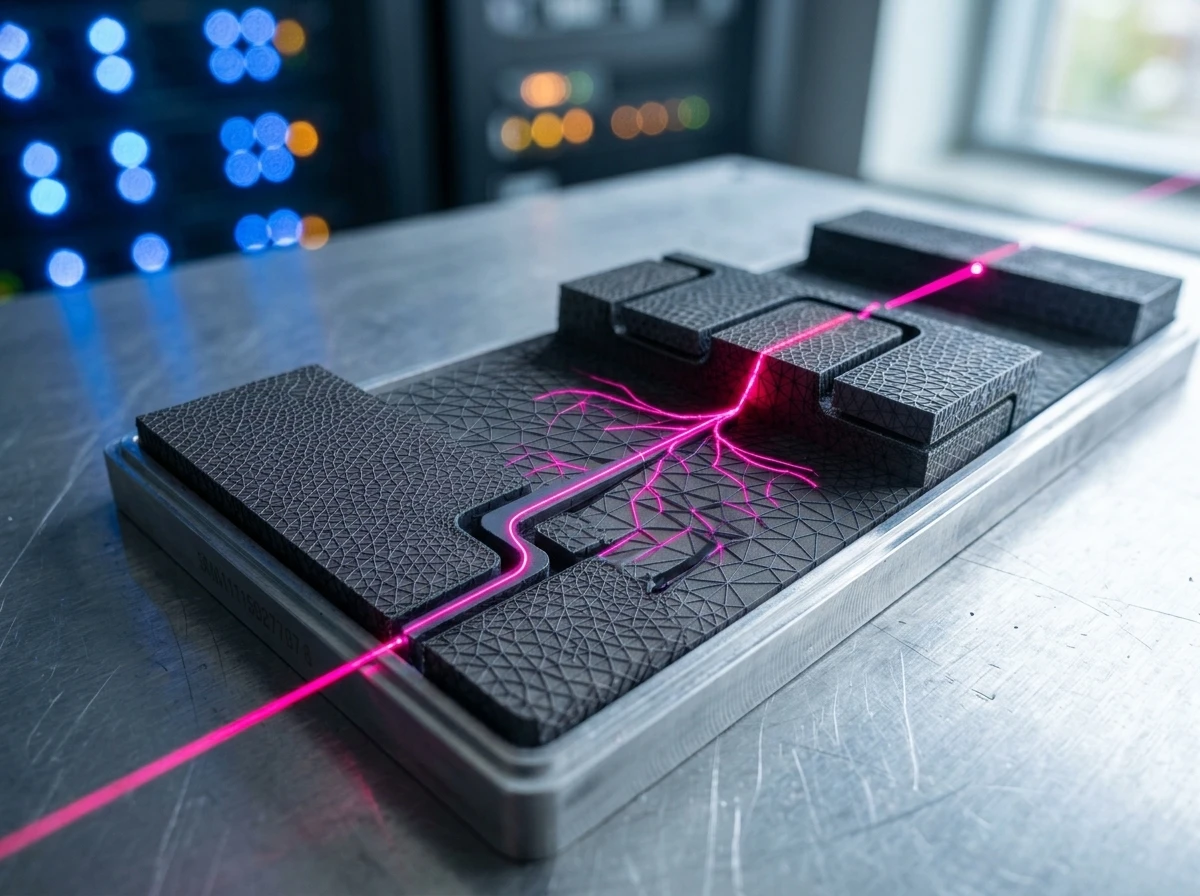
Each module targets a specific blind spot in older PIC codes. Together, they let one simulation run track how light moves through an entire device while individual electrons still obey quantum rules at the nanoscale. Both modified codes sit publicly on GitHub, free to download, run or modify.
The Trade-Off That Shaped an Industry
Engineers have leaned on simulation to predict device behavior long before fabrication starts. Most existing tools handle only half of that job.
Some tools model an entire device accurately but say little about what individual electrons are doing inside it. Others track electron behavior in fine detail but only at scales far smaller than a real device. Wu Lin, an associate professor in SUTD’s Science, Mathematics and Technology Cluster who led the project, compares the problem to a mapping app: zoom out for the whole city, zoom in for individual cars, never both.
For many years, researchers have had to choose between understanding how an entire device behaves and seeing what individual electrons are doing. We wanted to remove that trade-off.
Wu made the remark in a statement on the project, adding that building on an established method rather than starting fresh gave the team “a much richer picture of how light and electrons interact inside advanced materials.”
The commercial market built around that trade-off looks concentrated. Ansys Lumerical FDTD, a tool its maker markets as the gold standard for modeling photonic components, deepened its integration with Synopsys OptoCompiler in its 2026 R1 release. A separate market analysis credits Ansys Lumerical with a 20 percent simulation speed increase and Synopsys’s Light Tec acquisition with an 18 percent gain in optical measurement efficiency. Those are incremental upgrades sold at commercial license prices, not a structural fix for the underlying trade-off.
A Six-Year Trail of Plasmon Papers
Wu called the new framework a starting point, but the lab’s own research trail goes back further. A 2020 study in the journal Nanophotonics simulated plasmons particle by particle. A 2021 follow-up in Nanoscale mapped electron dynamics inside those same plasmons. By 2024, the group had pushed the approach into terahertz resonances from ballistic electron funnelling, work co-authored with Gregory Ngirmang, who also worked on the new release alongside co-author Michel Bosman.
Six years of narrow, material-specific papers fed into one general-purpose release meant to handle metals, semiconductors and two-dimensional materials inside a single platform.
Who Actually Benefits from a Free Quantum Simulator?
The clearest winners are not the institutions that already license commercial photonics simulation suites. They are the smaller photonics manufacturers, university labs and independent researchers who never had that budget line, and who can now pull equivalent quantum-aware modeling power off GitHub at no cost.
The photonics industry is not dominated purely by giants. SPIE, the photonics industry’s professional society, counts nearly 5,000 optics and photonics companies operating across 59 countries, and puts 86 percent of them in the small or midsize category. Those are exactly the organizations least likely to carry an enterprise simulation license on the budget.
- Small photonics manufacturers – most of the roughly 5,000 optics and photonics firms worldwide fall into this bracket, without budget for enterprise-tier simulation licenses
- University research groups – gain device-scale and electron-scale modeling in one platform instead of paying for two separate tools
- Open-source contributors – can fork the GitHub-hosted EPOCH and Smilei extensions to add their own material models
Wu is counting on that last group specifically. “This is only the beginning,” Wu said of the release, hoping outside researchers keep adding material models and applications instead of waiting for the SUTD-NUS team to build them alone.
That ambition points toward digital twins, virtual models detailed enough to mirror a real device’s performance before it gets built. NVIDIA has chased a similar vision on the factory floor, rallying manufacturing partners Fujitsu, Fanuc, Yaskawa and Kawasaki around physical AI built on simulated twins of robots and production lines. Wu wants the same virtual test loop for chips and photonic circuits.
AI’s Photonics Hunger Raises the Stakes
The press release names AI hardware among the fields set to benefit most from better photonic simulation, and the manufacturing numbers back that up.
- $5.9 billion: projected 2029 sales of lasers and photonic integrated circuits for optical transceivers, up from $2.4 billion in 2023, according to analyst firm LightCounting
- $20 billion-plus: co-packaged optics (CPO) market size research firm IDTechEx expects by 2036, growing at a 37 percent annual rate from 2026
- May 2026: GlobalFoundries launched SCALE, its Silicon Photonics Co-packaged Advanced Light Engine, for AI scale-up architectures
- March 2026: NVIDIA invested in silicon-photonics suppliers Lumentum and Coherent, tying itself closer to the optical supply chain
GlobalFoundries called the module the industry’s first Optical Compute Interconnect Multi-Source Agreement platform in a filing covering its first-quarter 2026 results. A separate market analysis of the co-packaged optics buildout flagged NVIDIA’s stake in Lumentum and Coherent as proof of how central optical supply has become to the industry’s roadmap.
These companies are not using the SUTD-NUS code, at least not yet. But they are exactly the kind of customer a faster, cheaper photonic design pipeline would eventually serve, and Flex’s recent move to expand Cerebras wafer-scale AI chip production sevenfold shows how quickly AI hardware capacity is scaling around them.
What the Framework Still Cannot See
The framework has real limits. Wu’s team says the current version does not yet capture complex many-body electron interactions or detailed electronic band structures, the physics that determines how a real semiconductor conducts or emits light. Both sit on the list for future versions.
The team also wants to stretch the code toward realistic, device-scale simulations rather than the nanoscale test cases used so far: plasmonic metals, ultraviolet silicon nanostructures and graphene-based materials. That jump in scale costs computing power, which is why the group is separately building AI accelerators based on physics-informed neural networks, aiming to cut computation time without losing physical accuracy.
That work is not finished. The code posted to GitHub today is a starting point, with plenty still to add. Wu’s own language, open, collaborative, still expanding, reads like an invitation to the rest of the field.
Frequently Asked Questions
What Is a Particle-in-Cell Simulation?
A particle-in-cell, or PIC, simulation tracks large numbers of individual charged particles moving through a grid of electromagnetic field values, updating the fields and the particles’ motion together at each time step. EPOCH, one of the two codes modified in this project, began as the Extendible Open PIC Collaboration, built by a UK consortium of roughly 30 researchers funded by the Engineering and Physical Sciences Research Council to study laser-plasma physics, not computer chips.
Is the New Quantum PIC Code Free to Use?
Yes. The modified versions of EPOCH and Smilei are hosted publicly on GitHub, and Wu Lin has said the team wants outside researchers to keep expanding the platform with new material models and applications rather than treat it as a closed, finished product.
How Does the Framework Treat Graphene Differently from Metals?
Graphene runs through a dedicated massless Dirac fermion module that mimics the relativistic-like behavior electrons show near graphene’s K-point. Metals and other dielectrics instead use the bound-particle dispersion module, which reproduces plasmonic and dielectric response without simulating every lattice electron individually.
What Is a Digital Twin for a Semiconductor or Photonic Device?
It is a virtual model accurate enough to predict how a real device performs before it is fabricated, letting engineers test design changes on a computer instead of in a cleanroom. SUTD and NUS see the quantum PIC framework as an early building block toward that kind of digital twin for photonic and semiconductor hardware.
Why Not Build One Simulator That Handles Everything at Once?
Tracking every electron in a device with full quantum detail is still too computationally expensive at real device sizes. The four new modules approximate quantum behavior only where it changes the outcome, such as material interfaces and dielectric response, keeping simulations fast enough to stay useful for actual design work.


Sony’s 10 Percent Disc Drop Leaves the 2028 Cutoff Intact

Chip Allocation Sidelines the Base iPhone 18 This Fall

Miami-Dade Fights the Vice City Brand It Already Wears

IFA 2026 Awards Put Tecno Ahead of Flagship Phones

USB-C Gadgets Made the Junk Drawer Rechargeable

Pixel 11 Pro Asks $1,099 for a Light Google Locked

The iPhone Ultra Sells Two Retired Minis as One Foldable

Google Opens Gmail to Voice and Gates Docs Live

Lenovo Prices the IdeaPad Vibe Against Apple’s $699 Neo

Xbox Caps Game Pass Cloud Gaming at 15 Hours

Oracle Cuts 21,000 Jobs in a Year, Cites AI in 10-K Filing

Fable 5 and Mythos 5 Return as US Lifts Anthropic Export Controls

SpaceX’s Google Deal Turns a Rocket Company Into a Cloud Landlord

CD Projekt Red Co-CEO: Redemption Arc Isn’t Done, Witcher 4 in 2027

XPL Rallies 30% Ahead of Plasma One Card Tier Launch

Google Search Profiles Build a Follow Graph Inside Discover

DGO App Brings Rs 549 Mobile Pass for FIFA World Cup 2026 in Nepal

Moonshot AI Targets $30 Billion in China’s Fastest AI Funding Sprint

Oppo’s ColorOS 17 Eligibility List Leaves A-Series Buyers Behind

Microsoft Xbox Layoffs Start in July as Sharma Slams 3% Margin
-
 AI3 months ago
Oracle Cuts 21,000 Jobs in a Year, Cites AI in 10-K Filing
-
 AI2 months ago
Fable 5 and Mythos 5 Return as US Lifts Anthropic Export Controls
-
 AI3 months ago
SpaceX’s Google Deal Turns a Rocket Company Into a Cloud Landlord
-
 GAMING3 months ago
CD Projekt Red Co-CEO: Redemption Arc Isn’t Done, Witcher 4 in 2027
-
 CRYPTO3 months ago
XPL Rallies 30% Ahead of Plasma One Card Tier Launch
-
 NEWS3 months ago
Google Search Profiles Build a Follow Graph Inside Discover
-
 APPS3 months ago
DGO App Brings Rs 549 Mobile Pass for FIFA World Cup 2026 in Nepal
-
 AI3 months ago
Moonshot AI Targets $30 Billion in China’s Fastest AI Funding Sprint